Fee Payer Growth vs Transaction Count: Which Better Shows Real Network Adoption?
— By Whatsertrade in Tutorials

Blockchain networks often use transaction count as a sign of adoption. If transactions are increasing, it may look like more users are active and the network is
Blockchain networks often use transaction count as a sign of adoption. If transactions are increasing, it may look like more users are active and the network is growing. But transaction count can be misleading.
A network can process millions of transactions without necessarily attracting many real users. Bots, airdrop farmers, repeated interactions and low value activity can inflate transaction numbers.
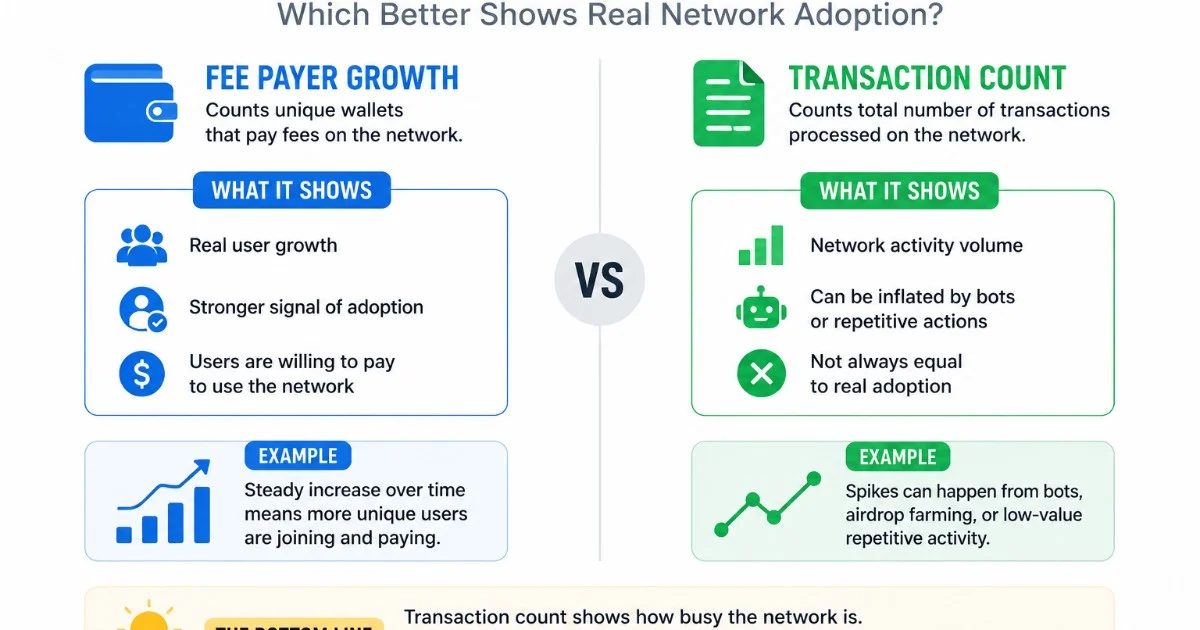
Fee payer growth can give a different perspective. It shows whether more unique users are actually paying to use the network.
Understanding fee payer growth vs transaction count can help traders and analysts separate real adoption from artificial activity.
What Is Transaction Count?
Transaction count measures the number of transactions processed by a blockchain over a specific period.
This can include token transfers, swaps, smart contract interactions, NFT mints, bridge activity, bot activity and repeated automated transactions.
High transaction count can show that a network is active. It may suggest strong application usage, low fees or growing ecosystem engagement.
However, transaction count does not always reveal how many real users are behind that activity.
What Is Fee Payer Growth?
Fee payer growth measures the increase in unique wallets or accounts that pay transaction fees on a network.
This metric focuses on users who are actively spending value to interact with the blockchain. If the number of fee payers grows over time, it may suggest that more users are finding the network useful.
Fee payer growth can be a stronger signal of adoption because it is harder to inflate than raw transaction count.
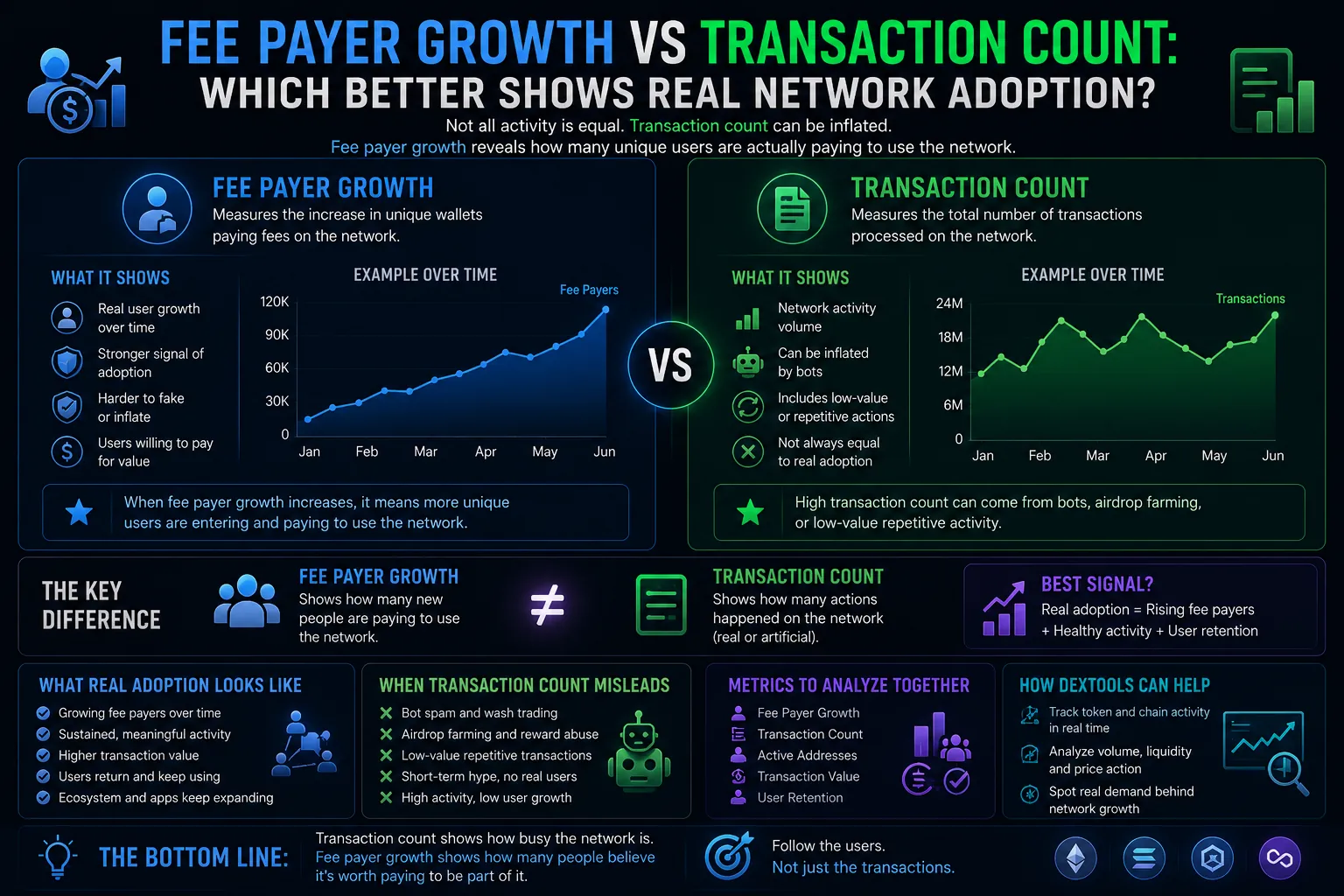
Fee Payer Growth vs Transaction Count: The Key Difference
The key difference is activity vs user demand.
Transaction count shows how many actions happened.
Fee payer growth shows whether more users are paying to perform those actions.
A network with rising transaction count but flat fee payer growth may be seeing more activity from the same users or bots. A network with rising fee payer growth may be attracting new participants.
Both metrics matter, but they answer different questions.
Why Transaction Count Can Be Misleading
Transaction count can rise for reasons that do not reflect real adoption.
Bots can generate large numbers of transactions. Airdrop campaigns can encourage users to interact repeatedly. Games or low cost applications may create high activity without meaningful economic value.
A network may look busy, but that does not always mean it is gaining valuable users.
This is why traders should avoid judging blockchain adoption only by transaction numbers.
Why Fee Payer Growth Matters
Fee payer growth can show whether a network is expanding its real user base.
When more wallets pay fees, it suggests that more users are willing to spend money to access the network. This may indicate product demand, ecosystem growth or stronger application usage.
Healthy fee payer growth can support a stronger network narrative because it shows adoption beyond simple transaction volume.
When Fee Payer Growth Can Also Mislead
Fee payer growth is useful, but it is not perfect.
One person can control multiple wallets. Airdrop farmers may create many accounts. Some applications may subsidize fees or encourage temporary activity.
This means fee payer growth should be analyzed with other metrics, such as active addresses, transaction value, retention, DEX volume and application usage.
The best analysis combines several signals.
What Real Network Adoption Looks Like
Real network adoption usually includes:
Growing fee payers.
Consistent transaction activity.
Higher quality application usage.
Stable or growing liquidity.
User retention after incentives end.
Increasing transaction value.
Broader ecosystem participation.
If transaction count rises but users disappear after rewards end, the adoption may not be durable.
If fee payers keep growing across different applications, the network may have stronger organic demand.
Why This Matters for Traders
Network adoption can affect token narratives. Traders often buy infrastructure tokens because they believe the network is gaining real users.
But if adoption metrics are inflated, the market may overvalue the token.
A network with impressive transaction count but weak fee payer growth may be less healthy than it appears. A network with steady fee payer growth and sustainable transaction activity may have a stronger foundation.
How DEXTools Can Help
DEXTools can help traders review live market behavior around ecosystem tokens. Price action, liquidity, volume and transaction flow can show whether adoption narratives are being supported by real market demand.
If a network token rises while liquidity and trading activity remain weak, traders should be cautious.
On chain metrics and market data work best when analyzed together.
Final Thoughts
Fee payer growth and transaction count both matter, but they show different parts of network activity.
Transaction count shows how busy a blockchain is. Fee payer growth shows whether more users are actually paying to use it.
For traders, the stronger signal is often the combination of both. A network with rising transactions, rising fee payers and strong user retention is more likely to show real adoption.
In crypto, more transactions do not always mean more users. Real adoption is about meaningful, repeated and paid usage.
How to Bridge Crypto Between Chains: Complete Cross-Chain Tutorial 2026 How to Use 1inch for Swaps: Classic, Fusion and Limit Orders (2026) OKX Web3 Wallet Tutorial 2026: Multi-Chain Setup GuideThe Granular Lens: Deciphering Fee Payer Behavior Beyond Raw Numbers
While an increasing number of unique fee payers undoubtedly signals broadening adoption, a deeper dive into their individual behaviors offers more nuanced insights. Not all fee payers are created equal; some represent active, engaged users participating in diverse on-chain activities, while others might be programmatic entities, smart contracts, or even "dust" accounts involved in minimal, sporadic transactions. Understanding the distribution of transaction values and frequencies among fee payers can reveal whether growth is driven by genuine utility or by less substantive activities.
For instance, a surge in fee payers associated with micro-transactions might indicate widespread gaming or social dApp adoption, which, while valuable, differs significantly from growth fueled by large value transfers in DeFi or enterprise solutions. Analyzing the types of smart contracts or protocols they interact with further refines this understanding, allowing us to differentiate between speculative interest and organic, utility-driven engagement.
Profiling the Active User
- Identify fee payers with consistent transaction frequency over multiple periods (e.g., daily, weekly).
- Analyze the diversity of their on-chain interactions (e.g., sending tokens, interacting with multiple dApps, participating in governance).
- Segment fee payers by the average value of their transactions, distinguishing between high-value participants and micro-transaction users.
- Track the "stickiness" of new fee payers - how many remain active after their initial transaction.
- Examine interactions with network-specific features, such as staking, liquidity provision, or unique dApp functionalities.
By moving beyond a simple count of unique addresses, and instead focusing on the quality and nature of their on-chain activities, we gain a much clearer picture of true network health and the underlying drivers of real adoption. This approach helps distinguish superficial growth from sustainable, value-generating engagement.
Related Guides
- Active Contracts vs Contract Deployments: Which Better Shows Real Developer Adoption?
- Settlement Volume vs Transfer Count: Which Better Shows Real On Chain Value Movement?
- Loan Origination vs Outstanding Debt: Which Shows Real Lending Growth?
- Fee Revenue per Active Wallet vs Total Fees: Which Shows Real dApp Monetization?
- Gas Subsidies vs Organic Fee Demand: When Free Transactions Hide Weak Adoption
- Protocol Error Rate vs Transaction Growth
Frequently Asked Questions
What is fee payer growth in crypto?
Fee payer growth measures the increase in the number of distinct wallets actually paying transaction fees on a network. It can be a more user-focused signal than raw activity counts.
Why is transaction count not always a good adoption metric?
Transaction count can be inflated by a small number of wallets, bots, or repeated automated activity. As a result, a rising count does not always mean more real users are joining the network.
Why might fee payer growth show real adoption better?
Counting unique addresses that pay fees focuses on distinct participants rather than total transactions. This can give a clearer picture of whether the user base is genuinely expanding.
Should you rely on a single on-chain metric?
No single metric tells the full story, since each can be gamed or misread. Combining fee payer growth, transaction count, retention, and value transferred gives a more balanced view of adoption.