Gas Subsidies vs Organic Fee Demand: When Free Transactions Hide Weak Adoption
— By Whatsertrade in Tutorials

Low fees are one of the biggest selling points in crypto. Some networks and applications go even further by subsidizing gas fees or offering free transactions t
Low fees are one of the biggest selling points in crypto. Some networks and applications go even further by subsidizing gas fees or offering free transactions to users.
This can improve onboarding and make blockchain apps easier to use. But it can also make adoption metrics harder to read.
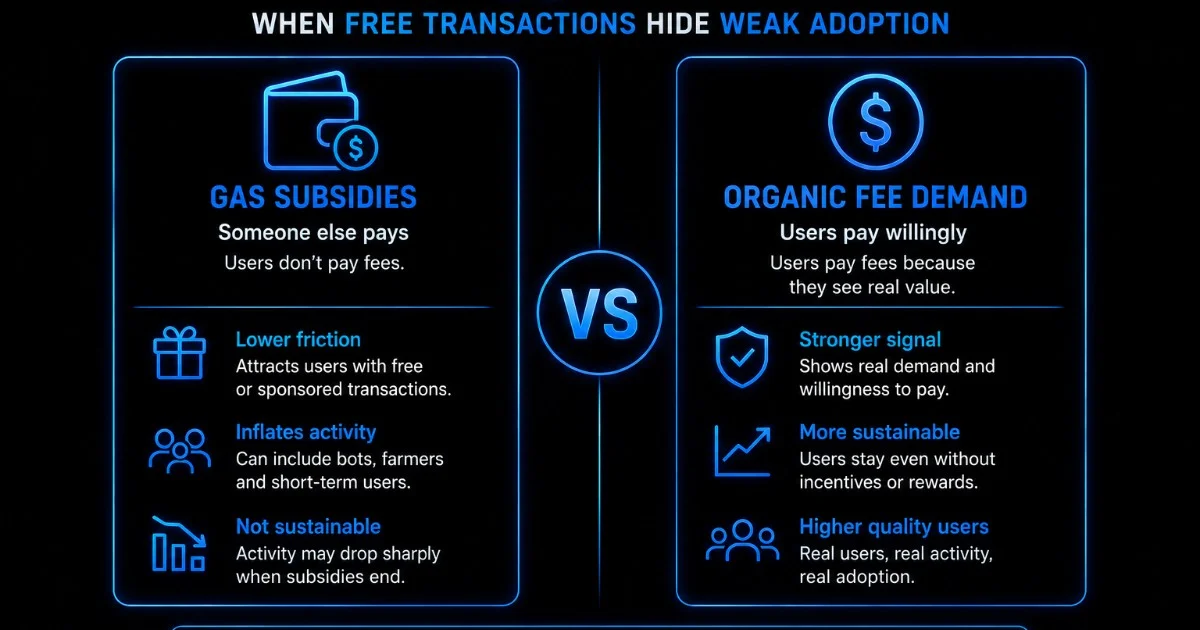
If users are not paying to use the network, are they showing real demand?
That is why traders should understand gas subsidies vs organic fee demand.
What Are Gas Subsidies?
Gas subsidies happen when a network, application or third party pays transaction costs for users.
This can happen through sponsored transactions, paymasters, promotional campaigns, wallets, dApps or ecosystem incentives.
Gas subsidies can make crypto easier for beginners. Users do not need to hold the native gas token before interacting with an application.
This can reduce friction and increase activity.
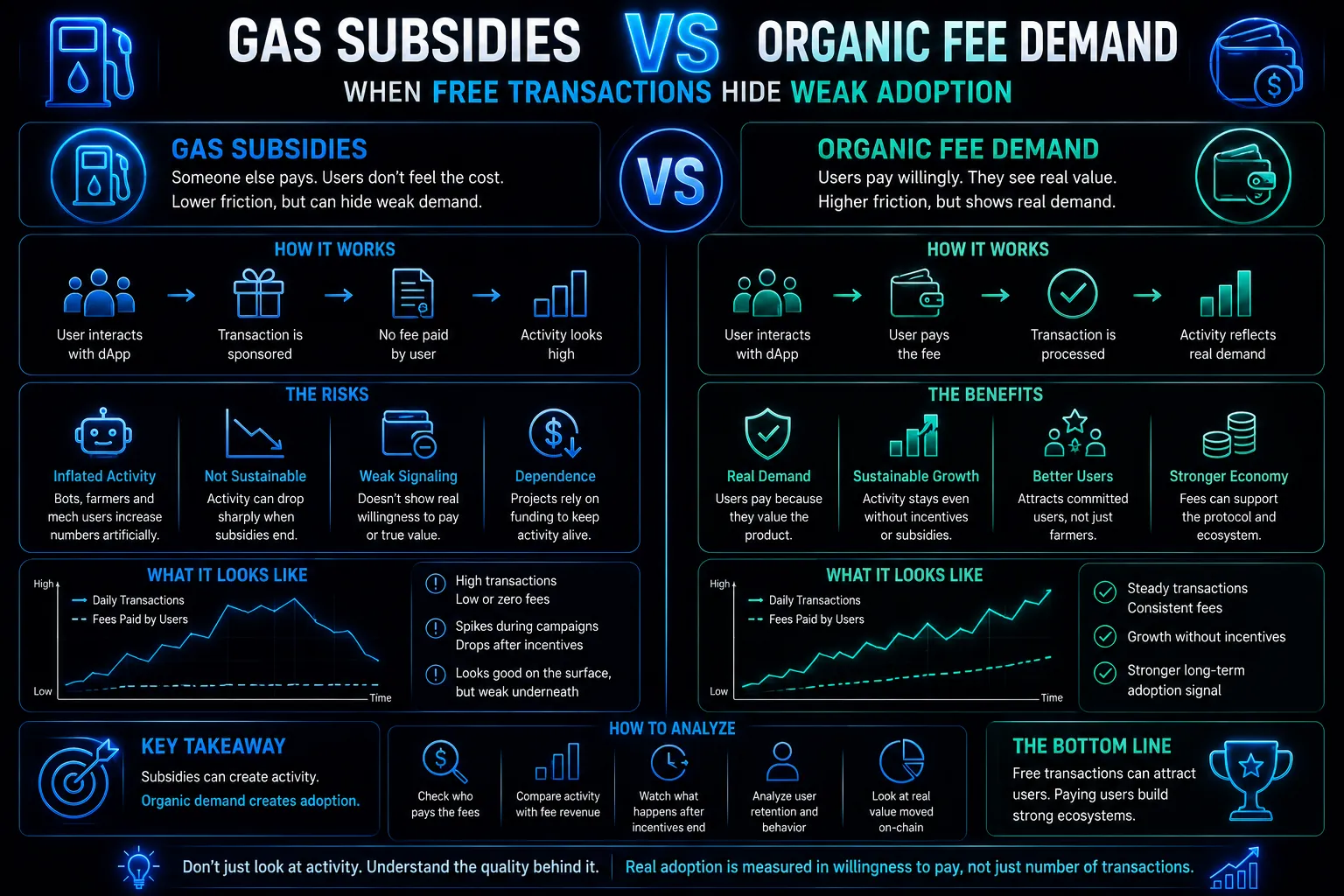
What Is Organic Fee Demand?
Organic fee demand happens when users willingly pay transaction fees because they value the network or application.
This is a stronger signal of demand because users are spending their own capital to interact.
Organic fee demand suggests that the product is useful enough for users to pay for access.
In blockchain economics, this can be an important sign of real adoption.
Gas Subsidies vs Organic Fee Demand: The Key Difference
The key difference is who pays.
With gas subsidies, someone else covers the cost. With organic fee demand, users pay directly.
Subsidized activity can show interest, but organic fee demand shows willingness to pay.
A network with high activity driven by subsidies may struggle when those subsidies end. A network with strong organic fee demand may have more durable usage.
Why Gas Subsidies Can Be Useful
Gas subsidies are not automatically bad.
They can help new users try an application without friction. They can support early adoption, improve user experience and make blockchain apps feel more like normal web products.
For games, social apps or consumer products, gas subsidies can be especially useful.
The problem appears when subsidized activity is mistaken for sustainable adoption.
How Free Transactions Can Hide Weak Demand
Free transactions can inflate usage metrics.
If users can transact without paying, they may interact more often. Bots may also become more active. Airdrop farmers may repeat actions to qualify for rewards.
This can make transaction count, active wallets and app interactions look stronger than they really are.
When subsidies stop, activity may fall sharply.
Why Organic Fee Demand Is Stronger
Organic fee demand is harder to fake.
When users pay fees, they show that the action has value to them. This does not guarantee long term adoption, but it is a stronger signal than free activity.
If users continue paying fees over time, the network may have real utility.
This is especially important for traders analyzing blockchain tokens, since fee demand can connect to network value.
When Gas Subsidies Become a Problem
Gas subsidies become risky when they are the main reason users are active.
If an ecosystem depends on subsidies to maintain transaction count, its adoption may not be sustainable.
Traders should be cautious when activity rises during incentive campaigns but falls after rewards end.
The key question is whether users stay when they must pay.
What Healthy Subsidized Growth Looks Like
Healthy subsidized growth usually has a transition.
At first, subsidies help users onboard. Over time, users continue interacting even when subsidies decline.
This suggests that the product has real value.
A weak pattern is when activity disappears as soon as free transactions end.
Subsidies should create habits, not artificial metrics.
What Traders Should Analyze
Traders should ask:
Who pays the gas fees?
Are transactions subsidized?
Does activity remain after subsidies end?
Are fee payers growing?
Are users returning?
Is transaction value meaningful?
Is activity dominated by bots or farmers?
Does the network generate real fee demand?
These questions help traders separate onboarding support from weak adoption.
How DEXTools Can Help
DEXTools can help traders review market behavior around network and application tokens. If a project claims strong user activity, traders should check whether token liquidity, volume and price action support that claim.
If activity depends on subsidies but the token market remains weak, the adoption narrative may be fragile.
Final Thoughts
Gas subsidies and organic fee demand tell different stories.
Gas subsidies reduce friction and can help users try new applications. Organic fee demand shows that users are willing to pay for access.
For real adoption, the strongest signal is not free activity. It is continued usage after users face real costs.
In crypto, free transactions can create growth. Paid usage proves demand.
How to Bridge Crypto Between Chains: Complete Cross-Chain Tutorial 2026 How to Use 1inch for Swaps: Classic, Fusion and Limit Orders (2026) OKX Web3 Wallet Tutorial 2026: Multi-Chain Setup GuideThe Hidden Costs of "Free" Transactions: Unpacking Economic Incentives
While the allure of zero gas fees is undeniable, particularly for new users, it's crucial to understand the underlying economic mechanisms at play. "Free" transactions are never truly free; the cost is simply absorbed or deferred elsewhere. This absorption can manifest in various ways, from network treasuries depleting over time to a subtle shifting of value extraction from transaction fees to other forms, such as MEV (Maximal Extractable Value) or protocol-level inflation. Understanding these dynamics is key to evaluating the long-term sustainability and true cost efficiency of a network.
The absence of direct transaction costs can also distort user behavior, potentially leading to network spam or inefficient resource utilization. When users face no immediate economic disincentive for broadcasting superfluous transactions, the network's capacity can be strained, paradoxically leading to poorer user experience for legitimate activity. This highlights a fundamental tension between fostering adoption through low barriers and maintaining network health and security through robust economic incentives.
Evaluating Sustainable Fee Models
- Examine the source of the subsidy: Is it from a treasury, investor funds, or a temporary promotional budget?
- Consider the network's long-term fee strategy: What is the plan once the subsidy is exhausted?
- Assess the potential for MEV extraction: Does the "free" transaction model inadvertently open new avenues for value extraction by validators?
- Analyze network congestion during peak times: Does the lack of a fee market lead to slower confirmations or failed transactions when demand is high?
- Evaluate the impact on decentralization: Does the subsidy mechanism centralize control over network resources or decision-making?
Related Guides
- Organic Traction vs Paid Campaigns: How to Analyze Real Demand in a New Token
- Fee Payer Growth vs Transaction Count: Which Better Shows Real Network Adoption?
- The Hidden Cost of a Round Trip Trade: Slippage, Gas, Failed Transactions and Fees
- Active Contracts vs Contract Deployments: Which Better Shows Real Developer Adoption?
- What Is a Fee-on-Transfer Token? Crypto Explained
Frequently Asked Questions
What are gas subsidies in crypto?
Gas subsidies occur when a network or application covers or reduces transaction fees so users pay little or nothing. This is often used to attract new users or lower barriers to onboarding.
What is organic fee demand?
Organic fee demand refers to fees that users willingly pay because they value the network's activity, without external subsidies. It is often seen as a stronger signal of genuine, sustainable usage.
Why can free transactions hide weak adoption?
When fees are subsidized, on-chain activity can look high even if users would not pay for it on their own. This can mask whether demand is real and sustainable once subsidies end.
How can you tell if network activity is genuine?
Looking at organic fee revenue, repeat usage, and whether activity persists without incentives can help gauge real adoption. Comparing subsidized periods to unsubsidized behavior is also informative.