Settlement Volume vs Transfer Count: Which Better Shows Real On Chain Value Movement?
— By Whatsertrade in Tutorials
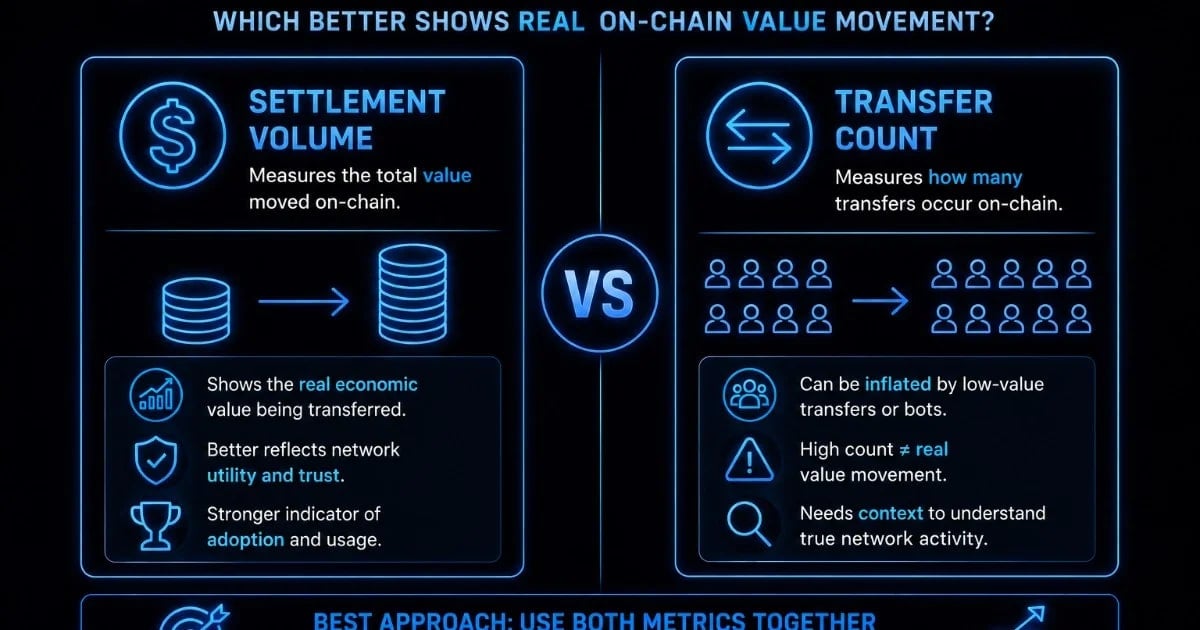
Blockchain networks are often judged by activity. If transfer count is rising, many traders assume the network is growing. But more transfers do not always mean
Blockchain networks are often judged by activity. If transfer count is rising, many traders assume the network is growing. But more transfers do not always mean more value is moving.
A network can process millions of small transfers while settling relatively little economic value. Another network may process fewer transfers but move billions of dollars in value.
Key Takeaways
- What Is Transfer Count?
- What Is Settlement Volume?
- Settlement Volume vs Transfer Count: The Key Difference
- Why Transfer Count Can Be Misleading
- Why Settlement Volume Matters
- When Settlement Volume Can Also Mislead
This is why settlement volume matters.
Understanding settlement volume vs transfer count helps traders evaluate whether a blockchain is being used for meaningful value movement or mainly for low value activity.
What Is Transfer Count?
Transfer count measures how many transfers happen on a blockchain over a specific period.
These transfers can include token movements, wallet to wallet payments, exchange flows, bridge transactions, smart contract interactions or automated activity.
High transfer count can show that a network is busy. It may indicate user activity, application usage or low transaction costs.
However, transfer count does not show the size or economic importance of those transfers.
What Is Settlement Volume?
Settlement volume measures the total value moved across a blockchain.
If users move large amounts of stablecoins, ETH, BTC wrapped assets or other valuable tokens, settlement volume increases.
Settlement volume helps answer a deeper question: how much economic value is the network actually processing?
This makes it useful for analyzing real on chain value movement.
Settlement Volume vs Transfer Count: The Key Difference
The key difference is quantity vs value.
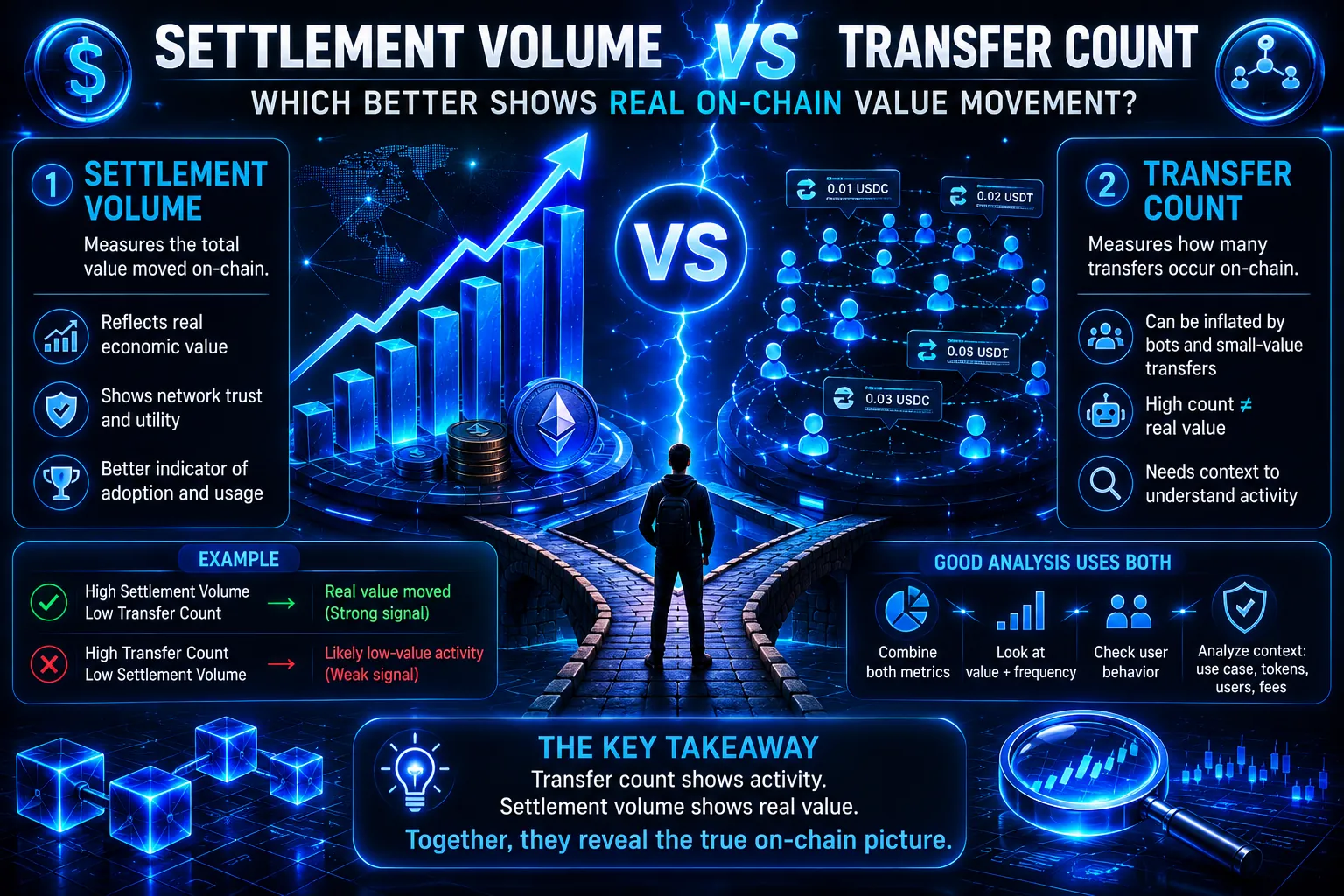
Transfer count shows how many movements happened. Settlement volume shows how much value moved.
A network with high transfer count may be popular for small payments, gaming, bots or low cost interactions. A network with high settlement volume may be used for larger financial transfers, DeFi activity or institutional flows.
Both metrics matter, but they tell different stories.
Why Transfer Count Can Be Misleading
Transfer count can be inflated by many types of low value activity.
Bots can generate thousands of transactions. Airdrop farmers may move small amounts repeatedly. Games or social apps may create high frequency actions with limited financial value.
This does not mean the activity is useless, but it may not represent strong economic demand.
A blockchain can look busy without settling much value.
Why Settlement Volume Matters
Settlement volume shows whether users trust the network to move meaningful capital.
High settlement volume can signal that users rely on the blockchain for payments, trading, liquidity management or treasury movements.
For DeFi ecosystems, settlement volume may also reflect deeper financial activity.
If value is moving consistently, the network may have stronger economic relevance.
When Settlement Volume Can Also Mislead
Settlement volume is useful, but it can be distorted.
Large internal transfers, exchange movements, bridge operations or repeated institutional flows can create high volume without broad user adoption.
One large wallet can move significant value and make a network appear more active than it is.
This is why settlement volume should be compared with active users, fee payers, applications and liquidity.
Small Transfers vs Large Transfers
Small transfers can indicate consumer usage, gaming activity or payment behavior. Large transfers may indicate capital movement, exchange activity or institutional usage.
Neither is automatically better.
The key is whether the transfer pattern matches the network's purpose.
A consumer chain may benefit from high transfer count. A financial settlement chain may be better judged by settlement volume.
What Real On Chain Value Movement Looks Like
Real on chain value movement usually includes:
Sustained settlement volume.
Healthy stablecoin transfers.
Growing DeFi liquidity.
Multiple active applications.
Increasing fee payers.
Consistent transaction value.
Low dependence on bots or farming.
If both transfer count and settlement volume rise together, the signal is stronger.
Why This Matters for Traders
Network tokens often depend on adoption narratives. Traders want to know whether a blockchain is gaining real economic activity.
If transfer count rises but settlement volume remains weak, activity may be shallow. If settlement volume grows while users and liquidity also increase, the network may be gaining real traction.
This can affect token sentiment and ecosystem confidence.
How DEXTools Can Help
DEXTools can help traders connect network narratives with market reality. A blockchain may show strong activity metrics, but ecosystem tokens still need liquidity, volume and healthy price action.
By reviewing live trading data, traders can check whether on chain value movement is reflected in market demand.
Final Thoughts
Settlement volume and transfer count are both useful, but they measure different things.
Transfer count shows how often assets move. Settlement volume shows how much value moves.
For traders, the best analysis compares both. A network with many transfers and growing settlement volume may show stronger adoption than one with only inflated activity.
In blockchain analysis, activity is not only about how many transactions happen. It is about how much value those transactions carry.
How to Bridge Crypto Between Chains: Complete Cross-Chain Tutorial 2026 How to Use 1inch for Swaps: Classic, Fusion and Limit Orders (2026) OKX Web3 Wallet Tutorial 2026: Multi-Chain Setup GuideBeyond the Raw Numbers: Understanding the Economic Context of Settlement
While settlement volume offers a more robust indicator of economic value moving across a blockchain than simple transfer counts, its true significance often lies in understanding the underlying economic activities it represents. A high settlement volume is not inherently good or bad; its interpretation requires a deeper look into the nature of the transactions. Are these movements primarily speculative, driven by traders rapidly buying and selling, or do they reflect genuine utility, such as payments for goods and services, institutional transfers, or the collateralization of DeFi positions?
The "why" behind the settlement volume is crucial. For instance, a network seeing consistent, high-value settlements related to stablecoin transfers for international remittances demonstrates a different kind of utility and adoption than one dominated by large, infrequent whale movements between exchanges. The former suggests real-world economic integration, while the latter might simply reflect market maker activity or large investors rebalancing portfolios.
The Nuances of Value Movement
Analyzing settlement volume effectively means dissecting its components and comparing it against other metrics. This holistic view provides a much clearer picture of a network's health and utility than any single metric in isolation.
- Transaction Type Analysis: Differentiate between pure token transfers, smart contract interactions (DeFi, NFTs), and native currency payments. Each category carries different economic implications.
- Average Transaction Value: Is the high settlement volume driven by a few extremely large transactions or a multitude of moderately sized ones? This helps gauge broad adoption versus concentrated activity.
- Velocity of Money: How frequently are tokens moving and settling? High velocity might indicate active use, but could also point to speculative trading.
- Correlation with Network Fees: Higher settlement volume accompanied by rising network fees (and vice versa) can indicate genuine demand for block space, reinforcing the value proposition.
- User Base Growth: Is settlement volume increasing alongside a growing number of active addresses? This suggests organic expansion rather than just existing users moving more value.
Related Guides
- Fee Payer Growth vs Transaction Count: Which Better Shows Real Network Adoption?
- Token Transfer Velocity vs Holder Retention: What Shows Real Conviction?
- Active Contracts vs Contract Deployments: Which Better Shows Real Developer Adoption?
- Volume Profile in Crypto Explained: POC, Value Area, HVN and LVN (2026)
- Loan Origination vs Outstanding Debt: Which Shows Real Lending Growth?
- The Attention Volume Gap
Frequently Asked Questions
What is the difference between settlement volume and transfer count?
Transfer count is the number of transactions on a network, while settlement volume measures the total value those transactions actually move. A network can have many transfers while moving relatively little value, or the reverse.
Why can transfer count be misleading?
A rising number of transfers does not always mean more real economic value is moving, since many transfers can be small or automated. Looking at value settled gives a better sense of actual usage.
Which metric better reflects real on chain value movement?
Settlement volume usually gives a clearer picture of how much value is actually moving across a network. Transfer count is still useful for measuring activity, but it should be read alongside value.
Should traders rely on a single network metric?
No, combining metrics such as value settled, transfer count, active addresses, and fees gives a more complete view. No single number captures the full health of a network.