Protocol Error Rate vs Transaction Growth: When More Activity Means Worse UX
— By Whatsertrade in Tutorials

Crypto networks and decentralized applications often celebrate transaction growth. More transactions can make a protocol look active, popular and widely adopted
Crypto networks and decentralized applications often celebrate transaction growth. More transactions can make a protocol look active, popular and widely adopted. For traders, this can seem like a bullish signal.
But more activity does not always mean better usage.
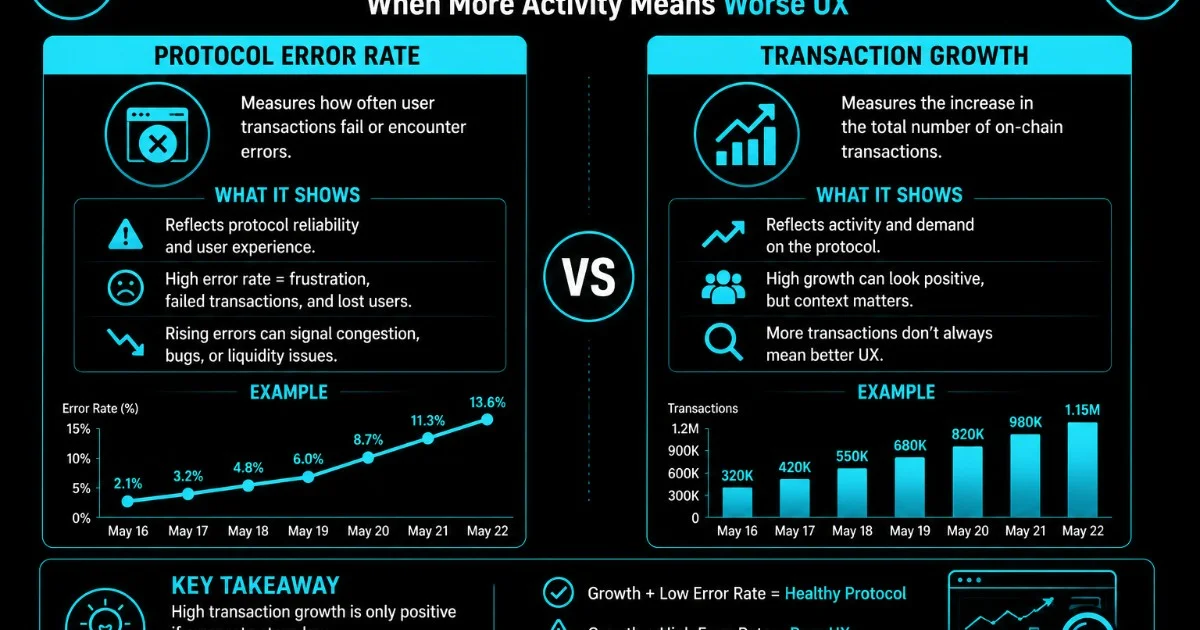
If transaction growth comes with a rising protocol error rate, the user experience may actually be getting worse. Failed transactions, reverted swaps, failed contract interactions and execution problems can turn growth into frustration.
This is why traders should compare protocol error rate vs transaction growth.
A protocol may be busy, but if users cannot complete actions reliably, that activity may not translate into real adoption.
What Is Transaction Growth?
Transaction growth measures the increase in on chain actions over time.
These actions can include swaps, transfers, deposits, withdrawals, mints, claims, votes, staking operations, bridge actions or smart contract interactions.
Transaction growth is useful because it shows that more activity is happening inside a protocol or network.
However, transaction growth alone does not show whether those transactions are successful, useful or valuable.
What Is Protocol Error Rate?
Protocol error rate measures how often user actions fail or produce errors.
This can include failed swaps, reverted contract calls, failed deposits, failed withdrawals, stuck transactions, failed claims or execution errors caused by smart contract logic, poor liquidity, gas issues or frontend problems.
A high error rate can indicate that users are trying to interact with the protocol but cannot complete their actions smoothly.
For user experience, this matters a lot.
Protocol Error Rate vs Transaction Growth: The Key Difference
The key difference is activity vs reliability.
Transaction growth shows how many actions users attempt or complete.
Protocol error rate shows how often the system fails to deliver a successful experience.
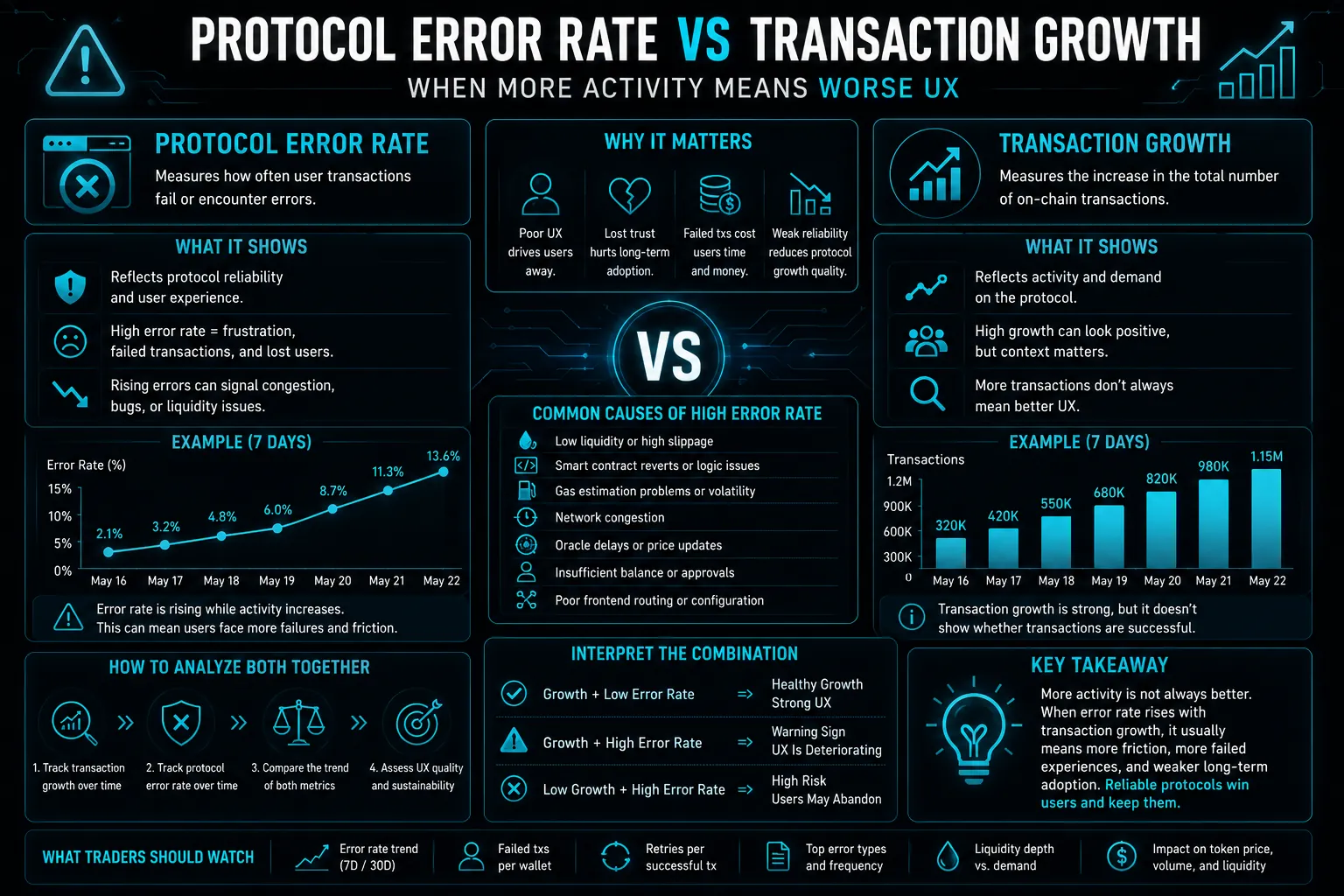
A protocol with rising transactions and low error rates may be growing in a healthy way. A protocol with rising transactions and rising errors may be under stress.
For traders, this distinction is important because poor UX can reduce retention, liquidity and confidence.
Why Transaction Growth Can Be Misleading
Transaction growth can look impressive on dashboards.
A protocol may show rising transaction count, more wallets and more smart contract interactions. But if many users are failing to complete actions, the growth may be lower quality than it appears.
Some activity may come from repeated retries. A user who fails a transaction several times may create more on chain activity without achieving the intended result.
In this case, higher transaction count can hide friction.
Why Error Rate Matters
Error rate matters because it reflects user experience.
If users cannot swap, claim, deposit, borrow or withdraw smoothly, they may leave. Even if the protocol has strong features, poor reliability can damage trust.
In DeFi, reliability is especially important because users often interact with real money. Failed transactions during volatility can be costly.
A low error rate can support confidence. A high error rate can signal hidden weakness.
When More Activity Means Worse UX
More activity can create worse UX when the protocol cannot handle demand.
This may happen during token launches, airdrops, market crashes, liquidity stress, bridge congestion or high volatility.
Users may face failed swaps, delayed confirmations, contract reverts, gas estimation problems or poor routing.
If transaction growth rises because users are repeatedly trying to complete failed actions, the apparent adoption may be misleading.
Common Causes of High Protocol Error Rate
Protocol errors can happen for several reasons.
Liquidity may be too thin for swaps.
Slippage settings may be too low.
Smart contracts may reject transactions.
Gas fees may change during execution.
Oracles may update prices before confirmation.
Frontend routing may be poor.
Network congestion may increase failure risk.
User balances or approvals may be insufficient.
Some errors are normal. But if errors rise consistently, traders should pay attention.
What Healthy Growth Looks Like
Healthy protocol growth usually includes rising transactions, low error rates, stable liquidity, successful user actions and returning users.
If users complete actions smoothly, growth is more likely to be real.
A protocol with strong UX can retain users even when competition increases.
Healthy growth is not just about more clicks, swaps or interactions. It is about successful interactions that create value.
What Traders Should Analyze
Before trusting a growth narrative, traders should ask:
Are transactions increasing?
Are failed transactions increasing too?
Are users retrying the same actions?
Is liquidity strong enough for demand?
Are swaps failing during volatility?
Are users returning after failed interactions?
Is the protocol improving reliability over time?
Does growth continue after campaigns or incentives end?
These questions help separate real adoption from noisy activity.
Why This Matters for Token Value
Protocol tokens often benefit from adoption narratives. If a protocol appears to grow, traders may expect higher demand, stronger fees and more market confidence.
But if growth comes with a poor user experience, the token narrative can weaken.
Users may leave for competitors. Liquidity providers may move capital elsewhere. Traders may lose trust in the application.
Reliability can become a hidden driver of token performance.
How DEXTools Can Help
DEXTools can help traders observe market reaction around protocol tokens. If a protocol claims strong activity, traders can compare that narrative with token liquidity, volume, price action and transaction behavior.
If activity is rising but token liquidity is weakening, traders should be cautious.
A strong protocol should not only attract users. It should also support smooth market activity.
Final Thoughts
Protocol error rate and transaction growth tell different stories.
Transaction growth shows activity. Protocol error rate shows whether that activity works properly.
More transactions can be bullish when users complete actions successfully. But if errors rise with activity, the protocol may be showing signs of stress.
For traders, the best signal is not simply more activity. The best signal is reliable activity, repeat usage and smooth execution.
In crypto, growth matters. User experience decides whether that growth lasts.
How to Bridge Crypto Between Chains: Complete Cross-Chain Tutorial 2026 How to Use 1inch for Swaps: Classic, Fusion and Limit Orders (2026) OKX Web3 Wallet Tutorial 2026: Multi-Chain Setup GuideThe Hidden Cost of Unbounded Scalability: Protocol Error Rate as a Leading Indicator
While raw transaction growth often serves as a superficial metric for network health, a deeper analysis reveals that an unchecked surge in activity can expose underlying architectural limitations. Protocol Error Rate (PER) emerges as a critical, often overlooked, leading indicator of impending user experience degradation. This metric goes beyond simple transaction failures; it encompasses a broader range of deviations from expected protocol behavior, including dropped transactions, consensus failures, and even smart contract execution anomalies that do not immediately halt the network but contribute to a less reliable environment.
Understanding PER as a function of transaction growth is crucial for developers and users alike. A healthy protocol should ideally maintain a low and stable PER even as transaction volume increases significantly. A rising PER alongside growth suggests that the network's current design or infrastructure is struggling to cope, indicating bottlenecks in block propagation, validator performance, or state management. This can manifest as longer confirmation times, increased gas prices due to re-tries, and a general sense of unreliability that erodes user trust.
Mitigating Protocol Error Rate in High-Growth Scenarios
- Implement robust off-chain scaling solutions to absorb peak transaction loads, reducing the pressure on the mainnet.
- Optimize validator client software and network configurations to improve block propagation and consensus stability.
- Develop and deploy advanced mempool management strategies to prioritize and process transactions more efficiently.
- Utilize modular blockchain architectures to isolate high-throughput applications onto dedicated execution layers or rollups.
- Regularly audit smart contract code for gas inefficiencies and potential re-entrancy or overflow vulnerabilities that could lead to errors.
- Establish comprehensive real-time monitoring systems to detect and alert on unusual spikes in PER, allowing for proactive intervention.
Proactively addressing a rising PER before it impacts a significant portion of the user base is paramount for sustaining long-term adoption and network vitality. Ignoring this metric can lead to a vicious cycle where poor UX deters new users and drives away existing ones, regardless of the headline transaction numbers.
Related Guides
- Fee Payer Growth vs Transaction Count: Which Better Shows Real Network Adoption?
- Nonce Error in Crypto: Complete Fix Guide for MetaMask & Bitcoin (2026)
- Market Cap vs FDV in Crypto: What the Gap Really Means (2026)
- The Market Cap Mirage: Why Token Valuation Means Little Without Depth
- Median Trade Size vs Trade Count: Why Small Swaps Can Inflate DEX Activity
Frequently Asked Questions
Why is transaction growth not always a good sign?
Rising transaction counts can look like adoption, but they do not show whether users are having a smooth experience. More activity can hide a growing share of failed or problematic transactions.
What is a protocol error rate?
A protocol error rate measures the proportion of transactions or interactions that fail or revert. A high error rate suggests users are struggling to complete actions successfully.
How can more activity mean worse user experience?
If transaction volume grows but the error rate climbs alongside it, many users may be facing failed transactions, wasted fees, or confusion. Raw growth can mask these underlying problems.
Why should analysts look at error rates with growth metrics?
Looking at error rates alongside growth gives a clearer picture of real usability and adoption. It helps distinguish genuine healthy usage from activity that frustrates users.