Utilization Rate vs TVL: The DeFi Metric That Matters
— By Whatsertrade in Tutorials

Utilization rate vs TVL in DeFi lending: which metric reveals idle capital, real borrowing demand, and protocol health, with examples and red flags.
This guide compares utilization rate vs TVL as DeFi lending metrics. If you want a closely related signal, also read Deposit Growth vs Borrow Growth.

DeFi lending protocols are often judged by total value locked, commonly known as TVL. A high TVL can make a protocol look strong, trusted and liquid. But TVL alone does not always show real lending demand.
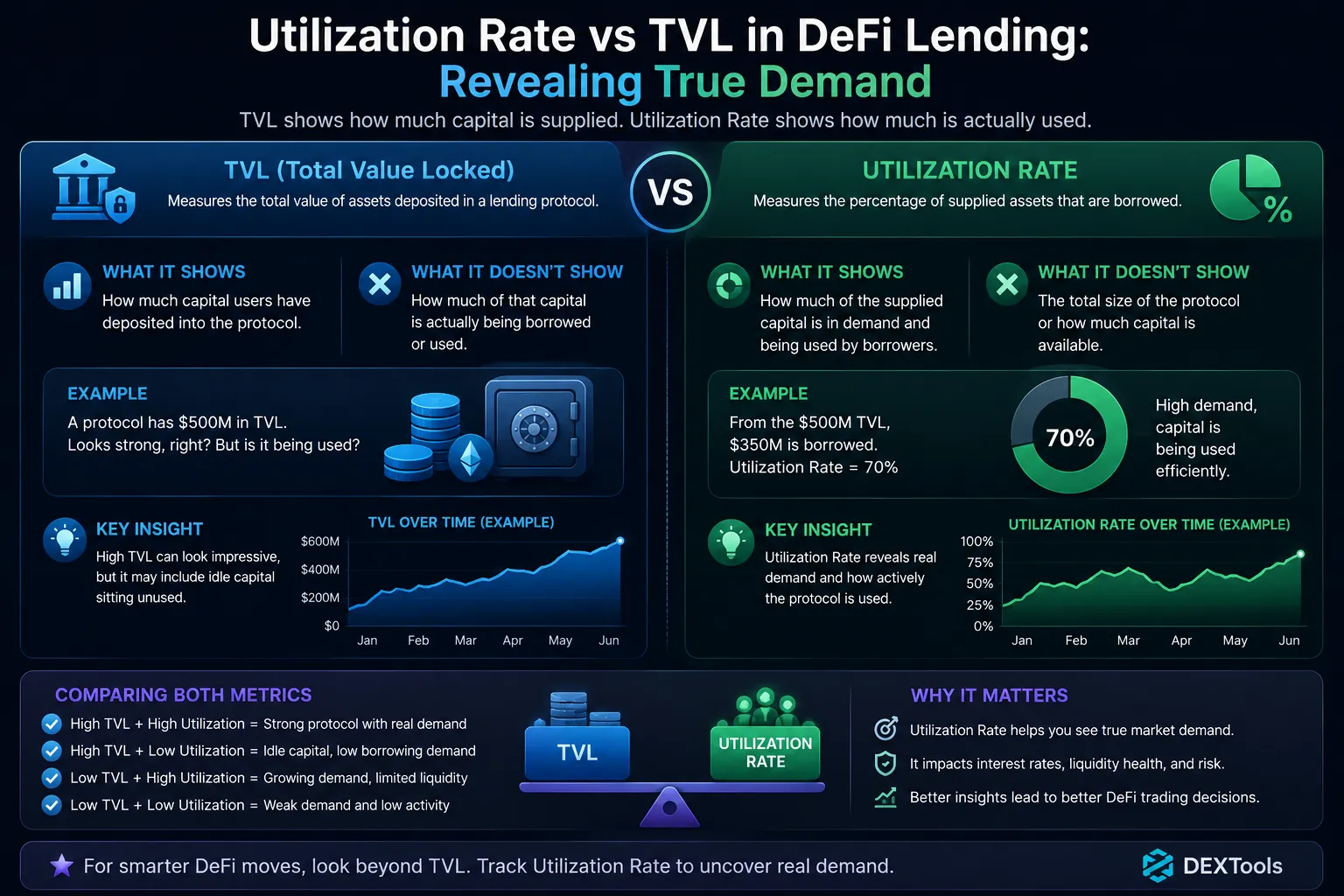
Another important metric is utilization rate. While TVL shows how much capital is deposited into a protocol, utilization rate shows how much of that capital is actually being borrowed or used.
For traders and analysts, comparing utilization rate vs TVL can give a clearer view of whether a lending protocol has real demand or simply a large amount of idle capital.
What Is TVL in DeFi Lending?
TVL measures the total value of assets deposited in a DeFi protocol. In lending markets, this includes assets supplied by users who want to earn yield.
A lending protocol with high TVL may look strong because it has a large base of deposited capital. This can improve confidence and make the protocol more attractive to borrowers.
However, TVL only shows supply. It does not show whether users are actually borrowing that capital.
A protocol can have high TVL and low lending activity if most assets are sitting unused.
What Is Utilization Rate?
Utilization rate measures how much of the supplied capital is being borrowed.
For example, if a lending pool has $100 million supplied and $70 million borrowed, the utilization rate is 70 percent.
This metric helps traders understand how active the lending market really is. A high utilization rate can suggest strong borrower demand. A low utilization rate may suggest that capital is available, but not being used.
Utilization Rate vs TVL: The Key Difference
The key difference is that TVL measures capital deposited, while utilization rate measures capital used.
TVL answers the question: how much money is inside the protocol?
Utilization rate answers the question: how much of that money is actually in demand?
Both metrics are useful, but they tell different stories. A strong lending protocol should ideally have meaningful TVL and healthy utilization.
Why High TVL Can Be Misleading
High TVL can create the appearance of strength, but it may not always reflect real lending demand.
A protocol may attract deposits through incentives, rewards or temporary yield campaigns. Users may supply assets to earn rewards, even if there is not much borrowing demand.
This can create idle liquidity. The protocol looks large, but the capital is not being actively used.
For traders, this matters because token value may depend more on real usage than on deposits alone.
Why Utilization Rate Matters
Utilization rate can reveal whether borrowers actually need the assets supplied to the protocol.
If utilization is healthy, it means supplied capital is being put to work. Borrowers are paying interest, lenders are earning yield and the protocol may generate more meaningful activity.
A very low utilization rate may suggest weak borrowing demand. A very high utilization rate may suggest strong demand, but it can also create risk if liquidity becomes too tight.
The best signal is not simply high utilization. The best signal is sustainable utilization.
When High Utilization Can Be Risky
High utilization may seem positive, but it can also create problems.
If most of the supplied capital is borrowed, there may be limited liquidity available for withdrawals. Lenders may face delays or reduced flexibility if many users want to withdraw at the same time.
High utilization can also push borrow rates higher. This may attract more deposits, but it can also discourage borrowers if rates become too expensive.
A healthy lending market needs balance.
What Healthy Lending Demand Looks Like
Healthy lending demand usually includes stable deposits, consistent borrowing, reasonable utilization and sustainable interest rates.
A protocol with growing TVL and growing utilization may be showing real momentum. A protocol with growing TVL but falling utilization may be attracting deposits faster than borrowers.
A protocol with rising utilization and falling TVL may be more fragile, because available liquidity may be shrinking.
Traders should compare both metrics together.
How Traders Can Use This Metric
Before judging a DeFi lending protocol, traders should ask:
Is TVL increasing because users trust the protocol or because incentives are high?
Is borrowed volume increasing too?
Is utilization stable or volatile?
Are borrow rates sustainable?
Is demand concentrated in one asset or spread across multiple markets?
These questions help separate real protocol demand from passive capital deposits.
How DEXTools Can Help
DEXTools can help traders monitor the market side of lending protocol tokens. Even if protocol metrics look strong, traders should still review token liquidity, volume, price action and transaction behavior.
A lending protocol may show strong TVL, but if its token has weak liquidity or unstable trading activity, market risk can remain high.
Combining DeFi metrics with live token data gives traders a more complete picture.
Final Thoughts
TVL and utilization rate are both important, but they measure different things. TVL shows deposited capital. Utilization rate shows how much of that capital is actually being borrowed.
For DeFi lending analysis, TVL alone is not enough. Traders need to know whether capital is active, productive and supported by real borrower demand.
A protocol with high TVL but low utilization may look strong on the surface. A protocol with balanced TVL and healthy utilization may show deeper demand.
In DeFi lending, real demand is not only about how much capital enters. It is about how much capital is actually used.
Protocol Revenue vs TVL: Understanding DeFi Demand What Is Impermanent Loss in DeFi? Complete Liquidity Provider Guide What Is Yield Farming in Crypto? Complete DeFi Strategy Guide Protocol Owned Liquidity vs Mercenary Liquidity What Is Crypto Arbitrage? Complete Trading GuideRelated Guides
- What Is a Flash Loan in DeFi: How It Works and Why It Matters (2026)
- 5 Best Crypto Lending Platforms 2026: APY, TVL & Safety
- Protocol Revenue vs TVL: Understanding DeFi Demand
- Liquidity Turnover vs TVL: How to Know If a DeFi Pool Is Active or Idle
- How to Use DefiLlama: Track TVL, Stablecoins and Protocol Revenue (2026)
Frequently Asked Questions
What is utilization rate in DeFi?
Utilization rate in DeFi lending is the share of deposited funds that is currently being borrowed. A high utilization rate means most supplied capital is in active use, while a low rate means more capital is sitting idle.
What does TVL mean in DeFi?
TVL, or total value locked, is the total value of assets deposited in a protocol. It is a common measure of size, but it does not by itself show how actively that capital is being used.
Why is utilization rate sometimes more useful than TVL?
TVL can be high while much of the capital sits idle, which exaggerates how much real demand exists. Utilization rate reveals actual borrowing demand and how efficiently a lending protocol's deposits are being put to work.
What are red flags in these DeFi metrics?
Very low utilization despite large TVL can signal weak borrowing demand or incentives propping up deposits. Extremely high utilization can also be risky, since it may leave little liquidity available for lenders to withdraw.