Borrower Diversity vs Whale Borrowing: How Concentrated Loan Demand Creates DeFi Risk
— By Whatsertrade in Tutorials

DeFi lending protocols depend on borrowers. When users borrow assets, lenders earn yield, protocols generate activity and markets become more dynamic.But not al
DeFi lending protocols depend on borrowers. When users borrow assets, lenders earn yield, protocols generate activity and markets become more dynamic.
But not all borrowing demand is equally healthy.
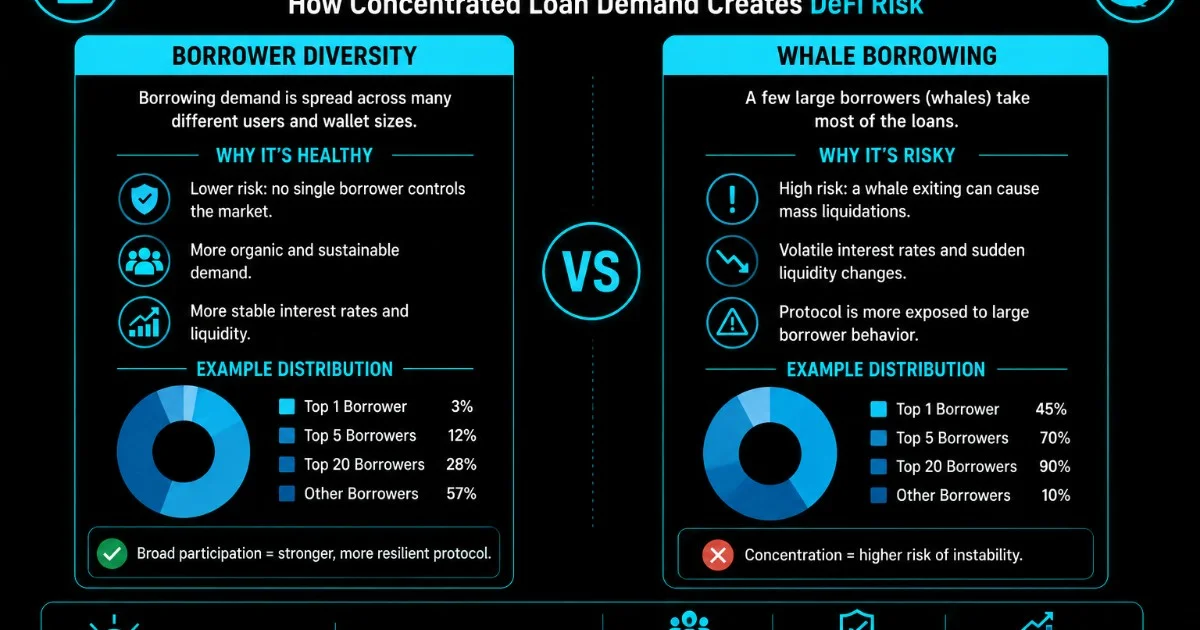
A lending protocol may look active because borrowed amounts are rising. However, if most of that demand comes from a small number of large borrowers, the protocol may be exposed to concentration risk.
This is why traders should compare borrower diversity vs whale borrowing.
A protocol with many independent borrowers may be more resilient than one where a few large wallets control most of the debt.
What Is Borrower Diversity?
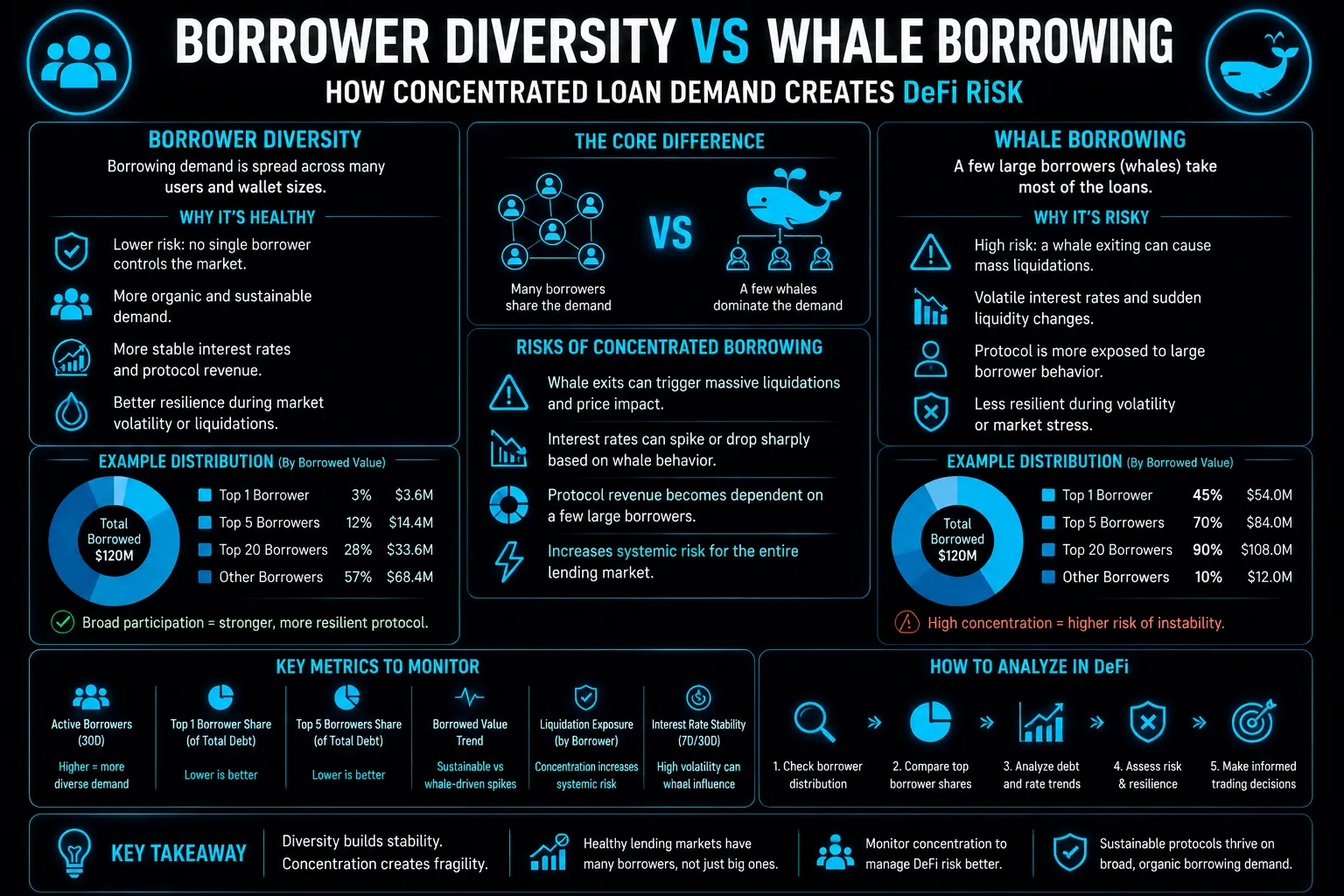
Borrower diversity measures how widely borrowing activity is distributed across users.
A lending protocol has strong borrower diversity when many different wallets borrow assets, no single borrower dominates the market and demand comes from multiple user types.
This can include traders, liquidity providers, hedgers, market makers, yield strategies and long term users.
Diverse borrowing demand can make a protocol more stable because the system does not depend heavily on one or two large wallets.
What Is Whale Borrowing?
Whale borrowing happens when a small number of large wallets account for a major share of total borrowed assets.
This may happen when institutions, funds, market makers or large DeFi users borrow heavily from a protocol.
Whale borrowing can make lending activity look strong, but it can also create hidden risk.
If one large borrower reduces activity, gets liquidated or exits the protocol, the impact can be significant.
Borrower Diversity vs Whale Borrowing: The Key Difference
The key difference is distributed demand vs concentrated demand.
Borrower diversity shows that many users need the lending market.
Whale borrowing shows that a small number of large users drive most of the activity.
A protocol with strong borrower diversity may have more durable demand. A protocol dominated by whale borrowing may be more fragile if those whales change behavior.
For DeFi traders, this distinction can reveal hidden lending risk.
Why Whale Borrowing Can Be Misleading
Whale borrowing can inflate protocol activity.
A lending protocol may report high borrowing demand, strong utilization and rising interest income. But if most of that activity comes from a few wallets, the market may not be as healthy as it looks.
Large borrowers can enter and exit quickly.
If a whale repays a large loan, protocol revenue may fall. If a whale is liquidated, collateral sales may pressure markets. If a whale withdraws supplied collateral, liquidity conditions may change.
Concentrated activity can make protocol metrics unstable.
Why Borrower Diversity Matters
Borrower diversity helps show whether a lending protocol has broad market demand.
If many borrowers use the protocol, demand may be more resilient. One borrower leaving is less likely to damage the whole market.
Diverse borrowers can also create more stable interest rate behavior.
This can benefit lenders, borrowers and protocol tokenholders.
A lending market with healthy borrower diversity is usually less dependent on individual whale decisions.
The Risk of Concentrated Debt
Concentrated debt can become dangerous during volatility.
If one large borrower uses a volatile asset as collateral, a market drop can create liquidation pressure. If the position is large enough, liquidators may struggle to absorb the collateral efficiently.
This can increase price impact, reduce liquidity and raise bad debt risk.
Concentrated borrowing can also affect interest rates. A single large position may push utilization higher or lower.
This makes the market more sensitive to individual wallet behavior.
When Whale Borrowing Can Be Positive
Whale borrowing is not always bad.
Large borrowers can bring liquidity, professional strategies and meaningful fee generation. They may use the protocol because it is efficient, trusted and liquid.
A whale borrower can also help bootstrap early protocol activity.
The risk appears when whale borrowing becomes too dominant.
A healthy protocol can serve whales without depending entirely on them.
Signs of Healthy Borrower Diversity
Healthy borrower diversity may include:
Many active borrowers.
Debt spread across multiple wallets.
Borrowing across several assets.
Stable borrowing demand over time.
Limited dependence on one borrower.
Low liquidation concentration.
Consistent revenue from broad usage.
This type of structure suggests stronger lending demand.
Signs of Whale Borrowing Risk
Whale borrowing risk may be high when:
A few wallets control most debt.
One asset dominates borrowing activity.
Utilization changes sharply after whale activity.
Liquidation risk is concentrated.
Protocol revenue depends on large accounts.
Borrowing demand falls quickly when incentives change.
Collateral linked to whale loans is illiquid.
These signs can indicate hidden fragility.
What Traders Should Analyze
Before trusting lending growth, traders should ask:
How many borrowers are active?
What share of debt is controlled by the largest wallets?
Are whales borrowing against liquid collateral?
Is debt spread across different assets?
Are liquidation risks concentrated?
Would protocol revenue fall if one whale repaid?
Are borrowing rates stable?
Is demand organic or incentive driven?
These questions help traders understand whether lending activity is broad or fragile.
Why This Matters for Token Traders
Lending protocol tokens can react to both growth and risk.
If borrowing demand is broad, traders may see stronger fundamentals. If borrowing is dominated by whales, token risk may be higher than headline metrics suggest.
A protocol can have strong borrowed value but weak borrower diversity.
That means the token narrative may depend on a small number of users.
For traders, concentrated demand is always worth watching.
How DEXTools Can Help
DEXTools can help traders monitor market behavior around lending protocol tokens and major collateral assets.
If whale borrowing risk becomes visible, traders may see reactions in liquidity, price action, volume and transaction flow.
Combining lending metrics with live market data can help traders avoid relying only on headline borrowing growth.
Final Thoughts
Borrower diversity and whale borrowing reveal different sides of DeFi lending demand.
Borrower diversity shows broad demand. Whale borrowing shows concentrated demand.
A lending protocol can look strong when borrowed value rises, but if a few whales drive most of the activity, the market may be fragile.
For traders, real lending strength comes from many borrowers, liquid collateral, stable usage and controlled concentration risk.
In DeFi lending, who borrows can matter as much as how much is borrowed.
How to Bridge Crypto Between Chains: Complete Cross-Chain Tutorial 2026 How to Use 1inch for Swaps: Classic, Fusion and Limit Orders (2026) OKX Web3 Wallet Tutorial 2026: Multi-Chain Setup GuideThe Cascading Contagion: Understanding Systemic Leverage Risks
While borrower diversity is crucial, the mere number of participants doesn't fully mitigate risk if underlying collateral types or market conditions are highly correlated. A deep dive into whale borrowing reveals not just the concentration of individual loan demand, but also the potential for systemic leverage to amplify market shocks. When large entities utilize similar strategies, perhaps leveraging stablecoins against volatile assets or vice-versa, their collective actions can create a network of interconnected risk that transcends individual borrower profiles.
The "contagion" effect becomes particularly pronounced when collateral liquidation events are triggered across multiple large positions simultaneously. This can lead to a rapid sell-off in specific assets, driving down prices further and triggering more liquidations in a cascading loop. Understanding this dynamic requires moving beyond simple borrower counts to analyze the nature of the borrowed assets, the collateral types, and the overall market liquidity available to absorb potential shocks.
Mitigating Systemic Leverage Risks
For protocols and sophisticated users, recognizing and preparing for these systemic risks is paramount. It involves a multi-faceted approach to risk assessment and management, extending beyond individual creditworthiness to the broader market structure.
- Monitor large open interest positions across key collateral types.
- Analyze the correlation between various collateral assets in different market conditions.
- Assess the depth and liquidity of markets for assets commonly used as collateral.
- Stress-test protocol liquidation mechanisms under extreme price volatility scenarios.
- Diversify protocol-supported collateral to reduce single-asset dependency.
Related Guides
- What Is a Flash Loan in DeFi: How It Works and Why It Matters (2026)
- How to Use Aave: Deposit, Borrow, Repay and Manage Health Factor (2026)
- Governance Quorum vs Whale Voting: How DAO Control Risk Affects Tokenholders
- Protocol Revenue vs TVL: DeFi Demand Explained
- Fake Volume vs Real Demand: How to Spot Artificial Momentum in DeFi Trading
Frequently Asked Questions
Why do DeFi lending protocols depend on borrowers?
Borrowers pay interest that generates yield for lenders and activity for the protocol. Without borrowing demand, deposited capital sits idle and lenders earn little.
What is whale borrowing in DeFi?
Whale borrowing refers to a small number of very large borrowers accounting for a big share of a protocol's loan demand. This concentration means the protocol depends heavily on a few participants.
Why is concentrated loan demand risky?
If one or a few large borrowers repay, default, or leave, utilization and revenue can swing sharply. Concentration also raises the impact of a single position being liquidated during volatile markets.
Why does borrower diversity matter?
A broad base of borrowers spreads demand so the protocol is less exposed to any single actor's behavior. Greater diversity tends to make activity and revenue more stable over time.