Who Created ETH and When Was It Founded? Full History 2026
— By AliceOnChain in Tutorials

Who created ETH and when was it founded? Vitalik Buterin's 2013 whitepaper, the 8 co-founders, the 2014 ICO, July 30 2015 launch and 2026 timeline.
The question of who created ETH and when was it founded looks simple, but the real answer hides one of the most fascinating origin stories in technology. Ethereum was not invented by a corporation or a government. It started inside the head of a nineteen-year-old programmer who thought Bitcoin was too limited, was funded by a record-breaking crowdsale before most people knew what crypto was, and reshaped global finance from a Swiss village called Zug.
The short answer for the featured snippet: Ethereum was created by Vitalik Buterin, with the whitepaper published in November 2013, and the mainnet (Frontier) launching on July 30, 2015. But that single sentence skips eight co-founders, a dramatic split, the largest hack in early crypto history, and ten years of upgrades that turned a research project into the settlement layer underneath nearly every decentralized finance app you can trade today on DEXTools.
This guide walks through Vitalik's biography, the November 2013 whitepaper, the eight co-founders and who built what, the Miami meeting, the 2014 ICO that raised $18 million, the Frontier genesis block, the 2016 DAO hack, the post-Merge era, and the 2026 state of the network.
Who Created Ethereum? The 60-Second Answer
Ethereum was created by Vitalik Buterin, a Russian-Canadian programmer born in 1994 in Kolomna, Russia. He published the Ethereum Whitepaper in November 2013 at age 19, while writing for Bitcoin Magazine, a publication he had co-founded two years earlier. The project was formally announced in January 2014 at the North American Bitcoin Conference in Miami, where Vitalik brought together a group that grew to eight official co-founders. After a public crowdsale in July-August 2014 raised roughly 31,500 BTC (about $18 million at the time), the network's first block was mined on July 30, 2015. That launch, known as Frontier, is the date Ethereum officially "became real."
If you only remember three things from this article, remember those: Vitalik wrote the idea in November 2013, eight people built it together, and the chain went live on July 30, 2015.
Vitalik Buterin: The Architect Behind the Idea
Vitalik Buterin was born on January 31, 1994, in Kolomna, a small city about sixty miles southeast of Moscow. His father, Dmitry, was a computer scientist who emigrated the family to Canada when Vitalik was six. By his teens in Toronto, Vitalik was obsessed with the World of Warcraft economy, mathematics, and competitive programming. He won a bronze medal at the International Olympiad in Informatics in 2012 representing Canada.
His introduction to crypto came in 2011 when his father mentioned Bitcoin in passing. Vitalik initially dismissed it (the price was around $1), but kept reading. He started writing for Bitcoin Weekly, paid 5 BTC per article. In September 2011, at age 17, he co-founded Bitcoin Magazine with Mihai Alisie, who would later become an Ethereum co-founder.
Between 2012 and 2013, Vitalik traveled the world visiting Bitcoin communities in Spain, Italy, Switzerland, the Netherlands, and Israel. What he kept noticing was that almost every interesting project (colored coins, prediction markets, decentralized exchanges) was bumping into the same wall: Bitcoin's scripting language was deliberately limited. Every team ended up either forking Bitcoin or building rickety overlays.
Vitalik's insight was simple: instead of building a new chain for every application, build one chain that lets anyone deploy any application. A general-purpose blockchain with a Turing-complete programming language. He pitched the idea to several Bitcoin projects first. None were interested. So in late November 2013, he wrote the whitepaper himself and emailed it to about fifteen friends.
The whitepaper landed in late November 2013 and went viral inside the Bitcoin developer community within days. By December, dozens of people were emailing him asking how to help. By January, he was on a plane to Miami.
The Ethereum Whitepaper (November 2013): What It Actually Proposed
The original Ethereum Whitepaper is about 36 printed pages. Its central claim is that Bitcoin's scripting language is "missing several important features that are necessary to allow for many very important kinds of applications." Vitalik's proposal had three big technical pieces.
First, a Turing-complete programming language built directly into the blockchain. Developers could write any program, not just predefined templates. The execution environment became the Ethereum Virtual Machine (EVM), still the standard execution engine in 2026 and copied by dozens of "EVM-compatible" chains.
Second, an account-based state model instead of Bitcoin's UTXO model. Ethereum tracks balances on accounts, the way a bank ledger does. This made smart contract logic far simpler to write.
Third, a native currency (ether, ETH) used to pay for computation. Every operation costs a small amount of ETH called gas, which prevents anyone from spamming the network with infinite loops.
The whitepaper described what each application could look like: token contracts (which became ERC-20), financial derivatives, identity systems, decentralized autonomous organizations, prediction markets, and on-chain games. Almost every category of dApp that exists in 2026 was sketched out in those original pages.
The 8 Co-Founders of Ethereum: Who Built What
One of the most persistent myths about Ethereum is that Vitalik built it alone. He did not. By the end of January 2014, eight people had been formally designated as co-founders, and each contributed something the project would not have shipped without. The split between technical, business, and operational roles is what made Ethereum survive its first two years.
Here is the full list, with a snapshot of who did what and where they are today.
Vitalik Buterin: The Visionary
Vitalik was the technical north star. He did not run operations, did not hire staff, and famously hated meetings. His job was protocol design, and that has stayed his job for over a decade. In 2026 he is still the most influential researcher in Ethereum, writing roadmap posts about Verkle trees, PeerDAS, and stateless clients.
Gavin Wood: The Engineer Who Made It Real
If Vitalik was the architect, Gavin Wood was the foreman. An English computer scientist with a PhD from the University of York, Wood joined in late 2013 after reading the whitepaper. Within months he did three things no one else could: wrote the Ethereum Yellow Paper (the formal mathematical spec of the EVM) in 2014, created Solidity (the language almost every Ethereum smart contract is still written in), and built the first working Ethereum client in C++.
Wood left the Foundation in January 2016 to start Parity Technologies. He then designed Polkadot, a multi-chain protocol that launched in 2020. He also coined the term "Web3" in 2014.
Charles Hoskinson: The CEO Who Got Pushed Out
Charles Hoskinson, a Colorado-based mathematician, became Ethereum's first CEO in early 2014. He structured the project as a Swiss Stiftung in Zug and tried to give the loose collective a corporate skeleton. He also wanted Ethereum to be a for-profit Silicon Valley style company, with VC funding, rather than a nonprofit foundation.
This led to the most famous internal conflict in Ethereum's history: the June 7, 2014 meeting in Zug, where the eight co-founders voted on the project's structure. Vitalik sided with the "non-profit, open-source" camp. Hoskinson was removed as CEO that same day and eventually founded Cardano (ADA) in 2017, which has spent the better part of a decade positioning itself as a "scientific" alternative to Ethereum.
Joseph Lubin: The Money Guy
Joseph Lubin was the oldest co-founder, a former Goldman Sachs technologist. He served as COO during the pre-launch period and put his own capital into the project when nobody else would. After Frontier launched, Lubin started ConsenSys in Brooklyn, which built MetaMask (the dominant Ethereum wallet), Infura (the RPC service powering most dApps), and Linea (a popular Layer 2). Of all the co-founders, his ongoing work has had the biggest practical impact on what users actually touch.
Di Iorio, Alisie, Chetrit, Wilcke
Anthony Di Iorio, a Toronto entrepreneur, was the first person to write Vitalik a meaningful check. He funded early development out of his own pocket and provided the Toronto coworking space where the project gestated. He later built Decentral and stepped away from the industry around 2021 citing security concerns.
Mihai Alisie, a Romanian developer, co-founded Bitcoin Magazine with Vitalik in 2011 and led the Swiss legal setup for the Foundation in Zug. Today he runs Akasha, a decentralized social networking project on Ethereum. Amir Chetrit, an Israeli investor, helped introduce Vitalik to the Tel Aviv crypto scene and keeps a famously low public profile. Jeffrey Wilcke, a Dutch developer, wrote the original Go-Ethereum (geth) client, which is still the most widely used Ethereum execution client a decade later. He left for game development in 2018.
January 2014: The Miami Meeting Where Ethereum Was Announced
The exact moment Ethereum went from "a paper Vitalik wrote" to "a project people were building" was January 25-26, 2014, at the North American Bitcoin Conference in Miami. Vitalik took the stage and presented Ethereum publicly for the first time. The slides survived: he showed a flat list of applications, talked about smart contracts, and explained why a Turing-complete blockchain was different from anything that existed.
What is less well-known is that the real founding happened in a rented house, not on the conference stage. After the talk, Anthony Di Iorio, Charles Hoskinson, Mihai Alisie, Amir Chetrit and Vitalik converged on a house Di Iorio had rented. Joseph Lubin arrived a few weeks later. Gavin Wood and Jeffrey Wilcke joined remotely from Europe shortly after. That Miami house is often described as the place "Ethereum was born" because it is where the founding team agreed to actually quit their other projects and work on this full-time.
The 2014 Ether Crowdsale: $18 Million Without a Product
Ethereum needed money. Building a blockchain from scratch is expensive, and the team estimated they needed roughly $5-10 million to ship the mainnet within 18 months. So they organized what is now considered the first major Initial Coin Offering (ICO) in crypto history.
The Ether Sale ran from July 22 to September 2, 2014. Anyone in the world could send Bitcoin to a Swiss address and receive ETH at launch. The price started at 2,000 ETH per 1 BTC and decreased over time to incentivize early buyers. There was no maximum cap. When it was over, the sale had raised 31,529 BTC, worth approximately $18.3 million at the time, in exchange for 60 million ETH distributed to roughly 9,000 buyers.
Anyone who put $1,000 into the Ether Sale at the launch ratio received about 2,000 ETH. At ETH's all-time high prices, that would have been worth several million dollars. The sale also established the model that thousands of later projects copied (and abused) during the 2017 ICO boom.
The funds were transferred to the newly formed Ethereum Foundation, a Swiss nonprofit registered in Zug (which became known as "Crypto Valley" largely because of this decision). The Foundation is still the project's primary research and grant-making body in 2026, although it is no longer the only source of Ethereum core development.
July 30, 2015: The Frontier Launch and Genesis Block
After a year of frantic development, four major testnets (Olympic was the final one), and a security audit, the Ethereum mainnet went live on July 30, 2015 at 15:26:13 UTC. The first block, the genesis block, contained the initial allocations from the 2014 crowdsale plus a small endowment to the Foundation and the early developers.
The launch was called Frontier because the team explicitly told users this was the rough, experimental, "Wild West" version of Ethereum. There were no fancy wallets, no MetaMask, no decentralized exchanges, and not even a graphical interface. To send a transaction you had to use the command line. The official Frontier announcement told users explicitly that things could break, that they should test small amounts first, and that the network might need to be hard forked if a critical bug was found. It was a developers-only release.
For about six months, Ethereum existed almost entirely as a research toy. The price of ETH hovered between $0.50 and $1 for most of late 2015. Then, in March 2016, the network upgraded to Homestead, the first "stable" release, and developers started shipping real applications. By the middle of 2016, the price had touched $20 and the network was about to face its first existential crisis.
The 2016 DAO Hack and the Ethereum Classic Split
In April 2016 a group of developers launched The DAO, a decentralized autonomous organization that worked like an on-chain venture fund. Anyone could buy DAO tokens with ETH, vote on which startups to fund, and share in the returns. The launch was massively successful. Within four weeks, The DAO raised over 11.5 million ETH, worth around $150 million at the time, which was about 14% of all ETH in existence.
On June 17, 2016, an attacker exploited a reentrancy bug in The DAO's smart contract and drained roughly 3.6 million ETH (about $50 million) into a "child DAO" controlled by the attacker. The bug had been publicly noted weeks before the attack, but no one had patched it in time. Because The DAO held such a huge fraction of all ETH, the hack was an existential threat to the entire network, not just to one application.
The Ethereum community had to decide between two unprecedented options. The first was to do nothing and accept that the funds were lost (an "immutable code is law" position). The second was to hard fork the chain to reverse the hack, which would mean Ethereum was no longer truly immutable. Vitalik and most of the core developers supported the hard fork. After weeks of intense debate, on July 20, 2016, Ethereum forked.
The fork worked: the hacked funds were returned to the DAO token holders, and the chain that emerged is what we now simply call Ethereum (ETH). But a vocal minority of users refused to accept the fork and kept mining the original chain. That chain became Ethereum Classic (ETC), which still exists in 2026 as a separate, much smaller network with a niche following.
The DAO hack and the fork had three lasting effects. It established that Ethereum's governance is ultimately social, not purely technical. It funded the entire concept of "smart contract security" as a discipline and indirectly created firms like OpenZeppelin and Trail of Bits. And it cemented Vitalik's role as the project's de facto leader, because his public support for the fork was the deciding factor.
The Hard Fork Roadmap: A Decade of Upgrades
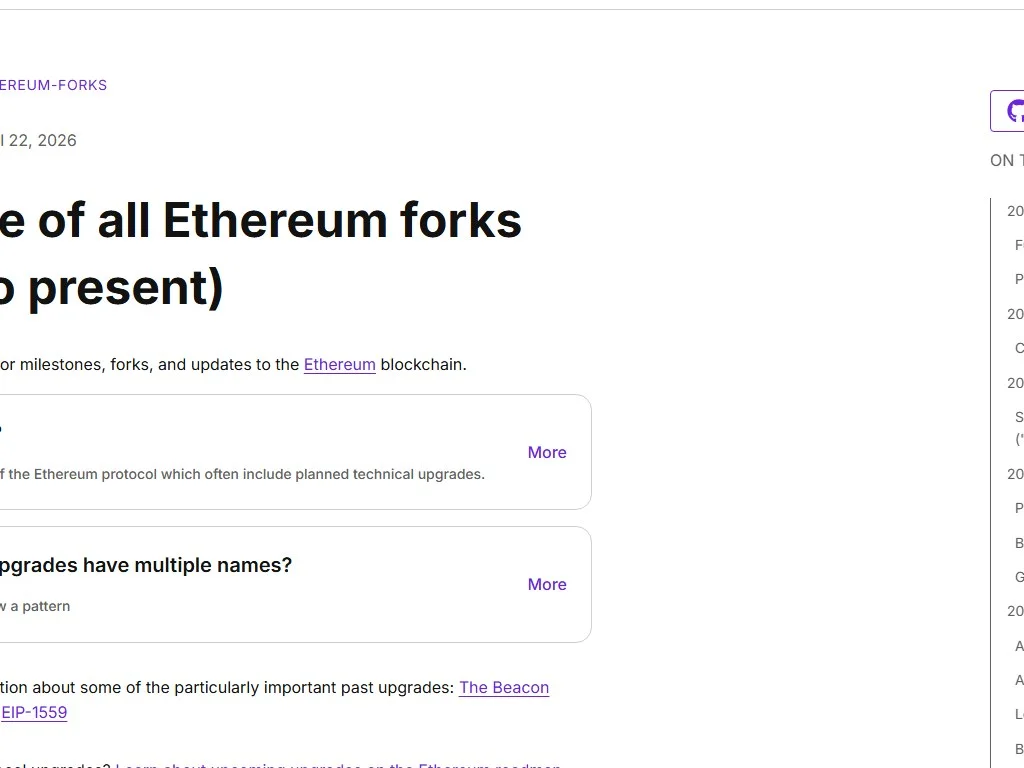
Since Frontier launched in 2015, Ethereum has shipped more than a dozen major upgrades. Each one is a coordinated hard fork that requires every node operator to update their client software. Here is the complete list through 2026, in chronological order, with what each one actually changed.
Why The Merge Was the Biggest One
The Merge, on September 15, 2022, is the most important upgrade in Ethereum's history after Frontier itself. Before the Merge, Ethereum used Proof-of-Work, the same mining-based consensus as Bitcoin, which consumed roughly as much electricity as a mid-sized country. The Merge replaced PoW with Proof-of-Stake, where validators stake 32 ETH and earn rewards for honestly verifying blocks. Overnight, Ethereum's energy consumption dropped by approximately 99.95%.
The Merge also opened the door to staking ETH for yield, which created an entire new subcategory of DeFi. Liquid staking tokens like Lido's stETH and Rocket Pool's rETH let anyone earn validator rewards without having to lock 32 ETH or run a node, and they are now among the largest assets in DeFi by total value.
EIP-1559: The Burn That Changed Tokenomics
The London upgrade in August 2021 introduced EIP-1559, which fundamentally changed how Ethereum's fee market works. Before EIP-1559, fees were a chaotic auction. After EIP-1559, every transaction has a "base fee" that is burned (permanently destroyed) and a "priority fee" that goes to validators. In high-activity periods, the burn rate exceeds the issuance rate, making ETH a deflationary asset for stretches at a time. This is why ETH is sometimes called "ultra-sound money," in contrast to Bitcoin's predictable but always-positive issuance.
Dencun and Pectra: The Layer 2 Era
Dencun (March 2024) and Pectra (May 2025) are the most recent upgrades, and both are explicitly designed for the Layer 2 era. Dencun introduced blob transactions (proto-danksharding), which cut the cost of posting data from L2 rollups by 10-100x and unlocked the wave of sub-cent transactions you can do today on Arbitrum, Base, Optimism, and others. Pectra brought EIP-7702 account abstraction, which lets ordinary wallets temporarily act like smart contract wallets, enabling features like batched transactions and gas sponsorship without forcing users to migrate.
Where the Original Founders Are in 2026
The most fascinating part of Ethereum's story is what happened to the founders after launch. Almost every one of them went on to either lead a competing chain or build infrastructure that the broader crypto ecosystem still depends on. Understanding this tree of post-Ethereum projects is itself a useful map of the modern crypto landscape.
Still leads research. Drives the post-Merge roadmap (Verge, Purge, Splurge) and writes most influential governance posts.
Founded Parity, then Polkadot. Coined the term "Web3" in 2014. Polkadot launched in 2020 and remains a top-25 chain in 2026.
Built MetaMask, Infura, and the Linea L2. Lubin's empire is the reason most users can even access Ethereum in the first place.
After being voted out in 2014, founded IOHK and launched Cardano in 2017. Still a top-15 chain, marketed as the "academic" L1.
Built the Jaxx wallet, then largely stepped away in 2021 citing personal security concerns and a desire to focus on philanthropy.
Building decentralized social networking on Ethereum. Lower profile, but still actively shipping after a decade.
Why Ethereum Survived Where Competitors Failed
Plenty of "Ethereum killers" have launched since 2015. EOS, Tezos, Tron, NEO, Cardano, Solana, Avalanche, Sui, Aptos, Near, Sei, Berachain. None has displaced Ethereum at the top of the smart-contract ecosystem. The reason traces directly back to the choices the original founders made.
First, the decision to run Ethereum as a nonprofit foundation rather than a for-profit corporation made it credible as a public good. That credibility is why most institutions default to Ethereum for on-chain assets.
Second, the broad founding team meant that when individuals left, the project did not collapse. Hoskinson leaving in 2014 would have killed many startups. Wood leaving in 2016 similarly did not stop progress, because the team had multiple senior engineers.
Third, the willingness to hard fork (the DAO) and later to change the consensus algorithm (the Merge) proved the network could adapt. Most blockchains never successfully execute a major consensus change.
Fourth, the commitment to client diversity (Geth, cpp-ethereum, Nethermind, Besu, Erigon, Reth) meant no single team controlled the protocol. In 2026, no execution client commands more than about 60% of network share.
Pros and Cons of Ethereum's Founding Story
- Multiple co-founders meant no single point of failure
- Nonprofit Foundation made the chain credible as a public good
- Open-source clients in multiple languages from day one
- Vitalik's ongoing presence keeps research vision intact
- Funded transparently via public ICO, not private VC
- Co-founder spinoffs built complementary infrastructure
- Hoskinson split created Cardano as a permanent competitor
- Premine to founders draws ongoing fairness critiques
- DAO fork forever broke pure immutability claim
- Heavy reliance on Vitalik as the social Schelling point
- Slow upgrade cadence frustrates app developers
- Many original founders no longer actively contribute
How the Founding Still Shapes Trading in 2026
If you are using DEXTools in 2026 to scan new pairs, set up liquidation alerts, or run a backtest, almost everything you touch eventually traces back to decisions the original founders made between 2013 and 2016. The ERC-20 token standard? Drafted by Fabian Vogelsteller and Vitalik in 2015, based on the whitepaper's account model. The Uniswap-style automated market maker? Built on EVM contracts that Gavin Wood's Yellow Paper formalized. USDT and USDC liquidity? Ninety percent of it lives on Ethereum or Ethereum L2s.
Even the way you connect to a dApp from MetaMask is a direct artifact of the founding story: MetaMask was built by Joseph Lubin's ConsenSys, the company he started immediately after Frontier launched. Infura, the RPC service that MetaMask defaults to, is also a ConsenSys product. The fact that you can trade tokens on 1inch or get oracle data from Pyth with one click is downstream of an architectural choice Vitalik made in November 2013 to support a general-purpose smart contract language.
This is why "who created ETH and when was it founded" is not just trivia. The technical decisions baked into the original protocol are the reason ETH still has the deepest liquidity pools, the most active developer community, and the most institutional ETF flows in the entire crypto market. Understanding the origin story is understanding why the network behaves the way it does.
Common Myths About Ethereum's Creation
Several popular claims about Ethereum's history are either wrong or oversimplified. Worth correcting them, because they keep showing up in lazy articles and YouTube videos.
Myth 1: "Vitalik invented Ethereum alone." He wrote the whitepaper alone, but he did not build the actual chain. Gavin Wood wrote the spec and the first client. Jeffrey Wilcke wrote Geth. The launch required the whole eight-person team plus dozens of contributors.
Myth 2: "Ethereum launched in 2014." The project was announced in January 2014 and the ICO happened in mid-2014, but the actual mainnet did not go live until July 30, 2015. People often conflate the announcement year with the launch year.
Myth 3: "Ethereum was always Proof-of-Stake." Ethereum was Proof-of-Work for almost exactly seven years, from July 2015 until September 15, 2022. The Merge was a massive engineering effort precisely because PoS was always part of the long-term plan but turned out to be incredibly hard to deliver.
Myth 4: "The 8 co-founders all still work on Ethereum." Only Vitalik, Lubin, and Alisie are still meaningfully active in the Ethereum ecosystem in 2026. Wood, Hoskinson, Di Iorio, Chetrit and Wilcke have all moved to other projects or out of crypto entirely.
Myth 5: "Ethereum Classic is the 'original' Ethereum." Technically ETC continued the pre-DAO-fork chain, but the broader community, the developer ecosystem, the dApps, the wallets, the exchanges, and almost all infrastructure followed the forked chain (ETH). Calling ETC the "original" is correct in the narrowest possible sense and misleading in every practical sense.
Best Practices for Researching Ethereum's History Yourself
If you want to verify any claim in this article, here are the canonical sources to consult.
For the original whitepaper, go to ethereum.org/en/whitepaper. For the technical specification, the Yellow Paper by Gavin Wood is at ethereum.github.io/yellowpaper and is updated for each hard fork.
For governance and roadmap changes, the EIP repository at eips.ethereum.org contains every Ethereum Improvement Proposal ever written, including rejected ones. Vitalik's blog at vitalik.eth.limo is the best primary source for understanding why the protocol evolved the way it did. For founder profiles, Camila Russo's book "The Infinite Machine" is the most thoroughly researched account of Ethereum's first three years.
Frequently Asked Questions
Q Q Who created Ethereum?
Ethereum was created by Vitalik Buterin, a Russian-Canadian programmer who was 19 years old when he published the Ethereum Whitepaper in November 2013. Vitalik wrote the original concept alone, but seven other people, Gavin Wood, Charles Hoskinson, Joseph Lubin, Anthony Di Iorio, Mihai Alisie, Amir Chetrit and Jeffrey Wilcke, are recognized as official co-founders. They formally joined the project in January 2014 at the North American Bitcoin Conference in Miami.
Q Q When was Ethereum founded and launched?
The Ethereum project was conceptually founded in November 2013 when Vitalik Buterin published the whitepaper, and was formally announced in January 2014. The mainnet, called Frontier, went live on July 30, 2015. That is the date the genesis block was mined and the network started running. Most people use "July 30, 2015" as the official launch date of Ethereum.
Q Q How old was Vitalik Buterin when he created Ethereum?
Vitalik was 19 years old when he wrote the Ethereum Whitepaper in November 2013. He was born on January 31, 1994. By the time the mainnet launched in July 2015, he was 21. He was awarded a Thiel Fellowship in 2014, which gave him $100,000 to drop out of the University of Waterloo and work on Ethereum full-time.
Q Q Who are the 8 co-founders of Ethereum?
The eight officially recognized co-founders are Vitalik Buterin (visionary), Gavin Wood (CTO and creator of Solidity), Charles Hoskinson (first CEO, later founded Cardano), Joseph Lubin (COO, later founded ConsenSys), Anthony Di Iorio (early financier), Mihai Alisie (Bitcoin Magazine co-founder), Amir Chetrit (early collaborator) and Jeffrey Wilcke (creator of the Go-Ethereum client). All eight were formally established as co-founders by mid-2014.
Q Q Why did Charles Hoskinson leave Ethereum?
Hoskinson was removed as CEO on June 7, 2014 after a vote in Zug, Switzerland. He wanted Ethereum to be structured as a for-profit Silicon Valley style company with VC funding. Vitalik and most of the other co-founders preferred a nonprofit foundation. After losing the vote, Hoskinson left the project and eventually founded IOHK, which built Cardano (ADA). Cardano launched in 2017 and is still in the top 15 crypto projects in 2026.
Q Q How much did the 2014 Ethereum ICO raise?
The Ether Sale ran from July 22 to September 2, 2014, and raised approximately 31,529 BTC, worth about $18.3 million at the time. In exchange, the team distributed 60 million ETH to around 9,000 buyers. It was the first major Initial Coin Offering in crypto history and set the template for thousands of later ICOs.
Q Q What happened during the 2016 DAO hack?
In June 2016, an attacker exploited a reentrancy bug in The DAO smart contract and drained roughly 3.6 million ETH (about $50 million at the time). Because The DAO held about 14% of all ETH, the hack was an existential threat to the network. The community voted to hard fork the chain to reverse the hack. The forked chain became modern Ethereum (ETH). A minority kept mining the original chain, which became Ethereum Classic (ETC).
Q Q Is Vitalik Buterin still involved with Ethereum in 2026?
Yes. Vitalik is still the most influential researcher in the Ethereum ecosystem. He does not have a formal management title, but he leads the long-term roadmap (currently focused on the "Verge, Purge and Splurge" upgrades), regularly publishes research posts on his blog, and his opinions remain the strongest single signal of where the protocol is going. He works through the Ethereum Foundation, which is based in Zug, Switzerland.
Q Q What does Joseph Lubin do today?
Joseph Lubin runs ConsenSys, the Brooklyn-based company he founded right after the 2015 Frontier launch. ConsenSys owns MetaMask (the dominant Ethereum wallet), Infura (the most-used RPC provider), and Linea (a leading Layer 2 network). Lubin is also one of the largest publicly known ETH holders and remains a major advocate for Ethereum at industry events and policy discussions.
Q Q Why was Ethereum created when Bitcoin already existed?
Vitalik's argument was that Bitcoin's scripting language was deliberately limited. You could do basic value transfers and very simple multi-signature setups, but you could not build complex applications. Every interesting project (colored coins, prediction markets, decentralized exchanges) had to either fork Bitcoin or build fragile overlays. Ethereum's pitch was: instead of forcing every application to make its own chain, build one chain with a general-purpose programming language that supports any application.
Q Q What was the first major upgrade after Ethereum launched?
The first major upgrade was Homestead on March 14, 2016. Frontier had launched with explicit warnings that the network was experimental. Homestead was the first "stable" release and removed those warnings. It is when Ethereum is considered to have become production-ready for real applications. The biggest later upgrades have been The Merge (Proof-of-Stake, September 2022), Dencun (proto-danksharding, March 2024) and Pectra (account abstraction, May 2025).
Q Q Why does Ethereum have so many ex-founders running competing chains?
The founding team was unusually large (eight people) and unusually opinionated. Each co-founder had their own ideas about governance, monetization, and scaling. The disagreements were resolved through votes and departures rather than mergers, which is why Ethereum spawned an entire generation of "alternative L1" projects. Cardano (Hoskinson), Polkadot (Wood) and ConsenSys infrastructure (Lubin) all trace directly back to those founding-team disagreements. It is a feature, not a bug, of Ethereum's intentionally distributed origin.
Q Q Where is the Ethereum Foundation based?
The Ethereum Foundation is a Swiss Stiftung (nonprofit foundation) registered in Zug, Switzerland. Zug was chosen in 2014 because of Switzerland's favorable nonprofit and crypto laws, and the city has since become known as "Crypto Valley" largely because of the Ethereum Foundation's presence and the dozens of related projects that set up shop nearby.
Conclusion: A Whitepaper That Became a World Computer
The answer to "who created ETH and when was it founded" turns out to be richer than any one-line definition. Ethereum was created by Vitalik Buterin in November 2013, built by an eight-person founding team through 2014, funded by an $18 million crowdsale in mid-2014, and launched on July 30, 2015. From a rented Miami house, it grew into the settlement layer for nearly every DeFi protocol, every major tokenized real-world asset, and most of the smart-contract activity in crypto.
The founding team scattered: Wood went to Polkadot, Hoskinson to Cardano, Lubin to ConsenSys, Di Iorio out of crypto, others to quieter projects. But Ethereum itself kept shipping, kept upgrading, and kept compounding. The 2016 DAO hack, the 2017 ICO boom, the 2020 DeFi summer, the 2022 Merge, the 2024 Dencun blobs, the 2025 Pectra account abstraction, every era stress-tested the network and it held.
For traders using DEXTools in 2026, that history is the reason you can trust the chain underneath every pair you scan. Whether you are tracking how to sell ETH effectively, deciding whether to buy more ETH, exploring a new beginner's guide to Ethereum, or studying how cryptocurrencies work in general, you are standing on top of an architecture that one teenager and seven collaborators sketched out in a Miami house twelve years ago. That is the real answer to who created ETH and when it was founded.
--
Disclaimer: This article is for informational purposes only and does not constitute investment advice, financial advice, trading advice, or any other kind of advice. DEXTools does not recommend buying, selling, or holding any cryptocurrency or token. Users should conduct their own research and consult with a qualified financial advisor before making any investment decisions. Cryptocurrency investments are volatile and high-risk. DEXTools is not responsible for any losses incurred.