Who Owns XRP? Founders, Ripple & Supply Dynamics
Examine how XRP ownership is distributed, discover its creators, and understand how Ripple shapes the cryptocurrency landscape in the evolving digital asset market.
No single entity or company, including Ripple, "owns" XRP in its entirety. While Ripple was instrumental in XRP's creation and holds a significant portion of its supply, XRP is a decentralized digital asset. Its ownership is distributed among various individuals, institutions, and the company itself, with its supply managed through a unique, pre-determined mechanism.
Intent check: This page is the ownership and supply-dynamics explainer for XRP. If you want the beginner overview of XRP and the XRP Ledger, read What Is XRP?.
Who Owns XRP?
- As of April 8, 2026, the digital asset market has entered a phase of high institutional integration. Following the regulatory clarity achieved in previous years and the technological leaps seen in networks like Ethereum with its Pectra upgrades, investors are performing deeper due diligence on asset ownership. XRP remains one of the most discussed assets in this regard.
- To understand who owns XRP, one must peel back the layers of its creation, the role of the company Ripple, and the unique way its supply is managed. There is often a significant amount of confusion regarding whether a single company "controls" the currency, making it essential to distinguish between the decentralized ledger and the centralized entities that hold the tokens.
The Genesis: Who Created XRP and When?
The story of XRP does not begin with the company Ripple, but rather with a group of developers who wanted to create a better version of Bitcoin. XRP was created by David Schwartz, Jed McCaleb, and Arthur Britto. They began developing the code in 2011 and officially launched the network in June 2012. At its inception, the ledger was known as the Ripple Search and later the NewCoin network, before finally settling on the XRP Ledger (XRPL).
Unlike Bitcoin, which is "mined" into existence over time, the creators of XRP designed the system with its entire supply already existing. Upon the launch in June 2012, 100 billion XRP tokens were created. This fixed supply is a fundamental part of the asset’s economic model. The creators decided to "gift" the vast majority of this supply to a newly formed company that would build use cases for the asset. This company was originally named OpenCoin, founded in September 2012, and later rebranded to Ripple Labs.
Example:
Think of the creation of XRP like a company that prints all its stock certificates on day one. Instead of printing new ones every year (like mining), they decide how to distribute that fixed amount to founders, the company treasury, and the open market over several decades.
Ripple Labs: The Majority Institutional Owner
By April 2026, Ripple Labs remains the largest single holder of XRP. When the company was formed, the founders gifted 80 billion XRP to the corporation. The goal was for Ripple to use these tokens to provide liquidity, incentivize market makers, and fund the development of the ecosystem.
Over the years, Ripple has sold or distributed a significant portion of its holdings, but it still maintains a massive treasury. To provide transparency and prevent the market from being flooded with tokens, Ripple placed the majority of its holdings into a secure escrow system in late 2017.
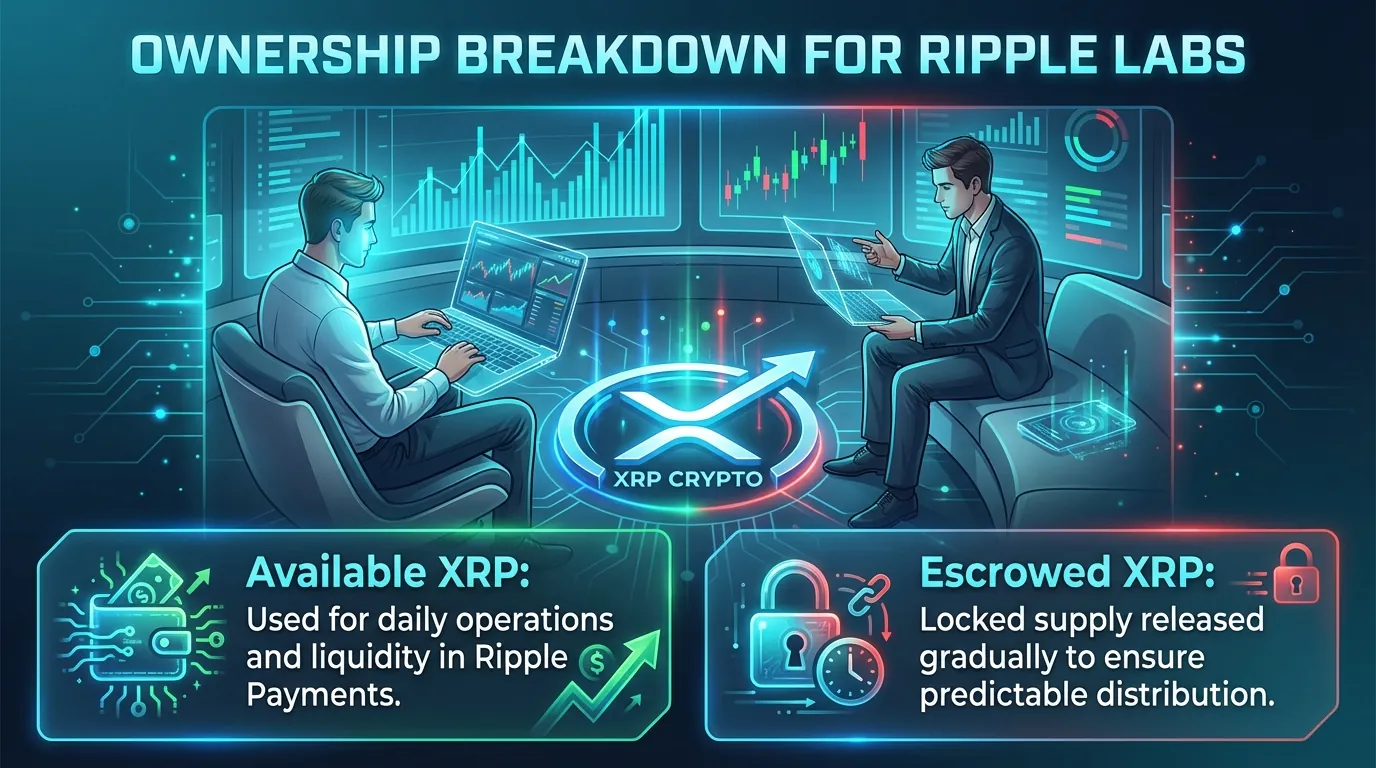
The ownership breakdown for Ripple Labs generally falls into two categories:
Available XRP: This is the amount of XRP the company holds in its operational wallets, used for day to day business expenses and liquidity for their "Ripple Payments" (formerly ODL) service.
Escrowed XRP: This is the largest portion of the supply. The company locked 55 billion XRP into a series of monthly escrows to ensure a predictable supply.
How the Escrow System Functions in 2026
- The escrow system is a smart contract on the XRP Ledger that controls the release of Ripple’s holdings. Every month, the escrow releases 1 billion XRP to Ripple Labs. The company then uses a small portion of this for its operations or sells it to institutional partners.
- A common misconception is that 1 billion new XRP enter the market every month. In reality, as of 2026, Ripple typically returns the vast majority of the released XRP (often 70% to 80%) into a new escrow at the end of the queue. This means that while Ripple "owns" the tokens, they do not have immediate access to them. This mechanism was designed to alleviate fears that Ripple could "dump" its holdings and crash the price.
Example Scenario:
On the first day of the month, the escrow releases 1,000,000,000 XRP to Ripple. Ripple might sell 200,000,000 to a global bank for cross border settlements. They then take the remaining 800,000,000 and lock them back up in a new escrow that will not open for several years. This ensures that the circulating supply grows at a controlled, transparent pace.
The Founders' Shares: Larsen and McCaleb
Aside from the company, the original founders received 20 billion XRP at the launch in 2012. Understanding the status of these shares is vital for a complete ownership picture in 2026.
But... Who Owns XRP?
Chris Larsen: As one of the early architects and former CEO, Chris Larsen received a significant portion of the founders' tokens. He remains a major individual holder and has committed large amounts of his XRP to various philanthropic causes.
Jed McCaleb: Perhaps the most famous story of XRP ownership involves Jed McCaleb. After leaving Ripple in 2013, he began a structured sell off of his multi billion XRP holdings. By July 2022, McCaleb had officially exhausted his "Taco Stand" wallet, meaning that by 2026, he is no longer a major individual owner of the asset.
David Schwartz and Arthur Britto: While both are creators, they famously took less XRP than McCaleb and Larsen, choosing instead to focus on the long term technical health of the ledger.
Public and Institutional Ownership
- The remainder of the 100 billion XRP is held by the public and various financial institutions. This includes millions of individual retail investors across the globe, as well as cryptocurrency exchanges like Binance, Coinbase, and Kraken, which hold XRP on behalf of their users.
- In 2026, a growing segment of ownership comes from institutional "custodians." Since the approval of XRP based exchange traded products in various jurisdictions, institutional investors now own XRP through traditional brokerage accounts. These tokens are held in highly secure cold storage by regulated entities, further diversifying the ownership of the network.
Does Ownership Mean Control?
One of the most important distinctions to make is the difference between owning the tokens and controlling the network. Even though Ripple Labs owns a large percentage of the XRP supply, they do not control the XRP Ledger.
The XRPL is a decentralized network maintained by independent validators. Ripple runs only a small fraction of these validators (less than 5%). If Ripple were to attempt to change the rules of the ledger against the will of the community, the other validators could simply reject the changes. This is a fundamental difference compared to a centralized database where the owner of the assets also controls the software.
| Group | Type of Ownership | Role in Ecosystem |
| Ripple Labs | Majority (Mostly Escrowed) | Infrastructure development and institutional sales. |
| Retail Investors | Liquid (Public Market) | Daily trading, use in retail payments, and DeFi. |
| Founders | Personal Holdings | Philanthropy and private investment. |
| Exchanges | Custodial | Providing liquidity for buyers and sellers. |
| Institutions | Managed Assets | Long term exposure for traditional portfolios. |
Summary of Key Points
XRP was created in June 2012 by David Schwartz, Jed McCaleb, and Arthur Britto.
100 billion XRP were created at launch. No new XRP can ever be "mined" or created.
Ripple Labs is the largest owner, holding a majority of the supply, though most of it is locked in a monthly escrow system.
The Escrow System releases 1 billion XRP per month, but the majority is usually returned to escrow to maintain market stability.
Jed McCaleb, a co founder, finished selling his billions of XRP in 2022, removing a long standing source of market pressure.
Decentralization: Ownership of tokens does not equal control of the network. The XRP Ledger is maintained by independent validators worldwide.
Institutional Growth: By 2026, a significant portion of the supply is held by regulated custodians for institutional investors.
Understanding Who Owns XRP and its distribution is essential for any participant in the 2026 digital economy. As you continue to monitor the supply dynamics and market movements of major assets, having access to real time data is your greatest advantage.
We invite you to explore the XRP dashboard on DEXTools to track your favorite assets and trade with the highest security standards. Gain access to the market insights and contract transparency needed to trade safely in today's fast paced environment. Optimize your trading strategy with confidence: trade XRP tokens on DEXTools here.
Disclaimer: This article is for informational purposes only and does not constitute investment advice, financial advice, trading advice, or any other kind of advice. DEXTools does not recommend buying, selling, or holding any cryptocurrency or token. Users should conduct their own research and consult with a qualified financial advisor before making any investment decisions. Cryptocurrency investments are volatile and high-risk. DEXTools is not responsible for any losses incurred.
Related Guides
- XRP to USD: Live Ripple Price Converter & Guide 2026
- What Is XRP? Beginner’s Guide to Ripple’s Token (2026)
- Is Ripple the Same as XRP? Key Differences Explained (2026)
- How Many ETH Are There? Ethereum Supply Guide 2026
- How Many XRP Are There? Total Supply and Escrow Mechanism
Frequently Asked Questions
Who created XRP?
XRP was created by a group of developers including David Schwartz, Jed McCaleb, and Arthur Britto, who began developing the code in 2011 and officially launched the network in June 2012.
How much XRP was created at launch?
At its launch in June 2012, a total of 100 billion XRP tokens were created, with the majority gifted to the company Ripple Labs to build use cases for the asset.
What role does Ripple Labs play in XRP ownership?
Ripple Labs is the largest single holder of XRP, having received 80 billion XRP at its inception to provide liquidity and fund ecosystem development.
How does the XRP escrow system work?
The escrow system releases 1 billion XRP to Ripple Labs each month, but Ripple typically returns 70% to 80% of the released XRP back into a new escrow to prevent flooding the market.
Is XRP a decentralized currency?
While XRP operates on a decentralized ledger, Ripple Labs, as a centralized entity, holds a significant portion of the tokens, leading to confusion about control over the currency.