TON Architecture Explained: Masterchain and Shards 2026
— By Tony Rabbit in Tutorials
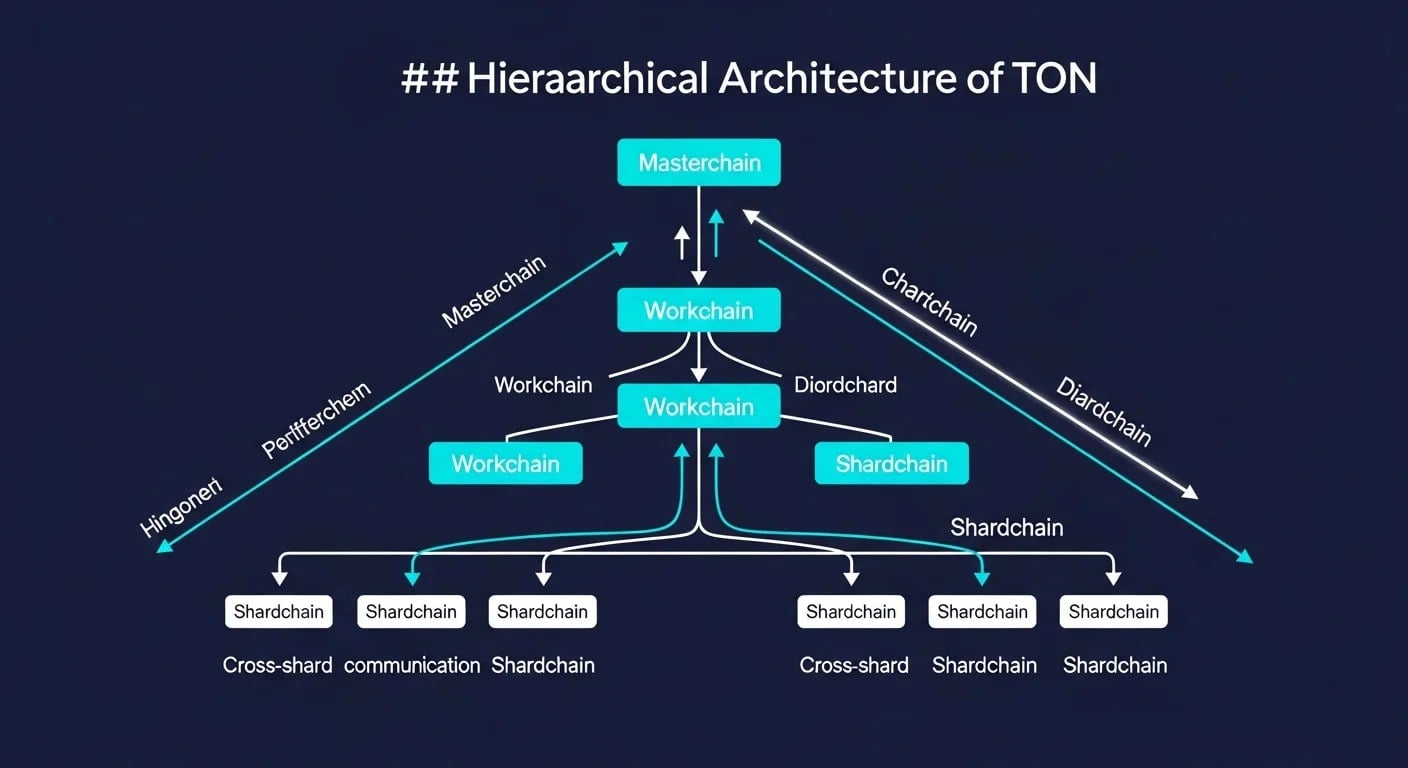
TON architecture explained: how the masterchain, workchains, shardchains and the TVM fit together, and why auto-sharding matters for scaling.
TON's architecture is one of the most-discussed and least-understood designs in crypto. Most chains are single-state machines: one chain, one global ledger, one bottleneck. TON is a hierarchy of chains that can split or merge automatically based on demand. The result is a network that feels like a single application to users while behaving like many connected chains under the hood.
Quick answer: TON is built as three connected layers. The masterchain coordinates the whole network and stores validator data. Workchains run application logic with their own rule sets, and currently the most-used workchain is the basic workchain (workchain 0). Shardchains are subdivisions of a workchain that split when load is high and merge back when load drops. All chains run the TVM (TON Virtual Machine), and validators are rotated across them by the masterchain.
- Masterchain is the source of truth. It holds validator info, configuration, and references to all other chains.
- Workchains can have different rule sets. Today the basic workchain handles most activity.
- Shardchains split automatically. Under load, a shard can split into two. Under quiet conditions they merge back.
- The TVM is asynchronous. Contracts pass messages rather than make synchronous calls.
- Validators rotate. The masterchain assigns validator groups to active shards in each round.
The three layers of TON
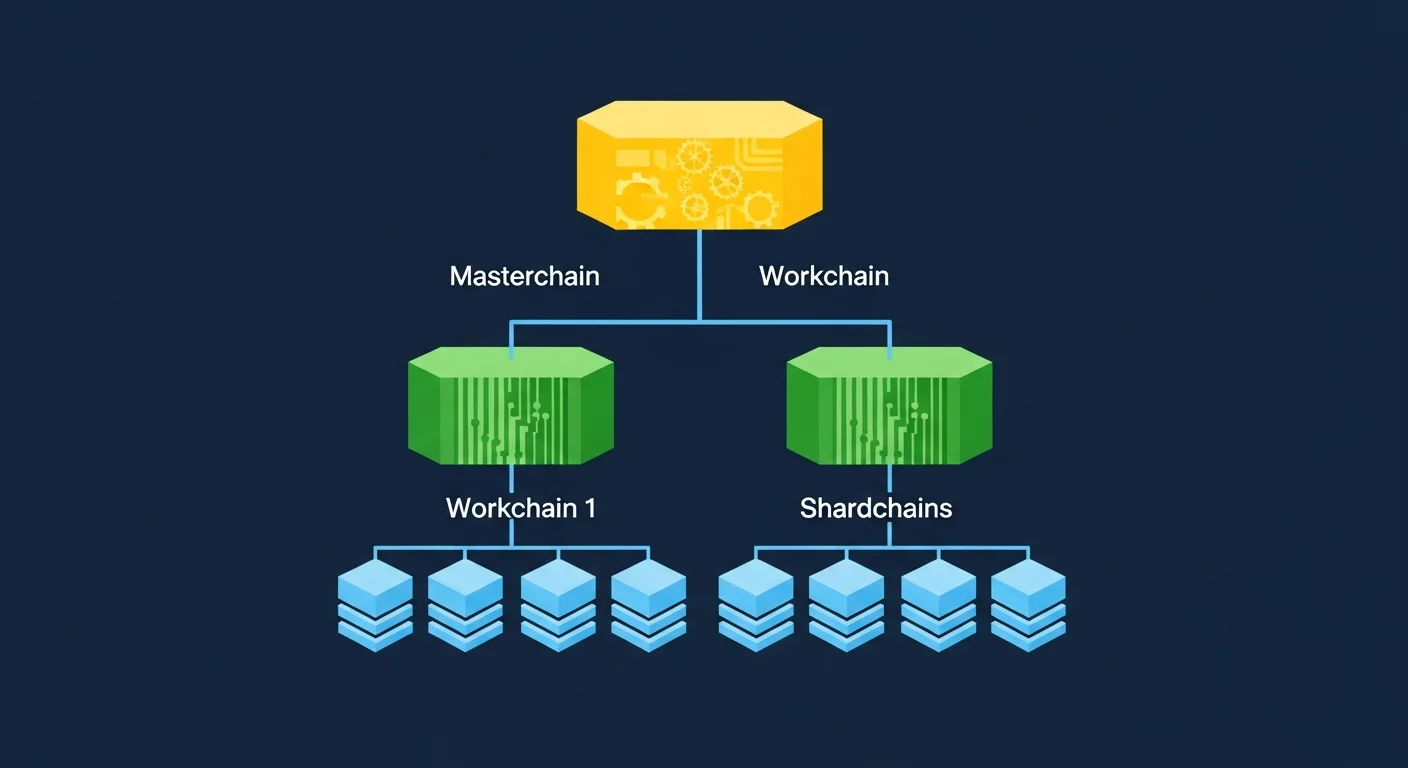
The hierarchy is the easiest place to start. Think of TON as one masterchain at the top, a small set of workchains below it, and many shardchains growing out of each workchain.
Trade TON with Not.Trade, the fastest terminal on TON
Not.Trade is purpose built for TON traders: real-time on-chain charts for every jetton, insider safety scoring (Top 10 wallets, snipers, dev movement, bundlers, LP lock), MCAP-trigger limit orders, multi-wallet sniping, MEV protection and one-click swaps routed across STON.fi and DeDust. It runs natively inside Telegram and as a fast web terminal, with TON Connect non-custodial wallet support.
Read the full Not.Trade guide →Masterchain
The masterchain is at the top of the hierarchy. It tracks the network's validator set, the current configuration parameters, and references the most recent block of every other chain. When you read TON's "global state," you are really reading the masterchain plus the latest references it points to.
Workchains
Workchains are the middle layer. The protocol allows up to 2^32 workchains, each able to define its own rule set and virtual machine settings. In practice, only the basic workchain (workchain 0) is widely used today. New workchains can be added through governance to host specialized environments.
Shardchains
Shardchains are the bottom layer. Each workchain can be subdivided into shardchains, with each shard handling a subset of accounts. The number of shards changes automatically with demand, which is why TON can absorb bursts of activity without choking on a single global queue.
Dynamic sharding in plain English
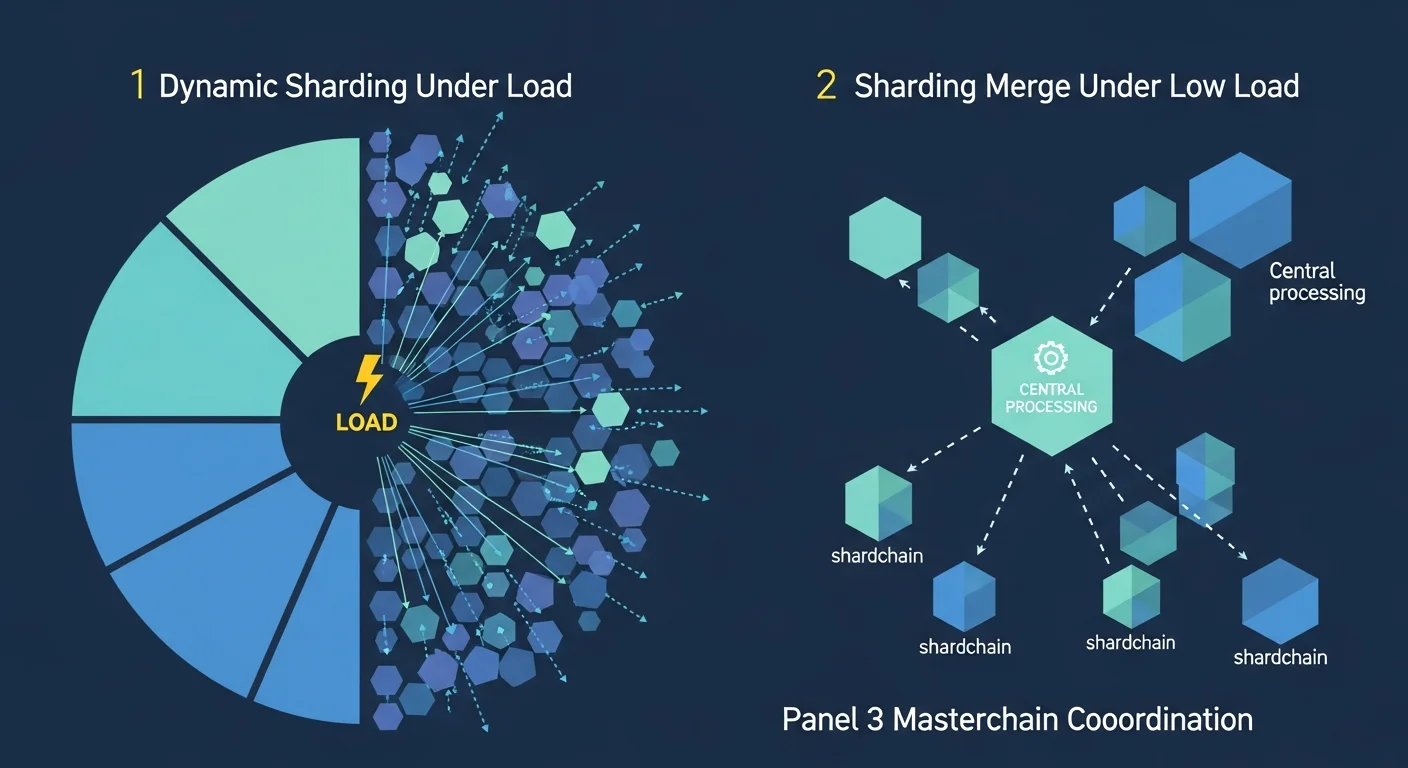
The most distinctive feature of TON is dynamic sharding. The number of shardchains is not fixed; it adapts to demand.
Splitting under load
When a shardchain becomes busy, the protocol triggers a split: the existing shardchain is divided into two new shardchains, each handling half of the original account range. New validators are assigned to the new shards, and throughput effectively doubles for that workchain.
Merging when quiet
When two adjacent shards have low load over a sustained window, they can merge back into one shardchain. This keeps validator overhead and storage costs in check during quiet periods.
Why it matters for fees
Most blockchains keep fees stable while load is light, then spike during congestion. Sharding flattens that profile by adding capacity exactly when capacity is needed. The user experience stays cheap and fast across regimes that would crush a single-chain design.
The TON Virtual Machine and asynchronous contracts
The TVM is the engine that runs TON smart contracts. It is genuinely different from the EVM, mostly because TON uses asynchronous message passing instead of synchronous calls.
Asynchronous execution
On Ethereum, one contract can call another and read the result inside the same transaction. On TON, contracts send messages to each other. The receiving contract processes the message in a later step, possibly in a different shard. This sounds slower, but it is what allows TON to spread work across shards in parallel.
Cells, bags of cells, and storage
TON's data model uses "cells" as the primitive structure. A cell is a chunk of data with up to four references to other cells. Smart contracts read and write cells, and the chain stores everything as a tree of cells. Storage costs depend on cell count and time, which is why long-lived contracts pay a small "rent" over time.
Languages
FunC is TON's lower-level smart contract language. Tact is a higher-level alternative that compiles down to FunC. Both target the TVM. Tact has gained popularity for being friendlier to developers coming from Solidity, while FunC remains the default for performance-critical contracts.
Validators, consensus and rotation
TON uses a Byzantine-fault-tolerant consensus protocol with a rotating validator assignment.
How validators are chosen
Validators stake TON and apply to participate. The masterchain selects an active validator set per round. Validators are rotated across shardchains so that no single group is permanently responsible for the same shard. This is intended to make targeted attacks harder.
Block production and finality
Each shardchain produces blocks rapidly, and the masterchain references the latest block of each shard. Once the masterchain confirms a block, the corresponding state is considered final. The combined effect is sub-second user-facing finality across the network.
Slashing and economic security
Validators that misbehave (double-signing, going offline, producing invalid blocks) can lose part of their stake. The economic security depends on total staked TON, the active validator count, and the cost of attacking the rotation mechanism.
TON's design vs single-chain and modular alternatives
Three broad design families dominate L1 conversations in 2026.
| Design | Examples | Throughput approach | Tradeoff |
|---|---|---|---|
| Single chain | Bitcoin, Solana | One global chain, tuned for speed | One bottleneck, regional latency |
| Modular L2 stack | Ethereum + rollups | L1 secures rollups, scaling on L2 | Bridging steps, fragmented liquidity |
| Sharded L1 | TON, NEAR | Many parallel shardchains | Async execution, cross-shard messaging |
What TON's design means for users and developers
- For users: sub-second finality and tiny fees, even when the network is busy.
- For developers: async message-passing requires a different mental model than EVM development.
- For dApps: contracts on different shards can communicate, but the latency model is multi-step.
- For DeFi: composability is possible but more complex than synchronous EVM calls.
- For storage: long-lived contracts pay rent, so resource-aware design matters more than on EVM.
A practical mental model
- Think of the masterchain as the registrar. It tracks who runs what and when.
- Think of workchains as application zones. Most activity sits in workchain 0 today.
- Think of shardchains as elastic lanes. They split and merge with demand.
- Think of contracts as actors. They send and receive messages, not synchronous calls.
- Think of validators as rotating coordinators. They are reassigned across shards each round.
Frequently asked questions
Why does TON use sharding instead of a single chain?
To scale throughput without crushing fees. Sharding lets the network add capacity exactly when load increases.
Is TON's sharding the same as Ethereum's?
No. Ethereum scales through external rollups; TON shards inside a single network. The user experience differs significantly.
What is the masterchain's role?
The masterchain coordinates the whole network: validator set, configuration, and references to the latest block of every other chain.
Are TON contracts asynchronous?
Yes. Contracts pass messages rather than make synchronous calls. This is what enables parallel execution across shards.
How many workchains does TON have today?
The protocol allows many, but in practice the basic workchain (workchain 0) handles almost all activity in 2026.
Final takeaway: TON's architecture trades synchronous simplicity for scalable parallelism. The masterchain plus workchain plus shardchain hierarchy is what keeps fees low and finality fast even when the network is busy. Understanding it is the difference between using TON as a black box and building reliably on top of it.
Disclaimer: This guide is for educational purposes only and does not constitute investment, financial, legal, or trading advice.
Related Guides
- TON Validators and Nominator Pools: Complete Architecture Guide (2026)
- How Blockchain Sharding Works: Parallelization, Throughput and Design Tradeoffs (2026)
- What Is NEAR Protocol? Beginner Guide to Nightshade, Sharding and NEAR Token (2026)
- Sui Network Architecture: Object-Centric Design, Parallel Execution and DeFi Apps (2026)
- What is Polygon zkEVM? Architecture and Use Cases (2026)
Frequently Asked Questions
What is the masterchain in TON?
The masterchain is TON's central coordinating chain that stores core network information and tracks the state of the other chains. It anchors consensus and helps keep the workchains and shardchains in sync.
What are workchains and shardchains in TON?
Workchains are separate blockchains within TON that can have their own rules, and each workchain can be divided into shardchains that process transactions in parallel. This layered structure is how TON spreads load to scale.
What is auto-sharding in TON?
Auto-sharding is TON's ability to split or merge shardchains automatically based on network load. The aim is to add capacity when demand rises and consolidate when activity falls, without manual intervention.
What is the TVM in TON?
The TVM, or TON Virtual Machine, is the environment that executes smart contracts across the network. It defines how contract code runs and interacts with TON's sharded architecture.