What Is NEAR Protocol? Beginner Guide to Nightshade, Sharding and NEAR Token (2026)
— By AliceOnChain in Tutorials
Learn what NEAR Protocol is, how Nightshade sharding works at a beginner level, what the NEAR token does, and why the network is designed around usability and scalability.
Intent check: This page is the beginner definition of NEAR Protocol. If you want the more advanced architecture angle around chain abstraction, signatures, and AI infrastructure, read NEAR Chain Abstraction Explained.
What is Near Protocol? Sharded PoS Guide (2026)
In the race for global blockchain adoption, most networks face a "trilemma": balancing security, decentralization, and speed. While Ethereum and Solana have their own approaches, many investors are asking what is Near Protocol and how it has managed to lead the industry in "chain abstraction." In 2026, this ecosystem has simplified Web3 so much that users often don't even realize they are interacting with a blockchain. For those tracking emerging DeFi gems on DEXTools, understanding the fundamentals of this network is essential.
This tutorial explores the technical heart of the project: its unique Nightshade sharding architecture and its user-centric Proof-of-Stake (PoS) model.
The Core Concept: Understanding the Infrastructure
Near is a Layer-1 decentralized platform designed to be developer-friendly and ultra-scalable. Unlike early blockchains that process transactions one by one in a single line, the protocol uses a "divide and conquer" strategy.
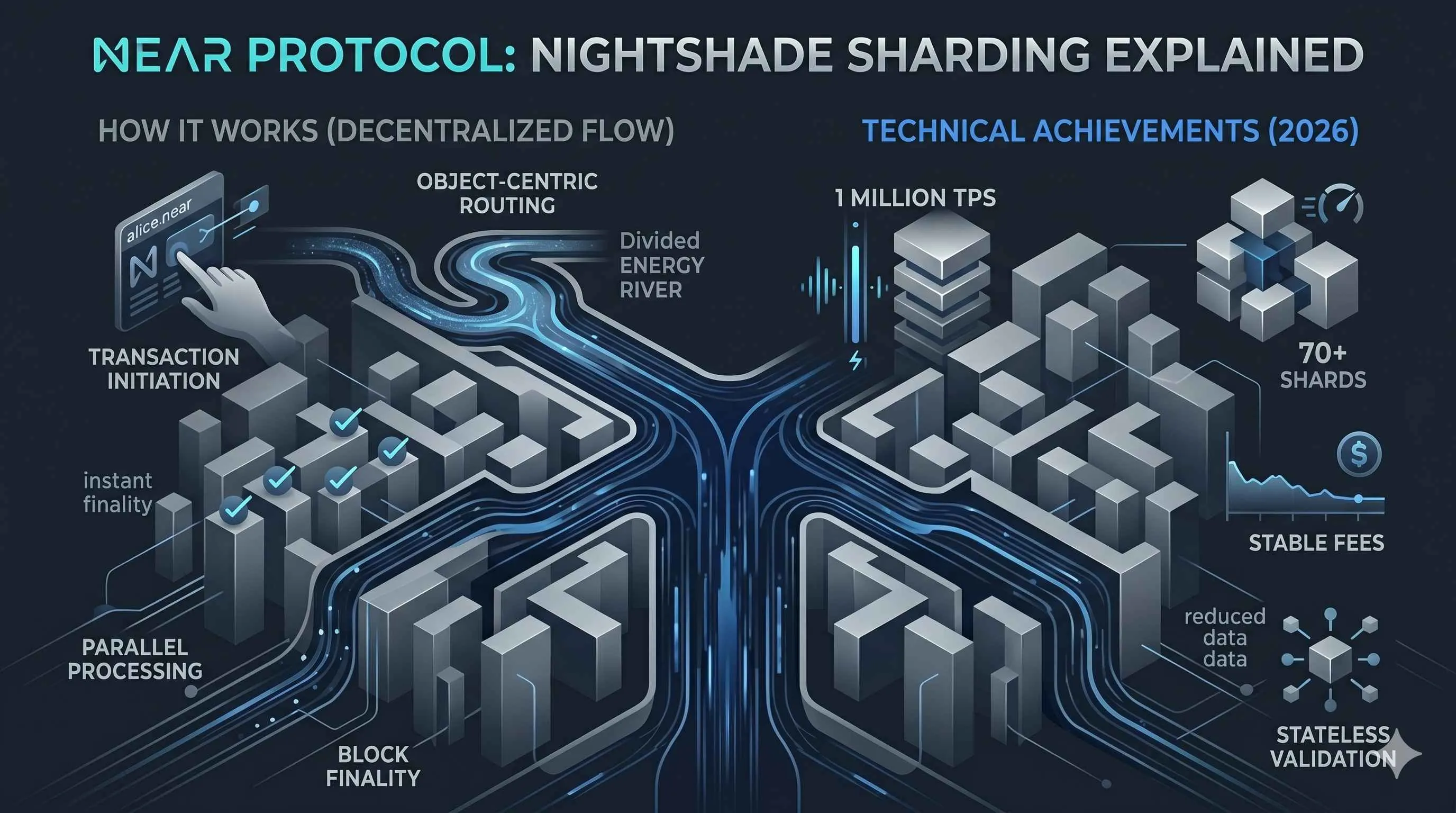
When analyzing what is Near Protocol's biggest advantage, the answer is usually usability. It features human-readable account names (like alice.near) and "Account Abstraction" built directly into its core. This allows for features like social recovery of wallets and gas-free transactions for new users within this blockchain, making it much more accessible than traditional networks.
How Nightshade Sharding Works
To truly grasp how the network operates, you must understand its sharding mechanism, known as Nightshade.
In traditional sharding, the blockchain is split into multiple parallel chains. This system does it differently: it shards individual blocks. Each block is composed of multiple "chunks" provided by different shards, ensuring that the protocol remains synchronized and secure. This unique approach is a key part of the answer when explaining what is Near Protocol to technical investors.
The 2026 Milestone: 1 Million TPS
As of May 2026, NEAR has reached a staggering milestone: 1 million transactions per second (TPS). This was achieved by scaling up to 70 shards on standard commercial hardware. For a DEXTools trader, this means:
Instant Finality: Transactions are confirmed almost as fast as you click the button.
Stable Fees: Even during massive market volatility, gas fees remain negligible across the ecosystem.
Stateless Validation: The Secret to Decentralization
A common critique of high-speed chains is that they require expensive hardware, which leads to centralization. To solve this, the project implemented Stateless Validation in late 2025.
Validators no longer need to download the entire history of the blockchain to verify a new block. This significantly lowers the barrier to entry for running a node, ensuring that as this infrastructure scales, it stays decentralized. When people investigate what is Near Protocol from a node-operator perspective, this feature stands out as a game-changer.
Chain Abstraction and AI Intents
In 2026, the network has evolved into a Unified Commerce Layer.
Through a technology called Chain Signatures, a single account can now sign transactions on Bitcoin, Ethereum, and Solana. This is part of the "Chain Abstraction" vision where you can swap a token on one chain for a token on another without ever leaving the protocol's interface.
Furthermore, this ecosystem has integrated AI Intents. Instead of manually navigating a DEX, you can simply state your "intent" and the network's AI solvers execute it optimally. This shift in user experience is redefining what is Near Protocol in the eyes of the mainstream public.
The NEAR Token: Staking and Utility
The native token is the lifeblood of the protocol. Its primary roles include:
Staking: Holders can delegate their assets to validators to earn passive rewards (the current PoS yield).
Transaction Fees: Used to pay for computation and storage within the network.
Governance: Empowering the community to vote on upgrades via the "House of Stake."
On DEXTools, you can monitor the NEAR/USDT pair to gauge the overall health of the ecosystem before diving into native DeFi protocols.
Determining what is Near Protocol in today's market means looking beyond just another fast blockchain. It is a technological stack built for "real-world scale," combining the security of sharded PoS with the simplicity of the modern web. As we move further into 2026, the protocol's ability to bridge the gap between different blockchains makes it a cornerstone of the multi-chain future.
What Is Chain Abstraction: The End of Bridging in CryptoWhat is Aptos? Move L1 vs Sui Compared
L1 and L2 Ecosystems 2026: Solana, BNB, Ethereum, and Base
Ethereum Market Trends 2026: Pectra & ETF Staking Guide
Crypto Market Trends 2026: AI Agents & Layer 3 Revolution
Disclaimer: This article is for informational purposes only and does not constitute investment advice, financial advice, trading advice, or any other kind of advice. DEXTools does not recommend buying, selling, or holding any cryptocurrency or token. Users should conduct their own research and consult with a qualified financial advisor before making any investment decisions. Cryptocurrency investments are volatile and high-risk. DEXTools is not responsible for any losses incurred.
Related Guides
- NEAR Chain Abstraction Explained: Nightshade, Signatures and AI Infra (2026)
- How Blockchain Sharding Works: Parallelization, Throughput and Design Tradeoffs (2026)
- TON Architecture Explained: Masterchain, Workchains and Sharding (2026)
- 5 Best AI Crypto Tokens 2026: Bittensor, Render, NEAR + 2 More
- NEAR vs Solana: Layer 1 Blockchains Compared (2026)
- What Is Story Protocol (IP)? Programmable Intellectual Prope
Frequently Asked Questions
What is NEAR Protocol?
NEAR Protocol is a Layer 1 blockchain designed with a focus on usability and scalability. It aims to make building and using decentralized applications more accessible to developers and everyday users.
What is Nightshade sharding?
Nightshade is NEAR's approach to sharding, which splits the network's work so transactions can be processed in parallel. The goal is to scale throughput while keeping the network secure as activity grows.
What is the NEAR token used for?
The NEAR token is used to pay transaction fees, stake for network security, and participate in governance. It is the core asset that powers activity on the network.
Why is NEAR considered beginner friendly?
NEAR emphasizes human-readable account names and a smoother onboarding experience compared with some older networks. These design choices aim to lower the barrier for new users and developers.