What Is Propy (PRO)? The Blockchain Real Estate Transaction Platform Explained in 2026
— By Tony Rabbit in Tutorials
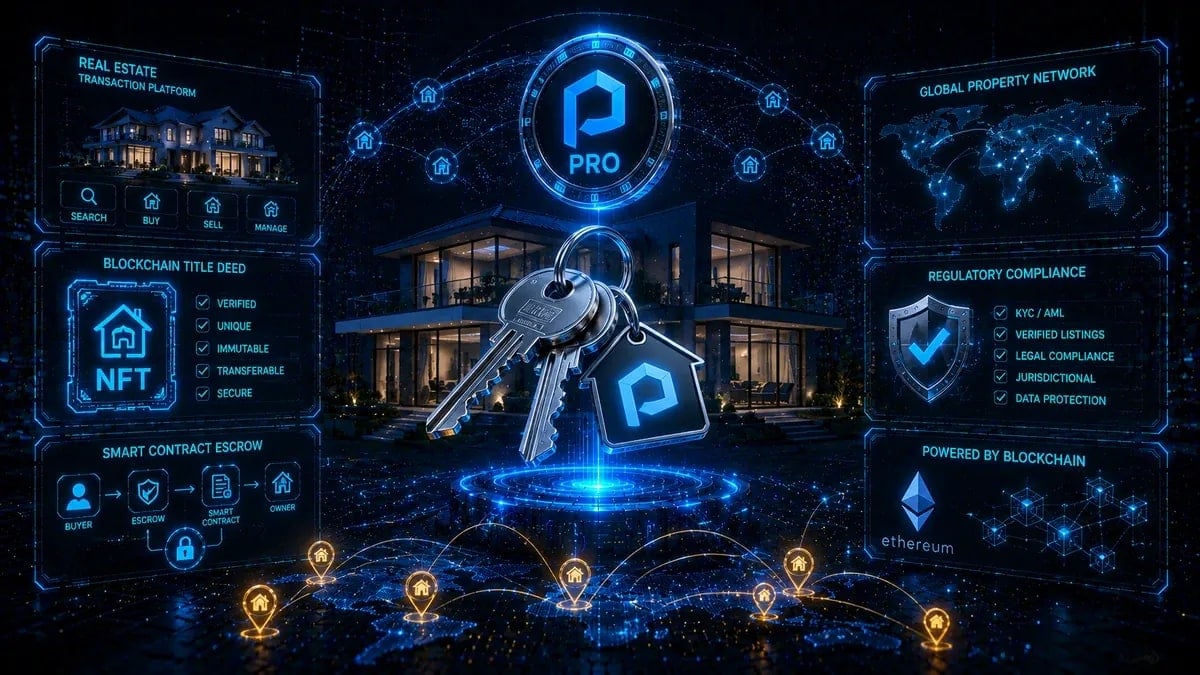
Propy is the production tested blockchain real estate platform founded by Natalia Karayaneva in 2017 that powers end to end home buying with NFT title deeds, smart contract escrow, an AI Agent for transactions, Bitcoin payment options, and licensed title company partnerships in all fifty US states.
What Is Propy (PRO)? The Blockchain Real Estate Transaction Platform Explained in 2026
Buying a house in the United States in 2026 still feels like running a marathon designed by lawyers. Forty five days of escrow on average, twelve to fifteen different counterparties between buyer and seller, a wet ink signature on a stack of paper an inch thick, and a final closing meeting where someone hands you a key. The friction is so deeply baked into the industry that most people forget there could be another way. Propy was built to remind them, and in 2026 it stands as the most production tested blockchain real estate platform ever to actually close homes in the real world.
Founded in 2017 by Natalia Karayaneva, a Bulgarian architect turned serial entrepreneur, Propy ran the first ever NFT backed home sale that same year, tokenizing the deed to a Ukrainian apartment and selling it on Ethereum in a transaction recorded by the local government. Eight years later, that single transaction has matured into the Propy Transaction Platform, a full end to end real estate operating system handling title management, smart contract escrow, NFT title deeds, AI Agent assisted paperwork, Bitcoin payment options, and partnerships with title companies across all fifty US states.
This guide explains everything you need to know about Propy in 2026: what it actually does, how blockchain title management works in plain English, how the PRO governance token captures value, what the AI Agent can and cannot automate, how Propy compares with fractional real estate platforms like Lofty and RealT, and the practical risks of buying property through a blockchain platform in a regulated industry. By the end you will understand Propy well enough to evaluate it for your own real estate decisions and to position PRO inside the broader real world assets narrative.
FEATURED SNIPPET
Propy (PRO) is a blockchain based real estate transaction platform founded in 2017 by Natalia Karayaneva that handles end to end home buying through smart contract escrow, NFT title deeds, and an AI Agent that automates paperwork. Propy settles transactions on Ethereum, partners with licensed title companies in all fifty US states, accepts both fiat and Bitcoin payments, and ran the world's first blockchain home sale in 2017. The PRO ERC-20 governance token powers platform fees, staking incentives, and decentralized title registry voting.
What Is Propy in Plain English
Imagine if buying a house felt more like buying a domain name than filing a tax return. That is the shortest honest description of what Propy is building. Under the hood, Propy orchestrates every step of a real estate transaction inside a single workspace, with the legal title represented as a non fungible token on a public blockchain. Buyers, sellers, agents, title officers, notaries, and lenders share the same state, sign documents inside the platform, and watch escrow funds move according to smart contract logic rather than back office spreadsheets.
The other half of Propy is the regulatory plumbing that makes any of this legally meaningful. A blockchain record of property ownership is only useful if a county recorder agrees it counts. Propy has spent the better part of a decade building partnerships with licensed title companies, notaries, and county recorders so transactions completed on its platform produce a legally valid deed under US law. The blockchain settlement happens on Ethereum, while the integration with the existing real estate system is what makes Propy more than a science experiment. If you are new to the broader idea of putting physical assets on chain, our explainer on what real world assets tokenization is is a useful primer.
It helps to be clear about what Propy is not. Propy is not a fractional investment platform like Lofty or RealT, where many investors buy small shares of a single rental property and collect rental yield. Propy is a transaction platform for entire properties, sold to a single buyer who actually owns the home. The asset is the whole house, not a fraction. That distinction shapes how the platform is regulated, who its customers are, and where the PRO token derives value.
The Real Estate Transaction Problem Propy Solves
To understand why Propy exists you have to understand how inefficient a normal home purchase is. The median US residential transaction in 2026 still takes between thirty and sixty days from accepted offer to closed deal. During that window, an army of intermediaries each perform their slice of work in isolation, with stale information, and with documents that get printed, signed, scanned, emailed, and printed again. Title searches, escrow trust accounts, notary visits, lender verifications, inspections, appraisals, and surveys are all coordinated by humans across disconnected systems.
The friction is not just inconvenient. It is genuinely expensive. Combined closing costs regularly run between three and five percent of the purchase price, with title insurance alone consuming roughly one percent. Wire fraud at closing is a multi billion dollar annual problem, with criminals impersonating title companies and tricking buyers into wiring six and seven figure sums into untraceable accounts. Cross border transactions, where a foreign buyer wants to purchase a US property, can take months and tens of thousands of dollars in legal fees just to navigate the documentation.

Propy was conceived as a direct response to that mess. The founding insight was that the entire chain of title, escrow, signature, and disclosure could be represented on a blockchain rather than in a folder full of paper, that smart contracts could replace the manual trust accounts where escrow funds sit, and that non fungible tokens could carry the deed itself as a uniquely identified on chain object. None of that eliminates the lawyers, the title companies, or the county recorders. It simply gives them a shared digital substrate to work on, where the state of every transaction is always current, every document is cryptographically signed, and every fund movement is conditional on the satisfaction of contract terms rather than the discretion of an intermediary.
Natalia Karayaneva and the Founding of Propy
Behind every successful protocol there is usually a stubborn founder who refused to give up, and in Propy that founder is Natalia Karayaneva. Natalia trained as an architect at the University of Oxford and worked in residential development across Europe before stumbling into the cryptocurrency world in 2014. Her path into crypto was not the usual one. She did not come from a trading desk or a cryptography lab. She came from years of watching foreign clients try and fail to buy property in Bulgaria, Spain, and Eastern Europe because the documentation infrastructure simply could not handle a cross border deal in any reasonable amount of time. That frustration led her to ask whether blockchain could provide a shared global title registry that any jurisdiction could plug into.
In 2017 Natalia founded Propy in Palo Alto, raised an initial round through a token sale that introduced PRO, and shipped a working product within months. The first deal Propy closed was the on chain sale of a TechCrunch Disrupt journalist's apartment in Kyiv, recorded both on Ethereum and at the local Ukrainian land registry. That single transaction made Propy the company that ran the first blockchain backed home sale in history. The Ukrainian government later integrated parts of the Propy approach into its national land registry pilot.
Since then, Natalia has stayed at the helm as CEO. The team has grown to include engineers, real estate attorneys, former title industry executives, and a research group focused on AI assisted transaction automation. The company raised follow on funding from Tim Draper and other crypto native investors, and slowly accumulated the title company partnerships, notary integrations, and county recorder relationships necessary to handle a real US closing. The decision to operate as a regulated business rather than a pure protocol experiment slowed product velocity, but it is the reason Propy is still standing while flashier real estate crypto projects from the same era have quietly disappeared.
A Timeline of Propy, 2017 to 2026
Natalia Karayaneva founds Propy in Palo Alto and raises an initial round through a PRO token sale. Within months the company closes the world's first blockchain backed home sale, transferring a Kyiv apartment between buyer and seller through an Ethereum smart contract that mirrors a notarized deed at the Ukrainian land registry.
Propy expands into the US market, opens California operations, and pilots blockchain backed escrow with select brokerages. The company partners with the South Burlington, Vermont city government for a pilot land registry on chain, one of the first US municipal experiments with public blockchain property records.
During the NFT boom, Propy formally launches its NFT title deed product, allowing US homes to be sold as unique tokens on Ethereum. The first US home sold as an NFT is a Gulfport, Florida property closed through Propy. The PRO token receives upgraded utility within the platform around fees, staking, and governance.
Propy partners with Abra to enable mortgages collateralized by NFT title deeds. The platform begins onboarding licensed title companies in additional US states, working toward full national coverage. The first NFT backed home equity loan against a Propy issued title is closed.
Propy integrates Bitcoin payments at closing, allowing buyers to settle directly in BTC while sellers receive USD via a conversion partner. Title company coverage expands to more than thirty US states. Propy launches a transaction insurance product backed by underwriting partners to cover smart contract specific risks.
Propy launches its AI Agent for real estate, a transaction copilot that ingests disclosures, contracts, and inspection reports, surfaces risks, drafts addenda, and walks buyers through closing tasks. The AI Agent dramatically reduces the average time from offer to close on properties handled inside the platform.
Propy crosses the threshold of supporting transactions in every US state through accumulated title company partnerships. The platform also adds cross border buyer flows for international purchasers acquiring US property, with on chain identity verification and stablecoin settlement options.
Propy formally completes its fifty state expansion with title company coverage and AI Agent localization for every US jurisdiction. The PRO token sees renewed activity as platform transaction volume climbs and the broader real world assets narrative pulls institutional attention toward tokenized real estate.
Title Management on Blockchain Explained
Title management is the central function of any real estate transaction. A title is the legal record of who owns a particular parcel of land and any improvements on it. Title management means making sure that record is accurate, that there are no competing claims, and that when ownership transfers, the new record is properly created and recorded with the relevant authority. In the US this work is performed by title companies, who do title searches, issue title insurance, and act as a trusted intermediary between buyer, seller, and the county recorder.
Blockchain based title management does not eliminate any of those functions. What it does is move the source of truth into a single cryptographic record on a public chain. Inside Propy, every property is represented as a non fungible token on Ethereum. That NFT contains structured metadata about the property: address, parcel number, legal description, recorded liens, and a cryptographic pointer to the underlying title chain. When the property is sold, the NFT moves from the seller's wallet to the buyer's wallet through a smart contract that simultaneously triggers the off chain recording of the new deed at the county and the release of escrow funds to the seller.
With an on chain title, any participant can independently verify the current owner, the chain of past owners, and the lien status by querying a single canonical contract. The county recorder still exists, the title insurance still exists, but they become consumers and validators of the on chain record rather than the only source of it. For a more technical explanation of how NFTs themselves work as unique digital objects, our guide to what an NFT is covers the underlying primitive in depth, and our explainer on the ERC-721 standard walks through the specific token contract pattern Propy relies on.
The Three Step Blockchain Home Purchase Flow
STEP 1 OFFER AND ESCROW
Buyer submits an offer inside the Propy platform. Once accepted, the buyer deposits earnest money into a smart contract escrow that will release funds to the seller only if every contract condition is satisfied. All parties sign disclosures and offer terms inside the platform.
STEP 2 DILIGENCE AND TITLE
A partner title company conducts the title search and uploads results to the Propy workspace. The AI Agent flags discrepancies, missing disclosures, and contract risks. Inspections, appraisals, and lender approvals are tracked against contract deadlines.
STEP 3 CLOSE AND RECORD
On the closing date, the smart contract releases funds to the seller, the NFT title deed transfers to the buyer, and the partner title company files the corresponding paper deed with the county recorder. The on chain record and the county record now agree.
The most important property of this flow is atomicity. In a traditional transaction, the steps that legally transfer ownership and the steps that move money are coordinated by humans across multiple systems. In a Propy transaction, the critical events at closing happen inside a single smart contract execution. Either everything completes or nothing does. The escrow is the contract, and the contract enforces itself.
The Propy AI Agent for Real Estate Transactions
In 2024 Propy launched what is now its most visible product: the AI Agent for real estate transactions. A residential closing involves more reading than most retail buyers have done in years. Purchase agreements, disclosures, inspection reports, title commitments, loan documents, HOA bylaws, and county specific addenda can easily run to hundreds of pages of dense legal prose. The AI Agent reads all of it, summarizes contents in plain English, flags clauses that deviate from market norms, drafts addenda when issues arise, and walks the buyer through the chronological sequence of decisions before closing.
The Agent is not a lawyer, and Propy positions it as a copilot rather than a replacement for licensed professionals. What it does is dramatically lower the cognitive cost of being an informed party to a transaction. A buyer who would previously have skimmed disclosures now has a personal analyst that catches things their agent would have missed. A real estate attorney can use the Agent to triage drafts and focus billable hours on the genuinely contested clauses.

The AI Agent is also where Propy's bet on full stack ownership of the transaction pays off. A platform that hosts contracts, manages the smart contract escrow, holds the NFT title, and integrates with title company partners has access to every piece of context needed to give intelligent advice. Each transaction the Agent helps complete becomes training data for the next. Over time, that compounding feedback loop is what could turn Propy into the operating system for residential real estate rather than just another listing site.
Buying a House with Bitcoin on Propy
One of the more talked about Propy features in recent years is Bitcoin payment at closing. The basic flow is straightforward. A buyer who holds significant wealth in BTC and wants to convert it into real estate without first selling for taxable fiat can deposit Bitcoin into a Propy partner conversion service at closing. The BTC is sold for US dollars at the closing exchange rate, the dollars settle into the escrow, and the seller receives the funds in their preferred currency. The buyer never holds the dollars, only the property. For BTC native buyers, this collapses what would otherwise be two separate friction filled transactions, the sale of Bitcoin and the purchase of the house, into a single coordinated event.
In most US jurisdictions, selling Bitcoin is a taxable event whether or not the proceeds are immediately spent. Using Propy's BTC payment option does not avoid that tax, but it eliminates the timing risk buyers face when they sell BTC in advance and then watch the price move before they can deploy proceeds into a house. It also avoids the operational hassles of wiring large fiat sums between exchanges, banks, and title companies.
Sellers are generally indifferent to whether the buyer paid in BTC or fiat, because they always receive fiat. Propy is not trying to force sellers to accept volatile crypto. It is lowering friction for buyers who already hold crypto wealth and want to convert it into real estate without leaving the platform. As stablecoin adoption deepens, expect similar flows for USDC and USDT to become standard. Our deeper coverage of DeFi infrastructure explains the broader stablecoin ecosystem these flows depend on.
The PRO Token, Tokenomics, and Utility
The PRO token is an ERC-20 asset originally distributed in the 2017 Propy token sale, with a fixed maximum supply of one hundred million tokens. PRO sits inside the Propy ecosystem as the asset that captures platform usage and governance over certain decentralized registry functions. Holders can stake PRO to validate certain on chain transactions and participate in title registry governance, can pay platform fees with discounted PRO denominated pricing, and can vote on proposals related to title NFT issuance standards and platform configuration.
The token is intentionally not a security claim on Propy company revenue or equity. Propy the company is a regulated US business that operates in a heavily licensed industry, and the PRO token was structured to be a utility asset for the protocol layer rather than a direct claim on enterprise cashflows. That distinction is important for both legal and conceptual reasons. PRO captures value to the extent that the protocol layer of Propy, the smart contracts that manage NFT title deeds and decentralized registry operations, is used. The off chain title company services, the AI Agent platform, and other software products are revenue streams of the Propy company that may or may not flow into the token.
A frank assessment is that PRO has historically traded as much on broader real world assets narratives as on Propy protocol metrics specifically. When tokenized real estate is in the news, PRO tends to outperform. When the broader RWA category is quiet, PRO tends to trade with low conviction. For long term holders, the most important question is whether actual real estate transaction volume on Propy compounds to the point where token level utility becomes the dominant pricing input. Investors should focus less on raw market cap and more on whether protocol level usage of NFT title deeds, registry operations, and staking grows over time.
The Title Company Partnership Network Across Fifty States
The least glamorous and most important part of the Propy story is the partnership network. Real estate is a state by state regulated industry in the United States. Each state has its own title insurance requirements, its own notarization rules, its own county recording standards, and its own consumer protection statutes. A platform that wants to actually close transactions everywhere has to either become a licensed title company in every state, which is operationally enormous, or partner with licensed title companies in every state, which is a years long business development project. Propy has taken the partnership path, and by 2026 has accumulated working relationships with title underwriters and title agencies covering all fifty US states.
What this means in practice is that a buyer using Propy to purchase a property in any US state will be matched with a licensed title company in that state, which performs the title search, issues title insurance, handles the county recording, and signs off on the legal validity of the closing. The Propy platform provides the workflow, the smart contract escrow, the NFT title deed, and the AI Agent. The licensed title company provides the regulatory legitimacy that turns the on chain record into a legally enforceable deed under that state's law. Both pieces are required. Without the platform, the deal is a paper deal. Without the partner, the deal is a science experiment.
This hybrid architecture is the strongest evidence that Propy understands the industry it is trying to disrupt. Real estate cannot be unbundled the way music or finance has been, because the asset is bolted to a particular county recorder's filing system that the local government legally controls. Propy's bet is that product market fit is in dramatically improving the existing system, not replacing it from the outside.
Propy vs Lofty vs RealT vs Traditional Title Companies
Propy does not exist in a vacuum. There is a small but interesting ecosystem of blockchain real estate platforms, each with different approaches, different threat models, and different target users. Understanding where Propy sits on this map is essential for any serious user or investor.

Propy vs Lofty
Lofty is the most prominent fractional residential real estate platform in crypto, and it deserves to be understood as a fundamentally different product from Propy. Lofty tokenizes individual rental properties, sells fractional ownership tokens on the Algorand blockchain, and distributes rental yield to token holders. A Lofty buyer is not buying a house to live in. They are buying a financial claim on a slice of someone else's house, with the operational management of the property handled by Lofty and its partners. Our deeper dive into Lofty real estate tokenization on Algorand covers that platform in detail. The simplest framing is that Lofty is an investment platform that turns rental real estate into a yield bearing on chain asset, while Propy is a transaction platform that helps a single buyer actually acquire and own a property end to end. Both can be valuable. They simply solve different problems for different people.
Propy vs RealT
RealT operates on a similar fractional ownership model to Lofty, primarily on Ethereum and Gnosis Chain, with a focus on US single family rental properties tokenized into securities offerings under Regulation D. RealT buyers receive token representations of LLC ownership claims to specific houses and collect rental income proportional to their holdings. Like Lofty, RealT is a yield investment platform, not a transaction platform. Comparing RealT to Propy is comparing a tokenized REIT to a brokerage workspace. They share the word real estate but they live in different parts of the value chain.
Propy vs Traditional Title Companies
The real competitive comparison for Propy is the traditional title company stack: Fidelity National, First American, Old Republic, Stewart Title, and the thousands of independent agents that handle the bulk of US residential transactions today. These incumbents have enormous scale and entrenched relationships, but operate on document workflows barely different from 1990. Propy's pitch is not to replace them but to provide a software layer on top of their legal services that compresses time, reduces fraud risk, and adds value through the AI Agent and on chain records. If the pitch lands, title companies become long term partners and the platform becomes the workspace they all use.
Propy vs Centrifuge and Mantra
In the broader real world assets category there are several adjacent projects worth distinguishing. Centrifuge focuses on tokenizing private credit pools backed by invoices, real estate loans, and other off chain receivables. Mantra is building a dedicated layer one for RWA issuance and compliance. Neither is a direct competitor to Propy because they do not handle the actual closing of a residential property purchase. Propy lives at a much more specific layer of the stack, the workflow and title management of an individual home sale, and is one of the only projects in crypto that has consistently pursued that vertical.
Risks and Open Challenges
No honest article about Propy can omit the risks, and there are several that any prospective user or PRO token holder should weigh seriously before committing meaningful time or capital.
Jurisdictional fragmentation is the largest structural risk. The United States has more than three thousand counties, each of which maintains its own land records under rules that vary by state. While Propy has built relationships in all fifty states, each new property type, each new county nuance, and each new state level regulatory shift can introduce friction. International expansion compounds this problem. The legal framework for representing property ownership on a blockchain ranges from supportive in places like Wyoming, Switzerland, and parts of the United Arab Emirates to ambiguous or hostile elsewhere. Propy has to navigate that patchwork transaction by transaction, and the cost of doing so is the price of operating in a heavily regulated industry.
Smart contract risk is real. The contracts that manage NFT title deeds and escrow funds are written in Solidity and subject to the same categories of vulnerabilities that have caused losses elsewhere in DeFi. Propy has invested in audits and conservative upgrade procedures, but no system is immune to bugs. The good news is that even in a worst case smart contract failure, the off chain legal recording with the partner title company provides a backstop.
Token concentration and liquidity risk apply to PRO specifically. The token has a relatively small total market capitalization with liquidity concentrated on a handful of exchanges. Large buys and sells can move the price significantly, and PRO will continue to trade with the volatility characteristic of mid cap crypto assets in the short term.
User error and counterparty risk are the most common in practice. The broader landscape of phishing, wire fraud, address poisoning, and social engineering attacks applies just as forcefully on a blockchain platform as on a traditional one. The fact that escrow funds are held in a smart contract does not protect a buyer who sends funds to a fake Propy address controlled by a scammer. Our guide to avoiding crypto address poisoning scams is mandatory reading before initiating any meaningful on chain transaction.
Pros and Cons at a Glance
PROS
- First and most production tested blockchain real estate platform
- End to end home transaction workflow inside a single workspace
- NFT title deeds and smart contract escrow add atomicity and transparency
- AI Agent dramatically reduces buyer cognitive load and time to close
- Bitcoin payment option simplifies BTC native to property conversion
- Partnerships with licensed title companies in all fifty US states
- Natalia Karayaneva and team have eight years of regulated industry experience
- Settlement on Ethereum provides credible long term security
CONS
- Still depends on traditional title companies and county recorders
- PRO token utility historically tied more to narrative than protocol metrics
- Mid cap token with limited liquidity outside major exchanges
- Smart contract risk applies despite audits and conservative procedures
- Jurisdictional fragmentation slows international expansion
- Not a fractional investment platform, will not produce rental yield
- Real estate transactions remain inherently slow versus pure DeFi flows
- Competition from incumbent title companies and from fractional platforms
Best Practices for Blockchain Home Buyers
If you decide to actually use Propy to buy or sell a property rather than just hold PRO as a financial asset, the following practices will dramatically improve your experience and reduce the chance of an avoidable problem.
First, verify the Propy domain and the specific partner title company assigned to your transaction before sending funds. Real estate is the single most common target for wire fraud in 2026. Use bookmarks rather than email links, confirm wallet addresses through multiple channels, and treat any urgent change of payment instructions as a red flag until verified out of band.
Second, treat the AI Agent as a copilot rather than an oracle. Read its summaries, follow its flags, but do not skip document review or replace consultation with a licensed real estate attorney for any non trivial issue. Use the Agent to identify which clauses warrant human attention and then use a human professional to resolve them.
Third, understand the off chain legal record alongside the on chain one. Even after a successful Propy closing, your property is legally yours because a deed has been filed with the county recorder, not because a token sits in your wallet. Verify the county recording after closing and obtain a recorded copy of the deed for your records. The on chain NFT is a useful convenience and a powerful verification primitive, not the sole source of legal truth.
Fourth, secure the wallet that holds your NFT title deed with the same seriousness as a safe deposit box holding a paper deed. Use a hardware wallet, back up your seed phrase offline, and consider multisig if the property value is substantial. Fifth, if you are an international buyer using Bitcoin or stablecoin settlement, work with a tax advisor familiar with both the crypto disposition and the cross border real estate purchase, because the interaction of those domains generates issues neither a generalist crypto accountant nor a generalist real estate lawyer will catch on their own.
Frequently Asked Questions
What is Propy?
Propy is a blockchain based real estate transaction platform founded in 2017 by Natalia Karayaneva that handles end to end home buying through smart contract escrow, NFT title deeds on Ethereum, an AI Agent for transaction automation, and partnerships with licensed title companies in all fifty US states.
How does blockchain title management work?
Each property is represented as a unique non fungible token on Ethereum with structured metadata about address, parcel number, and chain of title. When the property is sold, the NFT transfers to the buyer through a smart contract while a partner title company files the corresponding paper deed with the county recorder, keeping the on chain and off chain records synchronized.
Can I buy a house with Bitcoin on Propy?
Yes. Propy supports BTC payment at closing through a conversion partner that sells the Bitcoin and settles US dollars into the smart contract escrow. The seller receives fiat in the normal way, while the buyer never has to manage a separate BTC to USD conversion outside the platform.
What is the PRO token used for?
PRO is the ERC-20 utility and governance token of the Propy ecosystem. It is used for staking that supports NFT title validation, for paying certain platform and protocol fees with PRO denominated pricing, and for governance votes on title registry parameters and protocol upgrades.
Who founded Propy?
Propy was founded in 2017 by Natalia Karayaneva, a Bulgarian architect and serial entrepreneur trained at Oxford. Natalia continues to serve as CEO. The company is headquartered in Palo Alto, California, and has raised funding from Tim Draper and other crypto native investors.
What is the AI Agent feature?
The Propy AI Agent is a transaction copilot launched in 2024 that ingests every document in a deal, summarizes contents in plain English, flags risk clauses, drafts addenda, and walks buyers through the chronological sequence of closing decisions. It is positioned as an assistant to licensed professionals rather than a replacement for them.
How is Propy different from Lofty?
Lofty is a fractional investment platform that lets multiple investors buy small ownership shares of a single rental property on Algorand and collect rental yield. Propy is a transaction platform for entire properties acquired by a single buyer for full ownership. Both are blockchain real estate plays, but they solve fundamentally different problems for different users.
Is Propy available outside the US?
Propy has handled transactions in several countries including Ukraine, where it ran the first ever blockchain home sale in 2017, and parts of Europe. The strongest current coverage is in the United States, where Propy has partnerships in all fifty states. International expansion continues to be a long term focus but is gated by jurisdictional legal frameworks.
What states does Propy operate in?
As of 2026 Propy has accumulated title company partnerships covering all fifty US states, with progressively deeper integration in jurisdictions like Florida, Texas, California, Arizona, and Vermont that have been early adopters. Coverage at the county level continues to expand alongside the partnership network.
Where can I buy PRO?
PRO is listed on multiple centralized exchanges including Binance, KuCoin, Gate, and others, as well as on Ethereum decentralized exchanges like Uniswap. Liquidity varies across venues, so larger orders should be split across markets and routed carefully. Our guide to how to use DEXTools walks through how to monitor PRO liquidity and price action across DEX venues in real time.
What are the main risks?
The largest risks are jurisdictional fragmentation across US states and international markets, smart contract vulnerabilities in the NFT title and escrow contracts, token liquidity and concentration risk in PRO specifically, and the user error patterns of phishing, wire fraud, and address poisoning that target any high value real estate transaction regardless of platform.
How much does Propy charge for transactions?
Propy charges a platform fee for transactions handled through its workspace, with exact amounts depending on transaction type, jurisdiction, and the level of AI Agent support requested. The partner title company charges its own customary title insurance and closing fees on top, which vary by state. Total closing costs through Propy are generally competitive with or below traditional alternatives once the time savings are factored in.
The Bottom Line on Propy
Propy entered 2017 as an audacious thesis that the world's largest asset class could be brought on chain without breaking the legal infrastructure that makes property ownership meaningful, and in 2026 it stands as the most production tested blockchain real estate platform ever to actually close homes in the United States. Its NFT title deeds, smart contract escrow, AI Agent, and Bitcoin payment options provide a workspace for residential transactions that is measurably better than the paper based status quo. Its partnership network with licensed title companies in all fifty US states is the unglamorous backbone that turns the on chain record into a legally enforceable deed. Natalia Karayaneva has stayed at the helm through three crypto winters and built the company in the slow, regulated, partnership intensive way the industry rewards.
The road ahead is not without obstacles. Real estate remains a state by state regulated industry, and every new jurisdiction is its own integration project. PRO's value capture is structurally tied to protocol level usage of NFT title issuance rather than to enterprise revenue. Competition from incumbent title companies, from fractional platforms like Lofty, and from adjacent RWA infrastructure like Centrifuge will continue to apply pressure. Yet the patient compounding of fifty state partnership coverage and protocol level usage of NFT title deeds suggests Propy is positioning itself to be the operating system for residential real estate.
Whether you are a buyer evaluating Propy for your next home purchase, a seller curious whether the platform can shorten your time to close, a foreign investor with crypto wealth, or a PRO token holder thinking about long term positioning, the project deserves serious attention. Real estate on blockchain has been a promise since 2014, and Propy turned that promise into closed deals and a working AI Agent. That, more than any price chart, is the lasting accomplishment of Propy.
Related Guides
- What Is Lofty AI? Fractional Real Estate Tokenization on Algorand Explained in 2026
- How to Use Parcl in 2026: Real Estate Perps Guide
- What Is IoTeX (IOTX)? Modular DePIN Platform for IoT + AI Explained in 2026
- Fee Payer Growth vs Transaction Count: Which Better Shows Real Network Adoption?
- What Are Gas Fees: Complete Guide to Blockchain Transaction Costs (2026)