What Is Lofty AI? Fractional Real Estate Tokenization on Algorand Explained in 2026
— By Tony Rabbit in Tutorials
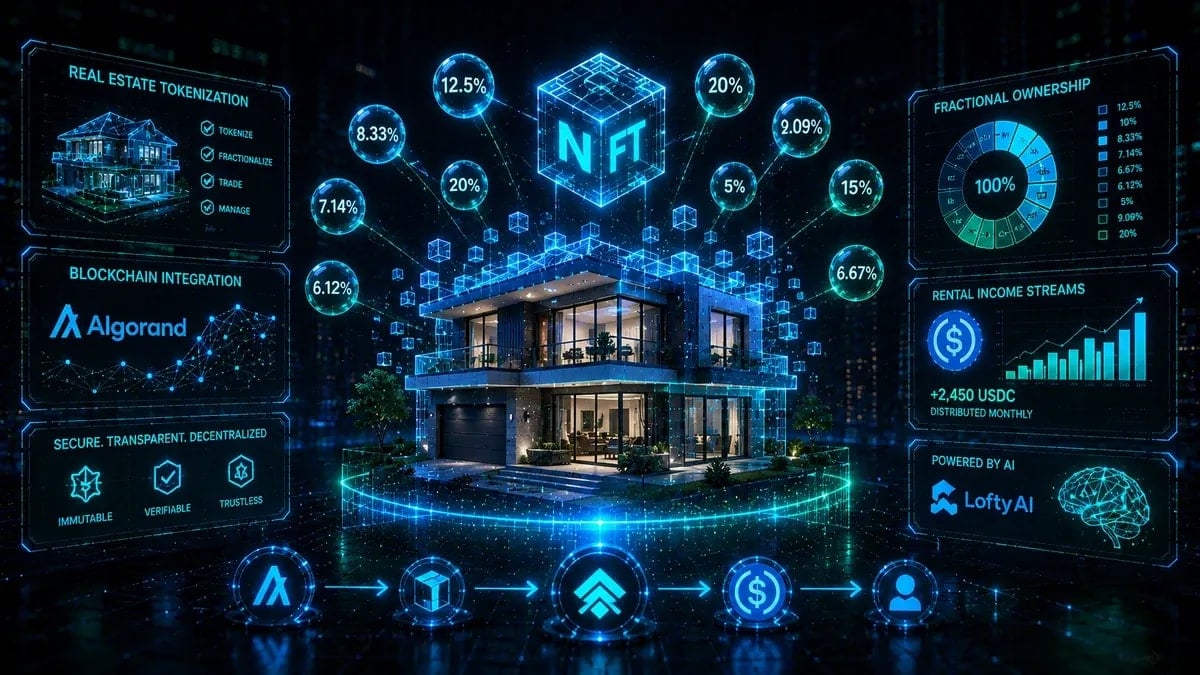
Complete 2026 guide to Lofty AI, the Algorand based real estate tokenization platform from Max Ball and Jerry Chu. Learn how fractional ownership of US single-family rentals works through ASA tokens, why daily stablecoin rental income changes the game, how the AI property selection algorithm filters listings, and how Lofty compares with RealT, Propy, Backed.fi, and Centrifuge. Step by step on buying a property share from fifty dollars, governance, regulatory framework, risks, and best practices for international investors.
What Is Lofty AI? Fractional Real Estate Tokenization on Algorand Explained in 2026
Owning a piece of an American single-family rental used to be a closed game. You needed a down payment large enough to scare a junior banker, a mortgage broker willing to underwrite your income, and the patience to wait years for the property to appreciate. The asset class is famously stable and famously inaccessible to anyone who is not already wealthy or who does not live within driving distance of the property in question.
Lofty AI was built to break that gate. Launched in 2018 and now running on the Algorand blockchain, Lofty tokenises individual rental properties in the United States, splits each one into thousands of low denomination shares represented as Algorand Standard Asset tokens, and lets anyone with fifty dollars and an internet connection buy a fractional stake in a real house that pays out rental income every single day.
This guide explains, in plain language, what Lofty AI is, how the Algorand token architecture works, how daily rent flows from tenant to token holder, why Coinbase Ventures led the early money in, and how Lofty compares with RealT, Propy, Backed, and Centrifuge. You will also see exactly how to buy a property share end to end and where Lofty fits inside the broader real world asset tokenisation wave.
Featured Snippet
Lofty AI is a real estate tokenisation platform that fractionalises United States single-family rental properties into Algorand Standard Asset tokens, allowing anyone to buy a share of a real income generating home from fifty dollars and receive a proportional cut of the daily rental income directly to their wallet. Each property is owned by a dedicated legal entity, governance for that property is exercised by the people who hold its tokens, and investments below fifty thousand dollars per property do not require accredited investor status under the regulatory framework Lofty uses.
What Is Lofty AI in Plain English
Picture a normal American rental house. Three bedrooms, two bathrooms, a tenant paying around fifteen hundred dollars a month, and a property manager handling day to day operations. Traditionally one investor or one family owns the house, the mortgage and equity sit on a single balance sheet, and rent flows monthly to a single bank account.
Now imagine the same house is owned by a Delaware limited liability company, the LLC has issued ten thousand digital shares, those shares live as tokens on a fast and cheap blockchain, and anyone in the world can buy as few or as many of them as they want. Rent still arrives monthly from the same tenant. But instead of going into one account, it is converted into stablecoin, streamed out every day to all ten thousand share holders in proportion to how many tokens they own, and made visible on a public ledger that nobody controls unilaterally.
That is Lofty AI. The company sources properties using an internal selection algorithm, structures each one inside a single purpose LLC, lists the LLC shares as Algorand Standard Asset tokens on its marketplace, manages the property operationally through partner property managers on the ground, distributes rental income through stablecoin streams, and lets owners trade their shares with each other on the Lofty marketplace.
The result is a hybrid system that fuses traditional real estate to a public blockchain that does the heavy lifting on ownership tracking, share transfers, and cash distributions. Most tokenisation projects either tokenise something nobody actually wants to own, or hide so much behind a custodian that the blockchain does almost no work. Lofty tokenises an asset that millions of people already want exposure to, and pushes ownership and payouts down to a level where the blockchain genuinely matters.
The Vision: Why Tokenise American Single-Family Rentals
The United States residential rental market is enormous. There are around fifteen million single-family rental homes in America, with a combined value in the trillions and generating tens of billions in annual rental cash flow. Returns are famously steady and the asset class has historically outperformed inflation over multi decade horizons.
And yet it is almost completely closed to outside capital at the individual level. Public REITs give indirect exposure but are diluted and disconnected from any specific property. Private rental funds require accredited investor status, large minimum tickets, multi year lockups, and high management fees. Direct ownership requires capital that prices out the vast majority of households.
Lofty's thesis is that this gap can be closed using a public blockchain. By splitting each property into thousands of small tokens, by using stablecoin rails for income distribution, and by leaning on Algorand's low fees and instant finality, the company offers something no traditional structure has. A retail investor in Madrid, Manila, or Mumbai can hold a verified, governed, income producing slice of a real American house, sized at whatever fraction matches their budget, with daily payouts and a secondary market.
The broader bet sits inside the larger decentralised finance conversation about what kinds of assets ultimately migrate onto public chains. Residential property has historically been treated as too messy, too legally local, and too operationally heavy. Lofty's wager is that the messy parts can be productised once and reused at scale.
The Founders: Max Ball and Jerry Chu
Lofty AI was founded by Max Ball and Jerry Chu, two operators with backgrounds that line up unusually well with the problem. Max Ball comes from real estate, with years of practitioner level experience in single-family rental investing. Jerry Chu came at the same opportunity from technology, with a focus on machine learning and product engineering.
The early version of Lofty was less a tokenisation company and more an AI tool for real estate investors. The original product helped users identify undervalued rental properties using a machine learning model that crunched local market data, school district scores, and employment trends. That early phase produced the AI in the name and gave the team a deep, evidence based view of which properties actually generate sustainable rental cash flow.
That experience became the foundation for the tokenisation pivot. The same selection algorithm that had been advising independent investors became the engine for curating properties to put on the platform itself. Instead of telling other people which houses to buy, Lofty started buying them in single purpose LLCs and selling tokenised shares directly.
Both founders remain central. Max Ball drives the real estate side, sourcing partner property managers and structuring deals. Jerry Chu drives the technology and product, including the integration with Algorand, the on-chain governance system, and the continuous improvement of the underwriting model.
Coinbase Ventures and the Investor Backing
Lofty raised institutional capital from a roster that signals serious belief in the model. Coinbase Ventures, the investment arm of the largest publicly listed crypto exchange in the United States, led early rounds and brought the credibility that real world asset projects often struggle to earn. That stamp matters because it telegraphs to other investors, to institutional partners, and to regulators that the project has been informally vetted by one of the most cautious balance sheets in the sector.
Beyond Coinbase Ventures, additional investors include real estate focused venture funds, proptech and fintech angels, and crypto native funds with explicit theses on tokenising physical assets. The mix of crypto and real estate capital matters. A purely crypto cap table would have struggled to navigate the operational realities of American residential property. A purely real estate cap table would have struggled to ship a credible blockchain product.
Funding has gone into three buckets: product engineering for the marketplace and stablecoin payouts, real estate operations covering legal scaffolding and the property manager network, and regulatory compliance work that allows the platform to operate at all under the United States securities framework.
Lofty AI Timeline: From AI Real Estate Tool to Algorand Marketplace
Lofty AI founded by Max Ball and Jerry Chu in San Francisco. The original product is an AI driven tool that scores single-family rental properties for independent investors using a machine learning model fed by local market data.
Internal pivot begins. The team starts experimenting with putting actual ownership of individual properties on chain, exploring different blockchain options and legal structures that could support fractional ownership without violating United States securities law.
Algorand selected as the settlement layer. The combination of sub-second finality, low transaction fees, the Algorand Standard Asset framework, and a friendly regulatory posture in the United States makes it the natural fit for residential property tokenisation.
Marketplace launches publicly. The first tokenised properties go live, each represented by ten thousand ASA tokens at fifty dollars per token, with stablecoin rental distributions paid out daily to wallet addresses holding the shares.
Coinbase Ventures leads an early funding round, validating the company within the crypto venture ecosystem and opening doors to follow on capital. Additional investors from real estate and proptech round out the cap table.
Per property governance rolls out. Token holders for each property are given the ability to vote on operational decisions like major repairs, refinancing, and the eventual decision to sell the underlying home and distribute proceeds.
Property catalogue crosses one hundred listings, the secondary market deepens with consistent intraday trading on a meaningful subset of properties, and international users from dozens of countries are onboarded through compliant flows.
The platform passes two hundred tokenised properties across multiple American states, with cumulative rental distributions running into the millions of dollars and the property selection algorithm continuously refined using performance data from the live portfolio.
Lofty operates as one of the largest tokenised residential real estate platforms in the world, with deepening secondary market liquidity, additional property types under exploration, and ongoing integration into the wider Algorand and real world asset ecosystems.

Algorand ASA Architecture: How a House Becomes a Token
The technical heart of Lofty is the Algorand Standard Asset framework. The ASA is Algorand's native token primitive, comparable to ERC-20 on Ethereum but baked directly into the protocol rather than implemented through smart contracts. ASA transfers settle in under three seconds with hard finality, and the per transaction fee is a fraction of a cent. For a use case involving thousands of daily micro distributions to thousands of small wallets, those properties are load bearing.
When Lofty onboards a property, the workflow follows a consistent pattern. A dedicated Delaware LLC is incorporated specifically for that house. The LLC takes legal title to the property under state law. Lofty then creates a unique ASA on Algorand for the LLC, mints a fixed supply of tokens, and registers the link between the on-chain asset and the off-chain legal vehicle. Most properties are split into ten thousand tokens.
From the buyer's perspective the experience is straightforward. They fund the account, browse the marketplace, choose a property, pick a number of tokens, and pay through stablecoin or a card and bank rail that converts behind the scenes. The corresponding ASA tokens land directly in the user's Algorand wallet, either a custodial wallet managed inside the app or an external self custody wallet.
The Algorand selection is itself a serious technical decision. The chain has been promoted heavily as a real world asset friendly layer because of its predictable performance and formal regulatory engagement. Anyone evaluating the broader Algorand thesis can read our deep dive on Algorand as a Layer 1 blockchain.
How Daily Rental Income Actually Flows
One of the features that separates Lofty from almost every other tokenised real estate platform is the cadence of distributions. Most rental funds pay quarterly. Early tokenised property experiments paid monthly. Lofty pays daily, and understanding the mechanism explains a lot about how the platform creates value for token holders.
When a tenant pays rent, the payment lands in a bank account controlled by the property's LLC. The platform allocates a portion to operating reserves, maintenance pools, property management fees, insurance, and taxes. What remains is the net rental income owed to token holders. Instead of holding that net income until the end of the month, Lofty converts it into stablecoin on a continuous basis and streams it out to wallet addresses in daily increments.
For a token holder, the practical experience is a small stablecoin payment landing in the wallet every day, sized in proportion to tokens held and the net rental performance of the underlying house. The amounts are small per day but accumulate into yields that typically range in the high single digits annualised as a percentage of the original token price, before any consideration of capital appreciation.
The benefits go beyond aesthetics. Daily distributions tighten the feedback loop between operational performance and investor experience. A holder notices very quickly if a property goes vacant. Algorand stablecoin rails are cheap enough that per transaction cost is not a deal breaker. The income arrives in a programmable asset that can be reinvested, swapped, or held with no manual intervention. The architecture is genuinely powered by the underlying blockchain, not just decorated by it.
The AI Property Selection Algorithm
The AI in Lofty AI is not a marketing label. The platform applies a machine learning driven selection process to every property considered for tokenisation, and the algorithm has been refined over years of live deployment using actual operational data from properties already on the platform.
At a high level, the algorithm ingests local rental rates, vacancy trends, school district quality, employment dynamics, recent sale comparables, the physical characteristics of the home, expected maintenance costs based on age and construction, and historical performance of similar properties already managed by Lofty. The model produces probabilistic estimates of expected net yield, vacancy rate, operating cost trajectory, and overall risk score.
Only properties that clear an internal scoring threshold are considered for acquisition. The threshold is calibrated against the actual realised performance of past Lofty properties, which gives the algorithm a feedback loop that pure desk research models lack. The result over time is a selection process meaningfully more disciplined than a typical retail investor approaching the single-family rental market alone.
For an investor, the practical implication is that the marketplace catalogue is not a random assortment of houses. It is a filtered set pre-screened to fit a particular risk and yield profile. Investors still choose which specific properties to buy, but the universe has already been narrowed by a system with more data and discipline than almost any individual could deploy alone.

How to Buy a Lofty Property Share in Three Steps
The full end to end flow for buying a tokenised property share on Lofty is intentionally simple, which is part of why the platform has been able to bring in a meaningful base of users who have never previously interacted with a blockchain. The three step breakdown below covers the path from a brand new visitor to a token holder receiving daily rental distributions.
Open and Fund an Account
Create a Lofty account, verify your identity through the standard onboarding flow, and fund the in app wallet using a bank transfer, debit card, or by depositing stablecoin directly. Funds are converted into the stablecoin used for property purchases and held in your account until you decide what to buy.
Browse and Select a Property
Explore the marketplace of tokenised properties, read the financials for each one, examine projected yields, look at the physical home and the local market data, and decide how many tokens you want. The minimum is a single token at fifty dollars, and you can size up from there based on your appetite.
Receive Daily Income
Confirm the purchase and the ASA tokens are deposited into your wallet. From that point on, stablecoin rental income is streamed to your wallet every day in proportion to the tokens you hold. You can reinvest, withdraw, vote on property governance, or list the tokens for sale on the secondary market.
The entire workflow is designed so that a first time user can complete it in a single session. Funding, browsing, and purchasing typically take less than thirty minutes for anyone who already has the documents required for identity verification. The daily distributions begin within twenty four to forty eight hours of token receipt, and the secondary market is open for sales at any moment thereafter.
Per Property Governance: One Token, One Vote
Owning a token in a Lofty property is not just a claim on cash flow. It is also a vote in the operational decisions that affect that specific property. Each property has its own governance scope. Holders of tokens for a particular house decide collectively how that house is managed, what major capital expenditures are approved, and when to sell.
This matters most for two kinds of events. The first is major maintenance and capital expenditure. If a property needs a new roof, a plumbing upgrade, or a kitchen renovation, the proposal is put to a vote weighted by token count. Holders see contractor estimates, the projected impact on rental income, and the expected return, then choose whether to approve the spend.
The second is exit. At some point the property may be sold because the local market has appreciated, because operational realities have changed, or because holders want to take capital back. The sale decision goes through governance. When the property sells, proceeds are distributed in proportion to token holdings, the LLC is wound down, and the ASA is retired. Holders walk away with their share of both accumulated rental income and capital appreciation.
The per property model means there is no meta token governing the entire platform. Lofty itself, as a company, is a private business with its own equity structure. The on-chain governance is purely at the property level, which keeps every decision local to the people who actually have economic exposure to it.

Lofty AI vs RealT, Propy, Backed, and Centrifuge
Lofty does not operate in a vacuum. Several other projects have attacked some version of the real world asset opportunity, and understanding the differences clarifies what makes the platform distinctive.
RealT is the most direct point of comparison. Both tokenise American residential rentals into low denomination shares and distribute rental income. Lofty runs on Algorand and pays out daily, while RealT runs primarily on Gnosis Chain with weekly distributions. Lofty leans more heavily on its AI selection algorithm and per property governance, while RealT has focused on volume and catalogue breadth. Serious investors often hold properties from both.
Propy plays a different game entirely. Rather than fractionalising properties, Propy uses blockchain to manage full property transactions, title transfer, and escrow. It is closer to a tokenised real estate brokerage and title company than to a marketplace for fractional ownership. The two projects can coexist comfortably.
Backed.fi and Centrifuge tokenise different asset classes. Backed focuses on equities, ETFs, and bonds. Centrifuge focuses on private credit, structuring pools of real world loans. Neither competes directly with Lofty, but together they form a broader real world asset landscape that also includes infrastructure assets explored in our guides on MANTRA Chain and Plume Network.
Regulatory Framework: Regulation D, Reg A, and Sub-$50K Accessibility
Real estate tokenisation lives or dies on its regulatory architecture, and Lofty has been unusually careful. Each tokenised property is offered as a security under United States law, because that is what a fractional ownership interest in an income generating real estate LLC actually is. The relevant question is which exemption the offering relies on.
For most properties, the offering structure allows non accredited investors to participate up to defined limits, which is what makes Lofty different from traditional private real estate funds. An investor putting less than fifty thousand dollars into a single property does not need to qualify as an accredited investor under the United States definition that normally gates these markets. That single design choice is the difference between a platform theoretically open to the public and one that actually is.
The reason this works is a combination of the exemption Lofty operates under, the per property issuance approach that keeps each offering modular, and the careful disclosures the platform produces. Investors receive the legal documentation describing the property, LLC, offering terms, fee structure, risk factors, and projected performance. The on-chain layer is record keeping and distribution. The legal substance lives in the documents.
International users can participate subject to compliance checks and the legal rules of their own jurisdiction. Lofty supports investors from a long list of countries while requiring identity verification. Anyone considering Lofty from outside the United States should consult local tax and securities guidance, because owning fractional interests in American real estate generates income that may have local consequences not handled by the platform.
Risks: What Can Go Wrong With Lofty AI
No honest guide to a tokenised investment platform is complete without an unfiltered review of the risks. Lofty carries several, and they fall into categories that any investor should understand before committing capital.
The first risk is illiquidity. While Lofty does operate a secondary marketplace where token holders can list their shares for sale, the depth and speed of that market is highly variable from property to property. A token in a popular property in a strong rental market may sell within hours. A token in a less popular property may sit on the order book for weeks. Anyone investing in Lofty should treat their position as predominantly illiquid until proven otherwise on the specific property they hold.
The second risk is vacancy and operational performance. The promise of daily rental income only holds when the property is actually rented and the tenant is actually paying. Vacancies happen, tenant turnover happens, evictions happen, and major repairs can interrupt cash flow. The AI selection algorithm aims to reduce the probability of bad outcomes, but no model eliminates them. A token holder needs to be comfortable with rental income that fluctuates, sometimes meaningfully, in response to real world operational events.
The third risk is property level depreciation. Real estate generally appreciates over long horizons, but specific properties in specific markets can lose value. A neighbourhood can deteriorate. A local employer can shut down. A natural disaster can hit. The pre-screening process aims to avoid the worst cases, but tokenised property is still exposed to the full range of risks that affect physical real estate in general.
The fourth risk is platform risk. Lofty is a private company, and like any private company it depends on continued operation, continued solvency, and continued execution. If Lofty itself were to fail, the legal structures that hold each property would still survive, because the LLCs and the property level entities exist independently of the platform. Token holders would still own their proportional share of the underlying houses. But the marketplace, the distributions, the property management coordination, and the technical front end could be disrupted, and unwinding positions could become significantly harder.
The fifth risk is regulatory. The legal framework that allows non accredited investors to participate in tokenised real estate at the current scale could evolve. New rules, new interpretations, or new enforcement priorities at the Securities and Exchange Commission or in state regulators could change what Lofty is allowed to offer and to whom. The platform has been careful in its design choices, but no operator in this category is immune to regulatory change.
The sixth risk is security and operational hygiene. Wallets holding Lofty tokens are exposed to the same threats as any crypto wallet, including phishing, address poisoning, and social engineering. The fact that the underlying value is tied to real property does not protect the keys. Anyone holding meaningful token positions should treat their wallet security as seriously as they would treat the security of any other significant financial account, and should review our guide on how to avoid address poisoning scams before signing any unfamiliar transaction.
Pros and Cons of Lofty AI
Pros
- Fifty dollar minimum investment opens American single-family rental exposure to a global retail audience
- Daily stablecoin rental distributions are unusual and operationally meaningful, not just marketing
- Algorand settlement is fast, cheap, and well suited to thousands of small daily payments
- Per property governance gives token holders real influence over capital expenditure and exit decisions
- AI driven property selection has been refined for years with live performance data feedback
- Coinbase Ventures backing signals serious validation from the most cautious capital in crypto
- Non accredited investors can participate up to defined limits, unlike most private real estate funds
- Each property is held in its own LLC, providing legal isolation between investments
- Catalogue has grown past two hundred properties across many United States metros
- Secondary marketplace allows exits without needing to wait for a physical sale of the home
Cons
- Secondary market liquidity varies widely from property to property and cannot be guaranteed
- Rental income fluctuates with vacancy, turnover, and operational issues at the property level
- Property values can decline if the local market deteriorates, even with strong pre-screening
- Platform itself is a private company, and its failure would complicate the unwind of positions
- Regulatory framework supporting non accredited access could evolve and constrain future activity
- International users may face additional tax and reporting obligations not handled by the platform
- Wallet security and crypto operational hygiene apply just like with any other Algorand asset
- Cash flow can be modest in absolute terms for very small positions, especially after fees
- Diversification across many properties requires meaningful total capital to be effective
- Property management quality varies across markets and is only partly under Lofty's direct control
Best Practices for Lofty AI Investors
A few simple practices significantly improve outcomes for investors using Lofty. None of them are exotic, but consistently applying them over time separates the people who get real value out of the platform from the people who try one position and walk away frustrated.
Diversify across properties. Buying a meaningful position in a single house concentrates a lot of idiosyncratic risk into one place. Spreading the same capital across five or ten properties in different metros, with different rental profiles, dramatically reduces the impact of any one bad outcome. The fifty dollar minimum makes this easy in practice. A small total budget can still produce a diversified portfolio that smooths over individual property volatility.
Read the documents. Every property listed on the platform comes with detailed financial information, legal documentation, and risk disclosures. Treat these as required reading rather than optional fine print. The information that matters most for projecting realistic returns is in the operating expenses, vacancy assumptions, and capital expenditure reserves, not in the headline yield number.
Reinvest distributions strategically. The daily stablecoin payments can either be withdrawn or used to buy more property tokens. Systematic reinvestment compounds the position over time and is the easiest way to scale a Lofty portfolio without continuously injecting fresh capital. Many serious users set up a regular cadence of reinvestment that converts accumulated stablecoin into shares of newly listed properties.
Participate in governance. The per property voting system only works if the holders actually engage. Reading proposals, evaluating contractor estimates for major expenditures, and voting consciously on exit decisions are part of the responsibility of being a token holder. Passive holders still receive the same economic outcomes as active voters, but the quality of decisions at the property level improves when more knowledgeable holders weigh in.
Use self custody when appropriate. Lofty supports both custodial wallet flows and external Algorand wallets. For larger positions, moving tokens into a wallet you control directly reduces counterparty risk on the platform itself. The trade off is that you become responsible for your own key security. Decide which model matches your sophistication and your appetite, and apply the principles in our guide on how to spot scams in crypto to any third party integration you connect to your wallet.
Watch the secondary market before assuming exits. Before committing significant capital to any individual property, look at how actively that property's token has traded historically on the secondary market. A property with consistent intraday turnover offers far better exit optionality than one with sporadic trades. The same data is available on the platform for everyone, and it should inform position sizing.
Track tax obligations. Rental income, capital gains on property sales, and gains on secondary market trades are all potentially taxable events depending on jurisdiction. Lofty provides documentation to help, but the responsibility for accurate reporting sits with the investor. Anyone scaling a portfolio meaningfully should consult a tax professional familiar with both real estate and digital assets. Combining the on-chain trail from Algorand with the off-chain documents from Lofty makes the underlying records clean, but interpretation still matters.
Stay informed about the broader RWA sector. Lofty sits inside a much larger movement that includes tokenised treasuries, private credit pools, and infrastructure tokens. Understanding where Lofty fits in this landscape, and watching how investor flows move across the broader category, gives you context for the platform's own trajectory. Tools like DEXTools are useful for monitoring the on-chain activity of related tokens even when the primary investment is held off the open market.
Frequently Asked Questions
1. What is Lofty AI?
Lofty AI is a real estate tokenisation platform that fractionalises United States single-family rental properties into Algorand Standard Asset tokens, allowing anyone to buy a share of a real income producing home from fifty dollars and receive daily rental income directly to their wallet.
2. How does fractional ownership work?
Each property is held inside a dedicated Delaware LLC, and the LLC issues a fixed supply of ASA tokens on Algorand that represent proportional ownership. Holding tokens gives you a proportional claim on rental income, capital appreciation, and governance for that specific property.
3. Why Algorand?
Algorand provides sub-second finality, very low transaction fees, and the native ASA standard for asset issuance. Those properties are essential for a platform that needs to distribute thousands of micro stablecoin payments to thousands of wallets every single day without burning value on fees.
4. What is the minimum investment?
The minimum investment is fifty dollars, the price of a single property token. There is no upper limit on additional tokens beyond regulatory caps tied to investor accreditation status and the specific exemption that governs each offering.
5. How do I earn rental income?
Rental income is collected by the property LLC, net of operating expenses and reserves, then converted into stablecoin and streamed out daily to wallets holding tokens for that property. Distributions arrive automatically without any action required by the token holder.
6. Do I need to be an accredited investor?
For most properties, non accredited investors can participate up to defined limits, including an effective threshold of fifty thousand dollars per individual offering. Larger positions or specific deal types may require accredited status. Always read the disclosures for the specific property you are evaluating.
7. How does the AI pick properties?
Lofty's machine learning model scores candidate properties using local rental rates, vacancy trends, school and employment data, comparable sales, physical attributes, and historical performance of similar properties on the platform. Only properties that clear an internal threshold are even considered for tokenisation.
8. Who founded Lofty?
Lofty was founded by Max Ball and Jerry Chu. Max leads the real estate side, with deep operating experience in single-family rentals. Jerry leads the technology, with a background in machine learning and product engineering. The combined skill set has driven the company from an AI tool to a full tokenisation platform.
9. How is Lofty different from RealT or Propy?
RealT is the closest direct competitor, running on Gnosis Chain with weekly distributions instead of Algorand with daily ones. Propy is adjacent but focuses on whole property transactions and title rather than fractional ownership, so it complements rather than competes with Lofty's marketplace model.
10. What happens if a property is sold?
A sale is triggered by a governance vote among token holders. When the sale closes, proceeds are distributed in proportion to token holdings, the LLC is wound down, and the ASA is retired. Token holders receive both their share of capital appreciation and any accumulated rental income from the operating period.
11. What are the main risks?
Secondary market illiquidity, vacancy and operational performance, property level depreciation, platform risk, regulatory change, and wallet security are the main categories. None of these are unique to Lofty, but all of them apply, and any serious investor needs to be comfortable with them before committing capital.
12. Is Lofty available outside the United States?
Yes, Lofty supports investors from a long list of countries, subject to identity verification and the legal rules of each jurisdiction. The underlying properties are all in the United States, but token holders can be based almost anywhere with the documentation needed to clear platform compliance checks.
Final Thoughts
Lofty AI is one of the cleanest examples in the real world asset sector of what tokenisation is supposed to look like in practice. It picks an asset class that genuinely matters, uses a public blockchain in a way that materially improves the user experience, and pairs an AI driven selection model with a serious operational backbone of LLCs, property managers, and legal infrastructure. And it does all of this while solving for non accredited investor accessibility, which most private real estate vehicles have never even attempted.
The platform is not without risk. Liquidity is variable, vacancy happens, property values move both directions, and the regulatory environment is alive and evolving. The pitch is not that tokenised real estate is a free lunch. The pitch is that tokenisation lets you participate in a famously good asset class with a structure more transparent, more flexible, and more accessible than anything traditional finance has built for retail.
For a thoughtful investor, the right way to engage with Lofty is the same as with any serious financial product. Read the documents, diversify across properties, size positions to your real risk tolerance, treat wallet security with appropriate paranoia, and reinvest with discipline. Done that way, a Lofty portfolio becomes a small but meaningful slice of a strategy that finally puts a piece of American real estate within reach of anyone with a wallet and an internet connection.
Related Guides
- What Is Propy (PRO)? The Blockchain Real Estate Transaction Platform Explained in 2026
- How to Use Parcl in 2026: Real Estate Perps Guide
- What Is Tokenization? How Real World Assets Become Onchain Claims (2026)
- RWA Tokenization: A Beginner's Guide to Real-World Assets
- What Is Algorand (ALGO)? Pure Proof of Stake Explained