What Is an NFT Whitelist: Complete Mint Pass Guide (2026)
— By Tony Rabbit in Tutorials

What is an NFT whitelist? Complete mint pass guide: how to earn WL spots, top tools (Premint, Atlas3), avoiding scams, mint day workflow and 2026 trends.
If you have ever tried to mint a hyped NFT collection at launch, you already know the frustration. The page goes live, the contract fills up in seconds, gas prices spike to absurd levels, and by the time your transaction lands you have either paid double the mint price in fees or watched the entire supply sell out without you. Whitelist spots exist precisely to solve this problem, and in 2026 they are the most valuable form of social currency in the NFT space.
A whitelist, often abbreviated as WL or called an allowlist, is a pre-approved list of wallet addresses that get guaranteed access to mint an NFT before the general public. If your address is on the list, you can mint during a private window, usually at a lower price, without competing in a public gas war. Projects use whitelists to reward loyal community members, filter out bots, and make sure their early holders are genuine fans rather than mercenary flippers.
In this guide you will learn exactly what an NFT whitelist is, how the mechanics of a whitelist mint work step by step, the legitimate ways collectors can earn spots in 2026, the tools that aggregate whitelist opportunities across hundreds of projects, the scams that target whitelist hunters, and the emerging trends like soulbound mint pass tokens and zero-knowledge proof-of-engagement systems that are reshaping how communities gate access to mints.
What Is an NFT Whitelist?
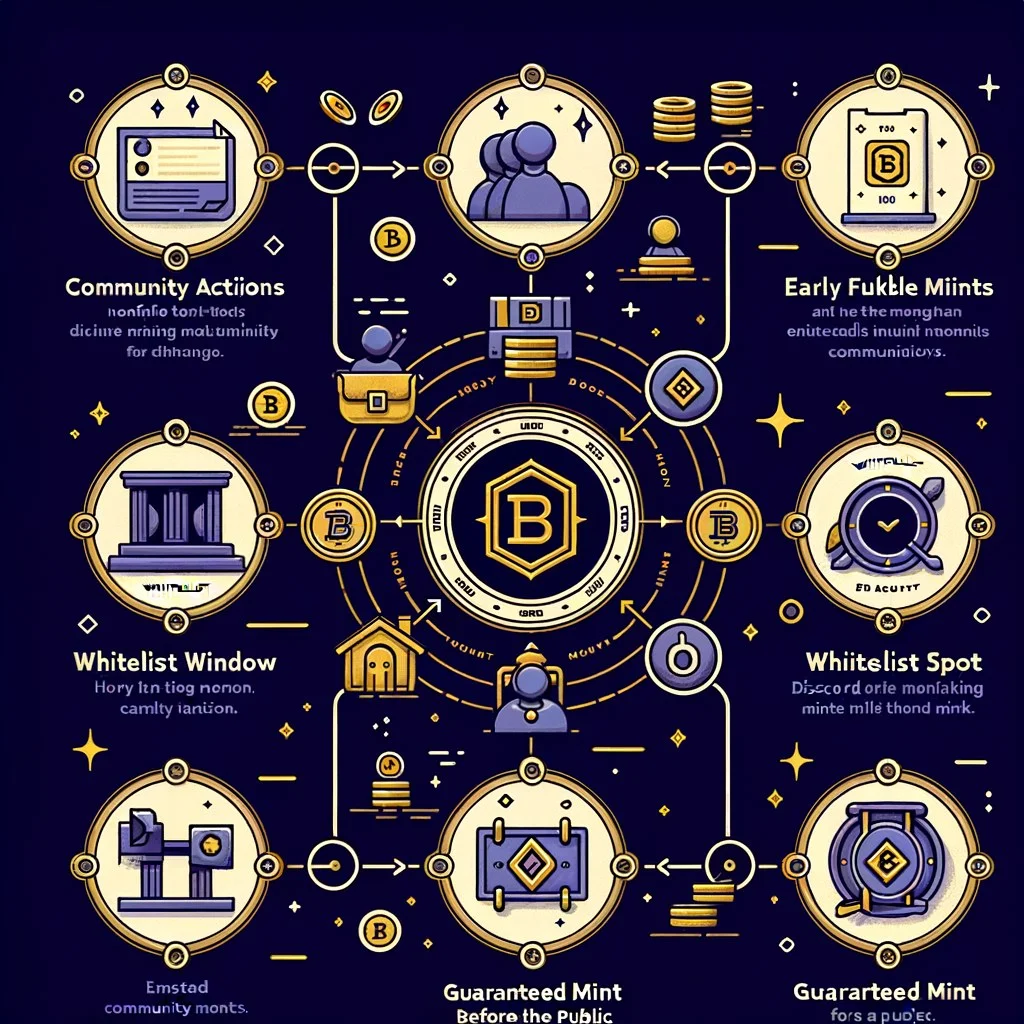
An NFT whitelist is a list of cryptocurrency wallet addresses that have been pre-approved by a project team to mint an NFT during a designated early window. The list lives inside the project's smart contract, typically as a Merkle tree root that lets the contract cheaply verify whether your address belongs to the allowlist without storing thousands of addresses on chain. When the mint goes live, the contract only accepts transactions from approved wallets during the whitelist phase.
The terminology has evolved over the past few years. Many projects now prefer the word allowlist or AL for cultural reasons, dropping the older "whitelist" term that some communities find loaded. You will also see OG lists reserved for the earliest supporters, premium mint pass NFTs that act as transferable tickets to a future mint, and free mint lists where approved wallets pay nothing but gas. All of these are variants of the same core concept: a pre-approved subset of wallets gets first dibs.
Whitelists are not a new invention. They have existed in some form since the earliest blue-chip mints in 2021. What has changed is the sophistication. Modern projects run tiered whitelists with different price levels, different mint windows, and different allocation sizes depending on how active a member has been in the community. Some tier systems give the top 100 most engaged Discord members a free mint, the next 500 a discounted mint, and another 2,000 a guaranteed regular-price slot before the public sale opens.
Why NFT Whitelists Exist
To understand why whitelists matter, you need to remember what minting a hyped NFT looked like before they became standard practice. In 2021, the launch of any anticipated collection turned into a brutal free-for-all. Thousands of users hit a website at the same instant, all racing to send their mint transaction first. Gas fees on Ethereum often spiked to 2,000 or 3,000 gwei. People spent hundreds of dollars in failed transactions just trying to land a single mint. Sniping bots dominated the contracts, capturing most of the supply before humans could even confirm their transaction.
Projects watched their genuine community members get priced out by bots and whales, and they hated it. A floor full of mercenary flippers who paid no attention to the brand was a guaranteed road to a dead community within weeks. Whitelists solved several problems at once. They allowed teams to verify that minters were real humans engaged with the project, they distributed allocations more fairly across geographies and time zones, and they put a hard cap on how much any single wallet could mint, blunting whale dominance.
The bot problem is worth emphasizing because it remains the primary driver of whitelist adoption in 2026. Sophisticated mint bots can submit hundreds of transactions per block, monitor mempool activity, and front-run any pending mint by paying slightly higher gas. Without a whitelist gate, the entire supply of a 5,000 piece collection can vanish into bot wallets within a single block. Whitelists, especially when paired with proof-of-personhood checks, raise the bar high enough that bots cannot trivially clear it. The remaining bots that do clear the bar usually do so by buying out real community members for their whitelist spots, which is a separate problem we cover below.
How a Whitelist Mint Works
The standard whitelist mint follows a four-stage flow. Understanding each stage will help you plan your participation and avoid common mistakes that cost collectors their spots every week.
The first stage, community engagement, is where most of the actual work happens. Projects watch how members behave in their Discord server and on Twitter. They look for genuine conversation, helpful contributions, art submissions, raid participation, and consistent presence over weeks rather than minutes. Teams often run engagement bots that score every member based on message quality, reaction history, and participation in events. The scoring data feeds the whitelist selection in stage two.
Stage two is the moment your wallet address is added to the Merkle tree. Most projects ask members to submit their wallet via a form on their website or through a Discord bot that links your Discord ID to your wallet. The team compiles the final allowlist, generates a Merkle root, and uploads the root to the mint contract. From that point on, the contract can verify any wallet against the root with a single proof submitted at mint time.
Stage three is the private mint window, usually lasting between two and 24 hours. Approved wallets call the whitelist mint function on the contract, paying a discounted price plus gas. Because demand is filtered down to a known list, gas competition during this window is dramatically lower than during a public sale. Stage four either continues the whitelist window until supply runs out, or transitions into a public sale where remaining tokens are released to anyone.
Whitelist vs Public Mint
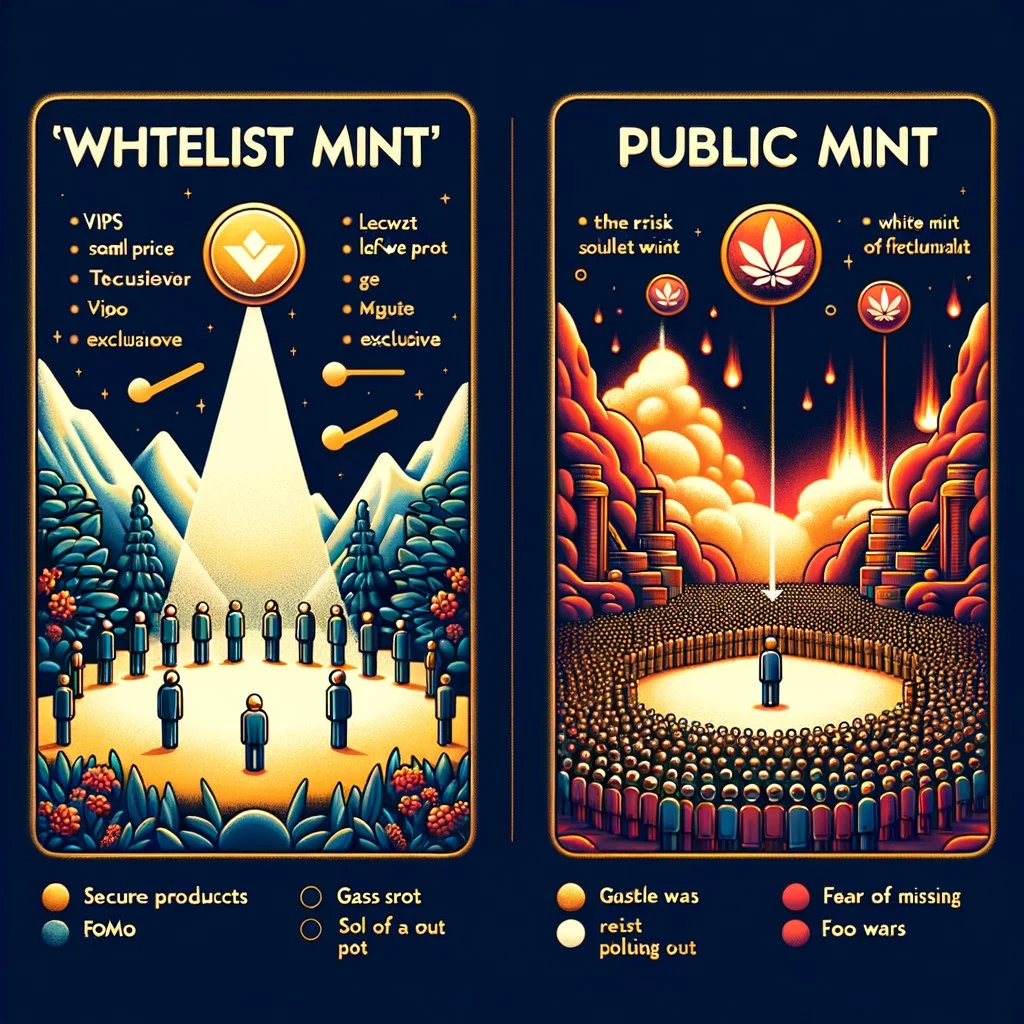
The difference between minting with and without a whitelist spot is night and day. The numbers below come from analyzing dozens of competitive mints across Ethereum and Solana over the past 12 months.
- Lower mint price (often 20-50% discount)
- Guaranteed slot, no gas war
- Private mint window, less stress
- Predictable gas fees
- Filtered out from sniping bots
- Often earns "OG" role in community
- Full mint price, no discount
- Open to everyone, including bots
- Severe gas wars, FOMO panic clicking
- Risk of failed transactions still paying gas
- Sold-out risk in seconds
- No community status reward
To put real numbers on this gap, the average whitelist mint price for a top-tier 2025 PFP collection was 0.05 ETH with gas fees of around 8 dollars on Layer 2 or 25 dollars on mainnet. The public mint of the same collection settled at 0.08 ETH with gas spikes that pushed total cost above 0.12 ETH for many minters who actually got through. A whitelist spot was effectively a free 50 percent discount, before counting the secondary market premium that whitelisted holders often captured by minting under floor.
4 Ways to Earn a Whitelist Spot
There are dozens of micro-tactics for landing whitelist spots, but they all fall into four broad categories. Pick the categories that match your skills and time budget, then double down on them.
Show up daily, contribute meaningful conversation, help newcomers, win events. Most projects grant whitelist via Discord roles tied to participation scores.
Like, retweet, comment, and tag friends on coordinated raid posts. Projects often hand out whitelist spots to the top engagement contributors each week.
Owning blue-chips like BAYC, Azuki, Pudgy, or Doodles often grants automatic whitelist into partner mints. Holdings are verified on chain.
Submit fan art, design memes, write threads, solve trivia, complete puzzles. Skill-based contests are how artists and writers consistently earn WL.
Activity-Based Whitelist Programs
Activity-based programs reward time and consistency in a community. The classic version is Discord level grinding, where the project runs an XP bot like MEE6, Lurkr, or Tatsu that awards experience points for every message you send. Once you reach a target level, usually somewhere between level 10 and level 25, you unlock a role that automatically qualifies you for whitelist. The catch is that quality bots filter out spam, so just posting "gm" 500 times in a row will get you flagged or muted.
Most teams now layer on top of XP a manual review where moderators flag the most thoughtful contributors. If you genuinely answer questions, post useful market context, or share artwork that gets praised, you stand out fast. Communities have memory. The same names appear in every channel for weeks, and those names get whitelist quietly without ever asking. The opposite is also true. If you only show up when whitelist is being announced, mods notice and skip you.
Twitter raids are the second pillar of activity grinding. A raid is a coordinated burst of engagement on a specific tweet, designed to push it into the algorithm and gain visibility. Projects typically post a raid target in their Discord, often via a dedicated bot like Hooks Protocol, Cabal, or Twitter Engagement Pro. The bot tracks who liked, retweeted, and commented within a time window. Top raiders get whitelist drops on a weekly or biweekly cadence. The trick is to comment with something substantive rather than a generic "fire" emoji, because the team reads the comments before assigning spots.
Other activity-based programs include hosting Twitter Spaces, leaving voice chat in Discord, recording video reviews of the project, and joining alpha groups that filter and share new opportunities. Projects with deep budgets sometimes pay creators in whitelist spots for full-length YouTube reviews or written breakdowns published on Medium and Mirror. If you have a content stack, you can collect whitelist spots faster than almost any other path.
Holding-Based Whitelist Programs
The simplest way to keep a steady stream of whitelist spots flowing into your wallet is to hold an established blue-chip NFT. Holders of BAYC and MAYC got automatic claims on ApeCoin and on dozens of partner projects from Yuga Labs and Otherside. Azuki holders received the entire Beanz airdrop and have continued to receive whitelist into every Chiru Labs and Azuki Tea Tree partner launch. Pudgy Penguins holders unlock allocations into Lil Pudgys, Pudgy Toys campaigns, and the Pudgy World ecosystem. Doodles, Cool Cats, Moonbirds, Milady, Mfers, and Captainz all run similar holder benefit programs.
This is one of the most overlooked reasons that blue-chip floors stay above 10 ETH even during NFT bear markets. The asset itself is paying you a continuous stream of whitelist optionality. Every new project that wants the attention of crypto-native PFP collectors offers carve-outs to blue-chip holders, often with the most generous allocations: free mints, OG spots, double allocation, the works. Holders also benefit from secondary effects, like staking systems that turn holding into a passive income stream of mint passes and partner project tokens.
Beyond classic PFPs, on-chain communities like Nouns, CryptoPunks, and Loot have spawned ecosystem after ecosystem of derivative projects that gate access via holder verification. The Nouns DAO funds dozens of public-goods experiments per year, and many of them airdrop or whitelist Nouns holders. Loot started an entire generative storytelling movement where any holder of the original Loot NFT receives priority access to spin-off mints from Crypts and Caverns, Realms, and similar derivative collections. Holding-based whitelists make compounded value possible. You buy one well-chosen NFT and harvest mint allocations from dozens of secondary launches without doing daily work.
For a beginner, the most accessible holding-based path is to acquire a single mid-tier collection that has an active partner network. Look at projects with three or more concluded partner mints in the last six months, check whether the team has a public partnerships page, and verify that recent partner mints actually went out to current holders rather than being marketed as a benefit and never delivered.
Bounty and Skill-Based Whitelist Programs
If you can draw, write, code, edit video, or design, skill-based bounties are by far the highest leverage way to collect whitelist spots. Projects post bounties in their Discord asking for specific deliverables. Fan art bounties might ask for a stylized rendering of the project mascot. Alpha submission bounties want a detailed write-up of why the project is undervalued. Dev bounties ask for a working bot, dashboard, or smart contract integration. Each delivered bounty earns you between one and ten whitelist spots depending on quality.
The reason this path is so effective is the supply side. Most communities have hundreds of lurkers willing to like a tweet but only a tiny minority capable of submitting professional-grade work on demand. If you become a recognized contributor, projects start direct messaging you with bounty offers before they even go public. Top artists in the NFT scene receive whitelist into dozens of high-quality mints every month, often without ever asking for them. The same is true for high-signal alpha callers who consistently identify projects before they go viral.
Dev and engineer talent is in particularly short supply. Even minor open-source contributions to a project's GitHub, like building a sales bot, fixing a bug in their staking dApp, or designing a custom subgraph, can land you the top tier whitelist allocation. Projects often have a separate "builder" whitelist with deeper allocations than the general community lane. Smart artists and devs treat whitelist spots like a portable currency. They earn them across multiple communities and rotate the spots they do not personally want into trades with collectors who do.
If you do not have skills yet, the meta-game is to develop them in public. Start a Twitter account focused on NFT design tutorials. Build a tiny tool that scrapes mint data and posts it nightly. Compile a weekly newsletter of upcoming mints. Within a few months you will accumulate enough reputation that projects approach you directly. Reputation compounds faster than any other social capital in the NFT space.
NFT Whitelist Aggregators and Tools
Hunting whitelist spots one project at a time across hundreds of Discords does not scale. Aggregator tools have become essential infrastructure for serious mint hunters in 2026. Each of the tools below covers slightly different angles, and most active collectors use two or three in combination.
The OG whitelist registration platform. Projects post lists, you register your wallet with anti-bot checks. Connects to 30,000+ collections.
Comprehensive WL tracking with raffle support, community campaigns, and built-in role verification across Discord servers.
High-quality raffle and giveaway platform used by top-tier projects. Aggressive anti-bot filtering and reputation scoring.
Calendar-style mint and whitelist scanner that pulls drops from across chains: Ethereum, Solana, Base, and ApeChain.
Azuki ecosystem hub for tea-related campaigns. Tracks side mints and partner allocations for Azuki and Beanz holders.
Premint is the de facto standard for whitelist registration. It runs anti-bot checks like minimum Twitter follower counts, account age, ENS ownership, NFT holdings, and Discord membership in specific servers. When a project lists their whitelist on Premint, the rules are transparent and the registration UX is consistent, which is why both projects and collectors prefer it. Premint also offers paid lists that filter for serious bidders, and free public lists for broad community outreach.
Atlas3 layers raffle mechanics on top of whitelist tracking, which is increasingly the dominant distribution method. Instead of granting whitelist to everyone who meets the criteria, a project posts 1,000 slots and 10,000 entrants, randomized with verifiable on-chain randomness. Atlas3 also integrates Discord role checks, which lets projects gate raffles to specific holder cohorts. Alphabot competes directly with Atlas3 and is often used by top projects for premium raffles thanks to its more aggressive bot filtering.
Ouellette is the calendar tool of choice for collectors who want a high-level view of every upcoming mint across multiple chains. The data ingests from project Twitter accounts, Discord announcements, and direct submissions from teams. Most active mint hunters use Ouellette daily to plan which projects to grind into and which to ignore. Tea Tree and similar ecosystem hubs serve narrower niches, focused on a single brand family and the network of projects it touches.
How to Verify a Whitelist Is Legitimate
Whitelist hype is one of the most heavily targeted attack surfaces in crypto. Scammers know that mint hunters are conditioned to click links the moment a project posts a whitelist announcement, especially when the announcement claims to be time-limited. Verifying the legitimacy of every whitelist before you connect your wallet or sign anything is non-negotiable. Treating private keys and signatures as the irrecoverable secrets they are will save your wallet from emptying out in a single bad click.
Start by confirming the official Discord and Twitter handles directly from the project's verified channels. Top projects pin their official links in their Discord welcome channel and link them from a verified Twitter account with a long history. If you find a Discord invite through Google or via a DM, assume it is malicious until you verify it against the official Twitter bio. Phishing servers often look identical to the real one, with the same logo and channel layout, and they push fraudulent mint links the moment you join.
For the mint contract itself, verify that the address posted in Discord matches the one announced by the team on Twitter and on their official website. Cross-check the contract on Etherscan, OpenSea, and Magic Eden if it has been deployed. Look for a green check next to the contract on the marketplace, and read recent transactions to confirm activity matches a legitimate mint pattern. Avoid signing any "claim your free mint" prompts that arrive via DM. No real project sends mint links via direct message, ever. The same logic that helps you avoid rug pulls in the token world applies one-to-one in NFT mints: verify everything from multiple independent channels before signing.
The Mint Day: Step-by-Step
You earned your whitelist spot. The countdown is at 30 minutes. Here is exactly what to do to maximize your chance of a clean mint without making the avoidable mistakes that ruin so many minters.
Step one: confirm your wallet. Log into the wallet that is actually on the whitelist. This sounds obvious but is the single most common cause of missed mints. Many collectors register a hot wallet for whitelist and then attempt to mint from their cold storage wallet on mint day, only to discover the contract rejects the transaction. Whitelist is tied to a specific address. If you registered with your hot wallet, you must mint with your hot wallet.
Step two: make sure you have enough ETH to cover both the mint price and gas with a comfortable buffer. A 0.05 ETH mint plus gas can spike to 0.07 or 0.08 ETH during peak congestion even with a whitelist that filters the bot army. Top up your wallet at least an hour ahead so the funds are confirmed before the mint window opens. If you are minting on Base, Arbitrum, or another Layer 2, bridge funds at least a day in advance to avoid bridge delays.
Step three: set your gas correctly. Most modern wallets like MetaMask, Rabby, and Frame let you bump priority fees manually. For a whitelist mint, set a priority fee about 20 percent above the network average. You do not need to fight a public gas war during the WL window because supply is filtered, but a slight bump helps your transaction land in the next block instead of the one after. Watch the network gas tracker on Etherscan or Blocknative right before the window opens.
Step four: bookmark the official mint page and have it open. Do not trust links posted in Discord 30 seconds before mint, even from team members. Scammers compromise mod accounts on mint day specifically to inject fake mint URLs. The page you bookmarked yesterday from the verified Twitter announcement is the source of truth.
Step five: when the window opens, mint promptly but do not panic-click. Each refresh and double-submit risks a duplicate transaction that wastes gas. Send one mint transaction, watch it propagate in your wallet's pending tab, and confirm before sending another. If the transaction fails or stalls, do not immediately re-submit. Cancel via the wallet's speed-up function or wait for it to resolve. Sniper bots specifically target panic-clickers who triple-submit transactions because they can intercept and front-run the duplicates.
After Mint: Holding vs Flipping
Once you have minted, you have a strategic decision to make before the reveal. Many collections mint as blind boxes, with the actual artwork revealed hours or days after mint. This window is where most of the price action happens. Flippers, often called paper hands, list their tokens on the secondary market before reveal hoping to capture a quick 2x or 3x over mint cost. Diamond hands hold through the reveal and bet that the rarity outcome plus long-term project growth will reward patience.
The right move depends on the project. For collections that telegraphed strong utility, brand partnerships, or recurring airdrops, the historical pattern strongly favors holding through reveal. Blue-chip mints like Pudgy Penguins, Azuki, and Pudgy Toys delivered 10x or higher returns to holders who refused to flip in the first 48 hours. For weaker projects with no public roadmap, the safer move is to list at one to two times mint cost immediately after mint, capturing the FOMO premium from latecomers before the floor collapses.
Reveal mechanics also matter. If the project uses a provably fair reveal, where art metadata is hidden until a public randomness function unlocks it, holding through reveal can produce huge rarity-driven upside if your token happens to land in the top 1 percent of traits. If the project allows team-controlled metadata, treat the reveal as a black box and lean toward flipping the FOMO premium before it evaporates. The interplay between mint psychology and short-term flipping behavior is similar to the dynamics of a pump and dump cycle, and recognizing the pattern early protects your downside.
Common Whitelist Scams
Whitelist hunting attracts scammers like blood in the water. Here are the most common attack patterns you will encounter in 2026, and how to neutralize each one.
Fake Discord servers are scam infrastructure number one. Attackers spin up clone servers with identical branding to a hyped project, then buy ads on Google and X to push the fake invite to the top of search results. Members who join see the same "claim your whitelist" channel layout as the real Discord, click the official-looking button, sign a malicious permit, and lose their NFT collection in one transaction. The mitigation is to bookmark Discord invites only from verified Twitter accounts and never from search engines or DMs.
Link-in-tweet phishing has become more sophisticated. Attackers compromise verified project Twitter accounts, often through a SIM swap or password reset attack on the team's social media manager, and post a fake mint link claiming the public mint just opened early. The wallet drainer attached to the link is designed to look like a routine mint approval. The signature you give actually transfers all your ApprovalForAll allowances to the attacker. Mitigation: never sign any signature request unless you are on the page you bookmarked, and never approve permissions on a contract you have not verified on Etherscan.
Fake support DMs are pure social engineering. You ask a question in Discord, and within minutes a "support agent" DMs you with a wallet-connect link to resolve your issue. Real projects never DM first, and no legitimate support flow requires you to sign signatures with your wallet. Discord servers used by major projects disable DMs entirely from non-friends. Always assume a DM is a scam, full stop.
Mint pass phishing has evolved as mint pass NFTs have grown in value. Scammers send fake "you have been allocated a free mint pass" emails or DMs with links to claim. The claim flow asks for a signature that authorizes a malicious contract to drain assets. Just like with honeypot tokens in the DeFi space, the trap relies on you not reading the signature data carefully. Use Rabby or Pocket Universe to simulate every signature before approving, and never approve a signature whose simulated outcome you do not fully understand.

Whitelist Trends in 2026
The whitelist model has evolved sharply since the early NFT cycles. Three trends define how leading projects gate access today, and understanding them will keep you ahead of the curve as the mint mechanics keep shifting.
Soulbound mint passes are the biggest structural change. A soulbound token is an NFT that cannot be transferred after it is minted to a wallet. Several top projects now issue soulbound whitelist passes that prove a wallet earned the spot through legitimate community work, and cannot be sold or flipped. This kills the secondary market for whitelist spots that allowed bots to buy their way past the engagement gate. If you want a soulbound whitelist, you must grind for it yourself.
Zero-knowledge proof-of-engagement is the second major trend. Newer projects integrate ZK systems that let a member prove they have a certain Discord activity score, Twitter follower count, or community tenure without revealing the underlying data on chain. This preserves privacy while still letting projects gate access cryptographically. ZK whitelist proofs also reduce the load on Discord servers because the team no longer needs to manage role assignments manually.
On-chain reputation gating ties whitelist eligibility to verifiable on-chain history. A project might require that your wallet has been active for at least 12 months, holds at least one NFT from a curated list of legitimate collections, and has never appeared on a known wallet drainer blocklist. Reputation-based gating ties cleanly into DID systems and ENS profiles, where collectors can build a portable Web3 identity that travels with them across communities. Wallets with strong reputation scores qualify for premium tier whitelist without doing project-specific work.
Looking further ahead, the line between whitelist mechanics and broader Web3 loyalty programs is blurring. Projects are experimenting with tradable loyalty tokens, AI-curated engagement metrics, and cross-chain identity protocols that aggregate reputation across Ethereum, Solana, Base, and emerging chains. The whitelist of 2027 may look closer to a frequent flyer program with tiered status, point balances, and partner rewards than the static address list that dominated 2021.
Frequently Asked Questions
What is the difference between whitelist and allowlist?
There is no functional difference. Both terms describe a pre-approved list of wallet addresses that get to mint an NFT before the public sale. Many projects have switched to "allowlist" or "AL" as the preferred term for cultural reasons, but the mechanics on chain are identical. You will also hear "OG list" for an even earlier or more exclusive tier within the same allowlist.
How do I get whitelisted for an NFT?
The four main paths are Discord engagement (build XP and reputation in the project's server), Twitter raids (consistently engage with raid posts), holding partner NFTs (blue-chip ownership unlocks automatic allocations), and skill-based bounties (submit fan art, alpha, or dev work for premium WL spots). Most active mint hunters combine two or three of these in parallel and track opportunities with aggregator tools like Premint, Atlas3, and Alphabot.
Is being whitelisted a guaranteed mint?
Usually yes, but not always. Tier-one whitelists, often called guaranteed lists or GTD, give holders a confirmed slot for one or more mints. Tier-two whitelists, sometimes labeled FCFS (first come first served), are guaranteed access to the mint window but supply can still run out if demand exceeds allocation. Raffle-style whitelists give you a chance to win a slot rather than a confirmed slot. Always check the project's mint mechanics before assuming your WL is a sure thing.
Can I sell my whitelist spot?
Sometimes. Traditional Merkle-tree whitelists are tied to a specific wallet address and cannot be sold directly, though secondary markets exist where collectors trade the whole wallet to a buyer. Transferable mint pass NFTs are designed to be tradable on OpenSea or Blur, with floor prices that can rival the mint cost itself. Soulbound whitelist passes, the newest trend in 2026, are non-transferable and can never be sold. Projects are increasingly moving toward soulbound to kill the secondary market and reward genuine community members.
What is a free mint vs whitelist mint?
A free mint costs nothing to mint other than gas fees. A whitelist mint is at a discounted price but still requires paying the mint cost in ETH or the project's native token. Free mints are often open to everyone, which makes them more vulnerable to bots, while whitelist mints are gated to specific wallets. Some projects combine both: a whitelist free mint where approved wallets pay zero mint cost and zero priority fees during a private window.
Why do projects use whitelists instead of just opening public mints?
Whitelists solve four problems that pure public mints cannot. They filter out sniping bots that would otherwise capture most of the supply. They reward genuine community members rather than mercenary flippers. They distribute allocations fairly across time zones and prevent whale dominance. And they reduce gas wars, making the actual mint experience smoother for everyone. Projects that ignore these benefits and run pure public mints usually end up with a dead community and a collapsing floor within weeks.
Conclusion
NFT whitelists turned from a niche distribution hack in 2021 into the dominant launch mechanic of the 2026 NFT market. They reward time, attention, skill, and ownership in ways that public mints simply cannot, and they protect both projects and collectors from the worst excesses of bot dominance, gas wars, and bad-faith flipping. Whether you are a Discord regular grinding XP in a few favorite communities, a holder of blue-chip PFPs collecting partner allocations passively, or a creator turning bounty submissions into a portfolio of mint passes, the whitelist economy in 2026 has a lane for every type of participant.
The most important habits to internalize are simple. Verify every link, every contract, and every signature from multiple independent channels before clicking. Track opportunities with aggregator tools like Premint, Atlas3, and Alphabot so you never miss a window. Build reputation in two or three communities deeply rather than spreading thin across 50 servers where you will never stand out. Read the mint mechanics carefully so you know whether your spot is guaranteed, first-come-first-served, or raffled. And keep enough ETH ready in the wallet that holds your whitelist allocation, because the most expensive mistake is missing a mint you already earned because of a sloppy preparation step.
Whitelist spots will keep getting more competitive as the NFT market matures. Soulbound passes, ZK proof-of-engagement, and on-chain reputation gating are raising the bar for what counts as legitimate community participation. The collectors who succeed in the next cycle will be the ones who treat whitelist hunting as a long-term game of compound social capital rather than a short-term hunt for free profit. Show up, contribute, hold quality assets, and the spots will start arriving in your wallet faster than you can mint them.
Related Guides
- What Is Mint Authority on Solana? Supply Control, Freeze Risk and Revocation (2026)
- What Is a Mint Function in Crypto? Guide (2026)
- How to Use Falcon Finance: Mint USDf Tutorial (2026)
- What Is UPEG? Unipeg Token Explained, From Ethereum Liquidity to the NFT Angle
- What Are Pudgy Penguins (PENGU)? NFT Collection + Token Guide 2026