What Is Decentralized Identity (DID): Complete Web3 Identity Guide (2026)
— By Tony Rabbit in Tutorials

What is decentralized identity (DID) in Web3? Complete guide: SSI principles, verifiable credentials, W3C standards, ENS, Polygon ID, Worldcoin and use cases (2026).
Your identity online is broken. Every time you sign up for a service, you hand over personal data to a company that stores it on servers you do not control, monetizes it without your consent, and loses it to hackers every few months. Your bank knows one version of you. Google knows another. Your government holds a third. None of these identities are portable, none of them are private, and none of them are truly yours. This fragmentation is the original sin of Web2, and it is exactly what decentralized identity sets out to fix.
Decentralized identity (DID) is a model where you, the human being, hold cryptographic control over your own identifiers and credentials. No corporation issues your identity. No central database stores it. Instead, you carry a wallet that signs proofs about who you are, what you have done, and what you are allowed to do. You decide which proofs to share, with whom, and for how long. In 2026, this concept has moved from academic whitepapers into shipped products used by millions, from did:ens domain owners to Polygon ID holders proving their humanity to DAOs.
In this guide you will learn what decentralized identity actually is, how the architecture works at a protocol level, the difference between identifiers and verifiable credentials, the three roles of issuer, holder and verifier, the most important DID methods in use today, real use cases ranging from KYC to DAO voting, the privacy power of zero-knowledge proofs, and the open problems the field still has to solve. By the end you will know how to set up your own decentralized identity and claim your first VC.
What Is Decentralized Identity?
Decentralized identity is a model for digital identity in which the individual controls their identifiers and the credentials attached to them, instead of those identifiers and credentials being owned and stored by a third party. The acronym DID stands for Decentralized Identifier, a globally unique string that points to a public key and metadata recorded on a verifiable data registry, usually a blockchain or another decentralized ledger. The broader philosophy behind DID is called Self-Sovereign Identity, or SSI.
The principles of self-sovereign identity were first articulated by Christopher Allen in 2016 and have since become the foundation for the entire field. The ten principles include existence (the user exists independently of any administrator), control (the user has authority over their identity), access (the user has access to their own data), transparency (the systems must be open), persistence (identities must be long-lived), portability (identities must move between systems), interoperability (identities should be widely usable), consent (the user must agree to use of their identity), minimisation (disclosure of claims must be minimized), and protection (the rights of the user must be protected).
In practice, what this means is simple. Instead of Facebook storing your name and email and selling it to advertisers, you store a signed credential in a wallet on your phone. When a website asks who you are, you present a proof that satisfies their requirement without revealing more than necessary. Instead of trusting Google to keep your account secure, you trust the math of a private key that only you hold. The trust shifts from institutions to cryptography.
Decentralized identity is not the same thing as anonymity. You can absolutely have a DID that is tied to your legal name and real-world identity, and you can prove things like your nationality, your age, or your professional license. The difference is that you are the one presenting these proofs, on your terms, rather than a third party doing it on your behalf without your knowledge.
The Architecture of a DID System
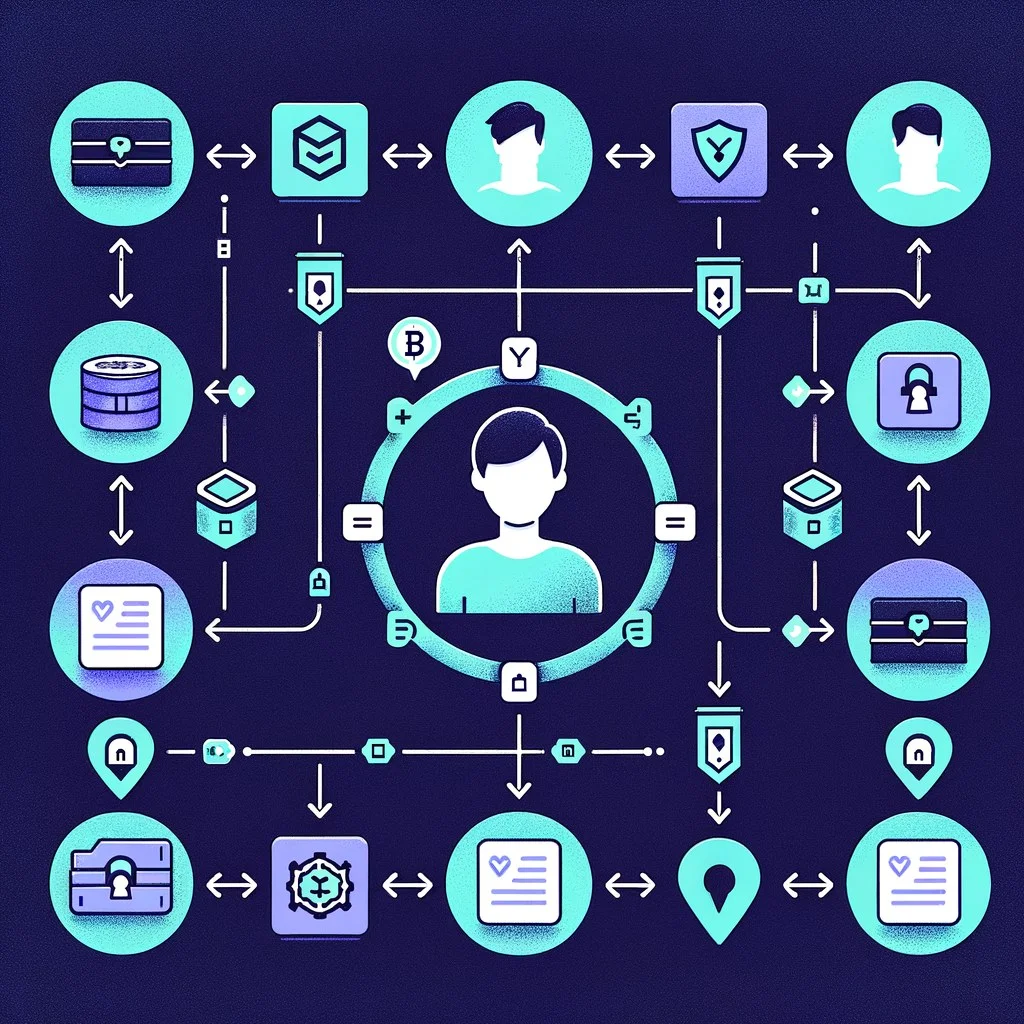
A working decentralized identity system has four key components: the user, the identity wallet that holds their keys and credentials, the verifiable credentials themselves, and an anchor on a blockchain or decentralized registry that allows third parties to resolve a DID into a public key and verify signatures. There is no central authority sitting in the middle, no identity provider charging fees, and no honeypot of personal data waiting to be breached.
The user creates a key pair on their device. From the public key, a DID is derived, looking something like did:key:z6Mkf5rGM... or did:ens:tony.eth. This DID resolves to a DID document, a small JSON file containing the public keys, service endpoints, and verification methods associated with the identity. The DID document can be anchored on Ethereum, Polygon, Bitcoin, or any chain that supports the chosen DID method.
The user collects verifiable credentials from various issuers throughout their life. A university issues a degree credential. A government issues a passport credential. An exchange issues a KYC pass credential. Each of these is signed by the issuer's own DID and stored in the user's wallet. When the user wants to prove something, they generate a presentation, often a zk-proof, and send it to the verifier. The verifier checks the issuer's signature by looking up the issuer's DID on the blockchain anchor. No personal data ever leaves the user's wallet except what is strictly necessary.
Traditional vs Decentralized Identity
The easiest way to grasp why DID matters is to put it side by side with how identity works today. The traditional model is a series of disconnected silos owned by powerful intermediaries. The decentralized model is a single, portable identity that the user carries between contexts.
- Siloed across Big Tech, banks, governments
- Data stored in centralized honeypots
- User has no real ownership or portability
- Reveals more data than necessary
- Provider can revoke or lock you out
- Constant breach and resale risk
- One identity portable across apps and chains
- Credentials live in the user's own wallet
- User signs every disclosure with a private key
- Selective disclosure with ZK proofs
- No central party can deplatform you
- Cryptographic trust, not institutional trust
The contrast becomes obvious when you imagine a typical scenario like renting an apartment. In the traditional model you send scans of your passport, your last three pay stubs, and your bank statements to a property manager who stores them on their laptop and emails them to a credit agency. In the decentralized model you generate a single proof that you are over 18, that you earn at least the income threshold, and that you have no eviction history, without revealing your name, salary, employer, or birthdate. The property manager learns exactly the facts they need and nothing more.
The 3 Roles: Issuer, Holder, Verifier
Every decentralized identity interaction is built around three roles. Understanding them is the cleanest way to reason about how the system actually works in practice.
The Issuer is any party that makes a verifiable claim about someone. A university is an issuer when it grants a degree. A government is an issuer when it certifies that someone is a citizen. A KYC provider is an issuer when it confirms that an applicant passed identity verification. The issuer has its own DID and signs the credential with its private key, so that anyone in the world can later verify that the credential genuinely came from that issuer and has not been tampered with.
The Holder is the user. The holder receives credentials from issuers and stores them in their identity wallet. The wallet might be a mobile app like Polygon ID, a browser extension like MetaMask integrated with an SSI plugin, or a dedicated hardware device. Crucially, the holder is not just passively storing data. They are an active participant who decides when, how, and to whom they present their credentials. They can hold a credential for years without anyone except themselves knowing it exists.
The Verifier is the relying party that needs proof of something. A bar verifies that a customer is over 21. A DAO verifies that a wallet belongs to a unique human before allowing a vote. An employer verifies that a job applicant truly holds a particular degree. The verifier receives a presentation from the holder, checks the issuer's signature against the DID document on the blockchain, and either accepts or rejects the proof. The verifier never has to call the issuer, never has to store the user's raw data, and never has to maintain its own identity database.
This triangle of issuer, holder and verifier is sometimes called the trust triangle. It is the central pattern of every working DID system, from W3C Verifiable Credentials to mobile driver's licenses in the European Union to Polygon ID's zero-knowledge attestations.

Verifiable Credentials Explained
A Verifiable Credential is the unit of currency in the decentralized identity world. Technically, a VC is a digitally signed claim from an issuer about a subject, expressed as a structured JSON or JSON-LD document. It includes the issuer's DID, the subject's DID, one or more claims, an issuance date, an optional expiration date, and a cryptographic signature that ties everything together. A degree credential might claim that the subject completed a master's program in computer science at a particular institution on a particular date.
The magic of verifiable credentials is that they can be presented in many forms. A holder can show the full credential, share only specific fields through selective disclosure, or generate a zero-knowledge proof that reveals nothing except the answer to a specific question. For example, a user with a passport credential could prove the statement "I am over 18 and a citizen of a Schengen country" without revealing their name, date of birth, nationality, or passport number. The verifier learns only what they actually need to make a decision.
This kind of selective disclosure is what makes decentralized identity vastly more privacy-preserving than the current system. In Web2, when you prove you are over 18 by showing your ID, you also reveal your full name, your photo, your exact birthdate, your address, and a unique national identifier that ties together every other database in the country. With a verifiable credential and a zero-knowledge proof, you reveal exactly one bit of information: yes or no.
Credentials can also be revoked. If a university discovers that a graduate forged their thesis, it can publish a revocation entry on a public registry, and any verifier checking the credential will see that it is no longer valid. The user does not have to surrender the original credential. The cryptographic proof of revocation makes it unusable.
The W3C DID Core Standard and DID Methods
Decentralized identity is not a single product or company. It is a set of open standards maintained by the World Wide Web Consortium, the same body that standardizes HTML and CSS. The two key specifications are DID Core, which describes the format of decentralized identifiers and DID documents, and Verifiable Credentials Data Model, which describes the format of credentials. Both became W3C Recommendations in 2022 and have continued to evolve since.
A DID follows a very specific syntax: did:method:identifier. The method portion tells you which DID method is being used, and there are now over 150 registered methods. Each method specifies its own rules for how DIDs are created, resolved, updated and deactivated. Here are the most important ones in 2026.
did:key is the simplest DID method. The identifier is literally the encoded public key itself. There is no blockchain, no registry, and no on-chain footprint. You can create a did:key entirely offline. The trade-off is that you cannot rotate keys, since the key is the identifier, so this method is best for ephemeral or test identities.
did:web uses a regular HTTPS domain to host the DID document. For example, did:web:example.com resolves to a document at https://example.com/.well-known/did.json. It is simple, free, and easy to deploy, but it relies on the security of DNS and TLS, which means it is not fully decentralized. It is widely used by organizations that want to publish a DID with minimal cost.
did:ens binds a DID to an Ethereum Name Service domain. If you own vitalik.eth, you have a fully functional decentralized identity right there, complete with a public key, a resolver, and metadata records. ENS has become one of the most popular DID methods because it offers human-readable names alongside cryptographic verifiability.
did:ethr uses Ethereum addresses directly. Every Ethereum address can serve as a did:web identifier with no additional setup. The DID document is computed deterministically from the address, with optional updates stored in a registry contract. This is widely used in enterprise blockchain consortia and in projects building on Ethereum mainnet.
Major DID Implementations in 2026
The DID space has matured dramatically since the early experiments of 2019 and 2020. Today there are several production-grade implementations being used by millions of people. Some focus on full self-sovereign identity, some focus on a single vertical like proof of humanity, and some are general purpose social graphs.
The base standard. Defines what a DID looks like and how it resolves to a DID document.
W3C VC Data Model 2.0. Standard format for signed claims with selective disclosure support.
Ethereum Name Service. Human-readable .eth names that double as decentralized identifiers.
Zero-knowledge identity protocol. Issue and verify credentials with ZK-SNARK proofs.
Biometric proof of personhood via iris scan. Controversial but widely deployed in 2026.
ZK attestations and passport-based proofs of citizenship and age without doxxing.
Polygon ID and Privado ID are open-source ZK identity stacks originally launched by Polygon Labs. They allow issuers to mint credentials and holders to generate ZK-SNARK proofs about those credentials without revealing the underlying data. Banks, exchanges, and gaming platforms use Polygon ID to verify users with strong privacy guarantees. Privado ID is the rebranded continuation of the protocol with a stronger enterprise focus.
Lens Protocol is a decentralized social graph that gives every user an on-chain identity NFT. Your profile, your follows, your posts, and your reputation all live in your wallet rather than on a company's database. Lens is built on Polygon and has become a hub for Web3 social applications. It is identity-as-a-graph rather than identity-as-a-document.
Sismo built a powerful set of ZK attestations that let users prove things about their on-chain history, like "I held more than 1 ETH for at least 6 months in 2024" or "I voted in at least one Aave governance proposal," without revealing the address that did so. This kind of pseudonymous reputation is becoming central to DAO governance and Sybil resistance.
Worldcoin and World ID take a very different approach: biometric proof of personhood. Users have their iris scanned by a hardware device called the Orb, which generates a unique hash that can later be used to prove "this account belongs to a unique human" without revealing identity. We will look at the debate around Worldcoin in a dedicated section below.
Soulbound Tokens (SBTs) and Non-Transferable Credentials
In 2022, Vitalik Buterin co-authored a paper introducing the concept of a soulbound token, an NFT that cannot be transferred. The wallet that holds it is called a Soul, and the SBT represents an identity-anchored credential like a degree, a club membership, or a credit history. The idea is to add provenance and reputation to on-chain identity without needing a full SSI stack.
SBTs are conceptually similar to verifiable credentials, but with a different trade-off. A VC is private by default, stored off-chain in the holder's wallet, and disclosed selectively. An SBT is fully public on chain, visible to anyone who looks at the wallet. This makes SBTs great for building open reputation systems but less suitable for sensitive credentials like medical records or salary history. In practice, many projects combine the two: public SBTs for reputation, private VCs for sensitive claims.
Unlike standard NFTs, which are designed to be traded freely on marketplaces, soulbound tokens revert any transfer attempt at the smart contract level. They are tied permanently to the wallet that minted them. The trade-off is that if you lose the private keys to that wallet, you lose every credential bound to it. This is one reason why account abstraction and social recovery have become major focus areas for the Ethereum community.
Use Cases
Decentralized identity stops being abstract the moment you see real applications. The four categories below are where DID is already shipping value to real users in 2026.
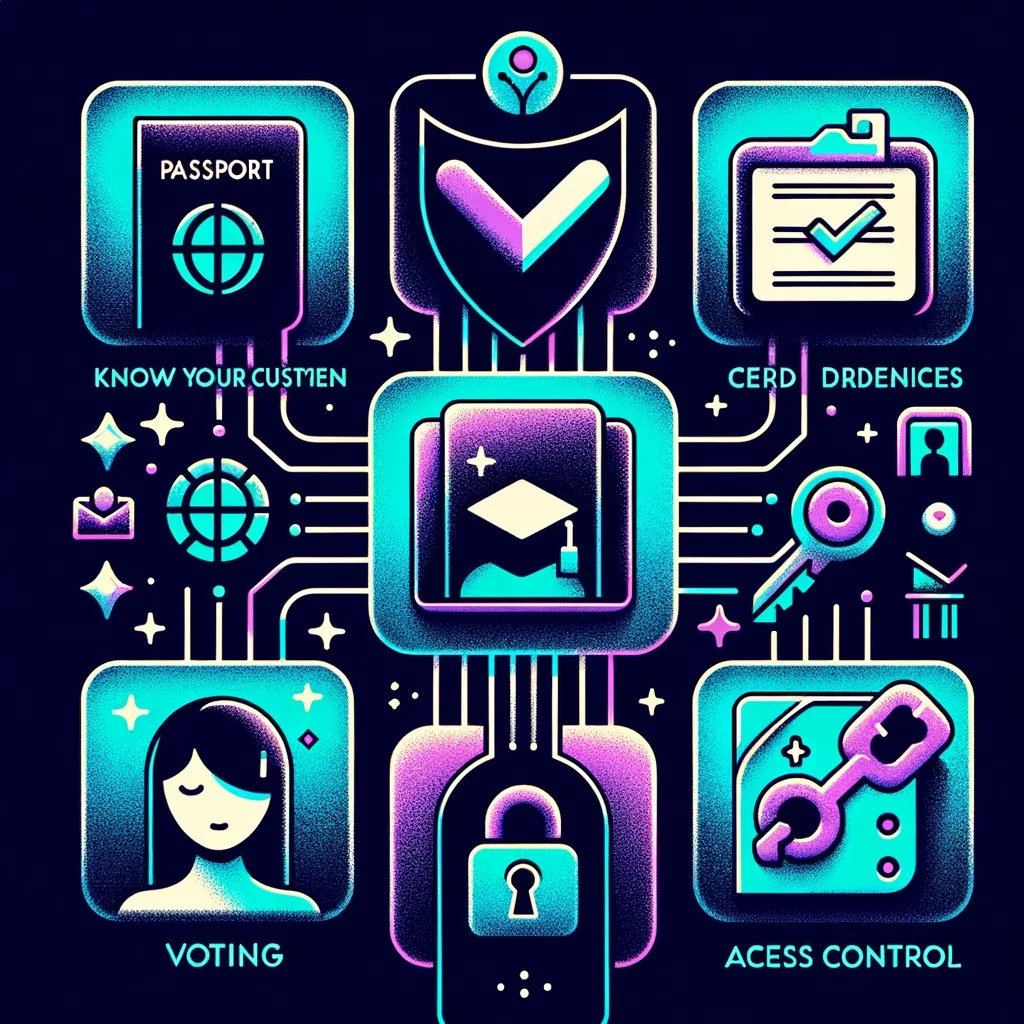
Pass KYC once with a regulated provider, get a reusable credential. Use it on every DeFi and CEX platform without resubmitting documents.
Universities and certifying bodies issue diplomas as VCs. Employers verify them instantly with a QR code scan. No fake diplomas, no calls to the registrar.
Prove you are one unique human to enforce 1-person-1-vote in DAOs. Combine proof of personhood with proof of contribution for nuanced governance.
Restrict Discord channels, websites, or events to holders of a specific credential. Combine credentials for fine-grained access policies.
KYC and compliance is the killer use case for crypto. Today, every centralized exchange and many DeFi protocols require users to upload passport scans and selfies. Each platform repeats the entire process and stores the documents independently. With a reusable KYC credential issued by a regulated provider, the user goes through verification once and reuses the credential across dozens of platforms. The platforms get the compliance they need. The user gets back their afternoon.
Education credentials have been one of the slowest-moving but highest-trust use cases. Pilot programs at MIT, the University of Maryland, and a dozen European institutions have issued digital diplomas as verifiable credentials since 2019. By 2026 several national governments accept these credentials as legal proof of qualification, and employers can verify a candidate's degree without ever phoning the registrar.
DAO governance needs proof of personhood more than almost any other domain. Token-weighted voting tends to concentrate power among whales. Switching to one-person-one-vote requires a way to prevent Sybil attacks, which is exactly what World ID, BrightID, and similar protocols provide. Combining humanity proofs with reputation attestations makes it possible to design DAOs where contribution actually counts.
Token gating and access control works just like club membership in the physical world. Holders of a particular SBT or VC get into a Discord server, a private newsletter, an in-person event, or a Twitter Space. Because credentials can be combined cryptographically, you can require "holds Bored Ape AND verified human AND has held wallet for over 1 year" without leaking any of the underlying details to the door.
Privacy and Zero-Knowledge Proofs in DID
Zero-knowledge proofs are the secret sauce that turns decentralized identity from a faster version of legacy KYC into something genuinely new. A zero-knowledge proof, or zk-proof, is a cryptographic technique that lets you prove a statement is true without revealing why it is true. The verifier learns only the answer, not the underlying data.
The classic example is proving age. Today, if a website needs to confirm you are over 18, you upload your ID. The website then sees your full name, birthdate, address, and a high-resolution photo. With a zero-knowledge proof generated from a passport credential, you reveal a single boolean: yes, the holder is over 18. Your name, your exact birthdate, and every other field on the passport stay private. The same technique lets you prove citizenship, income brackets, professional licensing, or any other attribute without leaking the rest.
The technology that makes this efficient enough for mobile devices is ZK-SNARKs, short for Zero-Knowledge Succinct Non-interactive Arguments of Knowledge. SNARK proofs are tiny, often a few hundred bytes, and they verify in milliseconds. This is what allows Polygon ID, Sismo, and zkPassport to generate a privacy-preserving proof on your phone in under a second.
Zero-knowledge proofs also enable Sybil resistance without doxxing. A protocol can require that each participant holds a unique humanity proof from World ID, BrightID or Gitcoin Passport, without ever learning the underlying biometric or social graph data. The protocol learns "this is a unique human" but never learns who.
The Worldcoin Debate: Biometric DID and Its Critics
Worldcoin is the most ambitious and most controversial decentralized identity project of the last few years. Founded by Sam Altman, Alex Blania and others, Worldcoin issues a unique identifier called World ID to anyone who has their iris scanned by a custom hardware device known as the Orb. The biometric data is processed locally on the device, hashed, and discarded according to the project. Users keep the resulting identifier in a mobile app and can use it to prove personhood across any application that integrates the World ID SDK.
The pitch is compelling. As AI agents get better at impersonating humans online, the value of a trustworthy proof-of-personhood will rise sharply. World ID claims to offer that proof without revealing identity. Millions of people in Argentina, Kenya, Spain, Germany and dozens of other countries have signed up since 2023, and projects like Razer, Reddit, and various DAOs have integrated World ID for Sybil resistance.
Critics raise serious concerns. Privacy advocates point out that any biometric collection, no matter how locally processed, creates risks if the system or the policy ever changes. Regulators in multiple countries have intervened. The Bayern data protection authority in Germany ordered Worldcoin to make changes to its data handling. The Spanish Data Protection Agency issued a temporary ban on Orb scans. Kenya suspended Worldcoin operations and seized devices pending a parliamentary review. France, Argentina, and Hong Kong have run their own investigations.
There is also a structural concern. Worldcoin is operated by Tools for Humanity, a for-profit company. Even if the cryptography is solid, the governance of the project is centralized in a way that other DID protocols like ENS or Polygon ID are not. Whether the benefits of mass-scale proof of personhood outweigh the risks of biometric collection at this scale is one of the open debates in the identity world. The factual situation in 2026 is that World ID continues to grow rapidly, regulatory scrutiny continues to grow alongside it, and competing biometric-free approaches like passport-based zkPassport are gaining ground as alternatives.
Challenges and Open Problems
Decentralized identity has shipped, but it has not won. Several hard problems still stand between today's state of the art and mass adoption.
Key recovery is the elephant in the room. If you lose the private key that controls your DID, you lose every credential attached to it. There is no support line to call, no password reset button. Solutions like social recovery wallets, multisig setups, and account abstraction with passkeys are emerging but they add complexity that the average user struggles with.
Revocation is another open problem. If a credential is compromised or invalidated, how do verifiers learn about it efficiently and without leaking metadata about who is checking? Various approaches like status list 2021, cryptographic accumulators, and ZK revocation registries are in production, but there is no single dominant standard yet.
Wallet UX remains primitive. Today, getting your first verifiable credential, storing it correctly, and presenting it to a verifier requires technical knowledge that most people do not have. Improvements like passkey-based wallets, account abstraction, and integration into mainstream apps are critical. Until grandma can use a DID without thinking about it, mass adoption is impossible.
KYC integration with traditional financial regulators is uneven. Some jurisdictions, like the European Union with eIDAS 2.0 and the EUDI Wallet initiative, have embraced verifiable credentials and made them legally recognized. Others still require physical documents or proprietary identity providers. Bridging these worlds is a long, political project.
Issuer reputation and trust frameworks are still being built. A verifiable credential is only as trustworthy as the issuer behind it. Establishing which issuers are reputable for which kinds of claims requires governance structures that mirror the role of accreditation bodies in the physical world. Initiatives like the Trust Over IP Foundation and the European Self-Sovereign Identity Framework are working on this.
How to Start Using DID Today
You do not need to wait for mass adoption to start using decentralized identity yourself. The tools are available right now and the learning curve is manageable. Here is a clean four-step path you can follow this week.
Step 1: Set up an identity wallet. Install a wallet that supports DIDs and verifiable credentials. Polygon ID Wallet and Privado ID are good ZK-focused choices. Lens Protocol's apps work for social identity. For ENS-based identity you can simply use MetaMask or Rainbow Wallet. Make sure to back up your seed phrase securely and consider using a hardware wallet if you plan to anchor significant credentials to the same keys.
Step 2: Get an ENS domain. Owning an did:ens identifier is the cheapest, simplest way to start. Buy a .eth name on app.ens.domains, set up a primary name pointing to your wallet, and fill in basic records like avatar, description, and social links. From that moment, you have a human-readable decentralized identity that resolves on Ethereum and works with hundreds of dApps.
Step 3: Claim your first verifiable credentials. Visit Gitcoin Passport to mint stamps that attest to your on-chain history, social accounts, and reputation. Try Sismo's app to mint ZK attestations about your DeFi or DAO activity without doxxing your main wallet. Sign up for Polygon ID's issuer marketplace and collect credentials from real-world issuers. Each new credential thickens your decentralized identity layer.
Step 4: Use your identity in the wild. Try logging into a Lens-based social app like Hey or Orb with your wallet. Vote on Snapshot using a Gitcoin Passport gate. Join a DAO that requires a Sismo proof for membership. The more places you use the same DID, the more you start to feel the difference between decentralized identity and the username-and-password world of Web2.
The Future: DID + AI Agents, Account Abstraction, Mass Adoption
The next phase of decentralized identity will be shaped by three forces converging at once. First, account abstraction is making smart-contract wallets the default rather than the exception. Wallets like Argent, Safe, and Coinbase Smart Wallet can natively integrate verifiable credentials, social recovery, and passkey authentication. This collapses the gap between "crypto wallet" and "identity wallet."
Second, AI agents are forcing the issue of proof-of-personhood. As autonomous AI agents transact, vote, and create content online, the question of "is there a human behind this account?" becomes both more important and more difficult to answer. Decentralized identity offers a clean way to bind agents to their human principals through delegation credentials, while still preserving the privacy of those humans. Expect to see explosive growth in the DID space driven by this exact need over the next two years.
Third, mass adoption is being unlocked by regulatory tailwinds. The European Union's eIDAS 2.0 regulation requires every member state to offer a digital identity wallet to its citizens by 2026, and those wallets must support W3C Verifiable Credentials. Once 450 million Europeans have a government-issued DID wallet in their pocket, every other jurisdiction will feel pressure to catch up. The same standards apply to private issuers, which means your bank, your insurance company, and your employer will be issuing VCs to you.
Passkeys are the final piece. Major operating systems now ship with passkey support, which means cryptographic identity is being baked into iOS, Android, macOS, and Windows. A passkey is essentially a public-key pair stored in the user's device. The same key material can power a DID, which means a future where logging in with Touch ID is also a decentralized identity action is no longer hypothetical. It is months away.
Frequently Asked Questions
What is the difference between DID and SSI?
DID stands for Decentralized Identifier and refers specifically to the W3C standard for a unique, user-controlled identifier and its associated DID document. SSI stands for Self-Sovereign Identity and refers to the broader philosophy and architecture in which the user owns and controls their identity, including DIDs, verifiable credentials, and the wallets that hold them. In short: DID is a technical building block, SSI is the philosophical and architectural framework that uses DIDs as one of its components.
Is ENS a decentralized identity?
Yes. ENS names function as decentralized identifiers through the did:ens DID method. Owning vitalik.eth or any other .eth name gives you a globally resolvable identifier that points to your public key, can store metadata like avatar and social links, and works with hundreds of Web3 applications. ENS is the most widely adopted DID method on Ethereum in 2026.
How does Worldcoin work?
Worldcoin issues a unique digital identifier called World ID by having users scan their iris with a hardware device called the Orb. The biometric data is processed locally on the Orb and the project says the raw iris image is discarded, leaving only a cryptographic hash that represents one unique human. This hash is then used to generate zero-knowledge proofs that an account belongs to a unique person without revealing the person's identity. The project has faced regulatory pushback in countries including Spain, Germany, Kenya, France and Hong Kong over biometric data collection concerns.
Are decentralized identities GDPR-compliant?
In principle, decentralized identity systems align well with GDPR's data minimization and user control principles. Verifiable credentials with selective disclosure and zero-knowledge proofs let users reveal only the minimum data needed, and the user holds their own data rather than having it stored in centralized databases. In practice, certain design choices like writing personal data on-chain can create tension with GDPR's right to erasure, since blockchain entries cannot easily be deleted. Best practice in 2026 is to store only DIDs and revocation status on chain, with all personal data kept in the user's wallet off chain.
What is a verifiable credential?
A verifiable credential is a digitally signed claim from an issuer about a subject, expressed in a standard format defined by the W3C. It contains the issuer's DID, the subject's DID, one or more claims like "this person holds a master's degree in physics," an issuance date, an optional expiration date, and a cryptographic signature. The holder stores the credential in their identity wallet and can present it to verifiers in various forms, including selective disclosure or zero-knowledge proofs that reveal only the minimum information needed.
Can decentralized identity replace passwords?
Yes, and this transition is already underway. Decentralized identity uses public-key cryptography rather than shared secrets, which eliminates phishing and credential reuse attacks. Combined with passkeys, which are essentially public-key authentication built into modern operating systems, DIDs let users sign in to services by cryptographically proving control over a key rather than typing a password. Major platforms including Apple, Google, and Microsoft already support passkeys, and binding passkeys to DIDs is the bridge between Web2 login and full self-sovereign identity.
How is decentralized identity related to hashing?
Decentralized identity relies heavily on cryptographic hashing for both signatures and zero-knowledge proofs. Hash functions like SHA-256 and Poseidon are used to commit to credential contents without revealing them, to anchor DID documents on chain, and to construct Merkle trees that enable selective disclosure. If you want to understand the math underneath, our guide to hashing and SHA-256 covers the fundamentals that make every DID system possible.
Conclusion
Decentralized identity is the missing layer of the internet. For thirty years we have built websites, applications, and entire economies on top of identity systems that were never designed for users. The result is an internet where you are the product, your data is the inventory, and your right to control your own digital existence is permanently rented from a handful of platforms. DID, SSI, verifiable credentials and zero-knowledge proofs together offer a path out of that trap.
The technology is real, the standards are mature, the wallets work, and the regulators are starting to require interoperable identity wallets at the scale of entire continents. The remaining gap is one of user experience and habit. As account abstraction merges crypto wallets with identity wallets, as AI agents force a reckoning around proof of personhood, and as governments roll out digital identity wallets to hundreds of millions of citizens, decentralized identity will quietly become the substrate of how you exist online.
You do not have to wait for that future to start practicing. Set up an identity wallet today. Claim an ENS name. Mint a few verifiable credentials. Try presenting them to a DAO or a Web3 app. The more time you spend inside a real DID workflow, the more obvious it becomes how broken the current system is, and how powerful the alternative is when it works. Welcome to the era where you, not Facebook, not your bank, and not your government, hold the keys to your own identity.
Related Guides
- What Is Unstoppable Domains: Web3 Domains, Identity and Digital Ownership (2026)
- What Is ENS: Ethereum Name Service, Wallet Names and Web3 Identity (2026)
- What Is Web3: The Complete Guide to the Decentralized Internet (2026)
- What Is Filecoin: Decentralized Storage Markets, Incentives and Web3 Data (2026)
- Why Did My Crypto Transaction Revert? Causes and Fixes