What Is UPEG? Unipeg Token Explained, From Ethereum Liquidity to the NFT Angle
— By Tony Rabbit in Tutorials
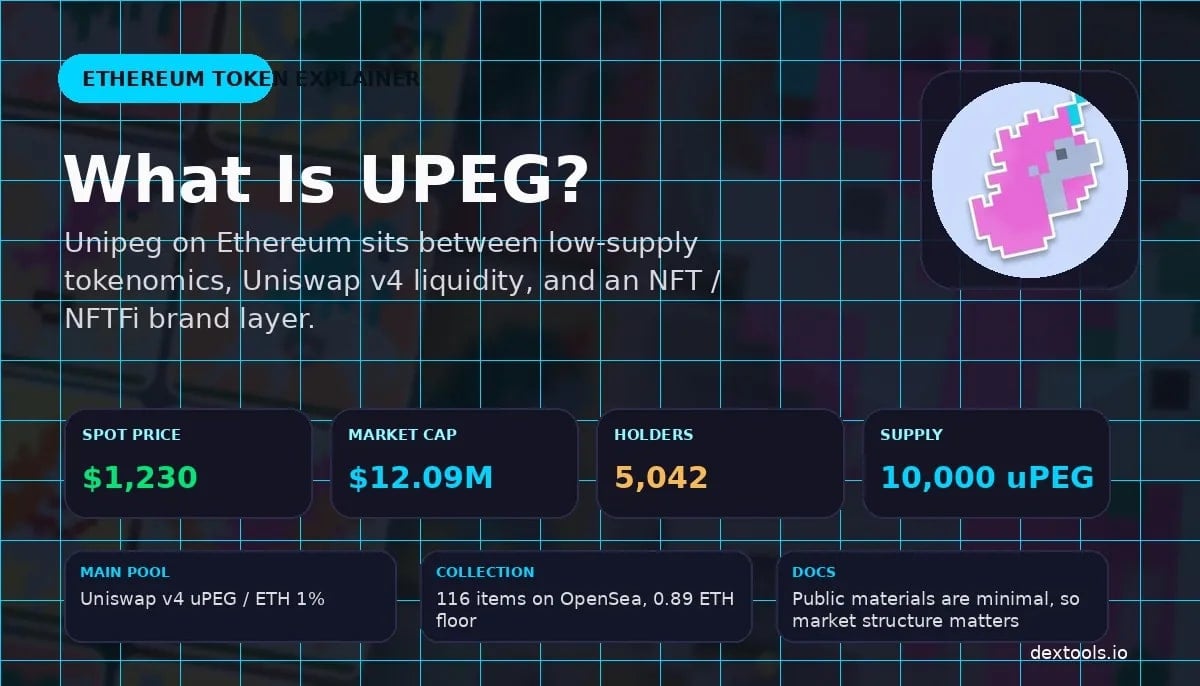
What is UPEG? Here is the clearest way to understand the Unipeg token on Ethereum, from supply and liquidity to the NFT / NFTFi angle behind the project.
Intent check: If you only want the live market, open the DEXTools pair explorer. This article is about what UPEG actually is, how the token is structured on Ethereum, and why it keeps getting read through an NFT / NFTFi lens.
UPEG can look confusing at first glance because the token prints a four-digit price while still sitting near a mid-cap valuation. The reason is simple: this is a very low-supply Ethereum token. CoinGecko currently shows 10,000 circulating, total, and max supply, so a price around $1,230 translates into a market cap closer to $12.30M, not a mega-cap.
The better way to read UPEG is as a three-part story. First, it is an ERC-20 token on Ethereum with real Uniswap v4 liquidity. Second, the public project footprint points to Unipeg as an art / collectible / NFT-native brand, not a pure utility protocol. Third, the official public materials are fairly sparse, so the safest interpretation comes from onchain facts, linked social profiles, and the linked OpenSea collection rather than from invented lore.
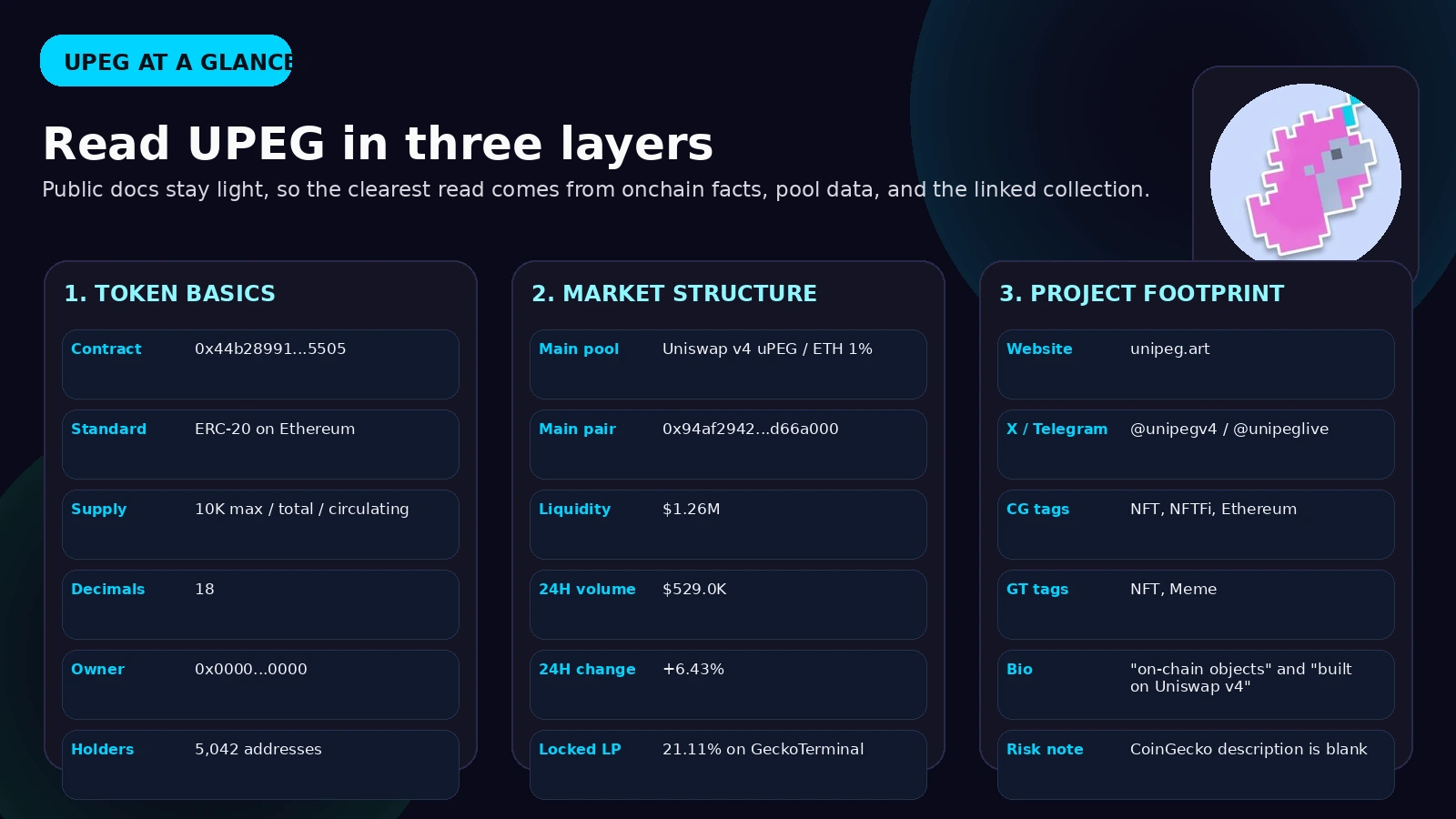
What UPEG is onchain
Onchain, UPEG is an ERC-20 token on Ethereum at contract 0x44b28991b167582f18ba0259e0173176ca125505. Public token data currently shows 18 decimals, a 10,000 token max supply, and the owner address set to the zero address, which means traders are not looking at a live owner-controlled contract in the usual Ownable sense.
GeckoTerminal also marks the token as verified, shows more than 5,042 holder addresses, and currently does not flag it as a honeypot. None of that removes market risk, but it does help frame UPEG as a real Ethereum market with meaningful participation rather than a ghost contract with no visible audience.
Why the price per token looks so high
Many traders see a token around $1,230 and assume it must be too expensive or already saturated. That logic breaks when supply is small. With only 10,000 units, even a price a little above $1,200 implies a market cap of about $12.30M.
This is exactly why supply context matters. The question is not whether one token unit looks expensive. The question is what the whole network valuation looks like relative to liquidity, holder distribution, and the project identity traders are actually buying into. If you want a broader primer on this mistake, our guide on token float vs total supply is the cleanest next read.
Where UPEG actually trades, and which pool matters most
The main live market is the uPEG / ETH 1% pool on Uniswap v4, with pair address 0x94af294207a2c592c08a39c82a7df42a18613d986eeb520b7164fe9ccd66a000. DexScreener currently shows about $1.26M in liquidity, around $528.9K in 24-hour volume, and a 24-hour move near +6.46%. The pair was created on 2026-04-15, so this is still a relatively young market at about 38 days old.
That is important because UPEG does not only exist as a concept. It has an actual onchain venue where price discovery is happening now. Public tickers also show secondary routing through other Uniswap v4 and v3 markets, which means traders should anchor on the contract and the most liquid pool instead of treating every UPEG ticker mention as equivalent.
Why UPEG gets tagged as NFT and NFTFi
This is where UPEG becomes more interesting than a simple low-supply trade. CoinGecko places the token under NFT, Ethereum Ecosystem, and NFTFi. GeckoTerminal also tags it as NFT and Meme. Those labels line up with the public branding more than with a conventional utility-token story.
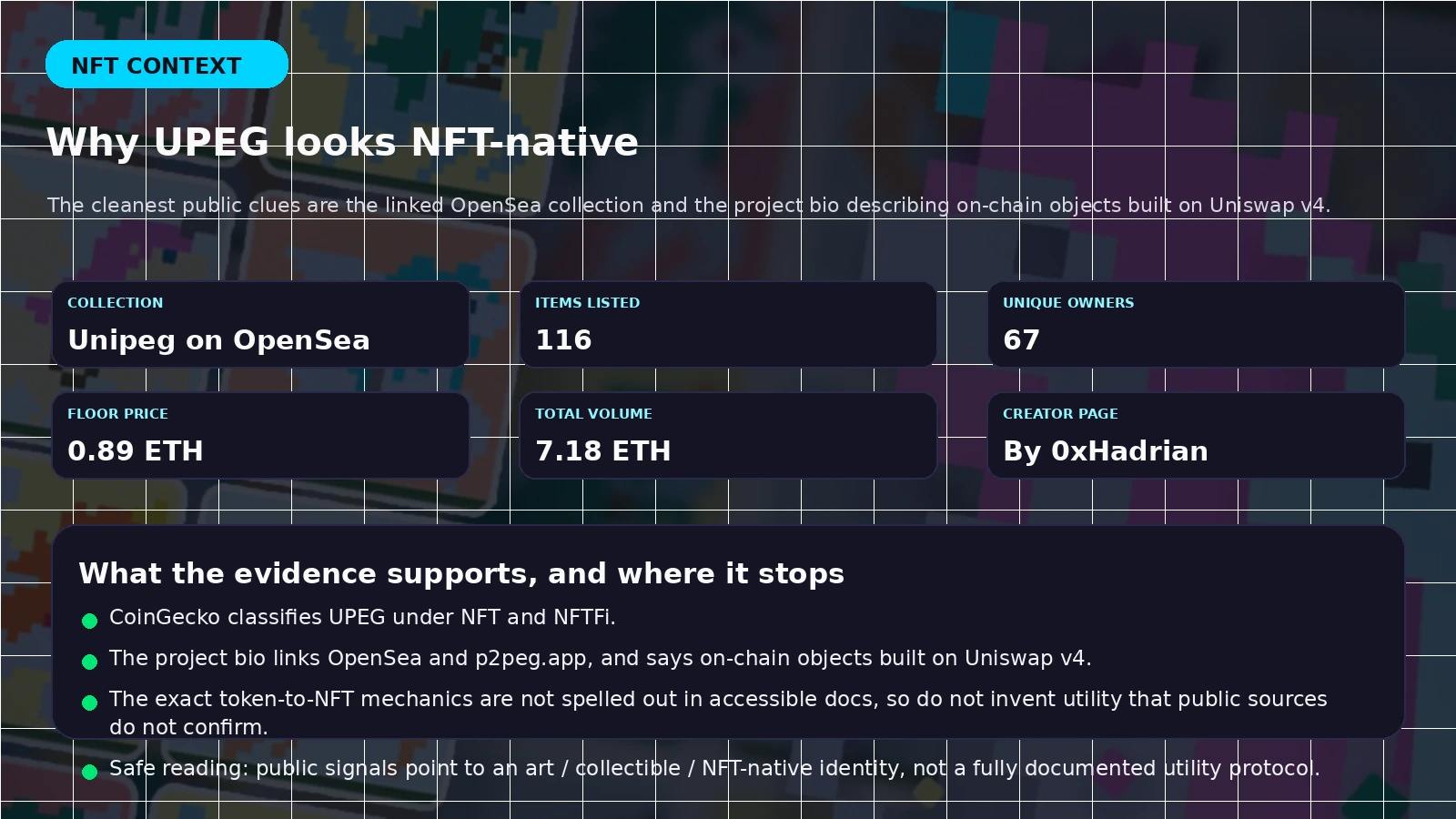
The clearest public clue is the project profile itself. The official X bio for @unipegv4 describes Unipeg as "on-chain objects. built on Uniswap v4" and links directly to the Unipeg OpenSea collection, p2peg.app, and the project socials. OpenSea currently shows 116 items, around 67 unique owners, a floor near 0.89 ETH, and about 7.18 ETH in total volume.
That does not automatically prove a specific redemption model, fractionalization mechanic, or NFT-backed claims structure. It does, however, strongly suggest that traders should think about UPEG as part of an NFT-native ecosystem, not as a plain utility coin or a generic Ethereum ticker with no cultural layer.
What public materials confirm, and what they do not
The confirmed pieces are fairly clear. UPEG is a live Ethereum token. It has a real Uniswap v4 market. It links to an official website, X profile, Telegram channel, and an OpenSea collection. The branding consistently points toward pixel-art, collectible-style identity rather than a corporate or infra-first protocol look.
What stays less clear is the full economic model behind that identity. CoinGecko's description field is blank. The website is linked publicly, but public text access is sparse and the social bio remains intentionally brief. That means the safest habit is to avoid overfilling the gaps. Read what the market structure proves, read what the public profiles say, and stop short of promising mechanics that are not spelled out.
Final take
The cleanest way to explain UPEG is this: it is a low-supply Ethereum token with real Uniswap liquidity, a mid-sized holder base, and a public identity that clearly leans into art, collectibles, and NFT-native branding. That combination is why the token feels different from a standard utility coin and different from a generic memecoin with no project surface behind it.
At the same time, the exact mechanics behind the Unipeg ecosystem are not fully laid out in the accessible public materials, so the smart read is disciplined, not romantic. Track the contract, track the main pool, use the DEXTools token explorer and pair explorer, and treat the NFT / NFTFi angle as a strong public signal rather than as an excuse to invent fundamentals.
FAQ
0x44b28991b167582f18ba0259e0173176ca125505, then check the main ETH pool and current liquidity on DEXTools. Start with the token explorer and pair explorer.Related Guides
- What Are Pudgy Penguins (PENGU)? NFT Collection + Token Guide 2026
- What Is an NFT Whitelist: Complete Mint Pass Guide (2026)
- What Is Milady (CULT)? Remilia NFT + Cult Coin Ecosystem Guide 2026
- What Are Bitcoin Stamps (SRC-20)? The Permanent NFT Protocol on Bitcoin Explained in 2026
- What Is Azuki (ANIME)? Anime NFT Collection + Token Ecosystem Guide 2026
- What Is FTT (FTX Token)? From Top
- How to Earn from DePIN
Frequently Asked Questions
What is the UPEG token?
UPEG, or Unipeg, is described as a token on Ethereum with an associated NFT or NFTFi angle. As with any small-cap token, its details and value depend entirely on the specific project and its onchain activity.
What does NFTFi mean?
NFTFi refers to applying DeFi-style financial activity to NFTs, such as using NFTs as collateral for loans or providing liquidity around them. It aims to make otherwise illiquid NFTs more usable in financial contexts.
How can I research a token's liquidity before buying?
You can check onchain explorers and DEX analytics tools to see liquidity pool size, holder distribution, and trading activity. Thin liquidity can make a token harder to sell and more prone to large price swings.
Are small-cap Ethereum tokens risky?
Yes, low-liquidity and low-market-cap tokens can be highly volatile and are more exposed to manipulation and scams. Doing independent research and verifying the contract are important risk-reduction steps.