What Is Chain Abstraction? The End of Bridging (2026)
— By Whatsertrade in Tutorials

What is chain abstraction and how does it remove manual bridging? A 2026 guide to how it works, the key projects and why it matters for multichain users.
The blockchain world in 2026 looks radically different from just two years ago. Users once had to juggle dozens of wallets, hunt for bridge interfaces, and sweat through 20-minute confirmation windows just to move tokens from one chain to another. That era is ending. Chain abstraction is the technology making it possible for anyone to use decentralized applications without ever thinking about which blockchain they are on. In this guide, you will learn exactly what chain abstraction is, why it matters, how it works under the hood, and which projects are leading the charge toward a truly unified crypto experience.
If you have ever lost funds in a bridge exploit, waited anxiously for a cross-chain transfer to finalize, or simply given up on a dApp because it lived on the wrong network, chain abstraction is the answer you have been waiting for. By the end of this article, you will understand the architecture, the key players, and the practical implications of a world where blockchains become invisible infrastructure rather than walled gardens.
What Is Chain Abstraction
Chain abstraction is a design philosophy and a set of technologies that hide the complexity of multiple blockchains from end users and developers. Instead of forcing a user to select a network, switch RPC endpoints, and bridge assets manually, chain abstraction layers handle all of that behind the scenes. The user simply states what they want to do, and the abstraction layer figures out the optimal route, the cheapest gas, and the fastest settlement path across every available chain.
Think of it like the internet itself. When you visit a website, you do not choose which undersea cable carries your data, which DNS resolver translates the domain, or which CDN node serves the page. The infrastructure is abstracted away. Chain abstraction aims to do the same thing for blockchains: make the underlying infrastructure invisible while preserving all the security and decentralization guarantees that make crypto valuable in the first place.
Key insight: Chain abstraction does not eliminate blockchains. It makes them invisible to the people who use them, the same way TCP/IP is invisible to someone browsing the web.
At its core, chain abstraction answers a simple question: why should a user care which chain their USDC sits on? If a user wants to buy an NFT on Base, supply liquidity on Arbitrum, or vote in a DAO on Optimism, the experience should be seamless. Chain abstraction protocols coordinate the necessary swaps, bridges, and message-passing so the user never has to leave a single interface.
The term gained mainstream traction in late 2024 when NEAR Protocol formally introduced its chain abstraction stack, but the concept has roots going back to the earliest cross-chain interoperability research. What changed is that the technology finally caught up with the vision. Solver networks, intent-based architectures, and account abstraction wallets matured enough to make real-time, cross-chain operations practical for everyday users.
The Problem with Bridging Today
To appreciate chain abstraction, you first need to understand why traditional bridging is broken. Cross-chain bridges have been one of the most dangerous and frustrating parts of the crypto ecosystem since their inception. Between 2021 and 2025, bridge exploits accounted for billions of dollars in losses. Ronin Bridge, Wormhole, Nomad, Multichain, and others suffered catastrophic hacks that shook user confidence in cross-chain transfers.
But security is only part of the problem. The user experience of bridging is terrible even when everything works correctly. A typical bridge interaction in the old model requires the user to:
That is nine steps for what should be a single action. Every step introduces friction, confusion, and risk. New users often get stranded on a destination chain without gas tokens, unable to do anything with the assets they just bridged. Experienced users waste hours comparing bridge fees, speeds, and security tradeoffs.
The bridging tax: Research from late 2025 estimated that the average DeFi user spent over 40 minutes per week managing cross-chain operations. That is time and cognitive overhead that directly suppresses adoption.
Fragmented liquidity is another critical issue. When the same token exists as wrapped versions across 15 different chains, liquidity gets split into shallow pools. This leads to higher slippage, worse prices, and inefficient capital allocation across the entire ecosystem. Chain abstraction solves this by allowing solvers to tap into liquidity wherever it exists, presenting the user with unified depth regardless of which chains hold the underlying assets.
How Chain Abstraction Works: Intents, Solvers, and Relayers
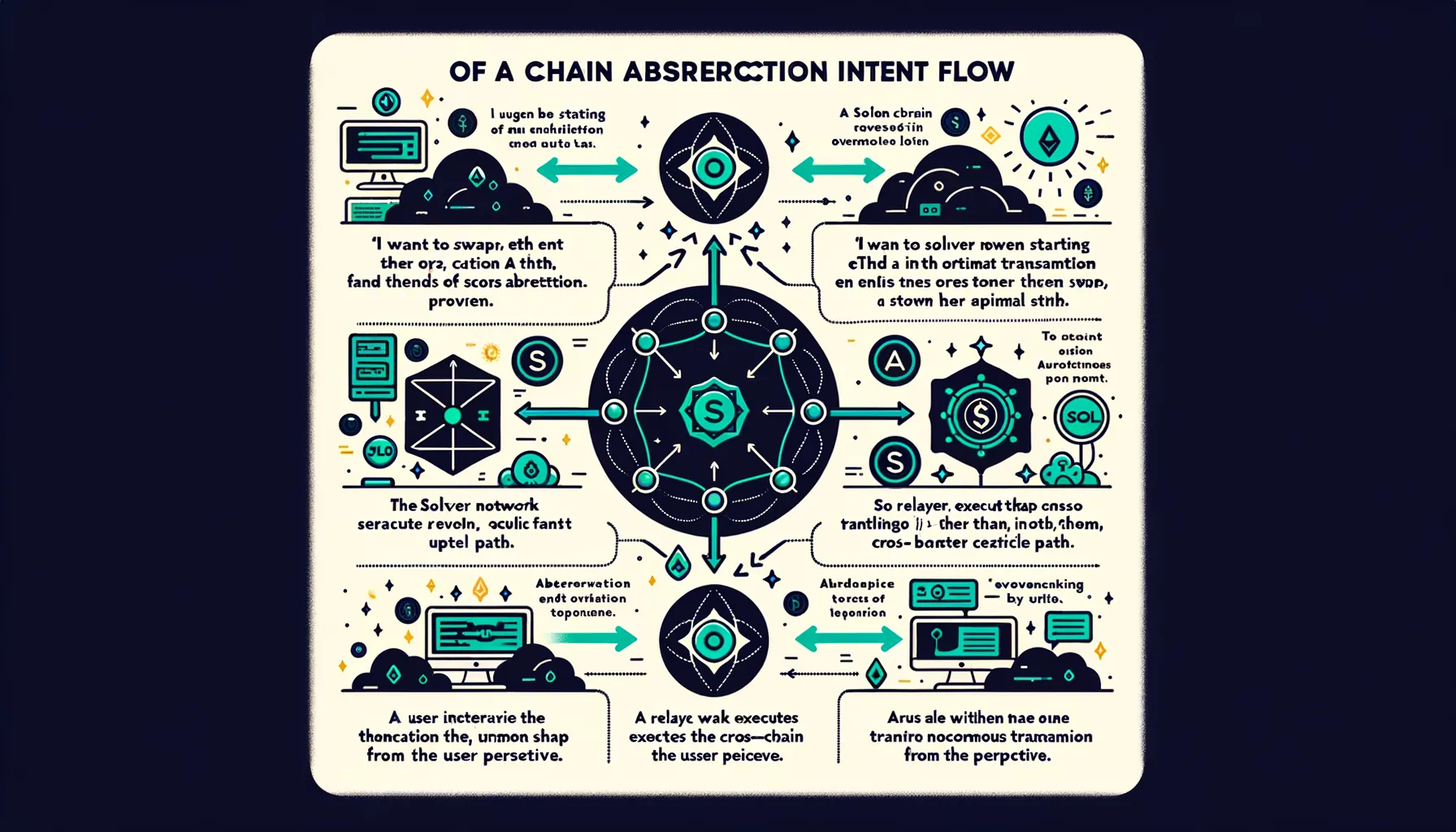
The technical architecture of chain abstraction revolves around three core components: intents, solvers, and relayers. Together, they replace the manual, step-by-step bridging process with a declarative system where users simply state what they want and the infrastructure figures out how to deliver it.
Intents
An intent is a signed message from a user that describes a desired outcome rather than a specific sequence of transactions. Instead of saying "swap 1 ETH for USDC on Uniswap V3 on Arbitrum using the 0.05% fee tier pool," a user simply says "I want to convert 1 ETH to USDC at the best available rate." The intent does not specify which chain, which DEX, or which route. It only specifies the desired result.
This is a fundamental shift from imperative to declarative interaction. In the old model, users had to understand and specify every step. In the intent model, they specify the goal and let specialized actors compete to fulfill it optimally.
Solvers
Solvers are off-chain agents (often run by professional market makers, MEV searchers, or specialized firms) that compete to fulfill user intents. When a user broadcasts an intent, solvers race to find the best execution path. A solver might route a trade through three different DEXs across two chains, using a flash loan on one chain to front the capital while waiting for settlement on another.
The competitive dynamics are crucial. Because multiple solvers compete for each intent, users benefit from a market-driven system that naturally optimizes for price, speed, and reliability. Solvers that offer worse execution lose the auction and earn nothing. This creates strong incentives for continuous improvement.
Relayers
Relayers handle the actual cross-chain message passing and settlement. They monitor source chains for events, relay proofs or messages to destination chains, and ensure that the atomic guarantees of the system hold. Different chain abstraction protocols use different relaying mechanisms, from optimistic verification (trust but verify with a challenge period) to zero-knowledge proofs (cryptographic certainty) to validator-based attestation.
The interplay between these three components creates a system where the user experience is simple but the backend is sophisticated. The user signs one intent, solvers compete to fill it, and relayers ensure everything settles correctly across all involved chains.
Key Chain Abstraction Projects in 2026
The chain abstraction landscape has matured significantly. Several projects have moved beyond whitepapers and testnets into production systems handling real volume. Here is a comparison of the leading protocols:
NEAR Protocol pioneered the term "chain abstraction" and built one of the most comprehensive stacks. NEAR's chain signatures use multi-party computation (MPC) to let a NEAR account sign transactions on any supported chain without needing a separate wallet. A user with a NEAR account can interact with Ethereum, Bitcoin, Solana, and more, all from a single interface. The MPC network collectively holds the signing keys, so no single node can act maliciously.
Particle Network took a different approach with Universal Accounts. Instead of routing through a single hub chain, Particle creates a unified account layer that aggregates balances across all connected chains. When a user checks their balance, they see a single number. When they execute a transaction on any chain, Particle automatically moves the necessary funds from wherever they sit. Their SDK has become popular with dApp developers looking to onboard users without forcing chain selection.
Socket Protocol provides the infrastructure plumbing that many chain-abstracted dApps rely on. Their modular architecture lets developers plug in different bridges, solvers, and verification mechanisms depending on their needs. Socket powers the cross-chain functionality behind several major DeFi protocols.
Across Protocol focuses on speed above all else. Using an optimistic verification model backed by UMA's oracle system, Across can settle cross-chain transfers in seconds rather than minutes. Their relayer network fronts the capital for users, so transfers feel instant even though final settlement happens asynchronously. Across has consistently offered some of the lowest fees and fastest execution times in the cross-chain space.
Chain Abstraction vs Cross-Chain Bridges: A Direct Comparison
It is important to understand that chain abstraction does not simply replace bridges. It represents a fundamentally different paradigm. Here is a side-by-side comparison:
The most significant difference is the security model. Traditional bridges are honeypots by design. They hold enormous amounts of locked value in smart contracts, making them irresistible targets for hackers. Chain abstraction protocols reduce this risk by using solver-based models where capital moves through individual solvers rather than pooling in a single contract. The attack surface is dramatically smaller.
Another critical difference is the failure mode. When a bridge transaction gets stuck, users can face hours or days of uncertainty, sometimes needing to contact support teams or use recovery tools. With intent-based chain abstraction, the outcome is binary: the intent either gets filled completely or it reverts. There is no intermediate "stuck" state that leaves users in limbo.
Chain-Abstracted Wallets and dApps
The wallet layer is where chain abstraction becomes most visible to users. A chain-abstracted wallet presents a single unified balance regardless of which chains the assets actually sit on. When the user wants to interact with a dApp on any chain, the wallet coordinates the necessary cross-chain operations transparently.
Several wallet projects have embraced chain abstraction as a core feature:
On the dApp side, chain abstraction is transforming how applications are built and used. A DeFi protocol can offer unified liquidity pools that draw from assets across multiple chains. An NFT marketplace can display collections from every chain without requiring users to switch networks. A DAO can accept votes from token holders regardless of which chain they hold governance tokens on.
Developer perspective: Chain abstraction does not just improve UX for end users. It fundamentally changes the developer experience. Instead of deploying and maintaining contracts on 10 chains, developers can build once and reach users everywhere through a single integration point.
The impact on onboarding is profound. New users entering crypto through a chain-abstracted application never encounter the confusing "which network are you on?" question that has historically driven away millions of potential users. They simply create an account, receive some tokens (via fiat onramp or airdrop), and start using the application. The multi-chain complexity is handled entirely by the infrastructure layer.
User Experience Without Chains
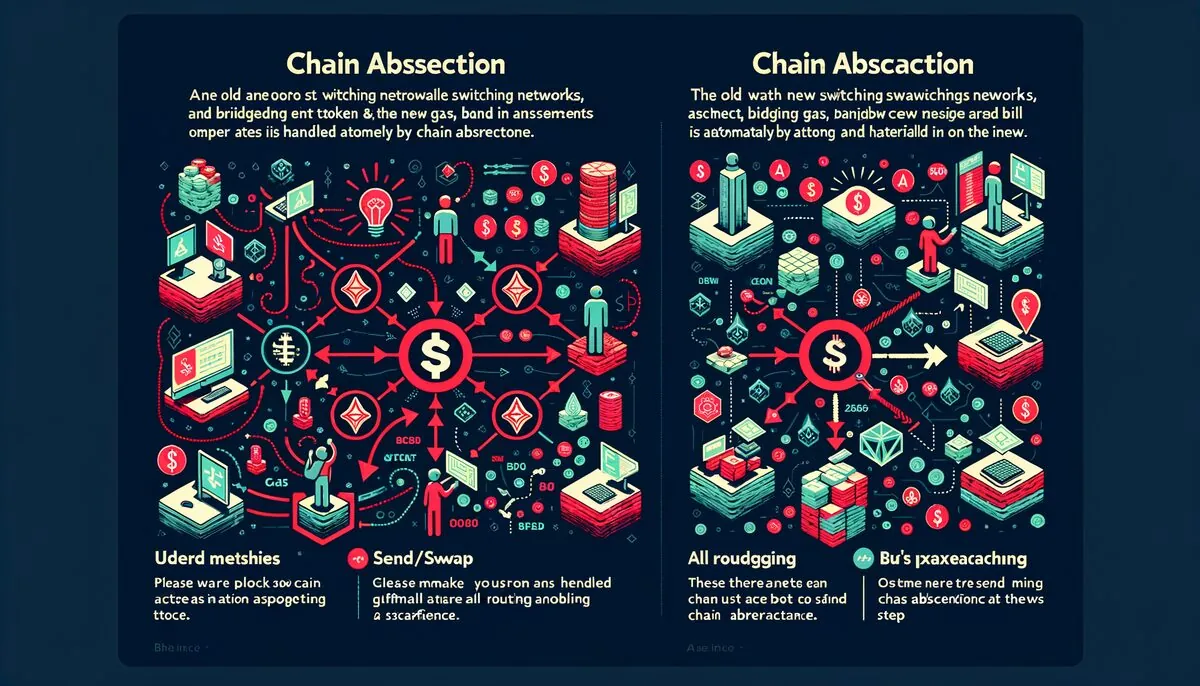
What does it actually feel like to use a chain-abstracted application? Imagine this scenario: Alice wants to buy an NFT listed on a marketplace built on Base. Her funds are spread across Ethereum mainnet (some ETH), Arbitrum (some USDC), and Polygon (some MATIC). In the old world, she would need to bridge USDC from Arbitrum to Base, swap some for ETH on Base for gas, navigate to the marketplace, and complete the purchase. Four separate interactions, three different networks, and at least 15 minutes.
With chain abstraction, Alice opens the marketplace, sees the NFT, clicks "Buy," and confirms a single transaction. Behind the scenes, the abstraction layer creates an intent to purchase the NFT. A solver picks up the intent, sources the necessary ETH from Arbitrum (swapping Alice's USDC), routes it to Base, buys the NFT, and delivers it to Alice's account. Total time: 5 to 15 seconds. Total user actions: one click and one confirmation.
This is not a hypothetical. Applications like these are already running in production in 2026. The gap between the vision and the reality has closed rapidly over the past 18 months as solver networks scaled, gas abstraction matured, and account abstraction (ERC-4337) gained widespread adoption.
Gas abstraction deserves special mention. One of the biggest friction points in multi-chain crypto has always been the need to hold native gas tokens on every chain you want to use. Chain abstraction eliminates this entirely. Users can pay fees in whatever token they already hold. The solver or relayer handles the gas token conversion on the backend. Some protocols even allow gasless transactions where the dApp sponsor pays all fees.
Intent-Based Architecture Explained
Intent-based architecture is the foundational design pattern that makes chain abstraction possible. It represents a shift from imperative to declarative transaction processing. Understanding this architecture is critical for grasping how chain abstraction achieves its performance and usability advantages.
In a traditional blockchain interaction, the user constructs a specific transaction: call function X on contract Y with parameters Z, using gas price W, on chain C. Every detail must be specified. If any parameter is suboptimal, the user gets a worse outcome. If the chain is congested, the transaction might fail.
In an intent-based system, the flow works differently:
This architecture has several powerful properties. First, it separates the "what" from the "how." Users express goals; solvers figure out execution. Second, competition among solvers ensures price efficiency. Third, the solver bears the execution risk, not the user. If a solver's execution plan fails partway through, the solver absorbs the loss while the user's intent simply goes back to the auction for another solver to fill.
The intent model also enables cross-chain atomic operations that would be impossible with traditional bridges. A single intent can trigger coordinated actions across five different chains, and the user experiences it as a single operation. This composability across chains is what makes chain abstraction truly transformative.
Security Considerations in Chain Abstraction
Security is the most important dimension of any cross-chain technology. The history of bridge exploits has made the crypto community rightfully cautious about new interoperability solutions. Chain abstraction protocols address security through several mechanisms, but they also introduce new attack vectors that users and developers should understand.
Solver risk: In an intent-based system, solvers are sophisticated actors that handle significant capital. If a solver is compromised or acts maliciously, they could front-run intents, deliver suboptimal execution, or fail to deliver at all. Protocols mitigate this through bonding requirements (solvers stake capital that gets slashed for misbehavior), reputation systems, and verification layers that check solver execution against intent specifications.
Verification layer security: The verification mechanism is the trust backbone of any chain abstraction protocol. Optimistic systems (like Across) assume honest behavior and only verify if challenged. ZK-based systems provide cryptographic proofs of correct execution. Validator-based systems rely on a committee to attest to cross-chain events. Each approach has tradeoffs:
Smart contract risk: Chain abstraction protocols still rely on smart contracts on each supported chain. These contracts handle intent settlement, solver payments, and user fund custody during transactions. Any vulnerability in these contracts could be exploited. The major protocols have undergone extensive auditing (Across has had audits by OpenZeppelin and Sherlock; NEAR has had audits by multiple firms), but no audit guarantees zero bugs.
Centralization vectors: Some chain abstraction implementations rely on centralized components, particularly in the solver selection and intent routing layers. If the entity running the orderbook or auction mechanism goes down or acts maliciously, the system can fail. Decentralizing these components without sacrificing performance remains an active area of development.
Users should evaluate chain abstraction protocols the same way they evaluate any DeFi protocol: check the audits, understand the trust assumptions, start with small amounts, and diversify across multiple solutions when possible.
How Developers Build Chain-Abstracted Apps
For developers, chain abstraction represents a massive simplification of the multi-chain development workflow. Instead of deploying contracts on every chain, maintaining bridge integrations, and building chain-selection UIs, developers integrate a single SDK that handles all cross-chain complexity.
Here is a simplified overview of what building a chain-abstracted dApp looks like in 2026:
Step 1: Choose an abstraction layer. Developers select a chain abstraction provider based on their needs. Socket is popular for its modularity. Particle Network offers the easiest onboarding with Universal Accounts. NEAR provides the deepest integration for projects willing to use NEAR as their base layer.
Step 2: Integrate the SDK. Most chain abstraction SDKs require fewer than 50 lines of code to integrate. The SDK handles wallet connection, chain detection, intent creation, solver interaction, and transaction settlement. Developers interact with a unified API regardless of which chains their users are on.
Step 3: Define supported operations. Developers specify which cross-chain operations their dApp supports. For a DEX, this might be cross-chain swaps. For a lending protocol, it might be cross-chain collateral deposits. The SDK translates these operations into intents that solvers can fulfill.
Step 4: Handle settlement callbacks. When a solver fulfills an intent, the dApp receives a callback confirming the result. Developers implement handlers for successful fills, partial fills (if supported), and failures. The SDK provides standardized events and error types.
Step 5: Test across chains. Chain abstraction SDKs typically include testnet environments that simulate multi-chain scenarios. Developers can test their dApp's behavior when users have funds on different chains, when solvers compete with different execution strategies, and when network conditions vary.
The development experience is evolving rapidly. In early 2025, building a chain-abstracted dApp required deep knowledge of cross-chain infrastructure. By mid-2026, it is becoming as straightforward as adding any other third-party SDK. This reduction in development friction is accelerating adoption and attracting developers who previously avoided multi-chain complexity.
The Future of Chain Abstraction
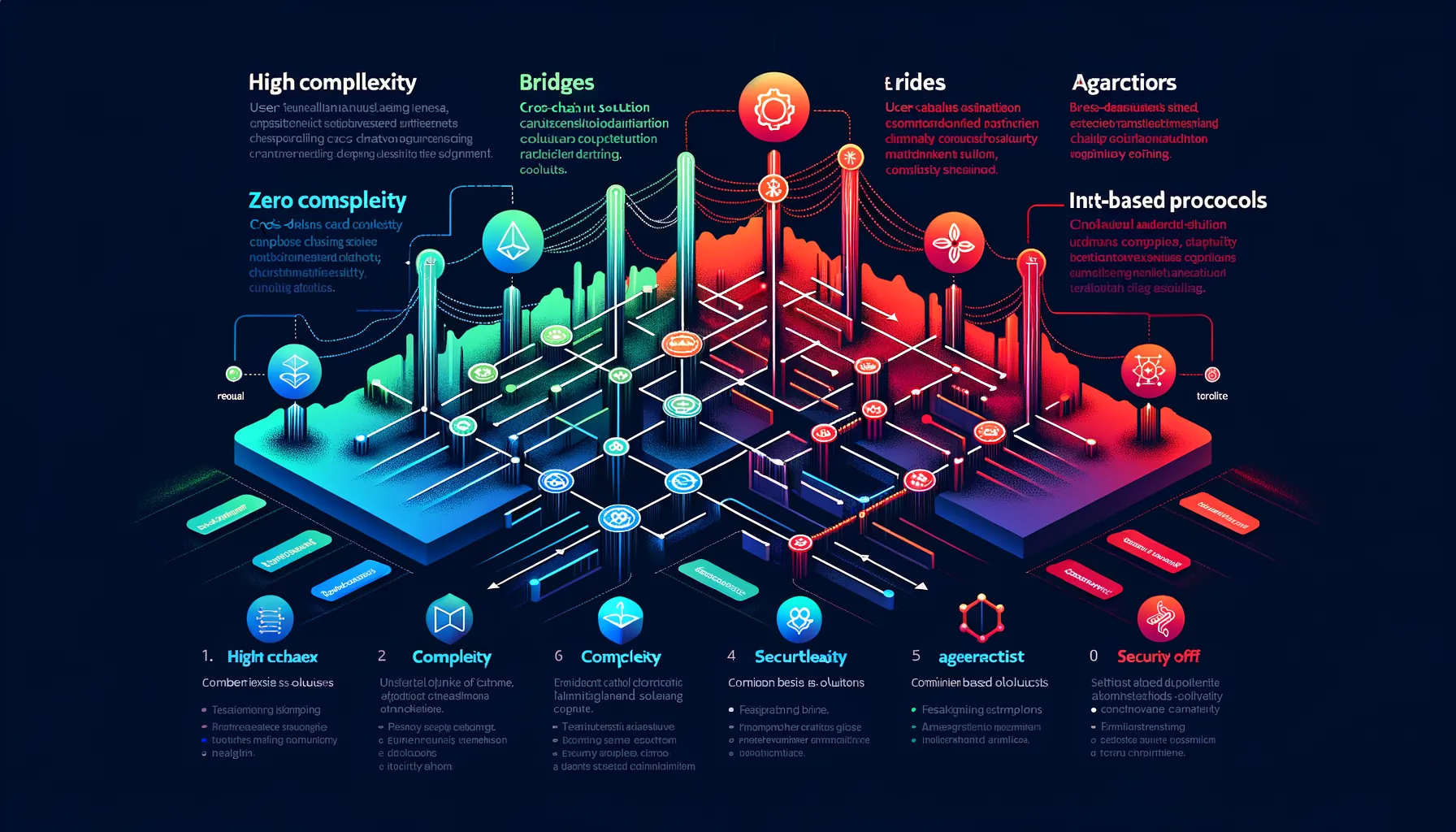
Chain abstraction is still in its early innings despite the significant progress made in 2025 and 2026. Several trends will shape its evolution over the next few years:
Standardization: Currently, each chain abstraction protocol has its own intent format, solver interface, and verification mechanism. Industry-wide standards are beginning to emerge through efforts like ERC-7683 (cross-chain intents standard) and the Chain Abstraction Working Group. Standardization will allow solvers to serve multiple protocols, increasing competition and reducing costs for users.
ZK maturation: Zero-knowledge proofs are becoming faster and cheaper. As ZK technology matures, more chain abstraction protocols will adopt ZK-based verification, offering cryptographic security guarantees without the challenge periods of optimistic systems. This will make chain abstraction safer and faster simultaneously.
Bitcoin and non-EVM integration: Most current chain abstraction solutions focus on EVM-compatible chains. Extending full chain abstraction to Bitcoin, Solana, Cosmos, Sui, Aptos, and other non-EVM ecosystems is a major growth frontier. NEAR's chain signatures already support Bitcoin, and other protocols are actively building non-EVM bridges.
AI-powered solvers: Machine learning is being applied to solver strategies, enabling more efficient route discovery, better price prediction, and faster response times. AI-powered solvers can analyze mempool data, predict gas prices, and optimize execution in ways that rule-based systems cannot.
Institutional adoption: As chain abstraction matures and security track records lengthen, institutional players will adopt these systems for cross-chain treasury management, multi-chain yield strategies, and unified reporting. Chainlink CCIP is already positioning for this market with its enterprise-grade cross-chain messaging.
Looking ahead: The endgame of chain abstraction is a crypto ecosystem where chains are like servers on the internet. They exist, they matter for performance and security, but users never think about them. We are perhaps 2 to 3 years from that reality becoming mainstream.
The competitive landscape is also likely to consolidate. Just as the early internet had hundreds of ISPs that consolidated into a handful of major providers, the chain abstraction space will likely see a few dominant platforms emerge. The winners will be those that offer the best combination of security, speed, cost, and developer experience.
Frequently Asked Questions
What is chain abstraction in simple terms?
Chain abstraction is technology that lets you use any blockchain application without worrying about which blockchain it runs on. It handles all the behind-the-scenes work of moving assets between chains, paying gas fees, and routing transactions. Think of it like how you use the internet without knowing which servers your data passes through.
Does chain abstraction replace bridges entirely?
Not entirely, but it makes bridges invisible to users. Chain abstraction protocols may still use bridge-like mechanisms under the hood, but users never interact with them directly. The key difference is that bridges are user-facing tools requiring manual operation, while chain abstraction handles cross-chain transfers automatically as part of a seamless user experience. Over time, as chain abstraction matures, traditional bridge UIs will become increasingly obsolete for everyday users.
Is chain abstraction safe to use?
Chain abstraction protocols have different security models, and no system is perfectly safe. However, many chain abstraction designs are actually safer than traditional bridges because they do not require large pools of locked assets that attract hackers. Intent-based systems with solver competition distribute risk across many actors rather than concentrating it in a single contract. Always check audit reports, start with small amounts, and use established protocols with proven track records.
Which chains does chain abstraction support?
Most chain abstraction protocols in 2026 support major EVM chains including Ethereum, Arbitrum, Optimism, Base, Polygon, BNB Chain, Avalanche, and several others. Leading protocols like NEAR also support non-EVM chains including Bitcoin and Solana. Coverage is expanding rapidly, and most new L2s and L3s are prioritizing chain abstraction compatibility from day one.
How much does chain abstraction cost compared to traditional bridging?
Chain abstraction is often cheaper than traditional bridging because solver competition drives down costs. Users typically pay a small solver fee (often 0.01% to 0.1% of the transaction value) instead of bridge fees plus gas on multiple chains. Some dApps even sponsor all fees, making cross-chain operations completely free for users. The total cost depends on the specific protocol, the chains involved, and network congestion at the time of the transaction.
What is the difference between chain abstraction and account abstraction?
Account abstraction (ERC-4337) changes how individual wallets work on a single chain, enabling features like gas sponsorship, batched transactions, and social recovery. Chain abstraction operates at a higher level, making multiple blockchains work together seamlessly. The two technologies are complementary: account abstraction improves the wallet experience on each chain, while chain abstraction connects those chains together. Many chain abstraction solutions use account abstraction as a building block.
Can developers integrate chain abstraction into existing dApps?
Yes. Most chain abstraction SDKs are designed for easy integration into existing applications. Developers typically need to add the SDK, replace chain-specific transaction logic with intent-based calls, and update their frontend to remove chain selection UIs. The process can take as little as a few days for simple applications, though complex DeFi protocols may need several weeks to fully integrate cross-chain functionality.
What are intents in the context of chain abstraction?
Intents are signed messages from users that describe a desired outcome rather than specific transaction steps. For example, instead of saying "swap token A for token B on DEX X on chain Y," an intent says "I want to receive at least N units of token B in exchange for M units of token A." Specialized actors called solvers then compete to fulfill the intent in the most efficient way possible. This declarative model is what allows chain abstraction to optimize execution across multiple chains automatically.
Will chain abstraction make individual blockchains irrelevant?
No. Individual blockchains will continue to matter for security, performance, and governance. Different chains offer different tradeoffs in terms of decentralization, throughput, finality time, and cost. What chain abstraction does is remove the requirement for end users to understand and manage these differences. Developers and infrastructure providers will still choose specific chains for specific use cases, but users will interact with applications without needing to know or care which chain is running underneath.
Frequently Asked Questions
What is chain abstraction?
Chain abstraction is a technology that allows users to interact with multiple blockchain networks without needing to understand or manage the complexities of each individual chain. It aims to create a unified user experience across the decentralized web.
How does chain abstraction differ from bridging?
Bridging typically involves moving assets between two specific blockchains, often creating wrapped versions of tokens. Chain abstraction focuses on abstracting away the underlying chain, allowing users to initiate transactions or access dApps on any supported chain from a single interface.
What problem does chain abstraction solve?
It addresses the fragmentation and complexity of the current multi-chain ecosystem. Users often need to manage multiple wallets, understand different gas tokens, and navigate various bridges, which can be a barrier to broader adoption.
What are the benefits of chain abstraction for users?
Users can experience simplified transactions, reduced friction when interacting with dApps across chains, and potentially lower transaction costs by optimizing routing. It aims for a more seamless and intuitive Web3 experience.
When is chain abstraction expected to be widely available?
While development is ongoing, significant advancements and broader adoption of chain abstraction solutions are anticipated around 2026, as the technology matures and integrates into more platforms.
Related Guides
- NEAR Chain Abstraction Explained: Nightshade, Signatures and AI Infra (2026)
- What Is Biconomy: Account Abstraction, Gasless UX and Cross-Chain Execution (2026)
- How Wrapped ETH Works in DeFi: WETH Guide for 2026
- What is zkSync Era? Account Abstraction L2 Explained
- What Is Biconomy: Account Abstraction, Gasless UX and Smart Account Infrastructure (2026)