What is Hivemapper? Drive-to-Earn Mapping Explained

Centralized mapping fleets are expensive, slow, and outdated. We break down Hivemapper's decentralized physical infrastructure model, the tech behind the Bee dashcam, and how drivers earn HONEY tokens.
The Cartography Monopoly: Crowdsourcing the Living Web of Roads
- Hivemapper completely disrupts this infrastructure layer by introducing a decentralized physical infrastructure network (DePIN). Operating natively on top of the high-throughput Solana blockchain, Hivemapper crowdsources street-level imagery collection from everyday commuters, commercial delivery fleets, and rideshare drivers. By shifting map production from a corporate overhead expense to a community-driven incentive model, Hivemapper continuously refreshes the global map at a fraction of the cost of traditional tech giants.
- Building and maintaining high-definition global maps has historically been a multi-billion dollar monopoly controlled by centralized technology conglomerates. Legacy services rely on expensive dedicated fleets of mapping vehicles outfitted with custom sensor arrays, navigating global streets once every few months or years. This centralized model results in highly fragmented, outdated maps that fail to reflect fast-changing real-world conditions like new road layouts, construction hazards, or updated speed limit zones.
1. The Hardware on Hivemapper Infrastructure: Embracing the Bee Dashcam
- The core data ingestion mechanism of Hivemapper depends entirely on certified, vehicle-mounted hardware tracking devices. While early network growth was powered by first-generation cameras, the modern architecture has completely centralized around the third-generation mapping device known as the Bee Dashcam.
- To understand the ecosystem's commercialization path, you must recognize the distinction between its base open-source architecture and its enterprise-facing applications. The Hivemapper Network represents the open-source, decentralized mapping layer built on the ledger. Conversely, Bee Maps functions as the specialized commercial platform that packages this crowdsourced, raw map data into developer-friendly APIs, map features, and dynamic street-view assets for enterprise mapping clients.
2. The Economic Engine: Earning $HONEY Rewards
The protocol incentivizes global data collection by distributing its native utility asset, the HONEY token. Instead of handing out flat payouts, the reward allocation engine runs an algorithmic matrix that evaluates the unique cryptoeconomic value of each data upload.
The distribution mechanism grades your contributions across four foundational pillars:
Novelty: Measures how recently a specific road coordinate was last updated. Driving through an unmapped rural corridor or refreshing a road that hasn’t been seen in weeks yields significantly higher rewards than cruising down a heavily saturated urban highway.
Reputation: Evaluates the contributor's historical data consistency. Operators who maintain steady uptime and exhibit low error frequencies establish high reputation scores, maximizing their baseline token payouts.
Clarity: Employs computer vision to inspect the raw imagery. If your dashcam suffers from a obstructed window view, heavy rain distortions, or incorrect mounting angles, the protocol automatically downgrades the payout weight.
Bounties: Specific high-priority target regions outlined by enterprise clients. When a mapping customer requires immediate, hyper-fresh tracking data for a specific logistics corridor, the network spins up targeted bounty multipliers to incentivize localized driver routing.
3. Edge AI Processing and Computer Vision Metadata
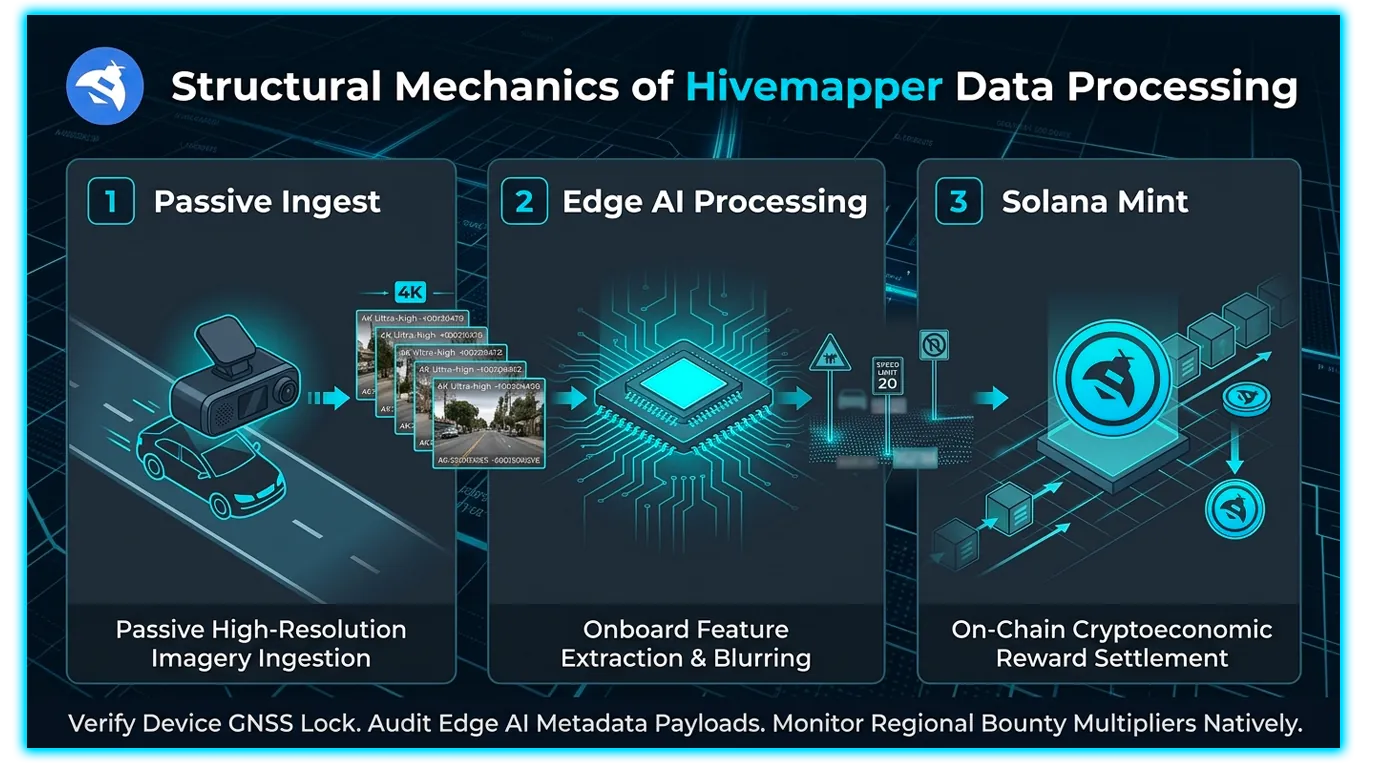
Uploading billions of raw 4K images to a central cloud server introduces immense network data charges and server computing bottlenecks. To scale globally, Hivemapper relies heavily on onboard edge computing.
The Bee dashcam operates less like a standard video recorder and more like an advanced driver assistance system (ADAS). Powered by an integrated machine learning microprocessor delivering substantial processing performance, the camera runs computer vision models directly on the device:
Instant Privacy Blurring: The onboard processor identifies and applies local blurring filters to human faces and vehicle license plates at the edge before data ever exits the device, ensuring strict compliance with global data privacy frameworks.
Dynamic Metadata Compacting: Instead of transmitting massive video files, the Bee detects both static landmarks (like stop signs and speed limits) and dynamic changes (like active road closures), translates them into compact metadata strings, and beams a lightweight telemetry footprint back to the network. This minimizes cellular data utilization while dramatically speeding up global map synchronization.
Mapping Infrastructure Comparison Matrix
| Device Model | Upload Architecture | Edge AI Capability |
| Legacy HDC Line | App Bridge Needed | Cloud-Heavy Processing |
| Modern Bee Series | Standalone WiFi / LTE | Onboard 5.1 TOPS Engine |
4. Evaluating DePIN Market Assets via DEXTools Telemetry
- Evaluating the financial health of DePIN projects requires robust visibility into circulating asset markets. Accessing comprehensive decentralized analytics through specialized networks like DEXTools gives the Web3 community a universal cockpit to monitor real-time token behaviors, assess exchange liquidity pool configurations, and audit live smart contracts across various ledgers.
- By checking data streams inside the Pair Explorer, monitoring immediate deployments via the Live New Pairs dashboard, or analyzing investor behaviors through Top Traders or Trade Story records, technical analysts can evaluate local volume trends, watch institutional movements via the Big Swap Explorer, and audit contract trust metrics before transacting, helping your hardware validator assets engage safely with verified trading environments.
You can access DEXTools here and start trading today!
Disclaimer: This article is for informational purposes only and does not constitute investment advice, financial advice, trading advice, or any other kind of advice. DEXTools does not recommend buying, selling, or holding any cryptocurrency or token. Users should conduct their own research and consult with a qualified financial advisor before making any investment decisions. Cryptocurrency investments are volatile and high-risk. DEXTools is not responsible for any losses incurred.
The Decentralized Mapping Data Flywheel
While the surface-level appeal of Hivemapper is the drive-to-earn model, the true innovation lies in the creation of a self-sustaining, decentralized mapping data flywheel. Traditional mapping companies face immense friction in scaling their data collection, often relying on expensive, proprietary fleets and manual processing. Hivemapper flips this script, leveraging a global network of contributors to continuously refresh and expand its map data.
This decentralized approach isn't just about cost savings; it's about speed and granularity. As more drivers contribute, the map becomes denser, more up-to-date, and more resilient to changes in the physical world. This rich, real-time data then attracts a wider array of data consumers, from logistics companies optimizing routes to autonomous vehicle developers refining their perception systems. The revenue generated from data sales then flows back into the network, incentivizing more contributors and further accelerating the data collection cycle.
Beyond the Dashcam: The Data Value Proposition
- Freshness Advantage: Traditional maps can be months or even years out of date. Hivemapper's continuous data stream provides near real-time updates.
- Global Coverage: Incentivized contributors can map areas that are economically unviable for centralized fleets to cover.
- Granular Detail: The collective effort captures minute details like lane closures, new construction, and road conditions more effectively.
- API Accessibility: Data consumers can access specific, high-quality map data segments on demand, paying for what they need.
- Verifiable Data: Blockchain records and community consensus help ensure the integrity and accuracy of collected map data.
Related Guides
- What Is Hivemapper (HONEY)? DePIN Mapping Network and Bee Dashcam Guide 2026
- Exit Liquidity Mapping: Who Might Sell Into You Before You Buy?
- OKX Tutorial: Wallet, DEX, and Earn Products Explained
- Tap-to-Earn Games on TON: Notcoin, Hamster Kombat and Beyond (2026)
- Play-to-Earn vs Play-to-Own: GameFi Evolution Since 2021
Frequently Asked Questions
What is Hivemapper?
Hivemapper is a decentralized mapping network where contributors collect street-level imagery and earn token rewards. It aims to build map data through a distributed community rather than a centralized fleet.
How does drive-to-earn work with Hivemapper?
Drivers use a compatible dashcam to capture road imagery as they drive, contributing data to the network. In return, they can earn the network's token based on their contributions.
What is the Bee dashcam used for?
The dashcam is the hardware used to capture the street-level imagery that feeds the mapping network. Mounting it and driving normally allows contributors to gather map data.
What are the risks of earning with Hivemapper?
Risks include token price volatility, uncertain and variable rewards, and the upfront cost of hardware that may not be recovered. Earnings depend on network demand and contribution quality.