Play-to-Earn vs Play-to-Own: GameFi Evolution Since 2021
— By AliceOnChain in Tutorials
The transition from speculative Play-to-Earn models to sustainable Play-to-Own ecosystems has fundamentally altered the Web3 gaming landscape. This deep dive analyzes the macroeconomic shifts, structural tokenomic overhauls, and essential on-chain verification metrics that modern blockchain traders and players use to navigate the evolving GameFi sector.
Play-to-Earn vs Play-to-Own: What Changed Since 2021
The year 2021 served as a structural milestone for blockchain-based gaming. Driven by unprecedented capital inflows, macroeconomic liquidity, and pioneering GameFi ecosystems, the ongoing debate of Play-to-Earn vs Play-to-Own captured global attention. Millions of active addresses interacted with early smart contracts, viewing digital environments not merely as entertainment, but as primary income generators.
However, the initial architecture relied heavily on continuous user acquisition to sustain token valuation. When player growth decelerated, inflationary pressure on in-game reward tokens outpaced organic demand, precipitating severe liquidity adjustments across the sector and forcing developers to re-evaluate the Play-to-Earn vs Play-to-Own framework.
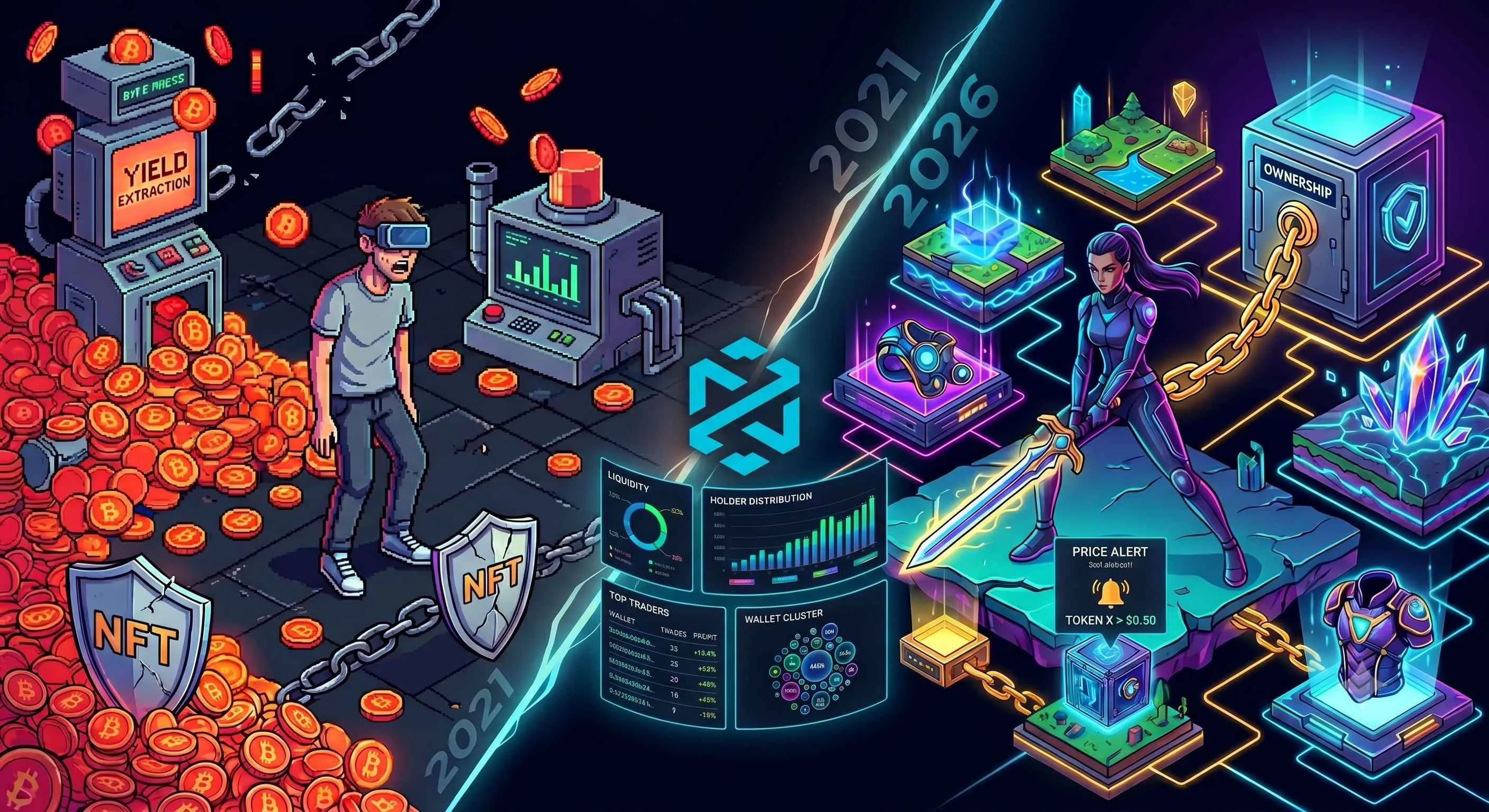
Five years later, the Web3 gaming paradigm has fundamentally matured. The industry has increasingly migrated away from hyper-inflationary reward loops, making the Play-to-Earn vs Play-to-Own transition one of the most significant architectural overhauls in crypto history. This structural shift prioritizes sustainable economic design, true asset ownership, and organic player retention over pure yield extraction. For on-chain analysts, traders, and participants, navigating this new landscape requires a deep understanding of the Play-to-Earn vs Play-to-Own dynamic, how token structures have evolved, and how to verify game health using raw on-chain data.
The Structural Mechanics of Play-to-Earn (P2E)
To understand what changed during the Play-to-Earn vs Play-to-Own evolution, one must examine the mechanics that powered the 2021 P2E bull market. Most P2E ecosystems operated on a dual-token model: a volatile governance token with a capped supply and an inflationary utility token with an uncapped supply used exclusively for in-game distributions.
In theory, this decoupled governance from daily gameplay utility. In practice, the legacy side of the Play-to-Earn vs Play-to-Own equation functioned as a continuous sell pressure engine. Players earned tokens through repeatable activities and immediately routed them to decentralized exchanges (DEXs) to capitalize on dollar-denominated value.
Because the utility token lacked structural sinks-meaning use cases that permanently consume or lock tokens out of circulation-the asset’s price action depended entirely on new capital entering the ecosystem to buy the assets required for entry. This reflexivity created extreme upside volatility during periods of high adoption. However, it also exposed the fundamental vulnerability in the early Play-to-Earn vs Play-to-Own model, where prolonged downward trends occurred when the issuance rate structurally overwhelmed the available liquidity pools.
The Shift to Play-to-Own (P2O)
The modern Play-to-Earn vs Play-to-Own paradigm addresses these systemic imbalances by refocusing on player utility and sustainable asset distribution. Rather than promising continuous monetary extraction, contemporary game design treats blockchain infrastructure as an ownership layer for digital property rights.
In an environment focused on Play-to-Earn vs Play-to-Own sustainability, games are designed as high-fidelity entertainment products first. Web3 integrations focus on non-fungible tokens (NFTs) and fungible assets that represent verified ownership of scarce in-game items, land, or achievements.
The core distinction lies in the economic incentive structure of the Play-to-Earn vs Play-to-Own thesis. In P2E, players primarily expect liquid cash flows for their time. In P2O, players accumulate digital assets that retain utility within an active economy, with the option to trade them on secondary markets. Capital preservation and organic demand replace speculative yield as the primary drivers of ecosystem value, redefining the benchmark for Play-to-Earn vs Play-to-Own performance.
Tokenomic Evolution: Inflation vs. Sustainability
The practical transition within the Play-to-Earn vs Play-to-Own matrix has fundamentally altered how developers structure crypto gaming assets. Several notable shifts define modern GameFi tokenomics:
Dynamic Emission Schedules
Early iterations featured rigid emission schedules that minted reward tokens regardless of market conditions. Modern architectures addressing the Play-to-Earn vs Play-to-Own gap often implement dynamic emission models that adjust minting rates based on active user metrics, overall economic velocity, and the depths of available automated market maker (AMM) liquidity.
Complex Token Sinks and Deflationary Vectors
To prevent the rapid depreciation observed in 2021-2022, contemporary designs incorporate robust sink mechanisms. Within the Play-to-Earn vs Play-to-Own framework, tokens are structurally consumed through crafting, upgrading, entry fees for competitive modes, and cosmetic customization. This converts circulating supply back into non-liquid or burned states, balancing the economic scale.
Value Capture via Platform Fees
Rather than relying on continuous token issuance to fund operations, modern gaming protocols focus on organic revenue generation. Transaction fees from native marketplaces, asset modification protocols, and tournament entry fees are accumulated and routed back to support liquidity pools or reward long-term governance participants, separating sustainable projects from outdated historical structures.
On-Chain Analysis: Evaluating Modern GameFi Ecosystems
For anyone analyzing the Web3 gaming sector, relying on surface-level social sentiment or marketing metrics is insufficient. True structural health is visible exclusively on-chain. Evaluating a project within the context of the Play-to-Earn vs Play-to-Own paradigm requires examining the underlying smart contracts, token distribution pools, and market liquidity depth.
Monitoring Liquidity and Volume
Healthy asset economies require deep, resilient liquidity. When analyzing a gaming token on the DEXTools Pair Explorer, look closely at how the Play-to-Earn vs Play-to-Own model impacts the relationship between the Total Value Locked (TVL) in the liquidity pool and the daily trading volume. A high volume-to-liquidity ratio can signal heightened short-term speculative volatility. Conversely, a stable pool with deep liquidity and consistent organic volume indicates a mature trading ecosystem capable of absorbing typical market adjustments without severe price slippage.
Assessing Holder Distribution and Concentration
A primary vulnerability of early projects was the heavy concentration of tokens held by early insiders or institutional yield farms, which often resulted in sudden market imbalances. Utilizing advanced on-chain analysis features, such as the built-in Bubblemaps integration on DEXTools, allows analysts to visually map out wallet clusters to see how capital is distributed.
If significant percentages of the circulating supply are linked through hidden intermediary wallets to a central deployer, the risk of synchronized distribution increases. A decentralized holder base, showing widespread retail interaction and steady accumulation, suggests a healthier market structure that has successfully moved past old inflationary mechanics.
Analyzing Smart Contract Security
The technical integrity of GameFi smart contracts is paramount. Many legacy projects suffered from catastrophic balance exploits or malicious contract changes. Before allocating capital or interacting with a protocol, review automated smart contract verification tools. Pay attention to critical parameters: Is the contract ownership renounced? Are there hidden mint functions that could dilute holders unexpectedly? Checking these variables directly on the DEXTools pair dashboard helps mitigate smart contract risk.
Technical Indicators and Market Sentiment
While fundamental on-chain analysis reveals long-term viability, price action and technical analysis provide execution context for active traders tracking GameFi assets.
Identifying Support and Resistance Levels
Evolving tokens often exhibit cyclical behavior tied to major game development updates, alpha releases, or macro sentiment shifts. Identifying long-term horizontal support zones helps establish where historical buying interest has materialized. Resistance levels, particularly near previous distribution peaks, can signal where profit-taking might occur.
Momentum Divergences
Monitoring momentum oscillators, such as the Relative Strength Index (RSI), can help clarify market direction. For instance, if a gaming token creates a lower low on the price chart while the RSI forms a higher low, this classic bullish divergence often suggests that the selling pressure is decelerating, indicating a potential stabilization phase. Conversely, bearish divergences at local highs may suggest that upward momentum is losing structural backing.
Managing High Volatility
Even structurally sound assets remain high-beta tokens subject to rapid shifts in market sentiment. Utilizing automated tools like DEXTools Price Alerts allows participants to monitor key price thresholds without falling victim to emotional overtrading or impulsive decision-making. Setting alerts at major historical breakout zones or breakdown levels ensures execution discipline across any market regime.
The Future Blueprint of Web3 Infrastructure
The progression across the Play-to-Earn vs Play-to-Own spectrum represents the natural maturation of the crypto asset class. By moving away from hyper-inflationary reward structures and embracing sustainable, player-centric digital ownership, the current generation of Web3 titles is building foundations designed to withstand multi-year market cycles.
Success in this evolving sector relies on rigorous, objective data validation. By combining fundamental tokenomic assessments with live on-chain metrics-such as tracking liquidity health, visualizing holder clusters, and validating contract security-market participants can look past speculative trends and identify ecosystems built for genuine longevity.
- CEX Deposit Pressure: How Exchange Inflows Can Signal Future Selling
- What Is RSI in Crypto? Beginner Guide to the Relative Strength Index (2026)
- How to Read Liquidity Pool Data Before Buying a Token (2026)
- Pair Explorer Data Trend Reversals: A Pro Trading Guide
Disclaimer: This article is for informational purposes only and does not constitute investment advice, financial advice, trading advice, or any other kind of advice. DEXTools does not recommend buying, selling, or holding any cryptocurrency or token. Users should conduct their own research and consult with a qualified financial advisor before making any investment decisions. Cryptocurrency investments are volatile and high-risk. DEXTools is not responsible for any losses incurred.
Related Guides
- What is GameFi? A Beginner’s Guide to Crypto Gaming
- Top 5 GameFi Crypto Games to Watch in 2026
- Ethereum Yield Evolution: Liquid Staking vs. Restaking
- How AI Trading Tools Are Revolutionizing Crypto Markets
- Micro-Exit Planning: How to Leave a Thin Pool Without Destroying Your Own Price
Frequently Asked Questions
What is the difference between play-to-earn and play-to-own?
Play-to-earn focuses on rewarding players with tokens for activity, while play-to-own emphasizes true ownership of in-game assets that players control as NFTs or tokens. Play-to-own aims for more sustainable value tied to gameplay rather than constant token emissions.
Why did many play-to-earn games struggle?
Many relied heavily on new players buying in to fund rewards, which is difficult to sustain when growth slows. When token emissions outpaced real demand, reward values often declined sharply.
What does owning an in-game asset as an NFT mean?
It means the asset is recorded onchain under the player's wallet, so they can hold, trade, or sell it independently of a single game server. This can give players more control compared with traditional games where items stay locked in the publisher's system.
What is GameFi?
GameFi combines gaming with decentralized finance elements, letting players interact with tokens, NFTs, and onchain economies inside games. It blends entertainment with the ability to own and trade digital assets.