Decentralized Physical Infrastructure (DePIN) Explained

Building real-world physical networks no longer requires centralized billions in upfront CapEx. We break down the tokenomic inner layers of DePIN, the BME economic model, and the hardware categories driving the decentralized economy.
The Real-World Revolution: Bootstrapping Hardware via Cryptoeconomics
- Decentralized Physical Infrastructure Networks (DePIN) invert this architecture completely. By utilizing open-source blockchain coordination and token incentives, DePIN crowdsources the construction and operation of physical hardware from a global network of independent contributors. This guide breaks down the structural tokenomics of the Burn-and-Mint Equilibrium model and maps the core functional categories defining the DePIN landscape.
- The rollout of traditional physical infrastructure has historically been the exclusive playground of monopolistic conglomerates and state agencies. Deploying telecommunications grids, global server hubs, cloud storage facilities, or energy distribution networks requires immense upfront capital expenditure (CapEx), decades of bureaucratic approvals, and massive centralized workforces. This top-down corporate model leaves users at the mercy of extractive pricing, arbitrary service limitations, and single-point-of-failure regional outages.
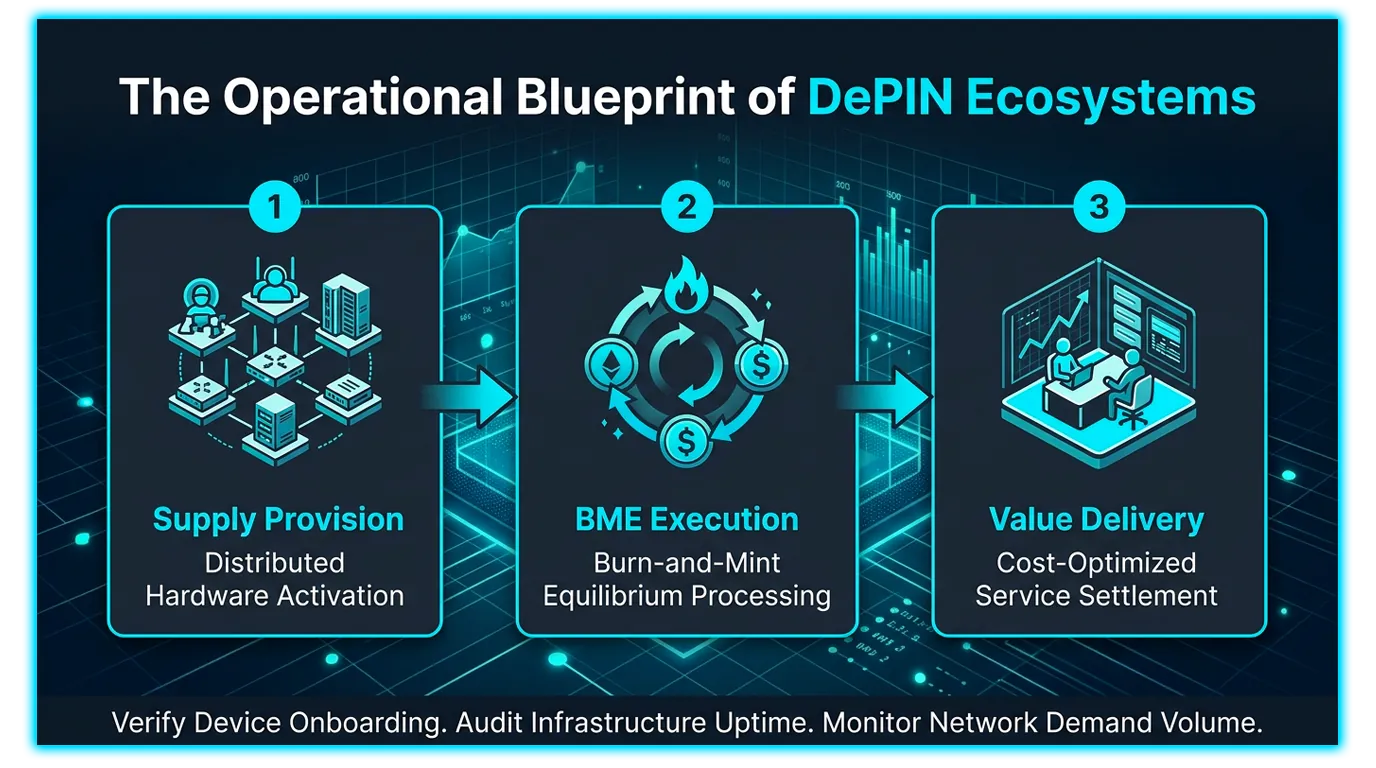
1. The Financial Engine: The Burn-and-Mint Equilibrium (BME) Model
- The primary challenge plaguing real-world infrastructure protocols is balancing token market volatility with the predictable cost structures demanded by mainstream enterprise clients. An artificial intelligence startup cannot accurately forecast its operation budgets if its core cloud computing costs swing wildly based on speculative trading volumes.
To solve this friction, mature DePIN networks utilize a tokenomic framework known as the Burn-and-Mint Equilibrium (BME) model.
The BME framework decouples asset volatility from end-user costs through a two-token balancing loop:
The Consumption Burn: Enterprise clients purchase services using a predictable, fiat-pegged credit unit (like Data Credits). Under the hood, the protocol acquires an equivalent market value of its native utility tokens and programmatically burns them, removing them from circulation forever. This directly ties token scarcity to real-world usage volume.
The Supplier Mint: Independently, the blockchain follows a programmatic emission schedule to mint brand-new native tokens, distributing them straight to the physical hardware operators as payment for verified uptime, coverage, or data throughput.
If real network usage is high, the volume of burned tokens exceeds the programmatic mint velocity, causing the underlying asset supply to become net deflationary and rewarding long-term network stake allocators.
2. Navigating the Core DePIN Categories
The DePIN ecosystem divides its real-world physical networks into distinct functional asset tracks.
The Decentralized Wireless Category (DeWi)
Wireless DePIN projects democratize telecommunications and connectivity networks by transforming individuals into independent network nodes. Providers install physical hotspots, 5G cellular antennas, or IoT routers in their homes or offices. These localized edge nodes mesh together to deliver high-quality, long-range connectivity at a fraction of the cost of legacy telecom monopolies. Helium stands as the primary pioneer of this sector, maintaining real-world mobile data offload utilities across extensive retail networks.
Decentralized Storage Networks
Rather than storing sensitive enterprise archives inside centralized corporate database complexes, decentralized storage frameworks segment, encrypt, and scatter data blocks across a global mesh of underutilized hard drives. No single entity holds the master key to your raw information. Protocols like Filecoin and Arweave utilize specialized cryptographic proof chains to ensure files are continuously preserved, establishing permanent, unalterable information storage structures.
Decentralized Compute Networks
Driven by the structural compute crunch of generative AI scaling, decentralized compute markets aggregate global processing units (GPUs) and central processors (CPUs). Platforms like Render Network, io.net, and Akash Network function as flexible infrastructure matchmakers. Solo developers can instantly rent high-performance hardware clusters for rendering or AI model training at immense cost discounts relative to traditional cloud providers, while operators convert idle computing silicon into consistent economic returns.
Decentralized Energy & Utility Grids
The frontier of the infrastructure space focuses on peer-to-peer energy distribution, mobility telemetry, and distributed sensing assets. Contributors deploy hardware modules to collect environmental analytics, mapping conditions, or vehicular telemetry data. Additionally, distributed energy networks enable localized solar panel networks or battery cells to trade excess electrical capacities trustlessly on open-source ledgers, optimizing energy efficiency across localized micro-grids.
DePIN Core Architecture Matrix
| Sector | Core Asset | Target Monopoly | Key Example |
| Wireless | 5G / IoT Hotspots | Big Telecom | Helium |
| Storage | Hard Drive Space | Central Cloud | Filecoin |
| Compute | High-End GPUs | AWS / Azure | Render |
| Energy | Grid Hardware | Utility Monopolies | Micro-grids |
Tracking Physical Asset Progress via DEXTools Telemetry
Analyzing the macroeconomic health of physical networks requires deep, on-chain structural data visibility to evaluate true consumer demand. Utilizing advanced decentralized charting architectures like DEXTools gives market participants an essential universal platform to monitor live token behaviors, evaluate pool depths, and inspect contract parameters across all public execution networks. By leveraging core features like the Pair Explorer, Live New Pairs dashboard, and the integrated Trade Story or Top Traders diagnostic tools, technical traders can seamlessly audit localized volume trends, track large whale wallet capital reallocations via the Big Swap Explorer, and check automated contract safety scores before initiating any on-chain interactions, ensuring your hardened hardware setup interacts safely with verified market venues.
You can access DEXTools here and start trading today!
Top 5 DePIN Projects in 2026: Decentralized Physical Infrastructure Leading the Way Top 5 Whale Tracking Tools in 2026: Large Wallet Monitoring Across Chains What Is Render Network (RNDR/RENDER)? Decentralized GPU DePIN Guide 2026 What Is DePIN: Complete Decentralized Physical Infrastructure Networks Guide (2026)Disclaimer: This article is for informational purposes only and does not constitute investment advice, financial advice, trading advice, or any other kind of advice. DEXTools does not recommend buying, selling, or holding any cryptocurrency or token. Users should conduct their own research and consult with a qualified financial advisor before making any investment decisions. Cryptocurrency investments are volatile and high-risk. DEXTools is not responsible for any losses incurred.
Related Guides
- What Is DePIN: Complete Decentralized Physical Infrastructure Networks Guide (2026)
- Top 5 DePIN Projects in 2026: Decentralized Physical Infrastructure Leading the Way
- What Is Render Network (RNDR/RENDER)? Decentralized GPU DePIN Guide 2026
- What Is io.net? The Decentralized GPU Network Powering AI on Solana in 2026
- What Is Aethir (ATH)? The Decentralized GPU Cloud Powering AI and Gaming in 2026
Frequently Asked Questions
What is DePIN in crypto?
DePIN stands for decentralized physical infrastructure networks, which use token incentives to coordinate many independent operators who contribute real world hardware such as sensors, storage, wireless, or computing. The goal is to build physical networks without a single centralized owner funding all the equipment.
How do DePIN tokens create incentives?
DePIN projects typically reward participants with tokens for supplying and maintaining hardware that provides a useful service, while users may pay tokens to consume that service. This links network growth to economic rewards for contributors.
What kinds of hardware do DePIN networks use?
DePIN networks span several categories, including computing and GPU resources, data storage, wireless connectivity, mapping and sensors, and energy related infrastructure. Each category coordinates physical devices through a shared token based system.
How is DePIN different from traditional infrastructure companies?
Traditional infrastructure is usually built and owned by a single company that funds the capital expense upfront, while DePIN distributes ownership and costs across many independent operators coordinated by a protocol. This can lower the barrier to participating in network buildout.