OKX Tutorial: Wallet, DEX, and Earn Products Explained
Unifying centralized exchange liquidity with decentralized web3 autonomy minimizes market friction. We break down OKX advanced trading, keyless MPC wallets, and X Layer mechanics.
What is OKX
- OKX is one of the largest centralized cryptocurrency spot and derivatives marketplaces and an expansive Web3 technology infrastructure provider. Founded in 2017 and operating globally under strict tier-1 virtual asset regulatory frameworks, the ecosystem clears billions of dollars in daily transactions.
- Rather than functioning as a standard token marketplace, OKX delivers a comprehensive portal that unifies high-frequency centralized matching engines with a native Layer 2 scaling blockchain, a self-sovereign multi-chain Web3 wallet app, decentralized exchange routing engines, and automated passive asset optimization vaults for tens of millions of global users.
- To maintain seamless compliance across heavily fragmented global jurisdictions, the parent group operates via geographically ring-fenced corporate subsidiaries. These regional OKXs (spanning specific licensed operational hubs in Europe, Dubai, Australia, and the Bahamas) each enforce custom token listing parameters, localized banking access paths, and tailored consumer safety standards to align strictly with their respective local virtual asset regulatory frameworks.
The Unified Interface: Merging CeFi Liquidity with Web3 Autonomy
- Navigating contemporary digital asset markets often forces users to choose between two conflicting operational environments. Centralized exchanges (CeFi) offer deep liquidity books, low trading execution fees, and high-leverage derivatives, but require sacrificing asset custody to a centralized intermediary.
- Conversely, decentralized web3 architectures provide absolute asset sovereignty and permissionless access to applications, but expose retail participants to high network gas fees, complex manual cross-chain bridging routes, and fragmented pool depths.
- OKX bridges this historic structural divide. By running a centralized trading house alongside a non-custodial web3 portal within a single interface, the platform serves as a versatile ecosystem for modern financial market participants. This comprehensive tutorial details how to navigate the centralized spot and derivatives books, leverage the non-custodial wallet framework, execute cross-chain swaps via its decentralized exchange (DEX) aggregator, and deploy idle assets into interest-bearing Earn vaults.
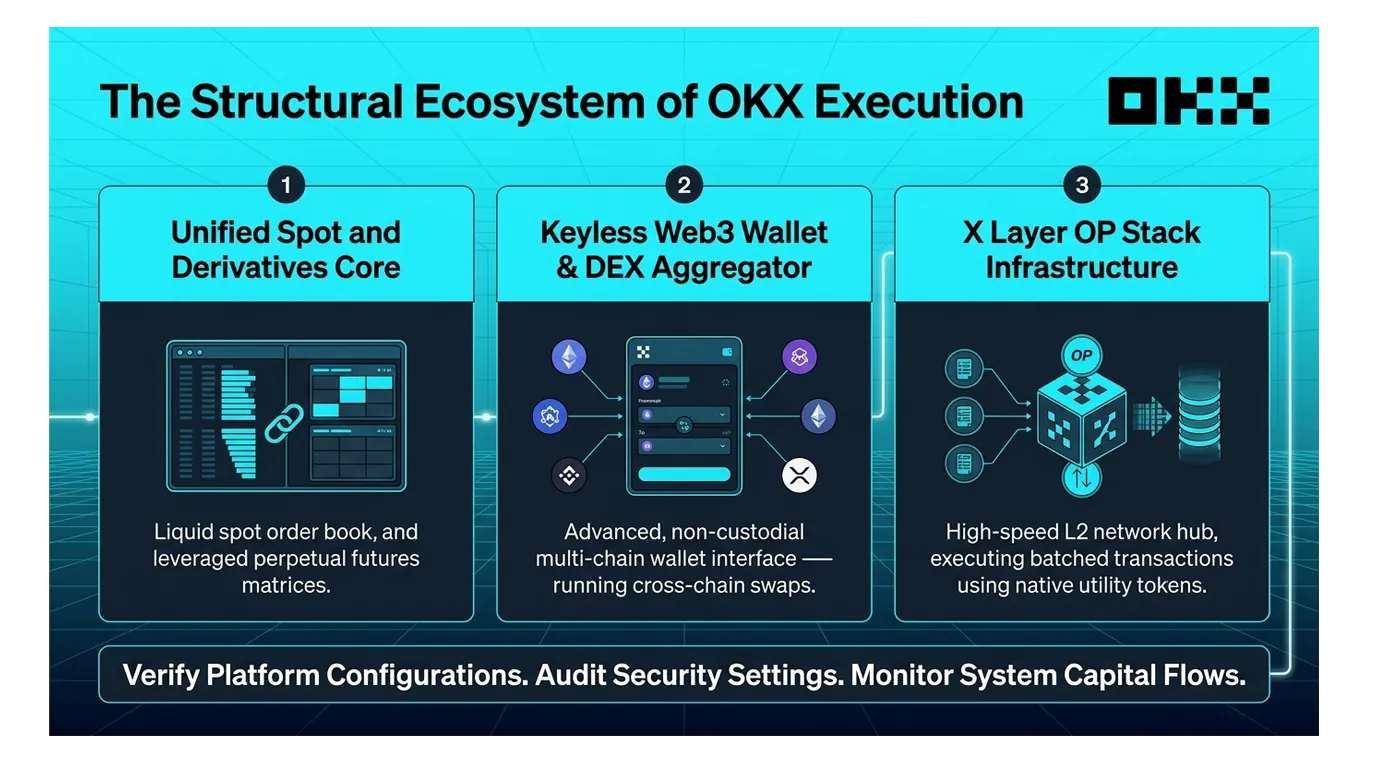
1. Centralized Core: Spot and Derivatives Execution Architecture
The centralized side of the ecosystem routes all customer transactions through an advanced Unified Account framework. This cross-collateral ledger allows shared margin management, meaning your open spot holdings, stablecoin reserves, and options contracts can simultaneously back complex derivatives positions to optimize capital efficiency.
The Spot and Futures Engines
Spot Trading Workspace: Connects buyers directly to a highly liquid Central Limit Order Book (CLOB). Users can execute immediate market fills or set passive limit, stop, and trailing orders to secure targeted price entries with minimal execution slippage.
Derivatives Workspace: Built for high-performance risk configuration, supporting perpetual swaps, dated futures, and options contracts with leverage scaling up to 100x. Position risk can be structured under isolated or cross-margin mechanics to isolate collateral fields from aggressive market liquidations.
- The financial backbone of the exchange relies on its native utility token, OKB. Beyond serving as a global loyalty asset that unlocks up to 40% transaction fee discounts for holders on the centralized exchange, OKB serves as the foundational economic engine for the platform's external on-chain networks.
2. The Web3 Powerhouse: The Non-Custodial Wallet
With a single toggle at the top of the interface, the app transforms from a centralized custodial environment into the fully independent OKX Web3 Wallet.
Operating as a completely self-sovereign application, the Web3 Wallet gives you full ownership over your cryptographic private keys. The system incorporates two advanced account custody options:
Traditional Seed Backups: Generates standard 12-to-24-word cryptographic master recovery phrases that users record offline using physical steel slates or paper media.
Next-Gen MPC Infrastructure: Utilizes Multi-Party Computation (MPC) principles to deliver a completely keyless onboarding experience. The private key is programmatically split into three separate encrypted data shards distributed across your personal device, cloud storage systems, and the platform's secure network nodes. This format eliminates the single point of failure inherent to written recovery sheets while maintaining true non-custodial control.
3. Direct Liquidity Hub
- Embedded natively inside the Web3 portal is the OKX DEX, a highly sophisticated decentralized exchange and cross-chain bridge aggregation gateway.
- When swapping tokens on-chain, relying on a single localized automated market maker (AMM) can lead to severe pricing slippage due to shallow capital pools. The platform solves this through X Routing technology. The aggregation algorithm continuously scans more than 400 independent decentralized exchanges and cross-chain liquidity bridges concurrently.
- When you configure an on-chain swap, X Routing automatically divides your transaction payload across the most capital-efficient paths on the market. It optimizes gas fees, eliminates artificial slippage markups, and enables seamless cross-chain asset swaps between entirely different Layer 1 and Layer 2 ecosystems in a single, atomic user operation.
4. The On-Chain Infrastructure: X Layer Scaling Engine
- If you have been tracking the platform's underlying technical development, you might recall early iterations of its native Layer 2 scaling blockchain under the name "X1." The network has completely matured into a public, zero-knowledge mainnet ecosystem renamed X Layer.
- In a major technical migration finalized in late 2025, OKX transitioned X Layer from its original Polygon CDK blueprint over to the OP Stack architecture, officially linking the blockchain into Optimism's interconnected global Superchain ecosystem.
The Gas Layer: X Layer uses the native OKB token as its primary fuel source to clear transactions, completely phasing out older legacy tokens (like OKT) to secure a fixed maximum supply structure.
XKO Address Innovation: To shield Web3 wallet participants from address poisoning and copy-paste clipboard exploits across similar EVM layers, the network utilizes a specialized XKO-prefix address format. This distinct visual design ensures instant network recognition on-chain, lowering human transmission errors while maintaining full underlying compatibility with traditional Ethereum-style addresses.
Technical Execution Matrix: Core OKX Suite Capabilities
| Product Module | Primary Operating Layout | Custody Framework | Native Gas / Fee Assets | Core Technical Advantage |
| Spot & Futures | Centralized Order Books | Custodial (Exchange Managed) | Settles via Trading Pairs / OKB Discounts | Shared margin via Unified Accounts |
| OKX Web3 Wallet | Keyless & Seed Portals | Non-Custodial (Self-Sovereign) | Controlled by Local Device | MPC shard security eliminates single seed risks |
| OKX DEX | Multi-Chain Aggregator | Non-Custodial (Smart Contract) | Network-Specific Blockchain Gas | X Routing checks 400+ venues for low slippage |
| X Layer Network | Layer 2 OP Stack Rollup | Trustless Ledger Environment | OKB Token Natively | Sub-cent execution costs on Superchain lines |
Universal On-Chain Forensics and Trading Telemetry via DEXTools
- Deploying digital assets across centralized order books, non-custodial wallet layers, and high-performance Layer 2 scaling rollups requires deep market transparency to preserve capital.
- Utilizing advanced decentralized analytical networks like DEXTools gives market participants an essential universal engine to track live token behaviors, evaluate pool depths, and inspect smart contract parameters across all public execution networks.
- You can access DEXTools here and start trading today!
Disclaimer: This article is for informational purposes only and does not constitute investment advice, financial advice, trading advice, or any other kind of advice. DEXTools does not recommend buying, selling, or holding any cryptocurrency or token. Users should conduct their own research and consult with a qualified financial advisor before making any investment decisions. Cryptocurrency investments are volatile and high-risk. DEXTools is not responsible for any losses incurred.
Related Guides
- OKX Web3 Wallet Tutorial 2026: Multi-Chain Setup Guide
- Send Crypto From OKX to Trust Wallet Safely
- How to Send Crypto from OKX to Rabby Wallet Safely in 2026
- How to Send Crypto from OKX to Phantom Wallet (2026)
- Send Crypto From OKX to Coinbase Wallet: Steps 2026
Frequently Asked Questions
What is the OKX Wallet?
The OKX Wallet is a crypto wallet that lets users hold assets and interact with decentralized applications across multiple chains. It is part of OKX's broader set of products that also includes exchange and earn features.
What is the difference between OKX exchange trading and the OKX DEX?
Exchange trading on a centralized platform uses the platform's order book and custody, while a DEX lets you swap tokens directly from a self-custody wallet using onchain liquidity. The DEX gives you control of your keys, whereas the exchange holds assets on your behalf.
What is an MPC wallet?
An MPC wallet uses multi-party computation to split control of a wallet's signing process across multiple parties or devices. This can remove the need for a single traditional seed phrase while still securing the wallet.
What are crypto Earn products?
Earn products are features that let users put their crypto to work to generate yield, often through mechanisms like staking or lending. Returns and risks vary by product, so it is important to understand how each one works.