Fundamental Analysis in Crypto: Complete Guide 2026
— By Tony Rabbit in Tutorials

Fundamental analysis in crypto explained: learn how to evaluate token design, control, liquidity, holders, usage, and red flags before you buy in 2026.
In crypto, a strong story can attract attention fast. What matters next is whether the structure underneath that story deserves capital. That is where fundamental analysis comes in. It is the discipline of testing a project's claims against supply design, usage, liquidity, control, and wallet behavior before you buy.
Intent check: This page is the broad project-evaluation framework. If you want the supply-design slice specifically, read What Is Tokenomics in Crypto?. If you want blockchain-data evidence rather than broad project research, read What Is On-Chain Analysis in Crypto?
Quick answer: fundamental analysis in crypto means evaluating a token or project based on its real structure and business logic, not only its chart. That includes token design, supply unlocks, treasury quality, insider allocation, liquidity, holder concentration, usage, fees, governance control, and whether the market narrative actually matches the evidence.
- Crypto fundamental analysis is workflow-based. No single metric decides the buy.
- Narrative is only the starting point. Great stories can still hide weak liquidity, bad unlocks, or poor admin design.
- Tokenomics matters, but it is not the whole job. Treasury control, holders, usage, and market structure matter just as much.
- DEXTools helps with the reality check. Pair quality, holder behavior, trading activity, and liquidity context help test the thesis.
- The goal is not perfect certainty. The goal is to avoid obvious structural traps before money is committed.
What fundamental analysis means in crypto
Fundamental analysis in crypto is the process of asking whether a project deserves value beyond short-term price action. In equities, that often means revenue, margins, balance sheets, and competitive positioning. In crypto, the workflow is more native to tokens and on-chain markets. You still care about product and demand, but you also have to care about supply design, unlock schedules, wallet concentration, liquidity quality, treasury control, and whether the token has a believable role in the system.
That difference is exactly why crypto fundamental analysis should feel like a practical research workflow, not a recycled stock-market primer with blockchain vocabulary sprinkled on top.
How crypto differs from stock-style analysis
Many crypto projects are part protocol, part product, part community, and part speculative asset all at once. Some generate fees. Some do not. Some have tokens that clearly capture value. Others have tokens that mainly exist because the market expects one. Traditional valuation ideas can still help, but they rarely tell the whole story.
The crypto analyst has to ask extra questions. Who controls the supply? What unlocks are coming? Can insiders change the game later? Is liquidity real or promotional? Does usage create demand for the token, or only attention for the narrative? Those questions are often more important than the chart during the research phase.
Why narrative alone is not enough
Narrative drives interest, but structure decides whether buyers are stepping into a healthy setup or a trap. A token can have a great story and still suffer from heavy insider concentration, weak liquidity, fake volume, vague treasury control, or a massive unlock overhang. Fundamental analysis exists to catch those contradictions before price teaches the lesson the expensive way.
| Lens | Main question | Best use |
|---|---|---|
| Fundamental analysis | Does the project structure deserve capital? | Evaluating quality before buying |
| Technical analysis | How is price behaving right now? | Timing entries and exits |
| On-chain analysis | What are wallets and flows doing? | Testing participation and behavior |
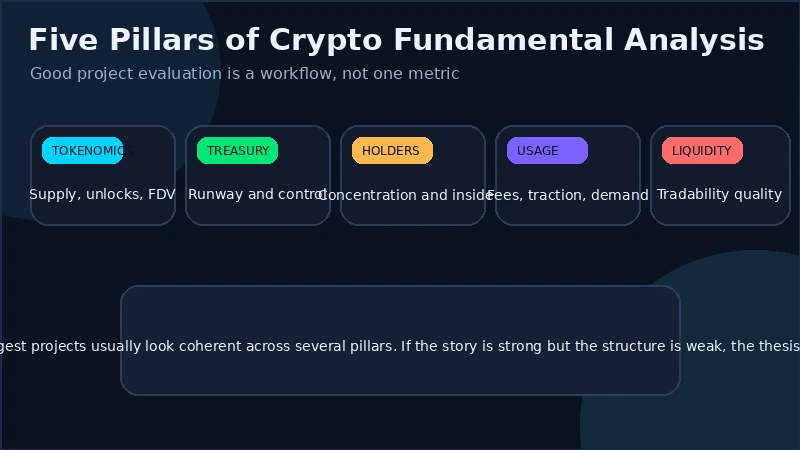
The core pillars of crypto fundamental analysis
The cleanest way to evaluate a project is to break the work into a few pillars and score each one honestly. No single pillar carries the whole decision.
| Pillar | What to check | Why it matters |
|---|---|---|
| Product and user demand | What the project does, who uses it, and whether the product solves a real problem | Attention without demand tends to fade quickly |
| Token structure | Circulating supply, unlocks, emissions, FDV, and whether the token captures value | Weak supply design can crush buyers even when the story is strong |
| Treasury, insiders, and control | Treasury wallets, insider allocation, multisig design, upgrade permissions, admin keys | Opaque control creates governance and sell-side risk |
| Liquidity and holders | Pool depth, holder concentration, top-wallet behavior, and volume quality | Bad market structure makes exits harder and manipulation easier |
| Usage, fees, and retention | Real activity, fee generation, repeat use, and whether numbers look organic | Demand should come from use, not only promotion |
| Competition and catalysts | Comparable projects, roadmap credibility, chain dependency, and upcoming events | A good project still needs a believable path to attention and adoption |
Notice that tokenomics is one pillar, not the entire page. That is intentional. This article should stay at the workflow level and route deeper theory outward where needed.
A practical workflow for evaluating a project before buying
The best workflow starts with the story, then tries to break it. If the story survives the checks, the idea gets stronger.
1. Understand the product and the user first
Start with the project's own explanation. What problem does it claim to solve? Who is the user? Why would that user choose this product instead of alternatives? This step sounds basic, but it filters out a surprising number of weak ideas. If you cannot explain the product in plain language, the thesis is probably not mature enough for capital.
Then ask a harder question: is the token actually necessary? Some projects have useful products but weak token logic. The product might gain adoption while the token captures little of the benefit. That mismatch matters.
A simple way to frame it is this: if the product succeeds, what improves for token holders? Better access, fee rebates, staking demand, governance power, revenue share, or some other clear mechanism can all matter. If the honest answer is mostly “more attention,” the thesis may be more fragile than the community assumes.
2. Check whether the token helps or hurts the buyer
The token should have a believable role in the system, and its supply path should not quietly work against new buyers. You do not need a huge spreadsheet to judge this. You do need to know the circulating supply, the rough fully diluted picture, whether emissions are heavy, and when meaningful unlocks arrive.
A token can look cheap on market cap and still be expensive once future supply is considered. That is why FDV, emissions, and unlock schedules matter. Buyers are not purchasing today's snapshot alone. They are buying into the future supply path as well.
3. Inspect treasury control, insider allocation, and admin risk
Crypto projects often have treasury wallets, foundation allocations, investor allocations, or admin permissions that can materially affect the market later. A project may have a good product and still carry large governance or sell-side risk if too much power sits with too few wallets.
That is why it helps to inspect treasury wallets, review insider allocation, and understand whether critical permissions sit behind a credible multisig or a vague promise. The goal is not paranoia. It is awareness.
4. Test liquidity, holders, and market quality
Even a promising project can be a poor buy if the market structure is weak. Look at pool depth, recent volume quality, pair age, and who actually holds the supply. If a handful of wallets dominate the token, the risk profile changes immediately.
Concentrated holders do not always kill a thesis, but they demand a higher standard of caution. The same is true for suspicious volume. If the chart looks active but the behavior resembles wash trading or manufactured churn, the signal quality of the market drops sharply.
5. Look for evidence of real usage
Fundamentals become far stronger when there is evidence that people actually use the product. Depending on the project, that might mean active addresses, transaction count, retained users, fee generation, protocol revenue, app usage, or some other on-chain demand signal. The exact metric changes by category, but the principle stays the same: usage should show up somewhere.
What you want to avoid is buying a project whose only proof of value is its own marketing. If the pitch says growth is strong, there should be signs of it. If the project claims the token accrues value, the mechanism should be understandable and observable.
6. Write down what would break the thesis
A proper fundamental view is not complete until you define invalidation. Maybe the product stops growing, a major unlock arrives into weak demand, treasury behavior turns concerning, or liquidity deteriorates. Writing those conditions down matters because it prevents the thesis from mutating after the buy.
This is the difference between analysis and attachment. Good research includes a path to saying no later.
Tokenomics, briefly and practically
This article should not turn into a full tokenomics manual, but buyers do need a practical checklist. Look at circulating supply, max or terminal supply if relevant, emissions, unlock schedules, and who receives new tokens. Ask whether the token captures value through fees, staking, governance, utility, or some combination, and whether that mechanism is meaningful or mostly symbolic.
The goal is not to master every theory of token design inside one page. It is to notice when supply expansion, insider distribution, or weak utility are working against the buyer. Readers who want the deeper framework should move to the dedicated tokenomics guide.
Questions that reveal whether a token can actually hold value
Many weak crypto theses sound good until you ask a few uncomfortable questions. These questions do not replace research, but they are excellent pressure tests before capital is committed.
Does the token capture demand, or only attention?
Some tokens benefit directly when usage rises. Others mostly benefit when social attention rises. That distinction matters because attention is easier to manufacture than durable demand. If the product can grow while the token remains optional, inflationary, or easy to bypass, the token may not deserve the same excitement as the app.
Where could future sell pressure come from?
Even strong projects can have awkward supply dynamics. Investor unlocks, team vesting, treasury diversification, incentives, and market-maker allocations can all create future sell pressure. None of these are automatically bad, but buyers should know where supply is likely to come from and whether the market is deep enough to absorb it.
What external dependency could weaken the thesis?
Some projects depend heavily on a specific chain, one app partner, one narrative cycle, or one regulatory assumption. Others are more resilient because they have multiple demand sources or broader ecosystem support. Fundamental analysis gets better when you stop asking only why the project could win and start asking what could make the setup weaker even if the team executes reasonably well.
Red flags that can break the thesis fast
Some flaws do not need long debate. They are strong enough to reduce conviction immediately.
- Weak liquidity or fake volume: if the market cannot absorb size cleanly, it becomes much harder to trust price discovery.
- Heavy insider concentration: too much supply in too few hands raises exit risk and governance risk.
- Opaque treasury or admin control: vague multisig structure, upgrade powers, or discretionary wallet behavior should never be brushed aside.
- Huge unlock overhang into weak demand: future supply matters most when current demand is thin.
- Utility mismatch: if the token does not clearly benefit from product success, the market may eventually notice.
- Usage claims without evidence: a project marketed as active should show something measurable.
These are not reasons to panic over every project. They are reasons to slow down and demand better proof before buying.
A practical DEXTools workflow for fundamental analysis
DEXTools is useful because it keeps fundamental analysis tied to the market reality a buyer will actually face. It does not replace broader research, but it does sharpen it.
- Start with market structure. Check pair age, liquidity depth, and whether trading quality looks credible enough for further work.
- Inspect holders and wallet behavior. Look for concentration, suspicious clusters, and whether a few wallets appear to control the story.
- Compare narrative with market behavior. If the project claims healthy demand, do recent trades, liquidity, and holder changes support that claim?
- Use related deep dives when needed. Treasury-wallet analysis, top-holder concentration, and on-chain analysis help turn a vague thesis into a testable one.
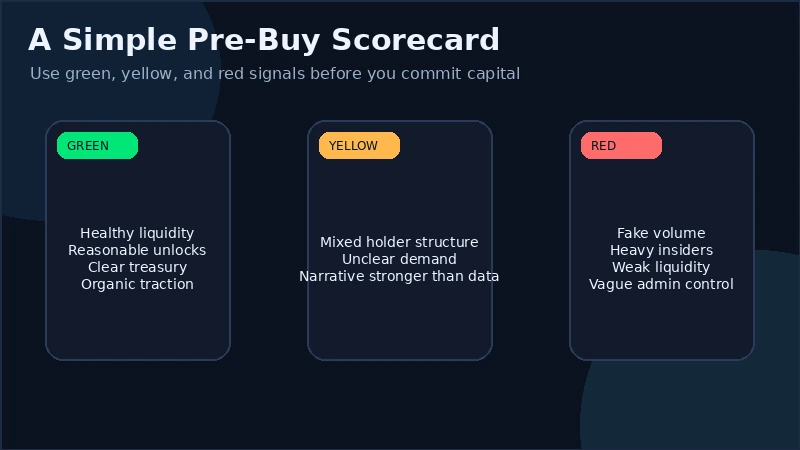
- Build a simple scorecard before buying. Green, yellow, and red signals are often more helpful than a pile of disconnected observations.
Good crypto fundamental analysis is not about predicting every winner. It is about avoiding structurally weak setups that were already showing flaws before entry.
That is also why simple scorecards help. A project does not need a perfect green light in every category, but a cluster of yellows and reds should change how much size, patience, and trust you are willing to give it. The workflow is meant to calibrate exposure, not only to produce a yes-or-no answer.
How fundamentals and technicals work together
Fundamental analysis and technical analysis solve different problems. Fundamentals help decide whether the project deserves attention and what risks the buyer is accepting. Technical analysis helps decide whether the timing is clean, whether the market is supporting the thesis, and where risk can be managed practically.
In other words, fundamentals can tell you what deserves study. Technicals can help with when and how. Neither fully replaces the other.
A clean workflow is to narrow the universe with fundamentals, then wait for the market to offer a reasonable entry instead of forcing one. That keeps good research from becoming an excuse to buy at any price, and it keeps attractive charts from distracting you away from weak project structure.
Common mistakes beginners make
- Confusing price action with strong fundamentals: a rising chart can be driven by positioning and attention, not durable structure.
- Trusting market cap alone: without dilution context, market cap can hide a much larger future supply burden.
- Letting one good metric excuse everything else: a strong community, one famous investor, or one good month of usage should not erase structural weaknesses.
- Reading documents but not behavior: polished docs matter less than what wallets, liquidity, and users are actually doing.
- Skipping a written checklist: without a process, enthusiasm usually replaces analysis.
The fix is simple, even if the work is not: use a checklist, compare narrative with evidence, and decide in advance what would make the thesis weaker.
Frequently asked questions
What is fundamental analysis in crypto?
It is the process of evaluating a project based on token structure, liquidity, usage, control, and market behavior instead of relying only on the chart.
Is tokenomics enough for crypto fundamental analysis?
No. Tokenomics is a core pillar, but it should be paired with treasury quality, insider allocation, holder concentration, liquidity, usage, and market-structure checks.
How is fundamental analysis different from technical analysis in crypto?
Fundamental analysis asks whether the project deserves value. Technical analysis focuses on how price is behaving and when entries or exits may be cleaner.
What are the biggest red flags when evaluating a crypto project?
Weak liquidity, fake volume, heavy insider concentration, vague treasury control, major unlock overhang, and unclear utility are among the biggest structural red flags.
Can you use DEXTools for crypto fundamental analysis?
Yes. DEXTools helps with the practical side by revealing pair quality, trading behavior, holders, liquidity context, and other clues that test the thesis before entry.
Final takeaway: fundamental analysis in crypto is less about finding one perfect number and more about building a durable pre-buy workflow. If the project's story, token structure, wallet behavior, liquidity, and demand picture line up, the thesis gets stronger. If they conflict, believe the conflict before you believe the marketing.
Disclaimer: This draft is for educational purposes only and does not constitute investment, financial, legal, or trading advice. Crypto projects can change rapidly, and every investment carries risk.
Related Guides
- What is the XRP ATH? Analysis & 2026 Outlook
- XRP Price Prediction 2030: Honest Bear/Base/Bull Analysis
- What Is Technical Analysis in Crypto Trading: Complete Beginner Guide (2026)
- What Is RSI in Crypto? Beginner Guide to the Relative Strength Index (2026)
- What is PYUSD? PayPal Stablecoin and On-Chain Analysis
Frequently Asked Questions
What is fundamental analysis in crypto?
Fundamental analysis is the process of evaluating a crypto project's underlying qualities, such as its tokenomics, team, usage, liquidity, and holder distribution, to judge its long-term value. It focuses on what a project actually does rather than only its price chart.
How is fundamental analysis different from technical analysis?
Fundamental analysis studies the project itself and its value drivers, while technical analysis studies price and volume patterns to time trades. Many traders use both together to form a fuller view.
What should I check when doing fundamental analysis on a token?
Common factors include the token supply and emission schedule, who controls the contract, liquidity depth, holder concentration, real usage, and any red flags in the code. Reviewing these helps you judge whether a project is sustainable.
What are common red flags in fundamental analysis?
Warning signs include highly concentrated holdings, unlocked or unverifiable liquidity, mint or owner privileges that allow abuse, and unclear or anonymous teams with no real product. Multiple red flags together raise the risk significantly.