What is the XRP ATH? Analysis & 2026 Outlook

Dive into XRP's historical price peaks, analyze market cycles, and explore future predictions as we head into 2026.
Context, Cycles, and the 2026 Outlook
- The journey of XRP is perhaps the most scrutinized "odyssey" in the history of digital assets. For years, the community sat in anticipation, watching as legal hurdles and market cycles played a game of tug-of-war with its valuation.
- To understand the XRP ATH, one must look beyond a simple price candle on a chart; it requires an examination of institutional adoption, the final resolution of the SEC saga, and the evolving role of the XRP Ledger (XRPL) in a world dominated by stablecoins and tokenized assets.
Analyzing the Historical XRP ATH and Market Peaks
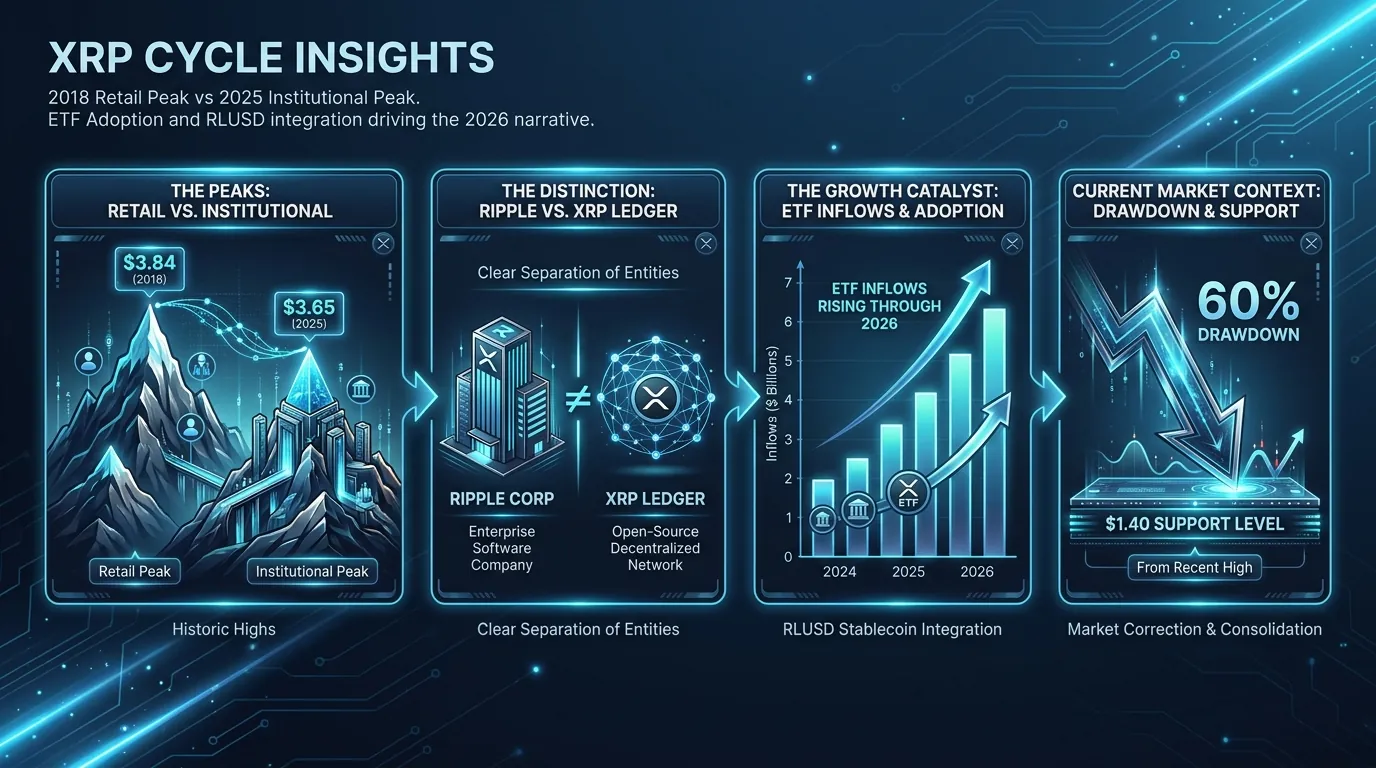
- When investors ask about the XRP ATH (or future XRP ATHs), the answer often depends on which data source or exchange you prioritize. Historically, the absolute record was set on January 4, 2018, when XRP touched a staggering $3.84. At that moment, the narrative was driven by pure retail euphoria and the promise of Ripple replacing the aging SWIFT system.
- During that 2017-2018 cycle, XRP performed a legendary "moonshot," rising from fractions of a cent to nearly four dollars in less than a year. The "Korean Premium" on exchanges like Bithumb often pushed these numbers even higher, creating a localized frenzy that remains a core memory for veteran crypto traders.
- However, the "modern" peak occurred in July 2025, following the comprehensive legal victory for Ripple. During this mid-2025 surge, the XRP ATH levels were nearly retested as the price touched approximately $3.65. While it fell just short of the 2018 record in terms of unit price, it achieved a significantly higher market capitalization due to the increased circulating supply over the intervening seven years. As of April 2026, XRP is trading in the $1.40 - $1.45 range, representing a drawdown of roughly 60% from its 2025 local high.
Understanding the Ripple vs. XRP Distinction
- One cannot discuss the price of the asset without clarifying the fundamental difference between the entity and the technology. Ripple is a private technology company based in San Francisco. It develops software solutions like RippleNet and the newer RLUSD stablecoin integrations for financial institutions to facilitate cross-border payments. Conversely, XRP is the native digital asset of the XRP Ledger (XRPL), an open-source, decentralized blockchain.
- While Ripple uses XRP in its products (notably for On-Demand Liquidity, or ODL), XRP exists independently of the company. This distinction was the cornerstone of the SEC legal battle. The court eventually ruled that XRP itself is not a security, a pivot that allowed institutional capital to flow back into the ecosystem in late 2024 and throughout 2025.
Market Cap and Liquidity: The Math Behind the Price
- The market capitalization of XRP currently sits at approximately $88 billion. To see a new XRP ATH that surpasses the $4.00 mark, the market cap would need to exceed $230 billion, assuming current supply levels. This is a significant milestone that requires massive liquidity. In early 2026, the primary liquidity drivers have shifted from retail speculative trading to institutional inflows.
- The launch of Spot XRP ETFs in late 2025 marked a turning point. Large institutions, including major asset managers, have disclosed significant positions in these ETFs. While these inflows have provided a "floor" for the price, they have also changed the asset's volatility profile. XRP has recently begun to behave more like a mature financial asset (often referred to by analysts as a "high-beta settlement asset") rather than the hyper-volatile altcoin it was during the 2017 mania.
How the XRPL Works in 2026
The XRP Ledger uses a unique Consensus Ledger rather than Proof of Work (like Bitcoin) or Proof of Stake (like Ethereum). Transactions are validated by a set of trusted nodes, allowing for settlements in 3-5 seconds with negligible fees. In 2026, the XRPL has evolved to support:
Automated Market Makers (AMMs): Providing native liquidity on-chain.
EVMSidechains: Allowing Ethereum-based developers to port their dApps to the XRPL.
CBDC Private Ledgers: Multiple central banks are now testing localized versions of the XRPL for digital currencies.
For those looking to enter the market, the process is more regulated and accessible than ever via Centralized Exchanges (CEXs), the native XRPL DEX, or the aforementioned ETFs.
Cycle Analysis: The 2026 Drawdown Context
- The current 60% drawdown from the 2025 peak is a textbook example of "selling the news." After the SEC legal battle concluded and the $3.65 spike occurred, the market entered a period of consolidation. The narrative has shifted from "Will they win the case?" to "How much volume is actually moving through the ledger?"
- The integration of RLUSD (Ripple’s USD-pegged stablecoin) has actually helped stabilize the ecosystem. By using RLUSD as a stable on-ramp and XRP as the volatile bridge asset, Ripple has created a dual-token system that appeals to conservative banks. As the market matures, the XRP ATH becomes a benchmark for long-term health rather than a target for "get rich quick" schemes. Analysts point to the 2017-style chart fractals, suggesting that the current consolidation near $1.40 is merely a retest of previous resistance-turned-support before a potential expansion toward the elusive $5.00 - $10.00 zone.
Real-World Usage Examples in 2026
Cross-Border Settlement: A bank in Tokyo uses XRP to bridge Japanese Yen to Brazilian Real. The transaction settles in 4 seconds for a cost of less than $0.01, compared to the 3 days and $30 fee of the traditional SWIFT network.
Tokenized Real Estate: A developer in Miami issues fractionalized ownership of a commercial building on the XRPL. Investors receive dividends automatically via the ledger’s built-in payment paths.
Institutional Hedging: Multinationals use XRP-based liquidity pools to hedge against currency fluctuations in emerging markets where local fiat is highly volatile.
Key Points to Remember
Historical Context: The 2018 ATH was $3.84, while the 2025 institutional peak reached $3.65.
Institutional Shift: The arrival of Spot ETFs and RLUSD has fundamentally changed XRP's liquidity profile.
Legal Clarity: XRP is legally recognized as a non-security, paving the way for global banking integration.
Market Dynamics: A new record high requires a market cap surpassing $230 billion.
Tracking these complex on-chain movements and institutional liquidity flows is vital for any serious investor. To monitor live XRPL pairs, analyze real-time market cap fluctuations, and stay ahead of the next volatility spike, start using DEXTools today here to empower your trading strategy.
Disclaimer: This article is for informational purposes only and does not constitute investment advice, financial advice, trading advice, or any other kind of advice. DEXTools does not recommend buying, selling, or holding any cryptocurrency or token. Users should conduct their own research and consult with a qualified financial advisor before making any investment decisions. Cryptocurrency investments are volatile and high-risk. DEXTools is not responsible for any losses incurred.
Related Guides
- XRP Price Prediction 2030: Honest Bear/Base/Bull Analysis
- Solana Chain Price Prediction 2026: Market outlook
- What is ETH ATH? Ethereum’s All-Time High Explained
- What Is Aethir (ATH)? The Decentralized GPU Cloud Powering AI and Gaming in 2026
- Solana chain All-Time High Explained: the Journey to the New ATH
Frequently Asked Questions
What is the all-time high (ATH) of XRP?
The all-time high (ATH) of XRP was set on January 4, 2018, when it reached $3.84.
What factors influence the XRP ATH?
Factors influencing the XRP ATH include institutional adoption, the resolution of legal issues with the SEC, and the usage of the XRP Ledger in decentralized finance and other applications.
How did XRP perform in 2025?
In July 2025, XRP reached a peak of approximately $3.65 following a legal victory for Ripple, marking a significant increase in market capitalization despite falling short of its 2018 record.
What is the current trading range of XRP as of April 2026?
As of April 2026, XRP is trading in the range of $1.40 to $1.45, which is a 60% drawdown from its 2025 local high.
How can I buy XRP in 2026?
In 2026, XRP can be purchased through centralized exchanges, Spot XRP ETFs for traditional investors, or the native XRPL decentralized exchange for peer-to-peer trading.