Risk-Reward Ratio in Crypto Explained 2026
— By Tony Rabbit in Tutorials

Risk-reward ratio in crypto explained: compare downside to upside, why a great ratio can still fail, and how to weigh fees, slippage, and win rate.
Risk-reward ratio in crypto is the relationship between what you stand to lose if a trade is wrong and what you stand to make if the thesis plays out. In plain language, it asks whether the upside is worth the downside before you enter. That sounds basic, but the metric matters because it forces a trade idea to become measurable instead of emotional.
Many beginners misuse the ratio by treating it like a magic number. It is not. A beautiful ratio can still belong to a bad trade if the stop is fake, the target is unrealistic, or slippage and fees crush the real payoff. The ratio is useful because it makes trade quality easier to judge, not because it replaces judgment altogether.
Quick answer
- Risk-reward ratio compares planned downside to planned upside before entry.
- A high ratio is only useful when the stop and target are realistic.
- Good traders connect the ratio to win rate, position size, fees, and market structure, not just chart fantasy.
Intent split
- This page is the trade-quality metric guide: how traders compare setup downside and upside before they enter.
- For the math of how much size to take, read How to Calculate Position Size in Crypto Trading.
- For the difference between exit tools, read Take Profit vs Stop Loss in Crypto.
What the Risk-Reward Ratio Actually Measures
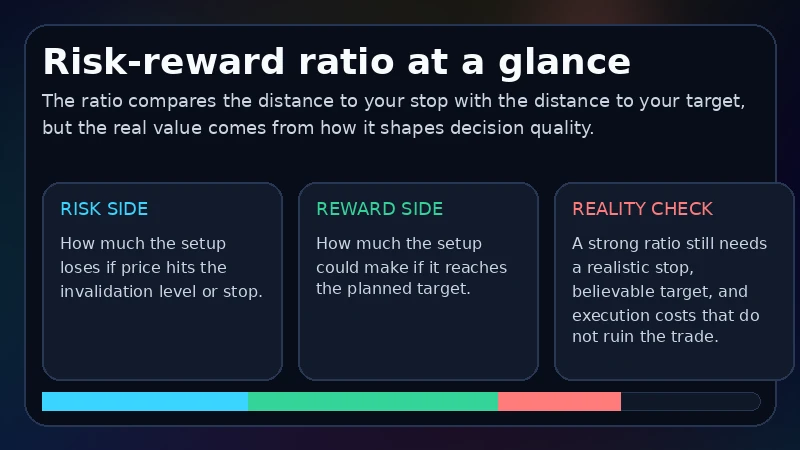
The ratio measures the relationship between two planned distances: the distance from entry to stop, and the distance from entry to target. If you are risking one unit to make three, the setup is often described as 1:3. That simple framing matters because it forces you to make the trade coherent. You cannot talk seriously about a setup if you do not know where it is invalidated and where the payoff would reasonably come from.
In crypto, the metric becomes even more important because volatility can make sloppy planning look normal. Traders often anchor on upside first and only think about downside later. The risk-reward ratio reverses that sequence. It makes you define the pain first, then judge whether the proposed reward actually justifies taking it.
Why the ratio is useful without being magical
How This Topic Differs From Position Size and Exit Pages
Risk-reward content often cannibalizes with position sizing or stop-loss articles because all three live inside the same trading workflow. The clean split is simple. Position size decides how much exposure you take. Stop-loss and take-profit pages explain the exit tools. Risk-reward ratio evaluates whether the setup deserves to be taken in the first place based on the relationship between the planned loss and planned gain.
That is why this page should stay centered on trade selection. The user searching risk-reward ratio usually wants a framework for judging setup quality, not a tutorial on order-entry buttons or a full primer on leverage mechanics. The metric sits earlier in the decision chain.
How the risk-reward page fits the trading-risk cluster
How to Use the Ratio Without Fooling Yourself
Start by placing the stop where the idea is actually wrong, not where the ratio starts to look pretty. Then place the target where the market could plausibly travel based on structure, liquidity, or trend context. Once both are honest, calculate the ratio. If the ratio is weak, the answer is not always to force the target farther away. Sometimes the right conclusion is that the setup is simply mediocre.
Then adjust for reality. On thin markets, memecoins, and fast DEX trades, the live fill can differ from the plan. Spread, slippage, and fees compress reward and sometimes expand risk. That means a theoretical 1:3 can behave more like 1:2 or worse. Advanced traders understand that trade math lives in actual execution, not only in neat chart drawings.
A practical risk-reward workflow
Common Risk-Reward Mistakes in Crypto Trading
Most ratio mistakes come from trying to manufacture a good number instead of discover an honest one. Traders tighten the stop too much, extend the target too far, or ignore execution costs entirely. The spreadsheet looks great, but the trade itself is weak.
Mistakes worth avoiding
Frequently Asked Questions
What is a good risk-reward ratio in crypto?
There is no universal perfect number. What matters is whether the ratio is honest, repeatable, and compatible with your win rate and execution quality.
Can a low ratio still work?
Yes, in some strategies with high win rates and fast exits. The ratio should be judged together with strategy context, not in isolation.
Why does slippage matter so much for the ratio?
Because slippage can worsen both entry and exit quality, reducing reward and sometimes increasing real loss.
Is risk-reward ratio the same thing as position size?
No. The ratio evaluates setup quality, while position size determines how much exposure you take once the setup is chosen.
Should I reject every trade below 1:2?
Not automatically. Some environments or strategies justify lower ratios, but you should know why rather than drifting into it accidentally.
Related reading
Disclaimer: This article is for educational purposes only and not financial, legal, or tax advice. No ratio guarantees profitability, and live market conditions can differ from any planned setup.
Related Guides
- What Is Put Call Ratio in Crypto? Explained 2026
- What Is a Block Reward: Complete Bitcoin Mining Reward Guide (2026)
- Yield Farming Strategies, APY Quality and Risk Management (2026)
- What Is Wrapped Asset Risk in Crypto? Guide 2026
- How to Evaluate Tokenomics: Supply, Emissions and Unlock Risk Guide (2026)