Understanding Block Reorgs: Temporary Blockchain Changes
— By Whatsertrade in Tutorials
Discover what block reorgs are in crypto, why they occur, and how they impact traders and blockchain stability.
A block reorg in crypto, short for blockchain reorganization, happens when a blockchain replaces part of its recent history with a different version. This reorg process means that one or more blocks previously considered valid are removed from the main chain and switched with other blocks.
For many, this sounds alarming. Blockchains are often seen as permanent, transparent, and immutable. So, how can blockchain history change?
Key Takeaways
- Causes and Effects of Block Reorgs
- Types of Reorgs and Their Implications
- Frequently Asked Questions
- Related Guides
The answer is that blockchain finality isn't always immediate. In many networks, especially those with distributed validators or miners, there can be brief moments when different parts of the network disagree about which block came first. A block reorg is the network's method for resolving that disagreement and selecting a version of history as the valid one.
In straightforward terms, a block reorg doesn't mean the entire blockchain failed. It means the network had competing versions of recent history temporarily and then selected the one that followed its consensus rules.
Causes and Effects of Block Reorgs
Why Do Block Reorgs Happen?
Block reorgs occur because blockchains are decentralized. There's no single central server deciding the order of every transaction in real time. Instead, many participants globally help produce, validate, and share blocks.
Sometimes, two valid blocks are created almost simultaneously. One group of nodes may see one block first, while another sees the other block. For a short period, both blocks may appear valid to different parts of the network.
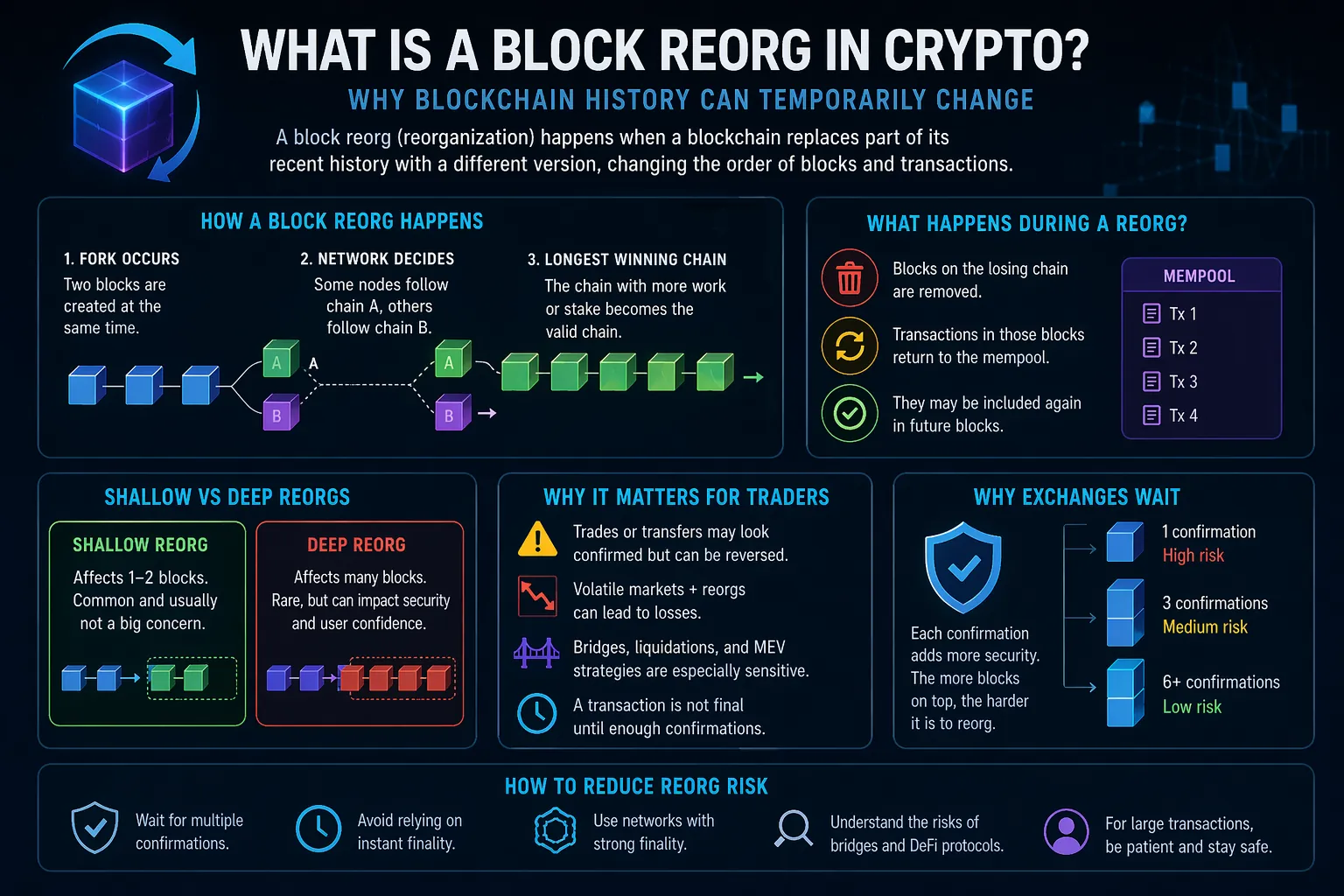
This creates a temporary fork. Eventually, one chain version becomes dominant according to the network's rules. The other version is abandoned. The blocks in this abandoned version are removed from the main chain, and this is what's known as the reorg.
This process is normal across many blockchain systems. Short reorgs can occur without any malicious activity. They are part of how decentralized networks coordinate under real-world conditions, including latency, network delays, and competition between block producers.
What Happens to Transactions During a Block Reorg?
When a block gets removed during a reorg, the transactions within that block are no longer considered confirmed on the main chain. This doesn't always mean they're lost forever. In many cases, those transactions return to the mempool and might be included again in a later block.
However, timing can be crucial. A user might see a transaction as confirmed, only for it to disappear temporarily after a reorg. A trader could think a swap went through, only to see it reorganized out of the chain later. An exchange might wait for several confirmations before crediting deposits, intending to mitigate this exact risk.
This is why a single confirmation isn't always enough for high-value transactions.
Types of Reorgs and Their Implications
Shallow Reorgs vs Deep Reorgs
Not all block reorgs carry the same weight. A shallow reorg affects only one or two blocks. These are typically less concerning and can happen naturally in some networks. On the other hand, a deep reorg affects many blocks. These are much more serious because they can undermine confidence in the network's settlement process. Deep reorgs might indicate a technical problem, network instability, or a potential attack.
The depth of the reorg correlates with the potential impact on traders, exchanges, bridges, and applications.
Why Block Reorgs Matter for Traders
For crypto traders, block reorgs matter because trading often hinges on timing. A trade, arbitrage, liquidation, or bridge transaction may appear complete before it's fully secure.
If a transaction is reorganized out of the chain, it might create confusion or even financial loss, depending on the situation. This holds particular importance for:
High-value transfers, Exchange deposits, DEX trades during volatility, Cross-chain bridge operations, Liquidation systems, MEV and arbitrage strategies.
Block reorgs in crypto remind us that blockchain settlement isn't always instant. A transaction might be visible before it's truly secure.
Why Exchanges Wait for Confirmations
Many exchanges require multiple confirmations before crediting a deposit. This isn't just a delay-it's a security measure. Each additional block added after a transaction makes it harder for that transaction to be removed by a reorg. More confirmations generally indicate more confidence that the transaction will remain part of the accepted chain.
The requisite number of confirmations depends on the network and the asset. Some chains offer faster finality, while others require more waiting to reduce reorg risk.
Are Block Reorgs a Security Problem?
Short block reorgs aren't inherently a security issue. They are part of normal consensus behavior in many systems. However, frequent or deep reorgs can be warning signs, suggesting the network might have weak finality, low validator participation, poor infrastructure, or vulnerability to attacks.
For users, the essential concern isn't whether reorgs can happen but how often they occur, how deep they go, and how the network manages them.
How Users Can Reduce Reorg Risk
Users can't prevent block reorgs, but they can mitigate exposure. For regular transfers, waiting for a reasonable number of confirmations is usually sufficient. For large transactions, users might want to wait longer. Traders should also realize that fast execution doesn't always equal final settlement.
When using bridges, lending protocols, or high-value DeFi strategies, finality assumptions become even more critical. A protocol treating transactions as final too soon might expose users to added risk.
A block reorg in crypto is the mechanism by which a blockchain replaces a recent part of its history with another valid version. It can naturally happen when two competing blocks appear at nearly the same time, and the network later selects one chain as the correct one.
For everyday users, shallow reorgs are usually invisible. For traders, exchanges, and DeFi protocols, they impact confirmation reliability and settlement risk.
The core takeaway is simple: a transaction can be confirmed before it's truly final. Understanding block reorgs aids crypto users in making informed decisions, especially when moving large amounts, trading during volatile periods, or interacting with infrastructure reliant on fast settlement.
How to Bridge Crypto Between Chains: Complete Cross-Chain Tutorial 2026 How to Use 1inch: Complete DEX Aggregator Swap Tutorial (2026) How to Use OKX Web3 Wallet: Multi-Chain DeFi Hub Guide (2026)Frequently Asked Questions
What is a block reorg?
A block reorg, or reorganization, occurs when a blockchain temporarily deviates from its main chain due to two or more miners finding a valid block at nearly the same time. This creates a temporary fork, where different versions of the blockchain exist simultaneously.
Why do block reorgs happen?
Block reorgs are a natural consequence of decentralized consensus mechanisms. When multiple miners solve the cryptographic puzzle for the next block almost simultaneously, their solutions propagate through the network at different speeds, leading to temporary disagreements on the 'true' next block.
How is a block reorg resolved?
The network resolves a block reorg by extending the longest chain. As more blocks are added, one of the competing chains will become longer, and the shorter chains are discarded, with their transactions typically re-added to the mempool.
What happens to transactions in a reorged block?
Transactions included in a block that is subsequently reorged out of the main chain are typically returned to the mempool. They then await inclusion in a new block on the winning chain.
Are block reorgs a security risk?
While temporary, frequent or large reorgs can indicate network instability or potential attack vectors, such as a 51% attack. However, small, infrequent reorgs are a normal part of blockchain operation and do not inherently pose a security risk.
Related Guides
- Basescan Tutorial 2026: Base Block Explorer Master Guide
- Event-Driven Liquidity: How Airdrops, Listings and TGEs Create Temporary Markets
- What Is a Rebase Token in Crypto? How Elastic Supply Changes Balances (2026)
- Liquidity Velocity: Why Fast LP Changes Matter More Than Total Liquidity
- What Is Block Time in Crypto? Speed Explained 2026