What is Big Time? AAA Crypto Game Explained
— By AliceOnChain in Tutorials

An in-depth structural look into Big Time, the AAA multiplayer action RPG redefining GameFi. Explore its dual-layer economic framework, token distribution, and practical methodologies for monitoring BIGTIME market metrics and liquidity via advanced on-chain analysis.
What is Big Time? AAA Crypto Game Explained
Introduction
The intersection of decentralized finance (DeFi) and interactive entertainment has underwent rapid structural changes over recent market cycles. For traders and analytical minds entering this sector, the primary foundational question often begins with: What is Big Time and how does it alter the existing GameFi paradigm? Early iterations of blockchain gaming frequently struggled with unsustainable, hyper-inflationary reward loops that prioritized short-term capital extraction over sustainable player retention. However, a new generation of high-production, high-budget applications-often classified as AAA Web3 games-aims to establish long-term economic equilibrium by decoupling pure speculation from structural gameplay engagement.
Among the prominent frontrunners of this paradigm shift is Big Time, a free-to-play, multiplayer action role-playing game (RPG) developed by Big Time Studios. Founded by industry veterans with extensive history across legacy gaming enterprises, understanding Big Time requires looking past the consumer-facing interface and analyzing the underlying token distribution pipelines, liquidity provisioning structures, and programmatic supply dampeners that dictate the behavior of its native asset, BIGTIME.
The Structural Architecture of Big Time
At its core, Big Time combines fast-paced, hack-and-slash combat mechanics with procedural dungeon crawls. Players form cooperative parties to explore time-shattered dimensions, defeat adverse entities, and acquire scarce digital assets. Unlike traditional Web2 titles, where in-game gear remains confined within closed corporate databases, the Big Time framework processes ownership layers via public ledger architecture.
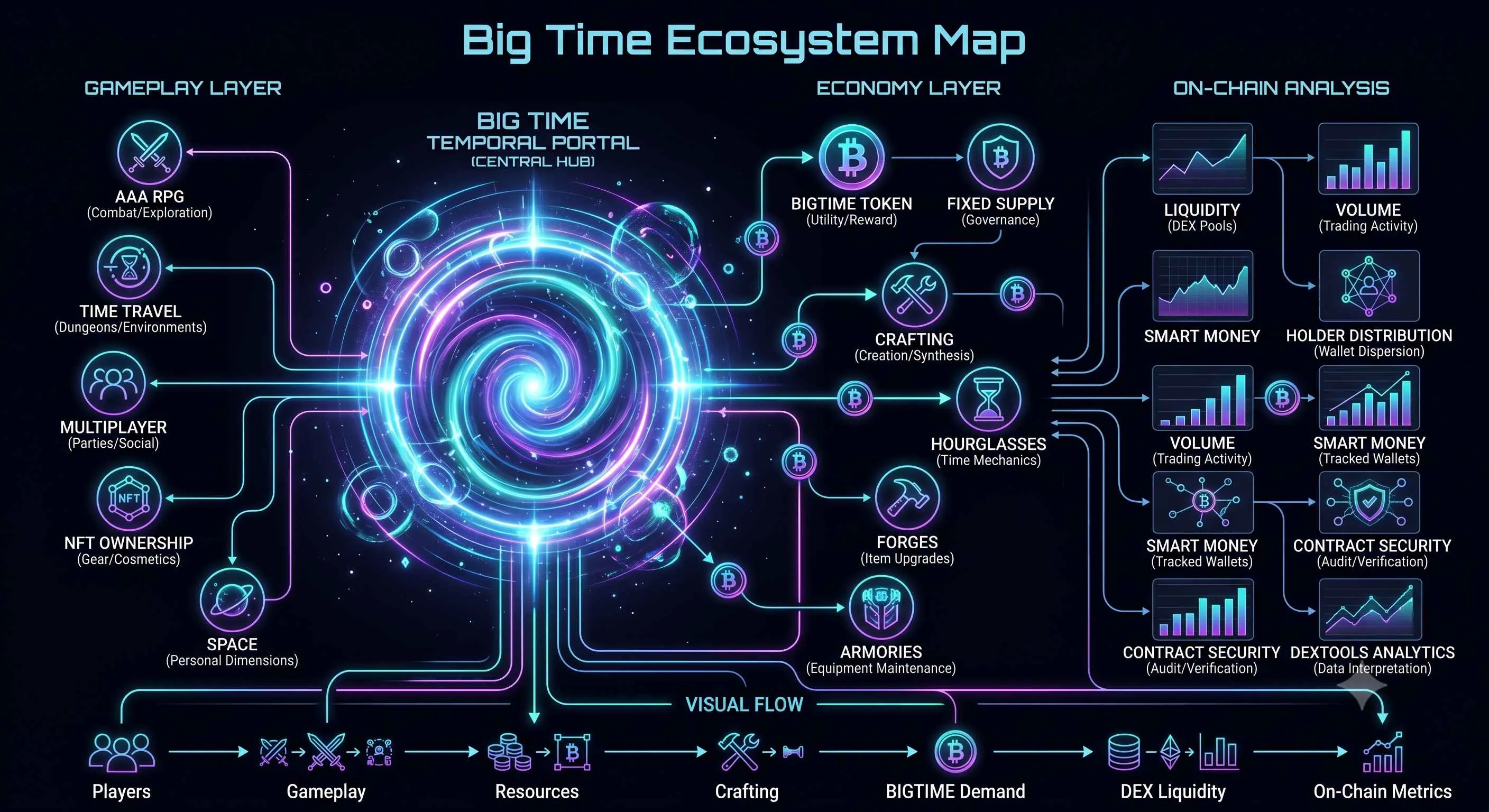
The core innovation behind the ecosystem lies in its dual-asset structure, separating purely aesthetic or utility-driven non-fungible tokens (NFTs) from the primary medium of exchange and craft, the BIGTIME token. The game bypasses conventional pay-to-win mechanisms by ensuring that high-tier combat advantages cannot be purchased directly from the treasury. Instead, performance enhancements and cosmetic dominance depend on real-time resource expenditure and complex crafting mechanisms within personal, customizable pocket dimensions known as SPACE.
The Crafting Infrastructure: Forges, Armories, and Time Wardens
To truly grasp what is Big Time from an operational perspective, one must dissect the roles of specialized structural components within the game economy that drive token velocity:
SPACE: Expansion modules that function as the foundational real estate for players wishing to participate in the high-tier crafting loop. SPACE scarcity scales inversely with tier rarities, limiting the physical capacity of production nodes across the ecosystem.
Time Wardens: On-chain structures responsible for producing, maintaining, and upgrading Hourglasses. Hourglasses are the critical pre-requisite required to generate or harvest the native token during active gameplay.
Forges and Armories: Production stations where players consume accumulated resources to generate high-fidelity cosmetic weapon modifications and armor sets. These items can be integrated directly back into the network or traded across secondary decentralized marketplaces.
Deconstructing the BIGTIME Token Economy
The native utility token, BIGTIME, operates primarily under an Ethereum-native ERC-20 standard, though its operational layer interfaces extensively with custom off-chain transaction engines to facilitate zero-gas microtransactions during live gaming sessions. The asset maintains a fixed hard cap of 5,000,000,000 units, completely avoiding programmatic dilutive minting functions common in legacy GameFi iterations.
Crucially, the token distribution model completely bypassed traditional institutional venture capital allocations, public pre-sales, or early-stage team distributions. Instead, the total supply enters active circulation through purely meritocratic game-driven pathways, organic ecosystem incentives, and structural operational requirements. This structural approach minimizes the sudden systemic supply shocks often associated with the expiration of institutional vesting schedules or early-stage investor lockup cliffs.
On-Chain Structural Note: Because the asset lacks large programmatic venture cliffs, short-to-medium-term price action and structural trends within the Big Time ecosystem are heavily dictated by organic macro velocity, net ecosystem inflows, active market-maker positioning, and live player resource consumption cycles rather than pre-scheduled balance sheet liquidations.
Primary Utility and Demand Triggers
The asset experiences persistent structural consumption across several primary vectors within the Web3 game environment:
Hourglass Production and Refinement: Crafting and upgrading Hourglasses requires a direct baseline expenditure of the native token alongside specialized raw material inputs.
Cosmetic Refinement and Crafting: Higher-tier cosmetic items manufactured via Armories or Forges necessitate burning specific amounts of the token to finalize the metadata mutation on-chain.
Prestige Portal Entry Fee Matrix: Advanced endgame arenas, which yield disproportionately higher drop rates for ultra-rare cosmetic upgrades and components, frequently implement variable access thresholds priced directly in the native asset.
Advanced On-Chain Analysis of the Big Time Ecosystem
Evaluating a high-velocity gaming token like BIGTIME requires looking past superficial exchange statistics and tracking the raw ledger movements that define market health. Speculative capital frequently cycles through Web3 gaming assets with high volatility, making real-time on-chain visibility an absolute requirement for active market participants seeking to understand what is Big Time in terms of actual market liquidity.
Monitoring Order Flow and Dynamic Volume Shifts
By utilizing the DEXTools Pair Explorer, analysts can evaluate live order flow across multiple decentralized exchanges (DEXs) simultaneously. When investigating the primary liquidity pools for gaming assets, focusing on the ratio between organic trading volume and total locked liquidity is vital. A sudden spike in net volume relative to historical baselines often precedes broader macroscopic volatility trends within the Big Time trading pairs.
When analyzing price action via advanced DEXTools charting layouts, applying technical overlays such as the Relative Strength Index (RSI) across multiple time horizons helps detect emerging structural divergences. For instance, if the asset price establishes a sequential series of higher local peaks while the underlying momentum oscillator records lower peaks, this technical divergence may indicate a potential exhaustion of localized buy-side pressure.
Liquidity Health and Pool Depth Evaluation
High nominal daily volume can sometimes present a misleading portrait of stability if the structural underlying liquidity depth is insufficient. Within the DEXTools platform, verifying the total liquidity backing the main pairs helps evaluate slippage thresholds for larger transactions.
A resilient pool features a deep commitment of base assets (such as ETH or stablecoins) paired against the native gaming asset. If liquidity depth contracts while trading velocity escalates, the pair becomes significantly more susceptible to sharp, asymmetric price swings driven by localized whale activity or systemic liquidations.
Tracking Smart Money and Concentrated Wallet Behavior
Using the holder analysis and integrated Bubblemaps features within DEXTools provides clear visibility into the asset's structural distribution architecture. When analyzing the top address distributions of the Big Time network, analysts should screen for specific structural risks:
Interconnected Wallet Clusters: Bubblemaps allows users to visually identify if seemingly independent holding addresses are bound together by historical off-chain or on-chain transfer chains, which might reveal undisclosed coordination or insider distribution.
Exchange Versus Private Wallet Saturation: A high concentration of tokens resting inside centralized exchange deposit contracts typically implies elevated near-term liquid supply ready to interact with order books, whereas growth in decentralized non-custodial wallet allocations often implies multi-cycle holding patterns.
Top Trader Identification: The top traders module on DEXTools tracks highly profitable addresses interacting with the pair, allowing users to cross-reference short-term distribution trends with known smart money behaviors.
Risk Management and Volatility Controls in Web3 Gaming Assets
The inherent cyclicality of Web3 gaming infrastructure introduces sharp volatility profiles that deviate significantly from large-cap crypto assets. Because token demand is partially linked to active player metrics, broader macroeconomic shifts or updates to game mechanics can generate dramatic shifts in market sentiment. Therefore, answering what is Big Time from a trader's viewpoint must always include a rigorous approach to capital preservation.
Mathematical Position Sizing and Capital Allocations
Sophisticated market participants mitigate systemic downside exposure by implementing meticulous capital controls. Rather than deploying capital based on speculative momentum, position sizes are frequently calculated as a strict percentage of total liquid capital, bounded by structural downside parameters. The maximum loss allocation can be represented by the formula:
By defining the absolute exit threshold prior to execution, traders isolate their primary capital blocks from unexpected macro liquidations or flash crashes within the decentralized ecosystem.
Implementing Proactive Risk Dampeners
Relying on constant manual screen monitoring is structurally inefficient during highly volatile conditions. Utilizing automated price alerts through DEXTools enables market participants to establish immediate notification points at critical macroeconomic support and resistance levels. When an asset breaches a validated multi-week consolidation range on heavy volume, these tactical alerts provide immediate situational awareness without requiring constant browser connectivity.
Conclusion
In summary, looking at what is Big Time reveals a significant milestone in the evolutionary trajectory of Web3 gaming, proving that complex, high-production ecosystems can successfully deploy sustainable token architectures when properly separated from hyper-inflationary models. The long-term trajectory of the BIGTIME ecosystem will ultimately depend on its capacity to scale player retention, balance resource sink mechanics, and continuously manage real-world token velocity.
For on-chain analysts and decentralized traders, navigating this space demands deep, uncompromised structural data visibility. By systematically combining robust risk parameters with the deep real-time analytics suite offered by DEXTools-including pool depth assessment, detailed wallet tracking, and precise order flow tracking-market participants can interpret the raw mechanics of GameFi networks with clarity, objectivity, and professional precision.
- Fee Revenue per Active Wallet vs Total Fees: Which Shows Real dApp Monetization?
- Token Transfer Velocity vs Holder Retention: What Shows Real Conviction?
- How Much XRP Should You Own? Position Sizing and Risk Management (2026)
- Top 5 Whale Tracking Tools in 2026: Large Wallet Monitoring Across Chains
Disclaimer: This article is for informational purposes only and does not constitute investment advice, financial advice, trading advice, or any other kind of advice. DEXTools does not recommend buying, selling, or holding any cryptocurrency or token. Users should conduct their own research and consult with a qualified financial advisor before making any investment decisions. Cryptocurrency investments are volatile and high-risk. DEXTools is not responsible for any losses incurred.
Navigating Big Time's Economic Undercurrents: Beyond the Surface
Understanding Big Time's economic resilience requires looking beyond mere token price and grasping the intricate interplay between its on-chain and in-game components. The game's success is deeply intertwined with the sustained utility and demand for its Space NFTs, cosmetic NFTs, and the BIGTIME token itself. This ecosystem fosters a circular economy where player engagement directly influences the scarcity and value of digital assets, creating a dynamic feedback loop that analysts must constantly monitor.
The "dual-layer economic framework" isn't just theoretical; it manifests in the practical decisions players make about crafting, refining, and selling items. Each action, from opening an Hourglass to minting a cosmetic, contributes data points to the broader economic picture. Savvy market participants on DEXTools can leverage this on-chain activity to gauge genuine adoption and potential future price movements, rather than relying solely on speculative hype.
Practical On-Chain Monitoring Strategies for BIGTIME
- Track the volume and frequency of Space NFT transfers: High activity can indicate growing interest in crafting and utility.
- Monitor the minting rates of cosmetic NFTs: This reflects player engagement and the health of the in-game economy.
- Analyze BIGTIME token liquidity across various decentralized exchanges: Deep liquidity is crucial for price stability and efficient trading.
- Observe the flow of BIGTIME tokens to and from prominent wallets: Large movements could signal institutional interest or significant player activity.
- Examine the number of unique wallets holding BIGTIME and Big Time NFTs: A growing base of holders suggests wider adoption and decentralization.
- Look for trends in Hourglass usage and Big Time collectible item minting: These metrics directly reflect in-game economic activity and demand.
Related Guides
- What Is Pixels (PIXEL)? The Web3 Farming Game on Ronin Explained in 2026
- What Is a Whale in Crypto? How Big Holders Move It
- Whale Buy or Exit Liquidity? How to Read Big Swaps Without Blindly Copying Whales
- Best Crypto Casinos 2026: MetaWin vs Stake vs BC.Game - Complete Comparison
- What Is MegaETH? Real-Time Ethereum L2 Guide 2026
Frequently Asked Questions
What is Big Time in crypto gaming?
Big Time is a multiplayer action role playing game in the GameFi space that combines gameplay with blockchain based digital items. Players can own, trade, and use in game assets that are recorded on chain.
How does the GameFi model work in a game like Big Time?
GameFi blends gaming with decentralized finance concepts, letting players own tokenized items and sometimes earn value through play and trading. Ownership of assets sits with the player rather than only the game company.
What is the role of tokens in blockchain games?
Blockchain games often use one or more tokens for in game economies, rewards, or governance, alongside non fungible tokens for unique items. The design of this economy strongly affects how value flows between players.
Why do traders track on chain data for crypto games?
On chain data can reveal trading activity, liquidity, and holder behavior for a game token, which helps traders gauge interest and risk. Pairing this with research on the game itself gives a fuller view.