The Wallet Age Signal: What Fresh Wallets vs Old Wallets Reveal About a Token
— By Whatsertrade in Tutorials

Holder count is one of the first metrics traders check when researching a token. A growing number of holders can look positive, but the number alone does not ex
Holder count is one of the first metrics traders check when researching a token. A growing number of holders can look positive, but the number alone does not explain who is buying, how experienced those wallets are, or whether the token is attracting real market participants. This is where the wallet age signal becomes useful.
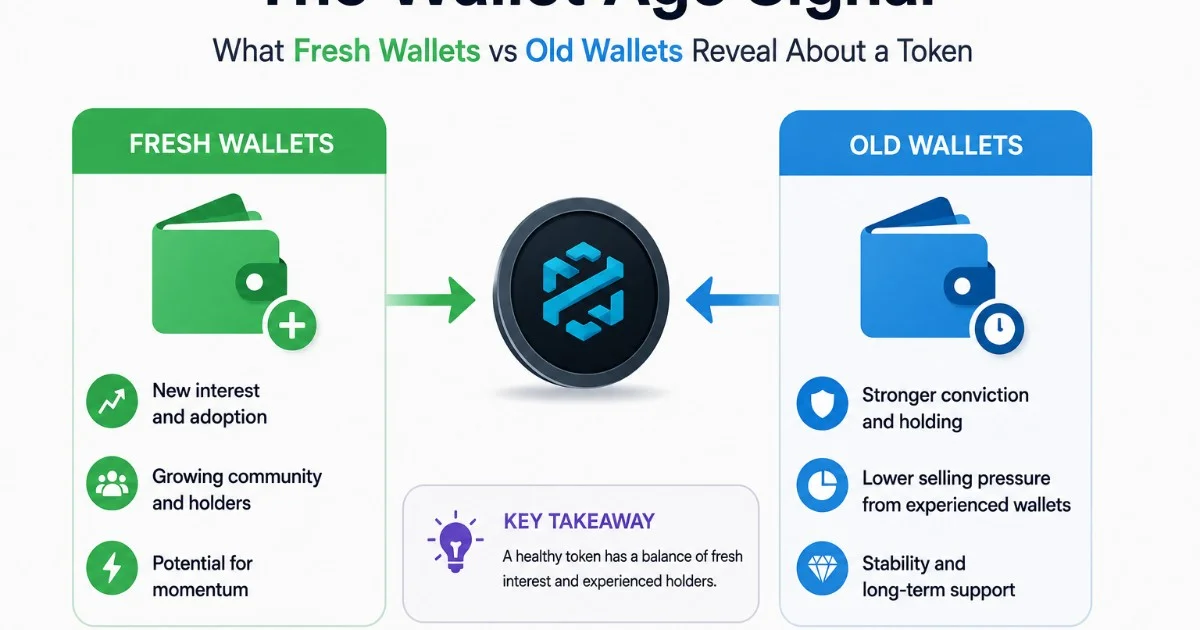
Wallet age can help traders understand whether a token is being bought mainly by fresh wallets, older wallets, active wallets, or a mix of different participants. Each group can reveal something different about market quality. A token with many new wallets may be gaining attention, but it may also be attracting speculative activity, bot behavior, or short term farming. A token with older wallets may suggest deeper market interest, but it can also indicate that experienced wallets are preparing to sell into retail demand.
The goal is not to judge a token by wallet age alone. The goal is to add another layer of context to token research.
Why Wallet Age Matters in Token Analysis
Every wallet has a history. Some wallets are newly created and have no visible trading background. Others have interacted with many tokens, decentralized exchanges, bridges, or DeFi protocols over time. When many wallets interact with a token, their age and behavior can provide clues about how the market is forming.
A token with a healthy mix of wallet types may be more interesting than a token dominated by one suspicious category. For example, a launch that attracts only fresh wallets may look active on the surface, but it may lack experienced participants. A token that attracts only old wallets may be controlled by insiders, early groups, or professional traders. A balanced market often includes both new interest and established wallet activity.
DEXTools helps traders study token activity, volume, transactions, and market behavior. When combined with wallet age research through on chain analysis, these signals can help traders move beyond basic holder count.
What Fresh Wallets Can Reveal
Fresh wallets are wallets with little or no previous activity. In a token launch, fresh wallets can appear for several reasons. Some users create new wallets for security. Some traders use separate wallets for high risk tokens. Some projects encourage users to interact from new wallets. Bots and coordinated groups may also create fresh wallets to make a launch look more active.
Fresh wallets are not automatically negative. In some cases, they show that new users are entering the market. A token that brings in first time participants may be gaining real attention. However, a large cluster of fresh wallets buying similar amounts at similar times deserves closer examination.
If fresh wallets buy and hold through volatility, that can suggest early conviction. If they buy and sell quickly, the token may be driven by short term speculation. If many fresh wallets receive tokens before trading begins, traders should be cautious and study the distribution more carefully.
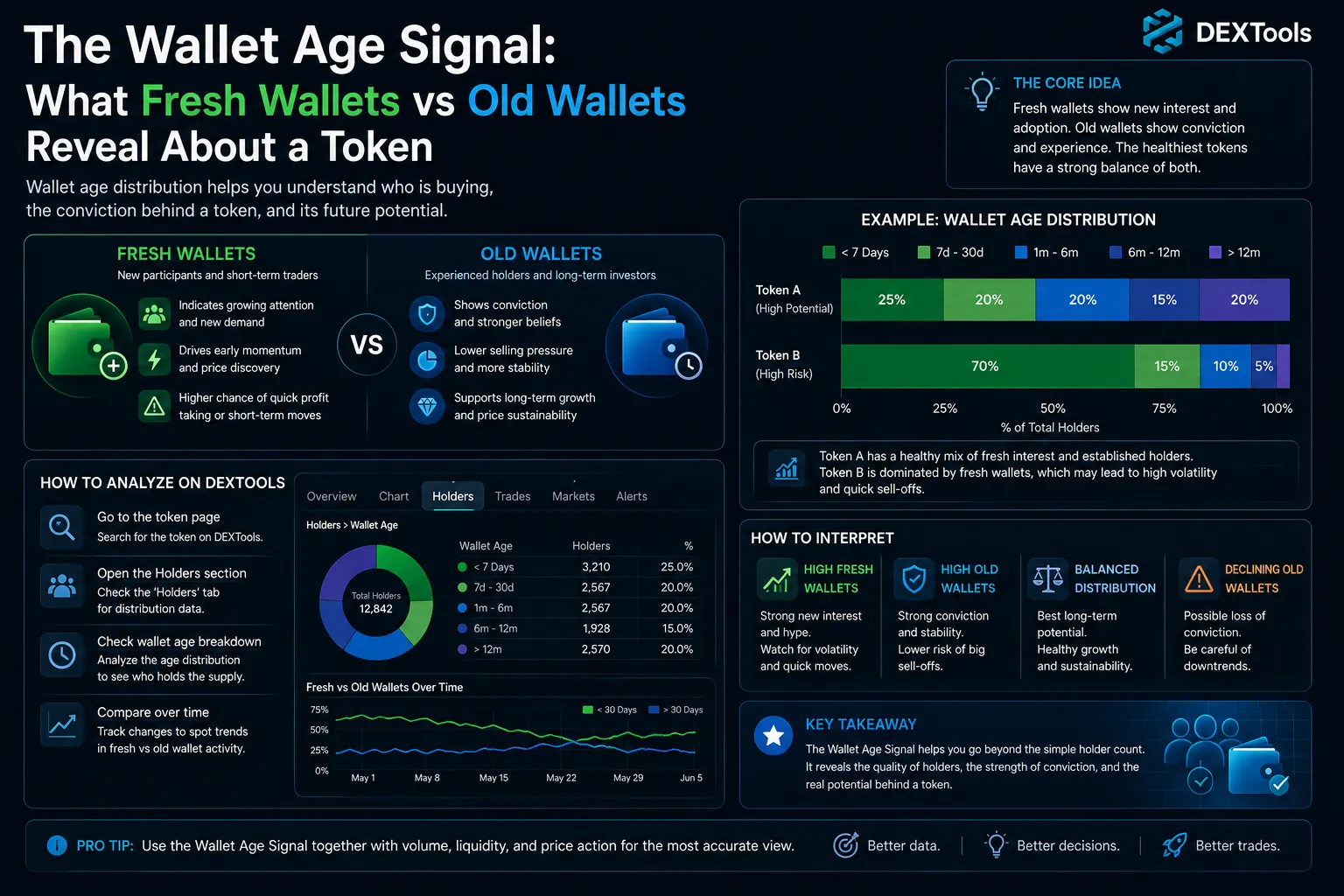
What Old Wallets Can Reveal
Old wallets can indicate experience. These wallets may have participated in previous launches, held different tokens, or interacted with many decentralized applications. When old wallets buy a new token, it may suggest that experienced traders see an opportunity.
However, old wallets are not always a bullish signal. Some older wallets specialize in quick launches, short term rotations, or selling into new demand. A wallet with a long history may be skilled, but it may not be aligned with later buyers.
The key question is what older wallets do after entering. Do they hold? Do they add during dips? Do they sell gradually into every pump? Do several old wallets appear connected by timing or behavior? The wallet age signal becomes stronger when traders combine it with transaction timing and position changes.
The Mixed Wallet Pattern
One of the more constructive patterns is a mixed wallet base. This means the token is attracting fresh interest while also bringing in wallets with existing activity. A mixed base can indicate that the token is reaching different segments of the market.
Fresh wallets may represent new attention. Older wallets may represent experienced capital. Smaller wallets may show community participation. Larger wallets may show conviction or concentration risk. When these groups behave in a balanced way, the market can look healthier.
A mixed wallet pattern is not a guarantee of success, but it is often more useful than a token dominated by a single suspicious cluster.
Wallet Age and Holder Quality
Holder quality is more important than holder quantity. A token with 10,000 holders can still be weak if most wallets hold tiny amounts or behave in a coordinated way. A token with fewer holders may be stronger if the holders are active, distributed, and willing to stay through normal market volatility.
Wallet age helps traders ask better questions. Are new holders real participants or empty wallets? Are old holders accumulating or preparing to exit? Are wallets buying at different times and sizes, or do they look synchronized? Are holders staying active after the first wave of hype?
These questions help traders avoid overvaluing a simple holder count.
How to Use DEXTools With Wallet Age Research
DEXTools can be the starting point for market analysis. Traders can review the token pair, price action, liquidity, volume, transactions, and market rhythm. From there, they can investigate wallet behavior more deeply by looking at relevant wallets and transaction history.
Start with the token chart. Check whether volume is consistent or concentrated in one short period. Review recent transactions and identify whether buys and sells come from many participants or a narrow group. Then look at whether wallets appear new or established.
The best insights come from connecting wallet age with market behavior. A large number of fresh wallets may be more interesting if volume remains stable and liquidity grows. The same pattern may be risky if price spikes once and then collapses.
Common Misinterpretations
One common mistake is assuming all fresh wallets are bots. Some are simply cautious traders using new wallets for risk control. Another mistake is assuming old wallets are always smart money. Some old wallets are aggressive short term traders that may exit quickly.
Traders should also avoid making decisions from one wallet. A single old wallet buying does not prove a token is strong. A single fresh wallet selling does not prove a token is weak. Patterns matter more than isolated transactions.
Wallet age is a signal, not a verdict.
Conclusion
The wallet age signal gives traders a deeper way to analyze token holders. Instead of asking only how many holders a token has, traders can ask who those holders appear to be, how they behave, and whether their activity supports real demand.
Fresh wallets can reveal new attention, but they can also signal artificial activity. Old wallets can reveal experienced interest, but they can also represent early exit risk. A healthy token often shows a balanced mix of wallet types, steady transaction activity, and behavior that matches the broader market structure.
DEXTools helps traders begin that analysis by showing the market side of token behavior. When paired with wallet age research, it becomes easier to separate surface level growth from stronger on chain signals.
A token is not only defined by how many wallets hold it. It is defined by what those wallets are, when they enter, and what they do next.
How to Bridge Crypto Between Chains: Complete Cross-Chain Tutorial 2026 How to Use 1inch for Swaps: Classic, Fusion and Limit Orders (2026) How to Use OKX Web3 Wallet: Multi-Chain DeFi Hub Guide (2026)Related Guides
- What Are Fresh Wallets in Crypto? Explained 2026
- Is ETH Dead? The Truth About Ethereum’s 2026 Metamorphosis
- Avoid Buying Old Token Contracts Post-Migration
- How to Withdraw from a CEX to Self-Custody Wallets
- What Is Privy: Embedded Wallets, User Onboarding and Key Infrastructure (2026)
Frequently Asked Questions
What does wallet age reveal about a token?
Wallet age looks at how long the addresses holding a token have existed and been active on-chain. A mix dominated by brand-new wallets can suggest artificial or coordinated activity rather than organic interest.
What is the difference between fresh wallets and old wallets?
Fresh wallets are recently created addresses with little history, while old wallets have a longer record of on-chain activity. Established wallets are often seen as a sign of more experienced or genuine participants.
Why is holder count alone not enough to evaluate a token?
Holder count is easy to inflate by spreading tokens across many new addresses controlled by the same party. Looking at wallet age and behavior gives more context about whether holders are distinct and genuine.
Can fresh wallets be a warning sign?
A sudden cluster of newly created wallets buying a token can indicate coordinated or manufactured demand. It is a signal to investigate further rather than proof of manipulation on its own.