Is ETH Dead? The Truth About Ethereum’s 2026 Metamorphosis
— By AliceOnChain in Tutorials
Is ETH dead? As Solana claims the spotlight and ETH/BTC hits new lows in April 2026, the crowd is calling for an end to the Vitalik era. But the on-chain data tells a different story. Ethereum isn't dying-it's evolving into the world’s institutional settlement layer. Discover why the 'L2 cannibalization' is a myth, how BlackRock is anchoring the network, and why the current boredom might be the greatest investment signal of the cycle.
Is ETH Dead? The Truth Behind Ethereum’s 2026 Metamorphosis
If you’ve spent any time on "Crypto Twitter" or monitored the trending pairs on DEXTools lately, you’ve undoubtedly seen the sentiment: "ETH is dead." With the ETH/BTC ratio hitting multi-year lows and Solana shattering daily transaction records, the narrative of decline is easy to swallow.
However, as we move through April 2026, the on-chain data tells a drastically different story. Ethereum isn't dying; it is undergoing a profound "growing up" phase, shifting from a chaotic retail playground to the invisible settlement layer of the global financial system. If you are asking is ETH a good investment today, you must look past the price candles and into the modular architecture of the future.
1. The Price vs. Fundamentals Paradox
While retail investors panic over ETH’s sideways movement between $2,800 and $3,400, institutional giants are quietly anchoring the network.
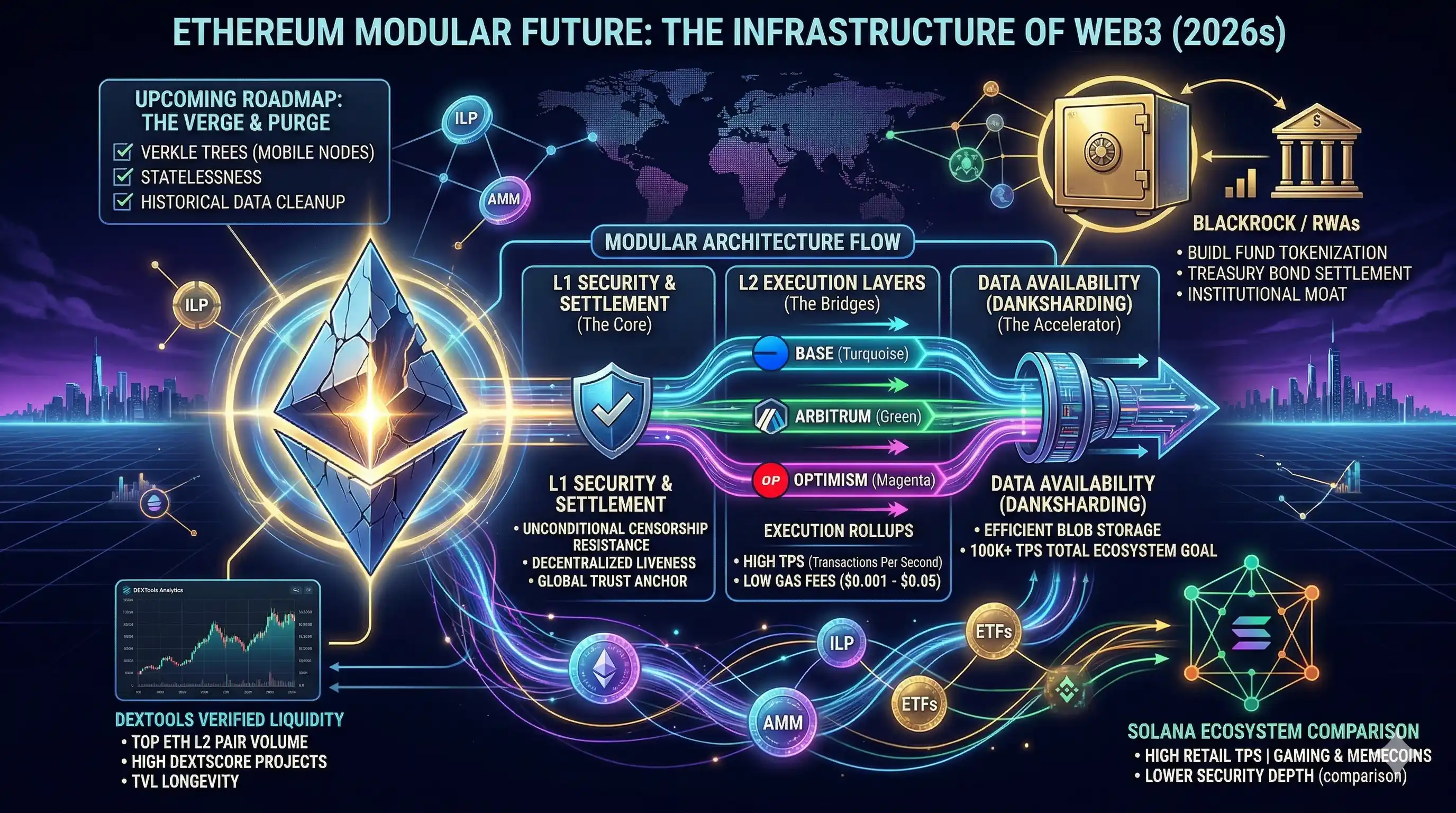
Real-World Assets (RWA): In 2026, Ethereum has become the primary ledger for tokenized treasury bills and bonds. BlackRock’s BUIDL fund and its successors now settle billions monthly on the Mainnet.
Institutional Moat: While other chains chase "TPS" (Transactions Per Second), Ethereum has won the "LPS" (Liquidity Per Second) war. It remains the only programmable blockchain with the security pedigree required by sovereign wealth funds.
2. The L2 "Cannibalization" Myth: Will ETH Recover?
A common argument for why people think ETH is dead is the migration of activity to Layer 2s (Base, Arbitrum, Optimism). Critics claim Ethereum has "cannibalized" its own fee revenue.
The Reality: Ethereum has successfully transitioned into a B2B (Business-to-Business) model. Instead of selling blockspace to individual users for $50 a swap, it sells massive "security batches" to L2s.
Post-Danksharding Efficiency: In 2026, L2 transactions cost fractions of a cent, driving a 10x increase in total ecosystem users. When people ask will ETH recover, they often miss that the ecosystem is already at an all-time high in terms of active addresses-they just aren't on the Mainnet anymore.
3. Ethereum vs. Solana: A Zero-Sum Lie
The "Solana Killer" narrative is a relic of 2024. By mid-2026, the market has matured enough to understand that these networks serve different masters:
Solana: The high-frequency "Nasdaq of Chains," perfect for retail DeFi, gaming, and the high-speed ripples of memecoin mania.
Ethereum: The "Global Settlement Bank." It is where the world’s most valuable assets live because of its decentralized liveness and censorship resistance. The DEXTScore of major Ethereum-based protocols remains higher on average than any other chain, reflecting a level of liquidity depth that competitors still struggle to replicate.
4. The 2026 Roadmap: The Verge and Beyond
The Ethereum roadmap hasn't stalled. This year's focus on The Verge is introducing Verkle Trees, allowing nodes to run on minimal hardware.
Statelessness: This makes Ethereum more decentralized than ever, allowing users to verify the chain from a mobile device.
Scalability: Combined with the upcoming "Purge" (removing historical data bloat), the Ethereum ecosystem is on a clear path to supporting over 100,000 TPS across its L2 landscape by the end of the 2026s.
5. Verdict: Is ETH a Good Investment Now?
Market cycles are often defined by "boredom" before the "breakout." Analysts at DEXTools note that the current accumulation phase mirrors the late 2020 period.
Upside Potential: If the "Clarity Act" passes and institutional RWA adoption doubles, a will ETH recover scenario could see price targets of $8,000 to $10,000 by Q4 2026.
Risk Mitigation: The "death" of ETH would require a total collapse of the DeFi and L2 sectors-an event currently deemed statistically improbable by most risk models.
Conclusion: Don't Mistake Evolution for Extinction
Is ETH dead? Only if you believe the internet is dead because you no longer see the "HTTP" prefix in your browser. Ethereum has become infrastructure. It is the plumbing of the new financial internet. The ripples of its early days as a speculative token are being replaced by the steady waves of a global utility asset.
For the disciplined investor, the noise of "ETH is dead" isn't a warning-it’s a signal.
--How to Bridge Crypto Between Chains: Complete Cross-Chain Tutorial 2026
How to Use 1inch: Complete DEX Aggregator Swap Tutorial (2026)
--
Disclaimer: This article is for informational purposes only and does not constitute investment advice, financial advice, trading advice, or any other kind of advice. DEXTools does not recommend buying, selling, or holding any cryptocurrency or token. Users should conduct their own research and consult with a qualified financial advisor before making any investment decisions. Cryptocurrency investments are volatile and high-risk. DEXTools is not responsible for any losses incurred.
Related Guides
- Should I Buy Ethereum (ETH) in 2026? Complete Analysis Framework
- What Is Ethereum Staking? How It Works, Rewards and Risks (2026)
- What Is Ethereum (ETH)? Beginner Guide 2026
- What is ETH? A Comprehensive Ethereum chain 2026 Guide
- What is ETH ATH? Ethereum’s All-Time High Explained
Frequently Asked Questions
Is Ethereum dead in 2026?
No, Ethereum is not dead; it is undergoing a significant transformation, evolving into a crucial component of the global financial system.
What is the current price range of ETH?
As of April 2026, ETH is trading between $2,800 and $3,400.
How has Ethereum adapted to Layer 2 solutions?
Ethereum has transitioned to a B2B model, selling security batches to Layer 2s, which has led to a significant increase in ecosystem users.
What is the future potential price of ETH?
If institutional adoption of Real-World Assets doubles, ETH could see price targets of $8,000 to $10,000 by Q4 2026.
What are Verkle Trees in Ethereum's roadmap?
Verkle Trees are part of Ethereum's 2026 roadmap, allowing nodes to operate on minimal hardware, enhancing decentralization and scalability.