How to Withdraw from a CEX to Self-Custody Wallets
— By AliceOnChain in Tutorials

An advanced step-by-step guide to executing secure cryptographic asset withdrawals from centralized platforms to private non-custodial environments, detailing network validation, gas management, and on-chain verification strategies.
How to Withdraw from a CEX to Your Self-Custody Wallet
Transitioning your digital assets from a centralized exchange (CEX) to a private, non-custodial environment is a critical milestone for any market participant. While centralized entities provide highly liquid fiat gateways and efficient order-matching engines, they require users to surrender absolute control of their cryptographic keys. Relying permanently on an exchange to safeguard your capital introduces systemic counterparty risk, protocol freeze vulnerabilities, and geometric structural limitations.
True sovereign participation in digital asset markets-such as deploying capital into early-stage automated market makers (AMMs), interacting with liquidity pools, and utilizing analytical dashboards on platforms like DEXTools-requires direct on-chain ownership. Executing a secure cryptographic transaction to withdraw from a CEX to your self-custody wallet represents the bridge between passive exchange dependency and active on-chain execution. However, navigating this clearing layer requires precise technical execution to mitigate irreversible loss from incorrect network configurations or misaligned security vectors.
The Technical Imperative: Why Self-Custody Changes Execution Dynamics
When your capital resides on a centralized exchange, your balance is merely an internal ledger entry on the platform’s private database. The exchange owns the architectural blockchain addresses and handles the underlying private keys.
By initiating a standard transfer out of these accounts, you shift your assets into a non-custodial software layer (such as a browser extension wallet) or a hardware security module (HSM). This deployment strategy changes your market positioning in two ways:
Elimination of Counterparty Friction: Your assets can no longer be subjected to unexpected platform-wide withdrawal freezes, localized insolvency risks, or arbitrary compliance reviews.
Immediate DeFi Preparedness: Your assets become instantly active on the blockchain. You gain the autonomy to execute immediate peer-to-peer token swaps, capitalize on yield disparities, or monitor live contract health metrics across diverse liquidity networks.
Step 1: Selecting and Hardening Your Target Non-Custodial Destination
Before initiating any outward transfer sequence, you must configure a secure, verified self-custody destination. Depending on your transactional intent and capital volume, you will typically deploy either a hot wallet framework for rapid DeFi interactions or a cold storage hardware framework for structural capital preservation.
Security Hardening Measures
Source Validation: Download software extensions or apps exclusively from official, cryptographically verified developer repositories. Counterfeit applications frequently populate search engine ads to harvest recovery combinations.
Sovereign Seed Phrase Isolation: Store your 12-to-24-word recovery seed phrase completely offline. Never capture digital screenshots, store seed phrases in cloud text documents, or expose them to connected environments.
Address Generation: Generate your clean public receive address. This public string (e.g., an Ethereum-standard 0x hexadecimal address) serves as your destination identifier on the decentralized network ledger.
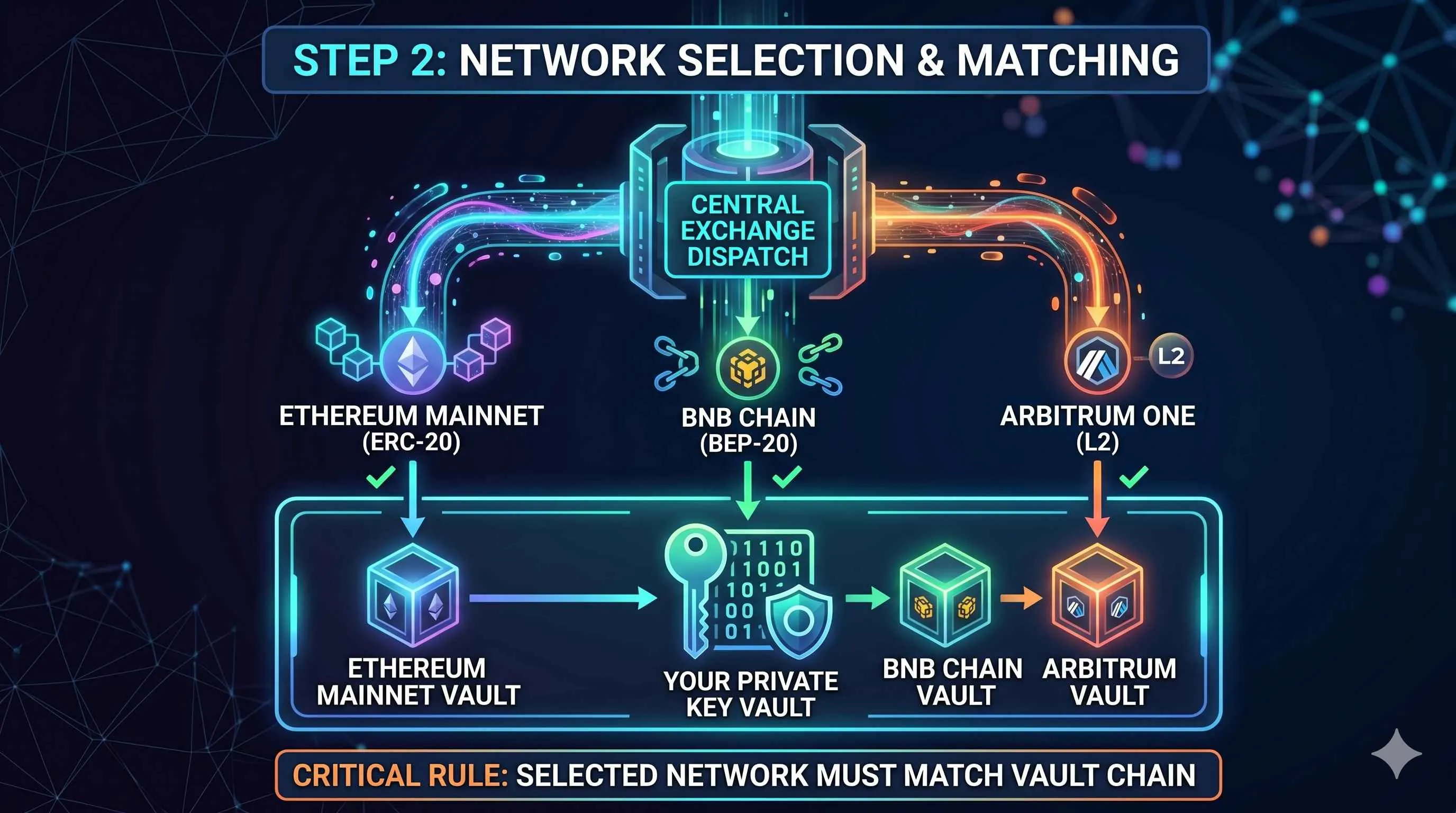
Step 2: The Critical Variable-Network Selection and Dynamic Alignment
The most prevalent error when trying to withdraw from a CEX to your self-custody wallet occurs during network selection on the exchange dispatch screen. Centralized platforms typically support multiple blockchain networks for a single asset to provide cheaper transactional options.
For instance, if you are moving Tether (USDT), the platform may offer options to route the transfer through Ethereum (ERC-20), BNB Chain (BEP-20), Arbitrum, or Solana.
The network configuration chosen on the CEX interface must align perfectly with the active network environment configured in your target vault setup.
If you select BNB Chain on the exchange side because the transfer fee is lower, but your destination environment is exclusively initialized to read the Ethereum Mainnet ledger, your funds will arrive on the BNB Chain accounting layer under your private key. While not permanently lost if you control the master key, the assets will not appear on your Ethereum ledger, requiring advanced manual network RPC adjustments to recover visibility. Conversely, sending an asset to an incompatible network layer that your target address cannot support can result in permanent asset destruction.
Step 3: Executing the Withdrawal Sequence and Fee Optimization
Once your target address is verified and the network configuration is perfectly matched, you can initiate the exchange outflow pipeline.
Operational Checklist
Address Copy Precision: Always use the direct "Copy Address" feature or scan the visual QR code. Never manually type out a cryptographic address string.
The Micro-Tranche Test: For significant capital transfers, always execute an initial small-scale test transaction. Verify that the test allocation clears completely and reflects accurately in your app dashboard before dispatching the remaining balance.
Fee Structure Awareness: Exchanges impose localized flat transfer premiums that operate independently of actual blockchain gas costs. Track these premium levels during low-congestion intervals to maximize total capital retention.
Step 4: Tracking the On-Chain Ledger Settlement via Analytical Tools
After the platform approves the outbound transfer, the transaction moves from a private database entry to an active public blockchain transaction. The platform will provide a unique Transaction ID (TxID) or hash.
Monitoring Network Validation
You can copy this transaction hash into the appropriate blockchain explorer (such as Etherscan or Solscan) to monitor its progress through the peer-to-peer validation layer. The transaction will progress through several stages:
Pending: The transaction is waiting in the network mempool to be included in an upcoming block by validators or miners.
Success/Confirmed: The transaction has been successfully written into a block. As subsequent blocks are added to the chain, the number of block confirmations increases, cementing the finality of your asset transfer.
Once the transaction achieves successful confirmation status, your assets are fully active within your non-custodial ecosystem. You can now seamlessly interface with decentralized discovery platforms. By connecting your newly funded accounts to data tools like the DEXTools Pair Explorer, you can actively cross-reference live token pairs, monitor liquidity migration, and interact securely with native smart contracts using your own private keys.
Conclusion: Securing Your Financial Autonomy
Mastering the mechanics required to move funds securely from account custody to decentralized control is a foundational technical requirement for navigating the modern crypto landscape with institutional precision. By treating network configurations with absolute precision, running methodical micro-tranche tests, and taking total ownership of your cryptographic keys, you successfully transition from a passive web3 observer to a fully autonomous market participant.
With your capital secured within your own private infrastructure, you possess the requisite baseline agility to explore decentralized financial protocols, manage on-chain volatility efficiently, and deploy capital safely across the global web3 ecosystem.
- How to Bridge Crypto Between Chains: Complete Cross-Chain Tutorial 2026
- How to Use 1inch for Swaps: Classic, Fusion and Limit Orders (2026)
- OKX Web3 Wallet Tutorial 2026: Multi-Chain Setup Guide
Disclaimer: This article is for informational purposes only and does not constitute investment advice, financial advice, trading advice, or any other kind of advice. DEXTools does not recommend buying, selling, or holding any cryptocurrency or token. Users should conduct their own research and consult with a qualified financial advisor before making any investment decisions. Cryptocurrency investments are volatile and high-risk. DEXTools is not responsible for any losses incurred.
Related Guides
- What Is a Non-Custodial Wallet: Complete Self-Custody Guide (2026)
- How to Use Coinbase Wallet: Self-Custody and dApp Guide (2026)
- What Is Self-Custody in Crypto? Explained 2026
- What Is Babylon Bitcoin Staking: Complete BTC Self-Custody Staking Guide (2026)
- What Is Fireblocks: Digital Asset Custody, MPC Wallets and Treasury Infrastructure (2026)