EMA vs SMA in Crypto: Key Differences Explained (2026)
— By Tony Rabbit in Tutorials
EMA vs SMA explained for crypto traders: the real differences, when each moving average works better, common periods and how to read crossover signals.
This guide is specifically about the EMA vs SMA comparison in crypto. If you want the broader five-line trend system instead of a moving-average comparison, read our Ichimoku Cloud guide.
Most traders learn about moving averages on day one and never look at them seriously again. That is a mistake. The simple moving average and the exponential moving average are not interchangeable. They answer different questions, react at different speeds, and break in different ways. Picking the right one for the right job is one of the cheapest edges a crypto trader can build.
Quick answer: The Simple Moving Average (SMA) gives every candle in the lookback window the same weight, producing a smooth line that lags more but filters noise better. The Exponential Moving Average (EMA) weights recent candles more heavily, producing a faster line that reacts quickly to new price action but whipsaws more often. Use SMAs to define structural trend on higher timeframes and EMAs for entries, dynamic support, and short-term momentum.
- SMA = equal weighting. Every candle in the period counts the same.
- EMA = recent-weighted. Newer candles count more, older candles fade.
- EMA reacts faster. Better for execution and dynamic support; worse in chop.
- SMA is smoother. Better for higher-timeframe regime reads; slower to confirm reversals.
- The choice is contextual. Trend traders, swing traders, and scalpers each have a default that fits their horizon.
How SMA and EMA are actually calculated
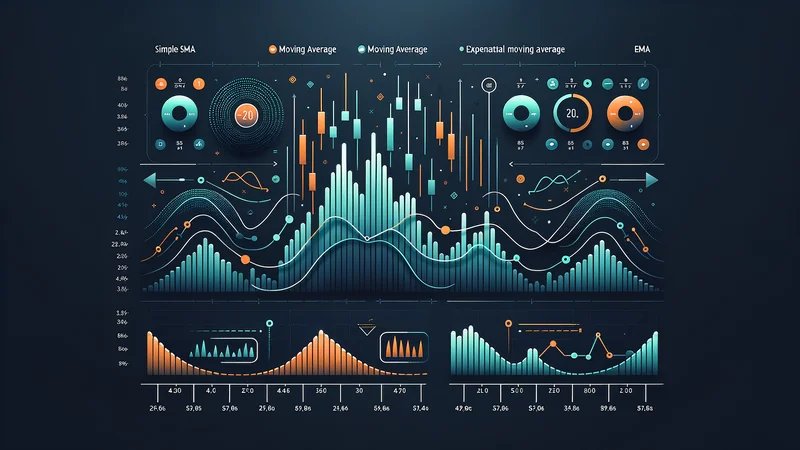
Both indicators take the closing prices of the last N candles and average them, but they do it differently. The SMA divides the sum by N. The EMA applies a weighting multiplier so the most recent candle counts the most and older candles count progressively less. The math is small. The behavioral difference is large.
The SMA: the boring, honest version
The 20-period SMA looks at the closes of the last 20 candles, adds them, and divides by 20. That is it. Every candle gets the same weight, no matter how recent. The line that comes out is smoother because it is dragged by older data. That smoothness is what makes the SMA so good at describing the higher-timeframe regime: you can see the trend without being whipsawed by every news headline.
The EMA: the reactive cousin
The EMA uses a smoothing factor, often expressed as 2/(N+1), so the latest candle has more pull on the average than the candle 20 bars ago. That sounds technical, but the practical effect is simple: the EMA hugs price more closely, turns earlier in trends, and reacts faster to fresh moves. A 20 EMA on Bitcoin will identify a trend change days before a 20 SMA does. It will also fake out more often when the market is choppy.
When each one wins
The SMA and EMA are good at different jobs. Picking based on the chart, not on personal preference, is what separates traders who use moving averages well from traders who fight them.
SMA strengths
- Higher-timeframe regime. The 200 SMA on the daily and weekly is one of the cleanest single trend filters on Bitcoin and Ethereum.
- Filtering noise. In low-quality, choppy conditions, the SMA refuses to react to every fake breakout.
- Long-term levels. The 50 and 200 SMAs are watched by enough traders that they often act as self-fulfilling support and resistance on majors.
EMA strengths
- Trend execution. Pullbacks to the 9 or 20 EMA in a strong uptrend often offer cleaner entries than waiting for the SMA to catch up.
- Dynamic support and resistance. A trending move tends to ride the EMA on every retest before failing.
- Faster trend confirmation. An EMA cross signals a regime shift earlier, which matters more for short-term traders.
Where each one fails
The EMA gets crushed in chop. Every micro-pullback triggers a fake cross or a fake break, and traders who chase those signals end up overtrading. The SMA gets crushed in fast moves. By the time the SMA confirms a reversal, the trade is often already gone. Honest moving-average users accept the trade-off rather than pretending one indicator is better than the other.
The popular periods and what they mean
Periods are not random conventions. They reflect different time horizons and different decisions.
| Period | Common use | SMA or EMA | Notes |
|---|---|---|---|
| 9 | Scalping, short-term momentum | EMA | Hugs price tightly; whipsaws fast. |
| 20 | Intraday and swing entries | EMA | Dynamic support in trending crypto pairs. |
| 50 | Mid-term trend | SMA or EMA | Often watched by both swing traders and algos. |
| 100 | Mid-to-long-term trend filter | SMA | Less popular than 50 and 200 but useful as a buffer. |
| 200 | Macro trend, bull/bear filter | SMA | The 200-day SMA on BTC is the most-watched moving average in crypto. |
Moving average crossovers, in plain English
Crossovers are the most discussed moving average signal and the most misunderstood. A "Golden Cross" happens when a faster moving average crosses above a slower one (most famously the 50 SMA crossing above the 200 SMA on the daily). A "Death Cross" is the same setup in reverse. Both are lagging signals: by the time they print, the price move that caused them is well underway.
What crossovers do well
They confirm regime. A daily 50/200 SMA Golden Cross tells you the macro trend has flipped from bear to bull, even if the move is already old. For position traders and risk managers, that is genuinely useful. The same logic applies to faster crossovers like the 9 and 20 EMA on intraday charts, which can confirm short-term momentum shifts.
What crossovers do poorly
They do not call tops or bottoms. They are bad timing tools. A trader who buys every Golden Cross and sells every Death Cross will buy late and sell late, repeatedly. Crossovers are filters, not signals. Use them to decide which side of the market you want to trade, not to decide exactly when to enter.

Stacking SMA and EMA together
The most useful workflow is not "EMA versus SMA" but "EMA and SMA". Many professional crypto traders use both, in different roles, on the same chart.
The trend filter + execution combo
Use the 200 SMA on the daily as a bull/bear filter. If price is above it, only take long setups. If below, only take shorts. Then drop to the 4-hour or 1-hour and use a 20 EMA to time entries. The SMA decides the side, the EMA decides the moment. Most beginner trades fail because they invert the two: trying to use the SMA for timing or the EMA for regime.
The pullback model
In a clean uptrend, price tends to pull back to the 9 or 20 EMA repeatedly before continuing. The setup is simple: wait for a pullback into the EMA, look for a bullish reaction candle, and enter with a stop just below the EMA. The trade fails when the EMA breaks decisively and price reclaims look weak. This is one of the cleanest swing setups in liquid crypto markets and is much harder to run with a slow SMA.
Common moving average mistakes
- Using EMA in chop. Sideways markets generate dozens of fake EMA signals per week.
- Using SMA for entries. By the time the SMA confirms, the move is often gone.
- Treating MAs as exact levels. Both lines are approximations. Wicks above and below are normal.
- Stacking too many MAs. Five moving averages on one chart is decoration, not analysis.
- Forgetting timeframe consistency. A 20 EMA on the 1-minute is a different tool than a 20 EMA on the daily, even though it is the "same" indicator.
A clean workflow for crypto traders
- Start on the daily. Add the 200 SMA. That is your macro filter.
- Drop to the 4-hour. Add the 50 EMA for medium-term trend context.
- Refine on the 1-hour or 15-minute. Add a 20 EMA for entries.
- Check liquidity. Use DEXTools or the venue's order book to confirm the pair can be traded at the prices the chart shows.
- Combine with structure. Pair the moving average bias with chart patterns, RSI, and volume profile for confirmation.
The point is not to follow the moving average blindly. It is to use it as one of several inputs that, when they agree, define a higher-quality setup.
Frequently asked questions
Is EMA better than SMA for crypto?
Neither is universally better. EMAs are typically better for short-term execution because they react faster, while SMAs are usually cleaner for higher-timeframe trend filters. The best traders use both in different roles rather than picking one.
What moving average periods do professional traders use?
The most common defaults are 9, 20, 50, 100, and 200. The 9 and 20 EMA are often used for short-term trends and entries; the 50 and 200 SMA are typically used for higher-timeframe regime context. Custom periods are fine, but they should be tested rather than picked at random.
Should beginners start with SMA or EMA?
Beginners usually benefit from starting with the 200 SMA on the daily as a bull/bear filter. It is hard to misuse and forces the trader to think about regime before reaching for fast tools. Once that habit is in place, adding a 20 EMA for entries makes more sense.
Do moving averages work on memecoins?
They work on liquid pairs. Thin or freshly launched memecoins generate noisy moving averages that lead to bad signals. Moving averages assume that the price action they are smoothing is at least somewhat orderly. On manipulated or whale-driven charts, they often are not.
Are EMA crossovers a good entry signal?
They are decent confirmation, but they are lagging. A trader who waits for an EMA cross before entering will catch trends late and miss reversals entirely. EMA crossovers are usually better used as filters that align with structure-based setups.
Final takeaway: EMA versus SMA is not a contest with a winner. The SMA describes regime, the EMA describes momentum, and the cleanest crypto workflows use both on different timeframes for different jobs. Pick the right tool for the right job and the moving average becomes a quiet, durable edge instead of an indicator argument.
Disclaimer: This guide is for educational purposes only and does not constitute investment, financial, legal, or trading advice. Indicators, including moving averages, can improve context but do not eliminate market risk.
Related Guides
- What Are Moving Averages in Crypto? EMA vs SMA Guide 2026
- ETH vs WETH in 2026: Differences, Uses and Tradeoffs
- Liquidity Pull vs Slow Rug: On-Chain Warning Signs (2026)
- Take Profit vs Stop Loss in Crypto: Key Differences, Trigger Logic and Fill Risk (2026)
- Is Ripple the Same as XRP? Key Differences Explained (2026)
- CBDCs vs Stablecoins
Frequently Asked Questions
What is the difference between EMA and SMA?
A simple moving average (SMA) gives equal weight to every price in the period, while an exponential moving average (EMA) gives more weight to recent prices. As a result, the EMA reacts faster to new price moves than the SMA.
Which is better for crypto trading, EMA or SMA?
Neither is universally better; the EMA can help catch fast moves quickly while the SMA tends to be smoother and less prone to false signals. Many traders pick based on whether they want responsiveness or stability.
What are common moving average periods?
Traders often use shorter periods like 9, 20, or 50 for near term trends and longer ones like 100 or 200 for the bigger picture. The right period depends on your timeframe and trading style.
How do moving average crossovers work?
A crossover happens when a shorter moving average crosses above or below a longer one, which some traders read as a possible trend change. These signals can lag and produce false alerts, so they are usually combined with other analysis.