CBDCs vs Stablecoins: Key Differences for Crypto Users
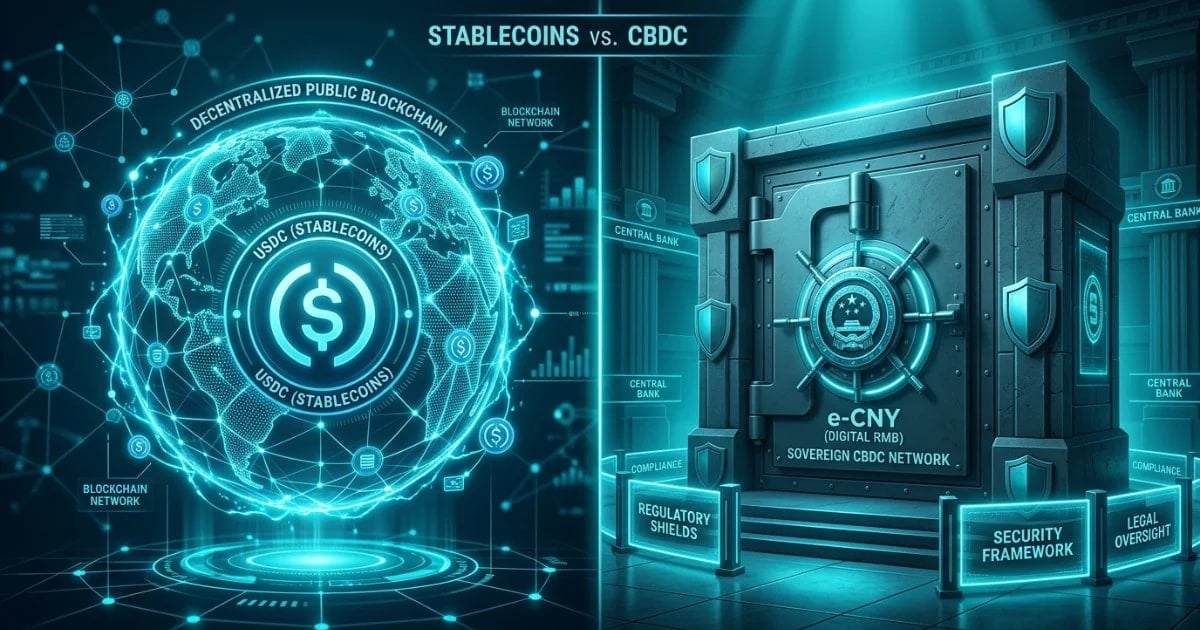
Digital fiat money has split into two opposite paradigms. We analyze the technical trade-offs between open stablecoins and sovereign CBDC architectures.
The Battle for Digital Settlement
- Digital assets navigate a deeply integrated financial system where sovereign experiments and private infrastructure compete for settlement dominance. The stablecoin market has grown to an aggregate capitalization of approximately $307 billion, while Central Bank Digital Currencies (CBDCs) have transitioned from abstract research papers into live monetary policy tools.
- For crypto users, distinguishing between these two digital monetary structures is essential. While they both present as digitized fiat representations, their underlying trust models, data visibility architectures, and integration targets are entirely opposite.
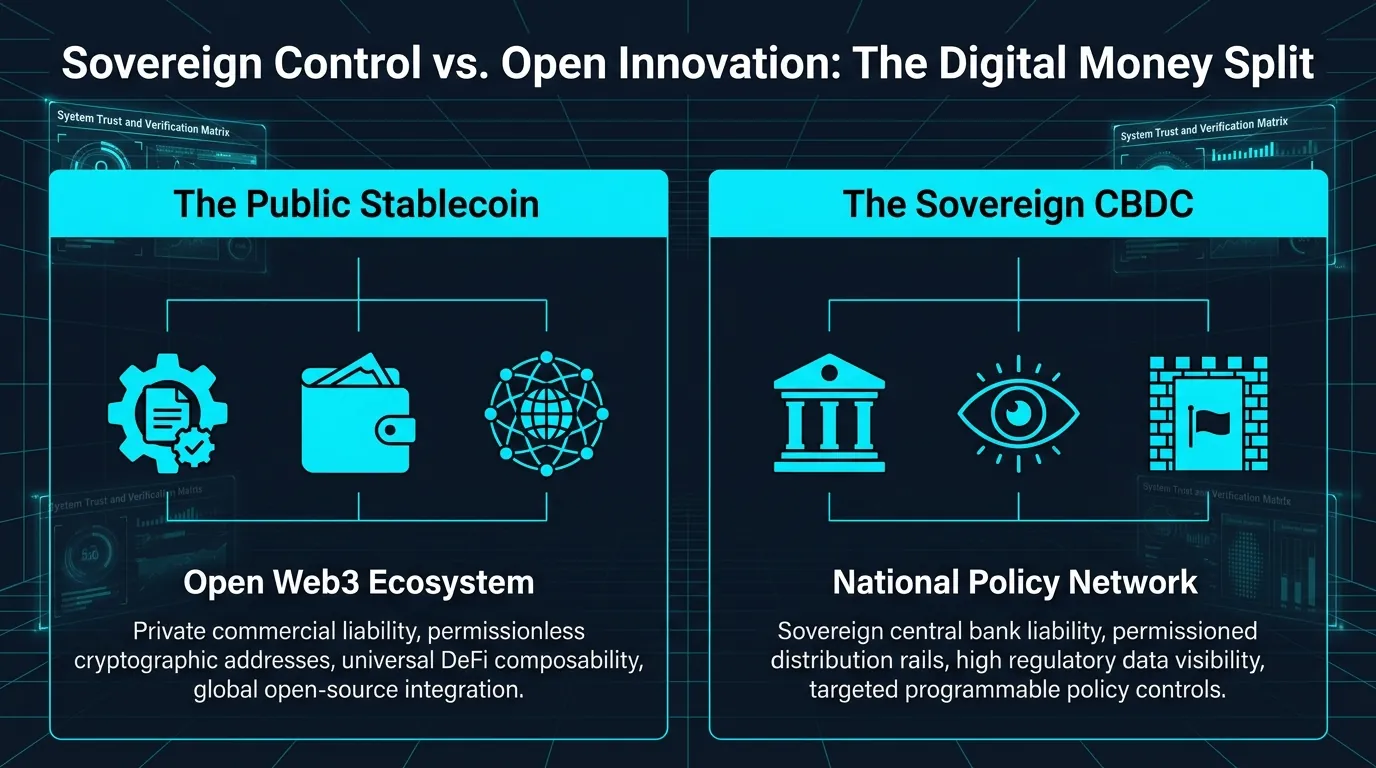
1. Core Archetypes: Sovereign Issuance vs. Private Open-Source Money
To understand the core difference, a user must look directly at the balance sheet liability of the digital token.
Stablecoins (e.g., USDC, USDT): A stablecoin is a privately issued digital token designed to mirror the value of a national currency, primarily the U.S. dollar. It is issued by private entities or decentralized protocols and is typically backed by exogenous reserves like cash, short-term treasury bills, or liquid commercial paper. The token represents a private commercial liability of the issuer, not the government itself, and operates on permissionless public blockchains.
Central Bank Digital Currencies (CBDCs): A CBDC is a digitally native representation of a country's official fiat currency issued directly by the sovereign monetary authority. It is not backed by reserves; it is the currency itself, representing a direct liability of the central bank. It typically runs on closed, permissioned, or federated networks distributed through a tier-two commercial banking model.
2. The Programmability Paradox: Composability vs. Policy Rules
While both forms of money leverage code to automate transactions, the execution targets serve entirely different masters.
Stablecoin Composability: Private stablecoins are built using open-source smart contract standards (like ERC-20 on Ethereum or SPL on Solana). This enables composability, meaning a stablecoin can be plugged seamlessly into any decentralized application (dApp), automated market maker, or lending protocol. The code is developer-centric, designed to build open-source financial Lego blocks.
CBDC Policy Automation: CBDC programmability is structurally designed for state-level monetary policy implementation. Instead of allowing universal integration into public DeFi, a sovereign algorithm is configured to manage economic target vectors. This includes programmable features such as automated distribution of targeted subsidies, geographic restrictions on usage, negative interest rate propagation, or expiration dates on stimulus funds to force velocity. It is a control-centric programming architecture.
3. The Privacy Horizon: Cash-Like Pseudonymity vs. Centralized Transparency
Data tracking is the primary point of friction for crypto-native users migrating between these ecosystems.
Public Ledger Pseudonymity: Stablecoins running on public blockchains utilize cryptographic address generation. While the ledger is fully transparent and audited by on-chain analytics, individual real-world identity is isolated behind a public key hash until off-ramped through an exchange requiring compliance checks. Transactions occur peer-to-peer without an intermediary manually approving the transfer state.
Centralized Data Visibility: Because CBDCs route through centralized or permissioned network layers, they give monetary authorities direct visibility into transaction streams. Regulators are developing localized privacy layers (such as the European Central Bank's digital euro offline small-value cash-like model) to limit public ledger indexing, but the foundational architecture inherently permits deep regulatory oversight, transaction auditing, and centralized wallet freezing without decentralized governance approval.
4. Comparative Ecosystem Analysis: USDC vs. e-CNY
The divide between open networks and national infrastructure is clearly observed when analyzing the status of leading digital assets.
USDC (Circle): Operates globally as a highly regulated, compliant dollar-pegged token. It handles the majority of regulated on-chain settlement, cross-border B2B remittances, and DeFi pair capitalization across Ethereum, Base, Solana, and dozens of high-speed execution environments.
e-CNY (Digital Yuan): China’s world-leading CBDC program has implemented a massive structural shift. Moving away from the initial retail cash-like model, the framework transitioned the e-CNY into a digital deposit money structure where commercial banks pay interest on wallet balances, integrated into commercial bank balance sheets under deposit insurance guidelines. It serves national payments, public transit, and international cross-border interbank routing channels via the mBridge initiative, remaining isolated from public public blockchains.
Technical Trade-offs and Market Realities. CBDCs vs Stablecoins
| Evaluation Parameter | Public Stablecoins (e.g., USDC) | Central Bank Digital Currencies (CBDCs) |
| System Liability | Private Corporate or Decentralized Protocol | Sovereign Central Bank Reserve Authority |
| Network Framework | Permissionless Public Blockchain Layer | Closed or Permissioned Sovereign Rails |
| DeFi Composability | Absolute (Universal dApp Integration) | Excluded (Isolated from open public Web3) |
| Privacy Mechanics | Pseudonymous cryptographic public-key state | Centralized regulatory data transparency |
| Yield Potential | Organic via DeFi and lending markets | Structural (Dynamic interest-bearing deposits) |
Public stablecoins remain the undisputed medium of exchange for the global open internet, providing developers and traders with the speed, transparency, and composability needed to drive permissionless finance. However, they carry corporate counterparty risks and lack deposit insurance. CBDCs eliminate default risk by offering direct sovereign settlement finality, but they sacrifice financial privacy, geographic flexibility, and public ecosystem interoperability to maintain state-level monetary control.
5. Cross-Chain Telemetry and Capital Tracking
As stablecoin capital blocks move continuously between public blockchain execution layers and layered deposit pools, tracking multi-chain volume distribution is essential for identifying liquidity trends. When navigating these changes, monitoring the health of decentralized pools prevents exposure to slippage during market movements.
Disclaimer: This article is for informational purposes only and does not constitute investment advice, financial advice, trading advice, or any other kind of advice. DEXTools does not recommend buying, selling, or holding any cryptocurrency or token. Users should conduct their own research and consult with a qualified financial advisor before making any investment decisions. Cryptocurrency investments are volatile and high-risk. DEXTools is not responsible for any losses incurred.
Related Guides
- Take Profit vs Stop Loss in Crypto: Key Differences (2026)
- Is Ripple the Same as XRP? Key Differences Explained (2026)
- EMA vs SMA in Crypto: Key Differences Explained (2026)
- Airdrop Farmers vs Real Users: How to Read On-Chain Activity
- USDT vs USDC vs DAI: Differences and Risks
Frequently Asked Questions
What is the difference between a CBDC and a stablecoin?
A CBDC is a digital form of a country's official currency issued by its central bank, while a stablecoin is usually issued by a private company and designed to track a currency's value. The key difference is who issues and controls the asset.
What is a CBDC?
A CBDC, or central bank digital currency, is a digital version of a nation's fiat money issued and backed by its central bank. It is a sovereign form of money rather than a privately issued token.
Are stablecoins issued by governments?
Most stablecoins are issued by private companies rather than governments. This makes them different from CBDCs, which are issued directly by a central bank.
Why do CBDCs and stablecoins raise different privacy considerations?
A CBDC is operated by a central authority that may have visibility into transactions, while stablecoins often run on public blockchains with their own transparency model. The trade-offs around privacy and control differ between the two designs.