Swing Trading Crypto for Beginners: Multi-Day Setups and Risk Rules (2026)
— By Tony Rabbit in Tutorials

Swing trading crypto explained for beginners: multi-day setups, daily-chart timing, stop placement, position sizing, and why swing trading differs from both day trading and long-term investing.
Swing trading is the version of crypto trading that beginners hear about least and benefit from most. It does not require staring at charts all day, does not depend on news minute by minute, and does not punish a single missed trade the way intraday trading does. The trade-off is patience: positions are held for days or weeks, and the trader must be comfortable doing nothing while the thesis plays out.
Quick answer: Swing trading crypto means holding positions from a few days to several weeks, aiming to capture the larger moves between meaningful support and resistance. It works best on liquid majors, on the daily and 4-hour timeframes, with a small set of repeatable setups (breakout retest, pullback to a moving average, range-edge fade). Compared to day trading, swing trading is slower, more forgiving on time, and far more compatible with a normal job and a normal sleep schedule.
- Swing trading targets multi-day moves. The horizon is days to weeks, not minutes to hours.
- The daily chart is the home base. Most setups are read on the daily, refined on the 4-hour.
- Liquidity matters even more here. Holding a thin coin overnight is a different risk than scalping it in 5 minutes.
- Patience replaces frequency. Three to ten quality trades a month beat thirty mediocre ones.
- Stops are wider, sizing is smaller. Wider stops require smaller position size to keep risk constant.
Intent split
- This page is the general swing-trading framework: time horizon, setups, and risk rules for multi-day trades.
- For the DEXTools-specific execution playbooks, read DEXTools Trading Playbooks.
- For the risk math behind trade size, read How to Calculate Position Size in Crypto Trading.
What swing trading actually is
Swing trading is the practice of holding a position long enough to capture a meaningful move while still operating on technical setups, not multi-year theses. A typical swing trade lasts between three days and a few weeks. Some last longer when the trend is strong. The key is that entries and exits are decided by chart structure, not by long-term fundamental conviction.
That distinction is important. A trader who buys ETH on a clean daily breakout, sets a stop, and rides the move for ten days is swing trading. A trader who buys ETH because they believe in Ethereum's roadmap and plans to hold it for two years is investing. The trade lives or dies on whether the chart structure holds, not on whether the project is good.
Swing trading vs day trading vs investing
The three styles answer different questions. Day trading asks: "what is going to happen in the next few hours?" Swing trading asks: "what is going to happen in the next one to four weeks?" Investing asks: "what is going to happen in the next one to four years?" Each style has a different time horizon, a different setup library, and a very different risk profile.
Why swing trading suits most beginners
Swing trading rewards process and punishes overtrading less than other styles. Decisions are made on closed daily candles, often once a day, sometimes once every two or three days. There is no need to react to every five-minute wick. For traders with a job, a family, or any life outside the chart, swing trading is the only style that scales without burning them out.

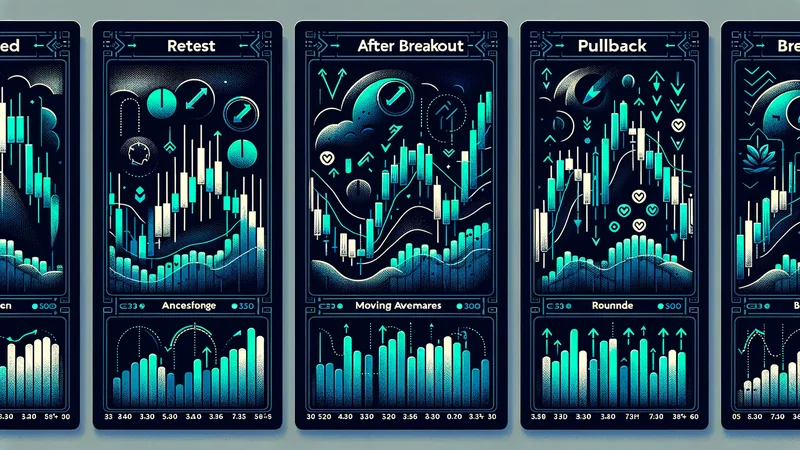
The three swing trading setups that work
Most profitable swing traders run a small toolkit of setups. Three of them cover the majority of opportunities on liquid crypto pairs.
Setup 1: breakout retest
A breakout retest swing setup waits for price to break a meaningful resistance level on the daily chart, then waits patiently for price to come back, retest the broken resistance as new support, and reject from above. Entry happens on the rejection candle, stop sits below the retest low.
The thesis is simple. A clean daily breakout flips a level. If buyers are still in control, that level becomes support on the first retest. If they are not, the breakout was a fakeout and the trade invalidates quickly. Either way, the trader gets a clear answer in days, not hours.
Setup 2: pullback to a moving average
In a clear uptrend, price tends to pull back periodically into key moving averages (commonly the 20-day, 50-day, or 200-day). The setup is to buy these pullbacks when price reacts cleanly off the moving average and a bullish candle confirms.
The advantage is that the trend is already proven. The disadvantage is that the deepest pullbacks (toward the 200-day) often coincide with maximum fear. The trader's job is to follow the rule, not to negotiate with the level. If the moving average breaks, the setup is invalidated. No story replaces a broken structure.
Setup 3: range-edge fade
When a major coin spends weeks oscillating inside a clear range, the cleanest swing trade is to fade the edges: buy near the bottom of the range, sell near the top, with stops just outside. This setup dies the moment the range breaks, so trade size and discipline matter more here than in trending setups.
Range fades work especially well on Bitcoin during accumulation phases between cycles, when volatility compresses but the level structure remains clear.
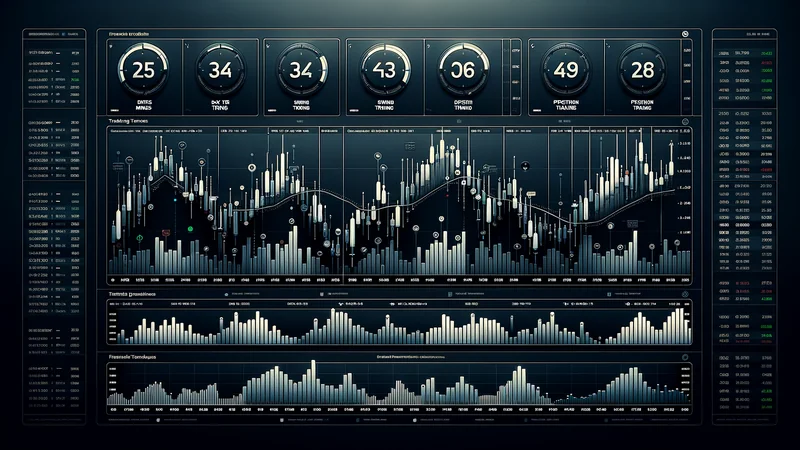
Swing vs day vs position trading at a glance
| Style | Time horizon | Trades per month | Screen time | Main strength |
|---|---|---|---|---|
| Day trading | Minutes to hours | 20 to 100+ | 4 to 8 hours per session | Compounding inside one session, no overnight risk |
| Swing trading | Days to weeks | 3 to 10 | 15 to 60 minutes per day | Captures larger moves with less screen time |
| Position trading | Months to years | 1 to 3 | Few hours per week | Catches macro moves with minimal noise |
Risk management for swing trades
Swing trades take wider stops than intraday trades because daily-chart structure produces wider invalidation levels. Wider stops require smaller position sizes to keep risk constant. The trader who copies an intraday position size into a swing trade ends up risking far too much.
Per-trade risk
The same 0.25 to 1 percent of account per trade convention applies. The math is identical: the stop distance multiplied by position size should equal the planned dollar risk. The only difference is that the stop distance is bigger, so the position size is smaller.
Overnight and weekend risk
Crypto trades 24/7, but news still tends to cluster outside business hours. ETF announcements, regulatory updates, and exchange incidents disproportionately hit weekends and Asian sessions. Sizing must assume the trade can move significantly while the trader sleeps. If a position cannot survive a 10 percent overnight gap, it is too large.
Holding through pullbacks
The hardest part of swing trading is holding through normal pullbacks. A coin in a strong daily uptrend can still pull back 15 to 25 percent without breaking trend. The trader who panics out at every red day will never realize the larger move. The discipline is to set the stop at the level that invalidates the trade, then leave it alone.
How to exit a swing trade
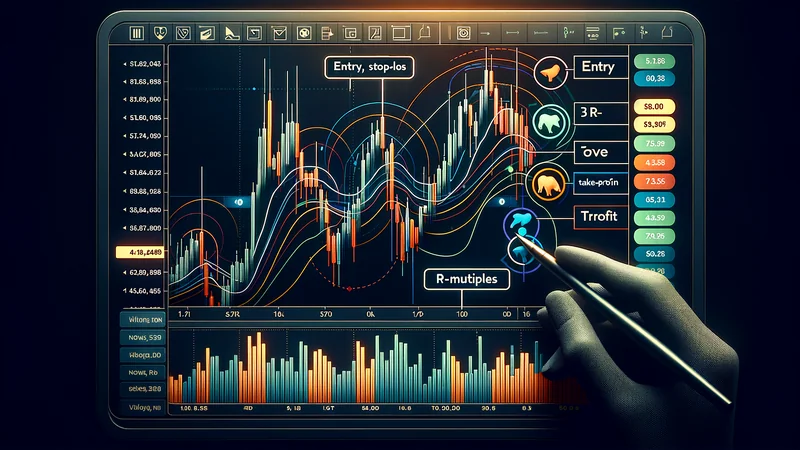
Most swing trade losses come not from bad entries, but from poor exits. Three exit frameworks cover the cleanest options.
Fixed-target exit
The simplest approach is to pre-define a take-profit level when the trade is entered. The level is usually based on a measured move from the pattern or a meaningful resistance ahead. The trade closes mechanically when price hits the target, with no negotiation. This style is boring but consistent.
Trailing stop exit
For trades inside a strong trend, a trailing stop captures more of the move. As price advances, the stop moves up to protect realized gains. The most common method is to trail behind the prior swing low or behind a chosen moving average. The trade exits only when the trend itself starts breaking.
Scale-out exit
The hybrid approach takes partial profits at intermediate targets while letting a remainder run with a trailing stop. The trader books smaller, more reliable wins on the first portion and keeps optional upside on the second. This style requires a written plan to avoid mid-trade improvisation.
The psychology of slow trading
Swing trading is mentally easier in the moment and harder over time. There are no rapid-fire decisions, but the temptation to "just check" the chart, "just adjust" the stop, "just take some early," is constant. Five common traps drain swing accounts.
- Moving the stop further away. Once a stop is moved against the original plan, the discipline is broken.
- Closing winners too early. Booking 1R wins because the brain wants certainty kills the math behind the strategy.
- Adding to losers. Averaging down on a trade that is breaking structure turns a small loss into a big one.
- Reacting to social media. A tweet from a popular account is not a reason to override a planned exit.
- Trading when bored. Slow weeks are normal in swing trading. Forcing trades to feel productive is the fastest way to bleed the account.
The strongest swing traders have an almost dull routine. Daily candle close, scan watchlist, update orders, walk away. The boredom is the edge.
A swing trading workflow you can copy
- Build a watchlist of liquid pairs. Bitcoin, Ethereum, top 10 to 20 large caps, plus a small group of narrative leaders.
- Define the higher-timeframe trend. Use the weekly chart for direction, daily for setups, 4-hour for entries.
- Mark structure. Major support and resistance, key moving averages, recent breakouts and ranges.
- Pre-set entries and stops. Use limit and stop orders so emotional execution is not required.
- Review once per day after daily close. Adjust orders, update journal, walk away.
Pair the workflow with broader context: Bitcoin dominance tells you whether to lean BTC or alts, altseason analysis tells you what kind of regime you are in, and chart patterns tell you what individual setups are forming.
Common swing trading mistakes
- Treating swing trades as investments. Refusing to stop out because "the project is good" turns a swing trade into an unintentional long-term bag.
- Trading too many pairs. Twenty open swing trades is a portfolio, not a strategy.
- Ignoring liquidity. An illiquid alt with a clean chart can still gap 30 percent overnight on no news.
- Sizing for the win, not the stop. Position size must be calculated from the stop distance, not from how confident the trader feels.
- Mixing strategies. Adding intraday adjustments to swing trades because of a 4-hour candle usually breaks both setups.
Frequently asked questions
How much capital do I need to swing trade crypto?
There is no fixed minimum, but small accounts struggle because position sizes calculated from a 1 percent risk rule become tiny. Many beginners benefit from starting with a small live account to enforce the discipline of real money, while keeping size low enough that mistakes are educational rather than account-ending.
How long should I hold a swing trade?
The honest answer is: as long as the structure that justified the trade still holds. That can be three days or three weeks. Setting an arbitrary "I'll hold for one week" rule usually leads to either taking profits too early or refusing to exit when the chart breaks down.
Is swing trading better than day trading for beginners?
Generally yes. Swing trading is more forgiving on time, less punishing on a single mistake, and easier to combine with a normal life. Day trading rewards experience and reaction speed, which beginners do not have yet.
Can I swing trade with leverage?
Yes, but only carefully. Wider stops on the daily chart mean leverage compounds risk faster than on intraday setups. Many professional swing traders use modest leverage (2x to 5x) only on high-conviction setups, with strict per-trade risk limits.
Which timeframe should I use for swing trading?
The daily chart for setups, the 4-hour chart for entries and exits, and the weekly chart for higher-timeframe context. Lower timeframes generate noise that pushes swing traders into intraday decisions they did not plan for.
Final takeaway: Swing trading is the boring, durable version of crypto trading. The traders who do it well share the same playbook: liquid pairs, a small set of setups, planned risk per trade, written exits, and one daily review. Everything else is a distraction that breaks the rules instead of supporting them.
Disclaimer: This guide is for educational purposes only and does not constitute investment, financial, legal, or trading advice. Crypto swing trading carries significant risk, including overnight gap risk, and most retail traders lose money. Always trade with capital you can afford to lose.
Related Guides
- How to Day Trade Crypto: Complete Strategy and Risk Management Guide (2026)
- How to Invest in Meme Coins: Risk Rules, Position Sizing and Entry Framework (2026)
- Candlestick Patterns Cheat Sheet: 35 Crypto Setups Explained (2026)
- Yield Farming Strategies, APY Quality and Risk Management (2026)
- Trade Trending Tokens: Strategies & Risk Checks
- Crypto Swing Trading
- What Is Day Trading in Crypto? 2026 Guide
Frequently Asked Questions
What is swing trading in crypto?
Swing trading is a style that aims to capture price moves over several days to weeks rather than minutes or years. Traders look to enter near the start of a move and exit when momentum fades.
How is swing trading different from day trading?
Day traders open and close positions within the same day, while swing traders hold for days or weeks and use higher time frames. Swing trading generally requires less constant screen time than day trading.
How do I manage risk when swing trading?
Common practices include setting a stop-loss to cap downside, sizing positions so a single loss is small relative to your account, and avoiding overexposure to one asset. Defining your exit before entering helps remove emotion from the decision.
What time frame is best for swing trading?
Swing traders often rely on daily charts to identify the overall trend and key levels, sometimes confirming entries on shorter time frames. The right choice depends on how long you intend to hold each trade.