How to Day Trade Crypto: Complete Strategy and Risk Management Guide (2026)
— By Tony Rabbit in Tutorials
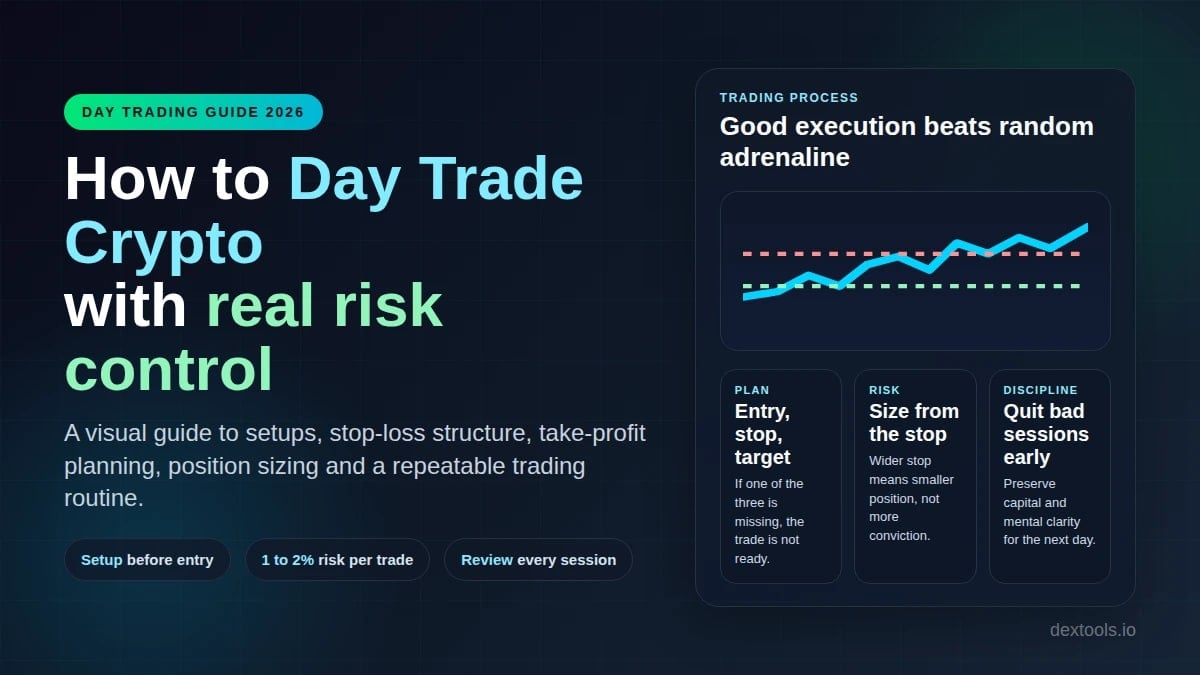
Learn how to day trade crypto with a repeatable process. Breakouts, pullbacks, support and resistance, stop losses, take-profit plans, position sizing, and risk rules for 2026.
Day trading crypto means opening and closing positions inside the same trading day to capture short-term moves. It sounds exciting because the market is fast and open 24/7, but that same speed is exactly why so many traders burn accounts. The problem is usually not access to charts. It is poor process, oversized risk, and reacting emotionally once the trade is live.
This guide is built to fix that. Instead of selling fantasy, it breaks the workflow down into something you can actually use: what day trading is, which setups matter, how to think about stop losses and take-profit planning, and how to survive long enough to build skill.
Quick answer
- Day trading crypto means opening and closing positions inside the same trading day, usually using short-term patterns, key levels, and tight risk control.
- The real edge is rarely a magic indicator. It comes from repeatable setups, small risk per trade, and consistent review.
- If you do not have a clear entry, stop loss, take-profit plan, and position size, you do not have a trade yet. You just have an impulse.
What day trading actually means
In crypto, day trading usually refers to positions opened and closed within the same day. Some traders hold for minutes. Others hold for a few hours. The main point is that the trade idea is intraday, not a week-long swing or a long-term investment thesis.
That matters because the skills are different. A day trader cares much more about execution, liquidity, short-term momentum, nearby levels, and discipline under pressure. If you want the broad foundation first, start with our crypto chart reading guide before trying to trade every bounce and breakout.
Who it fits, and who it does not
Day trading is not automatically the best route just because crypto moves fast. It tends to fit people who can focus for a block of time, stick to a routine, and accept that many trades will be small wins or small losses instead of jackpots.
It is usually a bad fit for traders who are constantly distracted, chase every alert, or need every trade to feel exciting. That is how overtrading starts. Boredom is often a better sign than adrenaline, because it usually means you are following a plan instead of improvising.
Who day trading usually fits
- People who can actually dedicate focused screen time instead of half-watching from the phone.
- Traders willing to journal, review, and accept small losses without drama.
- People who already understand basic chart reading, market structure, and execution.
If that is not you yet, start with chart reading, not high-frequency clicking.
The core setups most traders use
You do not need twenty setups. Most traders improve faster when they narrow the game to a few recurring situations they can recognize and execute well. A repeatable setup is far more useful than a huge pile of half-understood patterns.
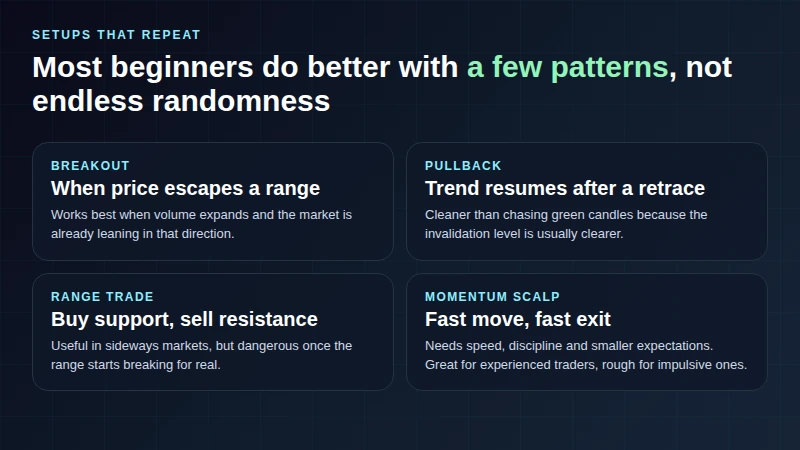
Notice the common thread: every setup depends on context. A breakout in a dead market is not the same as a breakout after hours of compression and rising volume. A range trade is great until the range breaks with real intent. This is why raw pattern memorization is not enough.
Risk management and position sizing
Risk management is where most day traders either become durable or disappear. You can be slightly wrong on entries and still survive. You cannot survive repeated oversized losses.
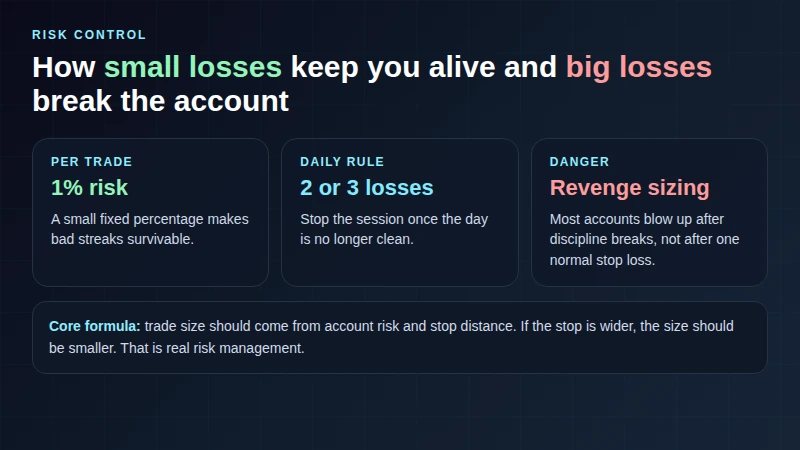
A good working rule for newer traders is to decide account risk first, then calculate size from the stop distance. If your setup needs a wider stop, your size should shrink. This is one of the simplest ideas in trading, and one of the most ignored.
If you are still getting comfortable with margin mechanics, read our leverage trading guide before touching high leverage. Leverage is not a substitute for an edge. It just makes mistakes arrive faster.
How stop loss and take-profit planning work
A stop loss should sit where the trade idea is clearly invalid, not at a random percentage or a number that simply feels comfortable. If you bought a breakout, the stop usually belongs beyond the level that would prove the breakout failed. If you bought a pullback, the stop belongs beyond the structure that says the trend continuation idea is wrong.
Take profit planning matters just as much. Many traders are good at finding entries and terrible at monetizing them. The fix is simple: mark likely target zones before you enter. Those zones might be the next resistance level, a measured move, a prior swing high, or a clear liquidity pocket.
Thinking in risk-reward terms helps. If a trade risks 1R to make 2R or 3R, you do not need a magical win rate. You need clean execution and discipline. That is a much healthier goal than trying to predict every candle perfectly.
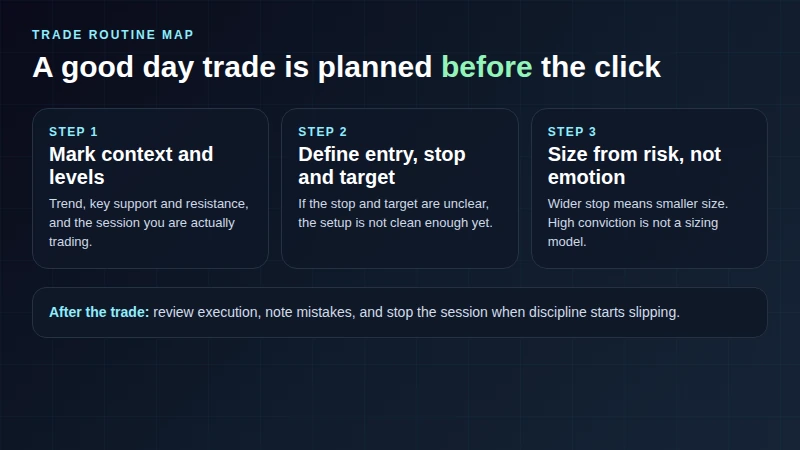
A simple day trading workflow
The easiest way to improve is to turn day trading into a routine. A routine reduces random decisions and makes it easier to review what is actually working. The exact workflow can vary, but the logic stays the same: narrow the universe, map the context, define the trade, execute, then review.
For chart-specific confirmation, many traders keep it simple with price action, volume, and one or two tools such as RSI. Adding more indicators does not automatically add more edge.
Common mistakes that ruin accounts
- Overtrading: feeling the need to be in a position at all times.
- Moving the stop: turning a planned small loss into a much bigger one.
- Revenge trading: trying to win back a loss immediately with worse discipline.
- Oversizing: risking too much because a setup feels obvious.
- Ignoring context: taking patterns without asking whether the market environment supports them.
- No review process: repeating the same mistakes because nothing gets logged.
The ugly truth is that most losing traders do not need a new indicator. They need fewer trades, better position sizing, and cleaner execution. That is less glamorous, but it is also what actually works.
Frequently Asked Questions
Is day trading crypto profitable?
It can be, but the barrier is much higher than social media makes it look. Most people fail because they oversize, overtrade, or trade without a real process.
How much money do I need to start day trading crypto?
There is no perfect number, but small accounts need even tighter discipline because fees, slippage, and emotional pressure matter more. Starting smaller is fine if the goal is process building, not instant income.
What is the best indicator for day trading crypto?
There is no single best indicator. Many traders combine simple tools like market structure, support and resistance, volume, and RSI or MACD rather than hunting for a magic signal.
Should beginners use leverage for day trading?
Usually no. Beginners should first learn how to manage entries, exits, and risk on spot or low leverage. Leverage magnifies bad process faster than it magnifies skill.
How many trades should I take per day?
Usually fewer than you think. A handful of clean trades is better than forcing action all day. Overtrading is one of the fastest ways to destroy performance.
Related DEXTools tutorials
Related Guides
- How to Trade Meme Coins: Pro Strategy and Risk Guide (2026)
- Swing Trading Crypto for Beginners: Multi-Day Setups and Risk Rules (2026)
- Yield Farming Strategies, APY Quality and Risk Management (2026)
- Memecoin Risk Management Guide for Traders 2026
- Meme Coin Position Size Calculator: Profit, Risk and Market Cap Scenarios (2026)