Detect Wash Trading on DEXTools Easily
— By Whatsertrade in Tutorials

Learn to identify wash trading on DEXTools by analyzing volume, transactions, wallets, liquidity, and suspicious trading behaviors before purchasing tokens.
Understanding Wash Trading on Decentralized Markets
Wash trading is one of the most common traps in decentralized crypto markets. A token can look active, popular, and ready to explode, while most of its volume is artificially created by wallets trading with each other. For retail traders, this deception can be dangerous because fake volume creates a false sense of confidence.
DEXTools provides traders with real-time market data, token charts, liquidity information, transactions, and insights into holder behavior. The key is knowing how to interpret these signals in conjunction. Wash trading rarely hides behind one metric; it usually manifests as a pattern across volume, wallets, timing, liquidity, and price action.
This guide explains how to detect possible wash trading on DEXTools before buying a token and avoid falling into apparent traps.
The Concept of Wash Trading in Crypto
Wash trading involves the same person, team, bot network, or coordinated group buying and selling the same asset to create fake trading activity. The objective is to make a token appear more liquid, popular, and appealing than it truly is.
In decentralized markets, wash trading can be used to:
- Push a token into trending lists
- Create fake hype around a launch
- Attract retail buyers
- Support influencer promotions
- Conceal weak organic demand
- Manipulate rankings based on volume
A token affected by wash trading may show substantial volume, but that volume doesn't necessarily imply that genuine buyers are entering the market.
Why Wash Trading Concerns DEX Traders
Fake volume can lead to poor trading decisions. If a token shows high volume, traders might assume it has strong demand and sufficient liquidity for safe entry and exit. In reality, the market may be controlled by a few wallets or bots.
This leads to several risks:
- You may buy near the peak of an artificial pump
- Liquidity may vanish when real selling starts
- The chart may appear stronger than it actually is
- You might mistake bot activity for community growth
- You could unwittingly become exit liquidity for insiders
Therefore, volume should never be analyzed in isolation. In DEXTools, volume is more valuable when compared with liquidity, transactions, holders, price movements, and wallet behaviors.
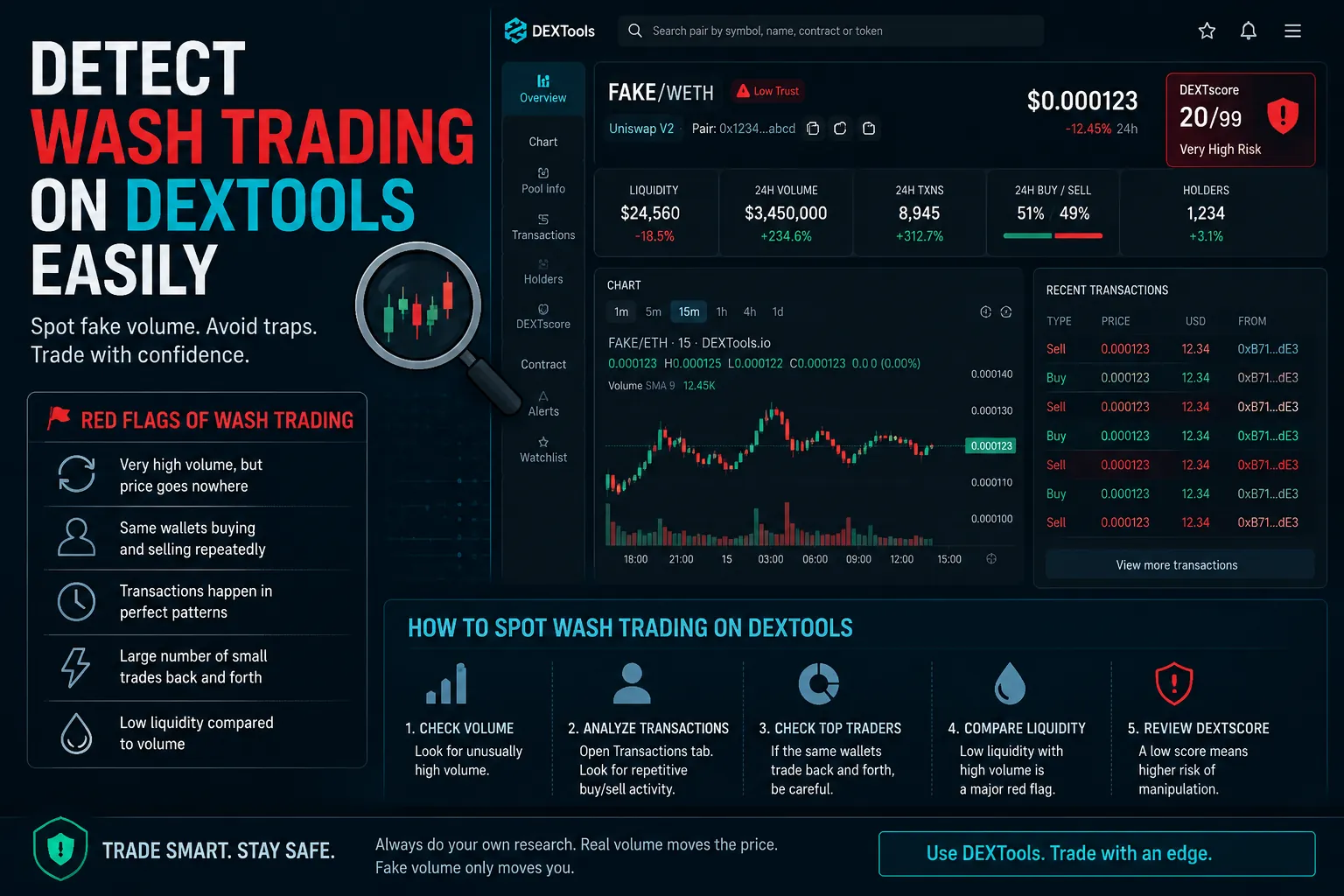
Spotting Suspicious Trading Patterns
1. High Volume Coupled with Low Liquidity
A clear red flag is a token exhibiting very high trading volume but very low liquidity.
A healthy token generally requires sufficient liquidity to back its volume. If a pair has thin liquidity but displays massive volume, question how that volume is being generated. Often, repeated small trades or bot activity inflate the numbers.
Look for this pattern:
- Volume appears impressive
- Liquidity is shallow
- Price impact is significant
- Small purchases move the chart aggressively
- Sales cause sharp declines
This doesn't automatically confirm wash trading, but it's a strong reason to pause and investigate further.
2. Repeated Buy and Sell Patterns
Examine the transaction feed and observe trading rhythms. Wash trading often appears as repeated buys and sells of similar size, sometimes within very short intervals.
Warning signs include:
- Similar transaction amounts repeating frequently
- Buy and sell orders alternating predictably
- Wallets entering and exiting rapidly
- Activity that seems too regular to be organic
- No apparent link between volume and genuine price discovery
Organic trading is usually complex. Different wallets buy different amounts at different times for varied reasons. Wash trading often feels mechanical.
3. Volume Spikes Without Price Movement
When a token suddenly shows a major volume spike, the price should typically react in a significant way. Strong genuine buying pressure tends to push the price upward, while strong selling pressure pushes it downward.
If volume increases sharply but the price barely moves, this can be suspicious.
Potential explanations include:
- Buyers and sellers controlled by the same group
- Bots trading back and forth
- Market makers creating fake activity
- The token being prepped for promotion
Compare the chart with the transaction feed. If the volume candle is large but the price candle is weak or flat, the activity may not reflect real demand.
4. Multiple Trades from Few Wallets
A token might show hundreds or even thousands of transactions, but that doesn't always mean many unique traders are involved. A small number of wallets can generate an immense amount of activity.
Check if activity seems concentrated. Look for wallets that repeatedly buy and sell the token. If the same wallets dominate the transaction feed, the market might not be as active as it seems.
A healthier token generally shows:
- More unique wallets
- More varied transaction sizes
- A more natural mix of buyers and sellers
- Holder growth that aligns with trading activity
- Less dependence on a few active addresses
If most volume comes from a small wallet cluster, exercise caution.
5. Holder Growth Mismatches Volume
Volume and holder growth should align. If a token has large volume but the number of holders scarcely increases, the activity may not be attracting genuine buyers.
This can happen when the same wallets trade repeatedly without significant accumulation. It may also indicate short-term bot traffic rather than real demand.
Consider the following questions:
- Is holder count rising with volume?
- Are new holders retaining their tokens or selling quickly?
- Are top wallets accumulating or distributing?
- Is the community growing beyond the chart?
- Does the token have tangible engagement beyond trading activity?
A token with strong organic demand should usually show some relationship between volume, holders, and community activity.
6. Suspicious Timing of Promotions
Wash trading often surfaces before or during promotional campaigns. A token may suddenly exhibit volume right before influencer posts, community raids, or paid marketing efforts.
Be cautious when you notice:
- Sudden volume spikes before major announcements
- Trending activity without a clear catalyst
- Influencers promoting a token after a sharp volume increase
- Repeated claims of “smart money entering” without evidence
- A chart seemingly crafted for social media screenshots
The goal of fake activity is often to make the token appear validated before retail traders appear.
7. Unnatural Chart Structure
Charts affected by wash trading often have irregular structures. Instead of natural waves of buying and selling, they might show sudden vertical candles, flat periods, and repeated artificial pushes.
Look for:
- Sharp pumps followed by no real consolidation
- Long periods of flatlining price with continuous transactions
- Uniform candle formations
- Sudden volume bursts at convenient times
- A price seemingly supported until real sellers enter
Technical analysis becomes less reliable when underlying activity is artificial. A pattern only matters if authentic market participants create it.
Creating a Wash Trading Checklist
Before buying a suspicious token, use this quick checklist:
- Does volume match liquidity?
- Are transaction sizes natural or repetitive?
- Are many unique wallets involved?
- Is holder count rising with volume?
- Does price action align with volume?
- Are top wallets accumulating or selling?
- Did volume spike before a promotion?
- Is there enough liquidity to exit safely?
- Is the token contract verified and transparent?
- Is there genuine community activity?
If several answers raise concerns, reconsider the trade or reduce position size.
Avoiding Mistakes with Volume Interpretation
Many traders mistakenly treat volume as a solitary indicator of demand. Volume is valuable, but only when backed by other signals.
Avoid these pitfalls:
- Buying solely because a token is trending
- Overlooking liquidity depth
- Assuming all trades come from unique buyers
- Trusting influencer screenshots without verifying data
- Misunderstanding bot activity as market confidence
- Investing in a token prior to checking wallet concentration
The most successful traders don't chase volume blindly. They question whether the volume is genuine, sustainable, and supported by broader market behaviors.
Conclusion
Wash trading is engineered to capture attention. It can make a token seem alive, active, and popular, despite weak actual demand. On DEXTools, traders can mitigate this risk by looking beyond headline volume numbers.
The strongest analysis combines volume, liquidity, transaction flow, wallet activity, holder growth, and chart structure. If the data conveys a consistent story, the market might be healthier. If it seems disjointed, there might be artificial activity involved.
Before buying any trending token, take a few minutes to examine the quality of its volume. In decentralized markets, this extra step can be the difference between seizing a legitimate opportunity and becoming exit liquidity.
FAQ on Wash Trading
Defining Wash Trading in Crypto
Wash trading creates fake trading activity when the same person, group, or bot network buys and sells the same asset to inflate volume and make a token appear more active than it is.
Can DEXTools Automatically Identify Wash Trading?
DEXTools offers real-time data that can help traders identify suspicious patterns, including volume, transactions, liquidity, charts, and wallet activity. Traders should analyze these signals collectively.
Is High Volume Always Indicative of Strong Demand?
No. High volume can be positive when it originates from genuine buyers and sellers, but it can also be artificial. Always compare volume with liquidity, holder growth, and transaction quality.
What is a Key Warning Sign of Fake Volume?
One of the most significant warning signs includes high volume with low liquidity, repeated transactions, and minimal or no holder growth.
How Can I Safeguard Against Wash Trading?
Use a checklist before buying. Review liquidity, transaction flow, wallet concentration, holder growth, chart behavior, and promotional timing.
Call to Action: Use DEXTools to verify trading activity before trading any token. Don't rely solely on volume. Analyze the data, compare signals, and trade carefully.
How to Bridge Crypto Between Chains: Complete Cross-Chain Tutorial 2026 How to Use 1inch: Complete DEX Aggregator Swap Tutorial (2026) How to Use OKX Web3 Wallet: Multi-Chain DeFi Hub Guide (2026)Related Guides
- Trojan Bot Tutorial 2026: Snipe & Copy Trade Solana Easily
- What Is Wash Trading in Crypto? Complete Beginner Guide (2026)
- Wash Trading Red Flags on Exchanges and DEXs (2026)
- DEXTools Trading Simulator Tutorial 2026: Free Paper Trading
- How to Use DEXTools Alerts for Early Trading Moves
Frequently Asked Questions
What is wash trading in crypto?
Wash trading is when the same party repeatedly buys and sells a token to create fake volume and the illusion of active demand. It is meant to mislead traders into thinking a token is more popular or liquid than it really is.
How can I spot wash trading on DEXTools?
Look for high volume that comes from very few wallets, repetitive trades of similar size, and buying and selling bouncing between the same addresses. Volume that does not match real holder growth or liquidity is a common warning sign.
Why is wash trading dangerous for buyers?
Fake volume can make a token look healthy and tradable when real demand and liquidity are thin. Buyers may enter expecting easy exits but find the market dries up once the artificial activity stops.
What metrics help reveal fake volume?
Comparing trade volume against the number of unique wallets, liquidity depth, and transaction patterns can expose manipulation. Real activity usually shows diverse wallets and volume that is consistent with the pool's liquidity.