What Is an RPC Endpoint? How Wallets Reach Blockchains
— By Whatsertrade in Tutorials

What is an RPC endpoint? How wallets and dApps use RPC to connect to blockchain nodes, public vs private RPC, and why it matters for speed and security.
This guide explains what an RPC endpoint is and how apps reach blockchain nodes. If you need the broader infrastructure primer first, see What Is a Node in Crypto?.
Key Takeaways
- Why RPC Endpoints Exist
- How an RPC Endpoint Works
- Types of RPC Requests
- Public vs Private RPC Endpoints
- Why RPC Endpoints Matter for Security
- RPC Endpoints and User Experience
An RPC endpoint is a communication interface that allows applications to interact with a blockchain node. RPC stands for remote procedure call, which is a method that lets one system request data or actions from another system over a network.
In crypto, an RPC endpoint acts as the bridge between a user interface, such as a wallet or a decentralized application, and the blockchain itself.
When you open a wallet, check your balance, or send a transaction, you are not directly interacting with the blockchain. Instead, your wallet sends requests to an RPC endpoint, which then communicates with a node and returns the necessary data.
Why RPC Endpoints Exist
Blockchains are distributed systems made up of many nodes. Each node stores and verifies the state of the network. However, running a node is resource intensive and not practical for most users.
RPC endpoints solve this problem by allowing users to access blockchain data without running their own node. They provide a simple interface for reading information and broadcasting transactions.
Without RPC endpoints, most crypto applications would not be usable for everyday users.
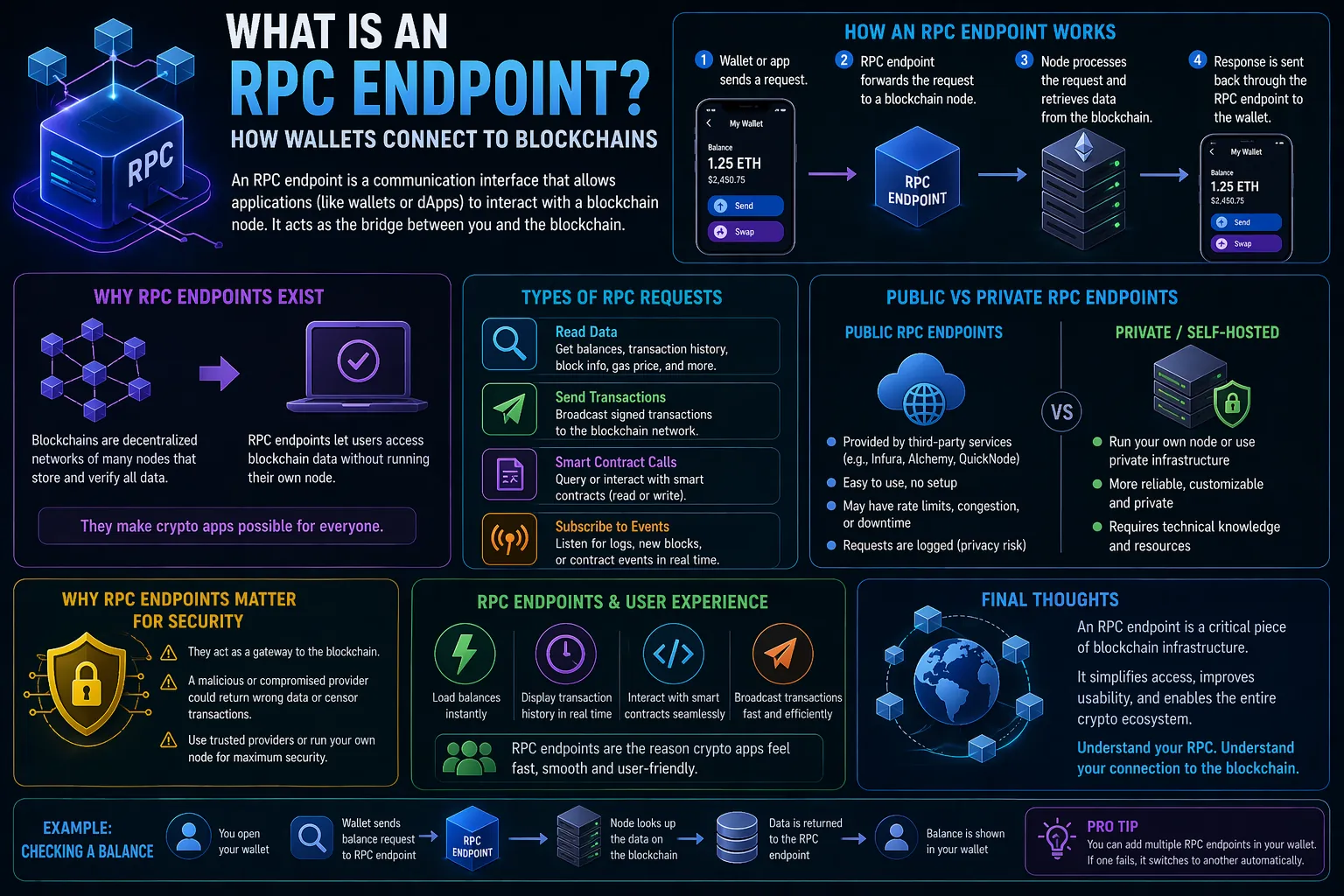
How an RPC Endpoint Works
When a user performs an action in a wallet or application, a request is sent to an RPC endpoint.
For example, when checking a balance:
The wallet sends a request to the RPC endpoint
The endpoint forwards the request to a blockchain node
The node retrieves the data from the blockchain
The endpoint sends the response back to the wallet
The same process applies when sending a transaction. The RPC endpoint broadcasts the transaction to the network on behalf of the user.
This interaction happens in milliseconds and is invisible to the user.
Types of RPC Requests
RPC endpoints support different types of requests, including:
Reading data, such as balances or transaction history
Sending transactions to the network
Querying smart contract state
Listening for blockchain events
These capabilities make RPC endpoints essential for both users and developers.
Public vs Private RPC Endpoints
Many users rely on public RPC endpoints provided by infrastructure services. These endpoints are easy to use and require no setup.
However, they come with trade offs.
Public endpoints may experience congestion, rate limits, or downtime. They may also introduce privacy concerns, since requests can be logged.
Private RPC endpoints or self hosted nodes provide more control and reliability, but require technical knowledge and resources.
Why RPC Endpoints Matter for Security
Although RPC endpoints are convenient, they introduce a layer between the user and the blockchain.
If an RPC provider is compromised or behaves incorrectly, it could potentially provide misleading data or censor transactions.
For most users, this risk is low, but it is still important to understand that using an RPC endpoint involves some level of trust.
Advanced users often mitigate this by using trusted providers or running their own nodes.
RPC Endpoints and User Experience
RPC endpoints are a major reason why crypto applications feel fast and responsive.
They allow wallets to:
Load balances instantly
Display transaction history
Interact with smart contracts in real time
Broadcast transactions quickly
Without RPC infrastructure, the user experience of crypto would be significantly slower and more complex.
Final Thoughts
An RPC endpoint is a critical piece of blockchain infrastructure that allows users to interact with networks without running their own nodes. It simplifies access, improves usability, and enables the modern crypto ecosystem.
At the same time, it introduces a dependency on external providers. Understanding how RPC endpoints work helps users make better decisions about privacy, reliability, and control when interacting with blockchain systems.
How to Bridge Crypto Between Chains: Complete Cross-Chain Tutorial 2026 How to Use 1inch: Complete DEX Aggregator Swap Tutorial (2026) How to Use OKX Web3 Wallet: Multi-Chain DeFi Hub Guide (2026)Public Versus Private RPC Endpoints
Not all RPC endpoints are equal, and the difference matters for both reliability and privacy. A public endpoint is shared by many users and is often free, which makes it convenient for casual activity and quick testing. The tradeoff is that public endpoints can become congested during periods of heavy network demand, leading to slow responses, timeouts, or dropped requests at exactly the moment you want a transaction to go through quickly.
A private or dedicated endpoint, by contrast, is provisioned for a specific user or application. Because traffic is not shared with the whole world, it tends to deliver steadier performance, higher request limits, and more predictable behavior under load. For applications that depend on fast, consistent reads and writes, this stability is often worth the cost.
Privacy is the other dimension worth weighing. Every request sent through an RPC provider can reveal which addresses you are querying and what actions you are preparing. Choosing your endpoint thoughtfully limits how much of that pattern is exposed.
- Reliability, since dedicated capacity reduces failed or delayed requests.
- Rate limits, which are usually higher on private plans.
- Data exposure, because the provider sees the requests you make.
- Trust, since a malicious endpoint could return misleading data.
The practical takeaway is to match the endpoint to the stakes. Low value experiments are fine on public infrastructure, while serious or frequent use benefits from a provider you have reason to trust.
Frequently Asked Questions
What is an RPC endpoint?
An RPC endpoint is a gateway that allows decentralized applications and wallets to interact with a blockchain. It acts as a communication bridge, sending requests and receiving information from the network.
How do wallets use RPC endpoints?
Wallets use RPC endpoints to send transactions, check balances, and query blockchain data. When you initiate a transaction, your wallet sends it to an RPC endpoint, which then relays it to the blockchain network.
Are RPC endpoints centralized?
While the blockchain itself is decentralized, individual RPC endpoints can be run by centralized entities or by a network of independent node operators. Users can often choose which RPC endpoint their wallet connects to.
What is the difference between a public and private RPC endpoint?
Public RPC endpoints are generally accessible and free to use, but may have rate limits or be less reliable during high traffic. Private RPC endpoints often offer better performance, higher rate limits, and enhanced security, typically for a fee or specific projects.
Why is choosing a reliable RPC endpoint important?
Choosing a reliable RPC endpoint ensures faster transaction processing, accurate data retrieval, and a smoother user experience. A poor endpoint can lead to delays, failed transactions, or incorrect information being displayed.