What Is a Node in Crypto? Blockchain Nodes Explained (2026)
— By Tony Rabbit in Tutorials

What is a node in crypto? How full nodes, light nodes and validators store and verify blockchain data, why they matter, and how to run or use one in 2026.
This page is the beginner guide to what a blockchain node is. If you are specifically deciding whether to run a validator or simply stake ETH, read our validator node vs ETH staking comparison.
The word "node" gets thrown around in crypto like everyone agrees on what it means. They do not. A node can be a tiny phone-based light client, a dedicated server running a full ledger, or a high-end machine validating new blocks. All three are accurately described as "a node," but they do completely different jobs and carry completely different responsibilities. Understanding the differences is the first step to making sense of how blockchains actually work under the hood.
Quick answer: A node in crypto is any computer that participates in a blockchain network. Nodes store some or all of the ledger, relay transactions, enforce protocol rules, and help maintain decentralization. The three main types are full nodes (which store the full ledger and verify everything independently), light nodes (which trust other nodes for most data), and validator/mining nodes (which actively produce new blocks). The more diverse the node network, the harder it is to attack or censor.
- A node is a participant. Any computer running protocol software that connects to the network is a node.
- Full nodes store the entire ledger. They verify every block and transaction independently.
- Light nodes are lightweight clients. They trust full nodes for most data, used for wallets and apps.
- Validator/mining nodes produce blocks. They earn rewards but carry network responsibilities and slashing risk.
- Decentralization depends on node diversity. A network with thousands of independent nodes is much harder to compromise.
What a node really is
At its simplest, a node is just a computer running the software for a specific blockchain network. That software follows a set of rules: how blocks are formed, how transactions are validated, how peers communicate. Any computer running compatible software and connected to the network is, by definition, a node. The hardware can be a laptop, a Raspberry Pi, a cloud server, or a high-performance dedicated machine.
What makes nodes interesting is not the hardware. It is what each node chooses to do with the data and how the network as a whole behaves when thousands of independent nodes cooperate without trusting each other.
Why nodes matter for decentralization
Blockchains are useful because no single party controls them. That property is not magic; it is enforced by the node network. If thousands of independent operators run nodes around the world, no single entity can rewrite history, censor transactions, or change the rules without convincing the rest. Lose the node network, and you lose the property that makes a blockchain different from a database.

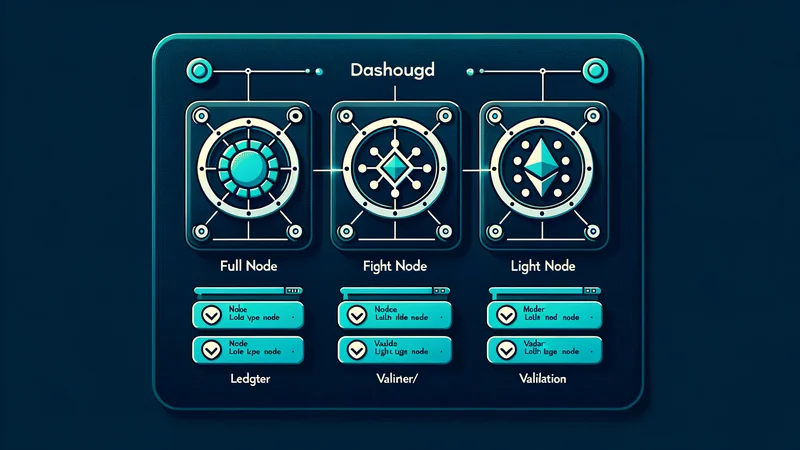
The three main types of nodes
Most blockchains classify nodes into three broad roles. The names vary, but the responsibilities are similar across networks.
Full nodes
A full node stores the complete blockchain ledger and independently verifies every transaction and every block. It does not trust other nodes for data. If a full node sees an invalid block, it rejects it, regardless of what other nodes say. Full nodes are the backbone of blockchain decentralization. The more there are, the harder the network is to manipulate.
Running a Bitcoin full node, for example, requires hundreds of gigabytes of disk, a stable internet connection, and patience for the initial sync. It does not require staking, mining hardware, or special hosting. Anyone with a basic computer and time can run one.
Light nodes (light clients)
A light node, also called a light client or SPV (Simplified Payment Verification) client, does not store the full ledger. Instead, it stores block headers and asks full nodes for the data it needs. Mobile wallets, hardware wallets, and most consumer apps are light clients. They trade some independence for vastly lower resource requirements.
Light nodes are not bad. They are the right tool for everyday use cases where running a full node is impractical. The cost of using one is that you implicitly trust the full nodes you connect to for things like balance lookups and transaction inclusion.
Validator and mining nodes
Validator nodes (in proof-of-stake networks) and mining nodes (in proof-of-work networks) actively produce new blocks. They are special: they not only verify the chain but also extend it. In return, they earn block rewards and transaction fees. Their responsibilities are higher: they have to be online, they have to behave correctly, and in PoS networks they can be slashed (penalized) for misbehavior.
Running a validator on Ethereum, for example, requires 32 ETH staked, a properly configured machine, and consistent uptime. Running a Bitcoin mining node requires specialized hardware and access to cheap electricity. Both pay rewards, but both also concentrate power if too few participants run them, which is part of why diverse validator distribution is a constant network health concern.
What nodes actually do during normal operation
The job of a node is invisible to most users, but it is busy. Five tasks happen continuously across the network.
- Store the ledger. Full nodes maintain a complete copy; light nodes maintain headers and request data on demand.
- Validate transactions. Each node checks signatures, balances, fees, and protocol rules against its copy of the rules.
- Relay messages. Transactions and blocks propagate through the network by being passed from node to node, not from a central server.
- Reach consensus. Nodes apply the network's consensus algorithm to agree on which blocks are valid and in what order.
- Serve clients. Wallets, apps, and explorers all read data from nodes (their own or someone else's) to show users their balances and transaction history.
None of these tasks require trust. Each node verifies independently. That is the whole point.

Full node vs light node, in plain English
| Property | Full node | Light node |
|---|---|---|
| Stores full ledger | Yes | No (headers only) |
| Verifies transactions independently | Yes | Partially |
| Disk space required | Hundreds of GB to TBs | Tens of MB |
| Trust assumption | None | Some (trusts the full nodes it connects to) |
| Typical use | Backbone, exchanges, services | Mobile wallets, browser wallets, hardware wallets |
| Resource demand | High | Low |
| Decentralization contribution | Direct | Indirect (relies on full nodes) |

Why someone would run their own node
Most users never run a node. They use a wallet that connects to someone else's. There are good reasons to consider running your own anyway.
- Sovereignty. Running your own full node means you do not have to trust anyone else's view of the chain.
- Privacy. Your wallet does not leak your addresses to a third-party node operator.
- Censorship resistance. You can broadcast and verify transactions without depending on infrastructure that can refuse them.
- Network health. Each additional node makes the network more decentralized, even by a tiny margin.
- Education. Running a node teaches more about how blockchains work than any tutorial.
The risks and limits of nodes
Nodes are not magic. There are real limits and trade-offs every operator should know.
Resource costs
A Bitcoin full node currently uses several hundred gigabytes of disk, plus continuous bandwidth. An Ethereum full node is heavier still, with state-growth concerns over the years. Light clients sidestep this, but only by trusting other nodes.
Validator slashing
Running a validator in proof-of-stake networks comes with slashing risk: misbehavior or extended downtime can cost staked funds. Validator economics often require professional setups, redundancy, and monitoring.
Centralization pressure
Many "node providers" run light or full nodes on behalf of dApps. This is convenient but introduces concentration: if a few providers operate most consumer-facing infrastructure, censorship and outage risks rise. Public node networks, RPC services, and self-hosted nodes each play a role in keeping that balance healthy.
Hardware and uptime
Even non-validator full nodes require reliable storage, decent bandwidth, and power. Running one on a laptop that goes to sleep nightly is technically possible but operationally messy. Dedicated hardware (a small server or single-board computer) usually pays off for serious operators.
Where nodes fit in the broader crypto stack
Nodes are the foundation; everything else sits on top of them.
- Wallets. Every wallet, from MetaMask to hardware wallets, ultimately reads chain data from a node.
- Block explorers. Tools like Etherscan and Solscan run their own nodes to index and serve data.
- DEXs and DeFi protocols. Smart contracts execute on nodes; users send transactions through them.
- RPC services. Providers like Infura, Alchemy, and QuickNode run large fleets of nodes so dApps do not have to.
- Validators and miners. Special-purpose nodes that secure the network in exchange for rewards.
Understanding nodes connects everything else. Concepts like mempool, finality, and block reorgs all become much clearer once nodes are no longer a black box.
Common misconceptions about nodes
- "Running a node earns money." Only validator and mining nodes earn rewards. Plain full nodes do not.
- "Light nodes are insecure." They have a different trust model, but they are perfectly fine for everyday use if you connect to reputable full nodes.
- "More nodes always means a faster network." Speed is mostly determined by consensus design and block size, not raw node count.
- "You need a node to use crypto." Most users use someone else's node through a wallet or RPC service.
- "Nodes and validators are the same thing." All validators are nodes; not all nodes are validators.
Frequently asked questions
Do I need to run a node to use crypto?
No. The vast majority of crypto users connect to nodes operated by others through wallets, exchanges, or RPC services. Running your own node is optional and primarily useful for sovereignty, privacy, and education.
How much does it cost to run a Bitcoin full node?
Hardware can range from a sub-$200 single-board computer with external storage to a dedicated mini-server. Ongoing costs are mainly bandwidth and electricity. Many people run nodes on existing home setups for almost no marginal cost.
What is the difference between a node and a validator?
A node is any participant in the network. A validator is a special type of node that produces and confirms new blocks (in proof-of-stake) and earns rewards in exchange for that work, with slashing risk for misbehavior. All validators are nodes, but most nodes are not validators.
Are RPC providers like Infura and Alchemy nodes?
They run large fleets of nodes and expose API endpoints so apps can read and write to chains without each app running its own node. Convenient, but they introduce a centralization concern: if many dApps rely on a single provider, an outage or policy change can ripple across the ecosystem.
Can a node refuse to relay my transaction?
Individual nodes can choose which transactions to broadcast, but as long as one honest node accepts and propagates a valid transaction, it eventually reaches the rest of the network. Censorship resistance comes from the diversity of node operators, not from any individual node.
Final takeaway: Nodes are the substrate beneath everything that makes crypto crypto. Full nodes verify, light nodes consume, validators and miners produce. Knowing which kind of node you (or your wallet) are talking to is the difference between using crypto with eyes open and using it on faith. The more nodes the network has, and the more diverse their operators, the harder it is to break the property everyone is here for.
Disclaimer: This guide is for educational purposes only and does not constitute investment, financial, legal, or trading advice. Running a validator or mining node carries real operational and financial risks that are beyond the scope of this article.
Related Guides
- What Is NOWNodes: Shared RPC, Dedicated Nodes and WebSocket Access (2026)
- What Is Chainstack: Managed Blockchain Nodes, Dedicated RPC and Web3 Infrastructure (2026)
- What Is a Crypto RPC Node: Complete Blockchain Infrastructure Guide (2026)
- Light Client in Crypto Explained: vs Full Nodes
- What Is GetBlock: Multichain RPC Access, Node APIs and Web3 Connectivity (2026)
Frequently Asked Questions
What is a node in crypto?
A node is a computer that runs blockchain software and helps store, share, or verify the network's data. Nodes collectively keep the blockchain running without needing a single central server.
What is the difference between a full node and a light node?
A full node stores a complete copy of the blockchain and independently validates transactions and blocks, while a light node keeps only part of the data and relies on full nodes for some information. Full nodes offer more independence; light nodes are easier to run on limited hardware.
What is the difference between a node and a validator?
A node stores and relays blockchain data, while a validator is a participant that actively proposes or confirms new blocks, usually in a proof-of-stake network. Every validator runs a node, but not every node is a validator.
Why do nodes matter for blockchain security?
A larger and more distributed set of nodes makes a network harder to attack, censor, or shut down because no single point controls it. Independent nodes also let users verify the chain's rules for themselves rather than trusting one provider.