How to Earn Passive Income with Crypto: Complete Guide (2026)
— By Whatsertrade in Tutorials

Earn passive income with crypto. Staking, lending, yield farming, and airdrops ranked by risk and APY. Beginner to advanced strategies.
Cryptocurrency has evolved far beyond simple buy-and-hold investing. In 2026, the crypto ecosystem offers dozens of ways to generate recurring revenue from your digital assets without actively trading. Whether you hold Bitcoin, Ethereum, Solana, or stablecoins, there is a passive income strategy that fits your risk tolerance and portfolio size. This guide covers every major method, compares returns and risks side by side, and gives you a concrete action plan to start earning today.
From staking and lending to yield farming, liquidity providing, and airdrops, each approach carries its own reward profile and risk considerations. We will walk through the mechanics of every strategy, highlight the best platforms and coins for each, show you real APY numbers, and explain the tax rules you need to know. By the end of this guide, you will have a clear roadmap to build a diversified crypto passive income portfolio in 2026.
Need the ranked shortlist instead? Use Top 5 Crypto Passive Income Strategies. This page stays focused on the full landscape of crypto passive income, not just a quick top-five comparison.
What Is Crypto Passive Income?
Crypto passive income refers to any strategy where you earn recurring rewards or interest on your cryptocurrency holdings without actively trading. Instead of trying to time the market or day-trade volatile tokens, you put your assets to work through blockchain protocols, decentralized applications, or centralized platforms that pay you for providing value to a network.
The concept mirrors traditional finance ideas like earning interest in a savings account, collecting dividends from stocks, or receiving rent from real estate. However, crypto passive income strategies often deliver significantly higher yields because decentralized protocols need liquidity, validators, and participants to function, and they reward those contributors generously.
The main categories of crypto passive income include:
- Staking: Locking tokens to secure proof-of-stake blockchains and earning validator rewards
- Lending: Supplying assets to borrowers through DeFi protocols or CeFi platforms for interest
- Yield Farming: Deploying capital across DeFi protocols to earn token incentives and fees
- Liquidity Providing: Adding token pairs to decentralized exchange pools and earning trading fees
- Airdrops and Points Farming: Using new protocols early to qualify for free token distributions
- Running Nodes: Operating validator or infrastructure nodes that earn protocol fees
- Real-World Asset (RWA) Yield: Earning yield from tokenized bonds, treasuries, and real estate
Each method carries different risk levels, capital requirements, and technical complexity. The key to success is understanding these differences and building a portfolio that matches your goals.
Staking: The Foundation of Crypto Passive Income
How Staking Works
Staking is the process of locking your cryptocurrency tokens in a proof-of-stake (PoS) blockchain network to help validate transactions and secure the network. In return, the protocol rewards you with newly minted tokens and a share of transaction fees. Think of it like earning interest on a deposit, except you are helping run the blockchain infrastructure.
When you stake tokens, you are either running a validator node yourself or delegating your tokens to an existing validator. Most retail investors choose delegation because it requires no technical setup. You simply select a validator through your wallet or a staking platform, delegate your tokens, and start earning rewards automatically.
Staking rewards come from two sources: inflation rewards (new tokens created by the protocol) and transaction fees paid by network users. The annual percentage yield (APY) varies by network, validator performance, and the total amount of tokens staked across the chain. Generally, when fewer tokens are staked, individual stakers earn higher rewards.
For a deep dive into staking mechanics, check out our complete staking guide.
Best Coins for Staking in 2026
Not all staking opportunities are equal. The best staking coins combine solid APY with strong fundamentals, large ecosystems, and reasonable lock-up periods. Here are the top picks for 2026:
Ethereum remains the safest staking option due to its massive network effect and institutional adoption. Learn how to stake ETH in our Ethereum staking tutorial. Solana offers the best balance of yield and ecosystem growth, and you can follow our Solana staking guide to get started. Cosmos and Polkadot deliver the highest yields but require longer lock-up periods.
Liquid Staking: Earning Yield Without Lock-ups
Liquid staking protocols solve the biggest drawback of traditional staking: locked capital. When you stake through protocols like Lido (stETH), Rocket Pool (rETH), Marinade (mSOL), or Jito (JitoSOL), you receive a liquid staking token (LST) that represents your staked position plus accumulated rewards.
These LSTs can be freely traded, used as collateral in DeFi lending protocols, or deposited into yield farming strategies. This means you earn staking rewards while simultaneously using your capital elsewhere. The composability of liquid staking tokens is one of the most powerful features of DeFi in 2026.
For example, you could stake ETH through Lido to earn ~3.5% APY, then deposit your stETH into Aave as collateral to borrow stablecoins, and then lend those stablecoins for an additional 5-8% yield. This layered approach can compound your returns significantly, though it also increases your exposure to smart contract risk.
Crypto Lending: Earn Interest on Your Holdings
DeFi Lending with Aave and Compound
Decentralized lending protocols allow you to supply your crypto assets to a lending pool and earn interest from borrowers. The interest rates are determined algorithmically based on supply and demand. When borrowing demand is high and supply is low, rates increase. When supply exceeds demand, rates decrease.
Aave is the leading DeFi lending protocol, operating across Ethereum, Polygon, Arbitrum, Optimism, Avalanche, and Base. In 2026, Aave V3 offers improved capital efficiency with features like eMode (efficiency mode) that allows higher borrowing power for correlated assets, and isolation mode that limits risk from volatile collateral types.
Current DeFi lending rates for popular assets:
- USDC/USDT (Stablecoins): 4% - 12% APY depending on chain and utilization
- ETH: 1.5% - 3.5% APY (lower because high supply)
- WBTC: 0.5% - 2% APY
- DAI: 5% - 10% APY via Maker DSR
- GHO (Aave stablecoin): Discounted borrow rates for stkAAVE holders
The main advantage of DeFi lending is that it is fully non-custodial. You retain ownership of your assets through smart contracts, and you can withdraw at any time (subject to liquidity availability). There are no credit checks, no KYC requirements, and no minimum deposits.
CeFi vs DeFi Lending: Which Is Better?
Centralized finance (CeFi) lending platforms like Nexo, YouHodler, and Ledn offer a simpler user experience with fixed or semi-fixed interest rates. You deposit your crypto, and the platform handles the lending on your behalf. However, CeFi platforms come with significant counterparty risk, as the collapses of Celsius, BlockFi, and FTX demonstrated in 2022-2023.
In 2026, the CeFi lending landscape has matured with better regulation and proof-of-reserves requirements. However, the fundamental trade-off remains: CeFi offers simplicity and sometimes higher rates, while DeFi offers transparency, self-custody, and censorship resistance.
Choose DeFi lending if: You value self-custody, want transparent on-chain operations, are comfortable using Web3 wallets, and want to combine lending with other DeFi strategies.
Choose CeFi lending if: You prefer a simple interface, want fixed rates, need fiat on/off ramps integrated with your lending, and are comfortable with a regulated custodian holding your assets.
Yield Farming: Maximizing DeFi Returns
Yield farming is the practice of moving your crypto assets between different DeFi protocols to maximize returns. Yield farmers actively seek out the highest-yielding opportunities by providing liquidity, lending, staking LP tokens, and claiming protocol incentive rewards. For a comprehensive breakdown, see our yield farming guide.
Modern yield farming in 2026 looks very different from the early "DeFi Summer" of 2020. Protocols have matured, yields have normalized, and the emphasis has shifted from unsustainable token emissions to real yield generated from actual protocol revenue. The most reliable yield farming strategies now focus on blue-chip protocols with proven track records.
Top Yield Farming Strategies for 2026
1. Stablecoin Yield Optimization: Depositing stablecoins into yield aggregators like Yearn Finance or Beefy Finance that automatically move your capital between lending protocols to capture the best rates. Expected returns: 5-15% APY with minimal impermanent loss risk.
2. Liquid Staking Token (LST) Loops: Using LSTs as collateral to borrow the base asset, stake it again, and repeat. This leverage-based strategy amplifies staking yields but introduces liquidation risk. Expected returns: 6-12% APY on ETH-based strategies.
3. Real Yield Protocols: Farming tokens from protocols that share actual revenue with token holders, such as GMX (decentralized perpetuals exchange), Gains Network, and Pendle Finance. These protocols distribute trading fees to stakers, providing sustainable yields tied to real economic activity.
4. Points-Boosted Farming: Many 2026 protocols offer points programs that convert to token airdrops. By farming these points alongside base yields, you can potentially earn 20-50%+ APY when the airdrop materializes. This strategy requires research and involves uncertainty about the final airdrop value.
5. Concentrated Liquidity Management: Using automated position managers like Gamma Strategies or Arrakis Finance to manage concentrated liquidity positions on Uniswap V3 or similar DEXs. These protocols handle range rebalancing and compounding, making concentrated LP positions accessible to passive investors.
Liquidity Providing: Earning Trading Fees
Liquidity providing (LP) means depositing token pairs into decentralized exchange pools so that traders can swap between those tokens. In return, you earn a share of the trading fees generated by the pool. On popular pairs with high trading volume, LP fees alone can generate attractive returns.
Understanding Impermanent Loss
The biggest risk for liquidity providers is impermanent loss (IL). This occurs when the price ratio of the two tokens in your LP position changes relative to when you deposited them. The more the prices diverge, the more value you lose compared to simply holding the tokens. If the prices return to their original ratio, the loss disappears, which is why it is called "impermanent."
In practice, impermanent loss can be significant for volatile pairs. For example, if you provide liquidity for an ETH/USDC pair and ETH doubles in price, you would have been better off holding ETH outright. The trading fees you earn need to exceed the impermanent loss for the LP position to be profitable.
To minimize impermanent loss:
- Choose stablecoin pairs (USDC/USDT, DAI/USDC) for near-zero IL
- Use correlated asset pairs (stETH/ETH, wBTC/BTC) where prices move together
- Select high-volume pools where fee income exceeds IL
- Consider concentrated liquidity positions with narrow ranges for higher fee capture
- Use IL protection features offered by some protocols
Best Platforms for Liquidity Providing
Uniswap V3 remains the most popular AMM for LP positions, offering concentrated liquidity that allows you to specify price ranges and earn higher fees. Curve Finance dominates stablecoin and pegged-asset pools with minimal IL. On Solana, Raydium and Orca provide fast and low-cost LP opportunities. Aerodrome on Base has emerged as a leading ve(3,3) DEX with attractive incentive structures for LPs.
Airdrops and Points Farming
Airdrops are free token distributions given to early users and supporters of crypto projects. In 2026, most major protocols use a points system where users accumulate points through platform activity, and those points later convert into token allocations when the project launches its governance token.
How to Position for Airdrops
Successful airdrop farming requires a systematic approach:
Step 1: Identify Promising Protocols. Look for well-funded projects that have not yet launched a token. Key indicators include significant venture capital backing, growing TVL (total value locked), active development, and public statements suggesting a future token launch.
Step 2: Use the Protocols Regularly. Most airdrops reward genuine usage over gaming. Make regular transactions, try different features, maintain activity over several months, and interact across multiple chains if the protocol is multichain.
Step 3: Accumulate Points. Many protocols now have explicit points programs. Maximize your point accumulation by depositing assets, referring friends, participating in governance, and completing special quests or campaigns.
Step 4: Maintain Wallet Hygiene. Use a dedicated wallet for airdrop farming. Keep a clean transaction history. Avoid Sybil behavior (using multiple wallets to game a single airdrop), as projects increasingly use Sybil detection algorithms that can disqualify your accounts.
Notable past airdrops include Uniswap ($UNI), Optimism ($OP), Arbitrum ($ARB), Jito ($JTO), and Jupiter ($JUP). Some of these distributed thousands of dollars to early users who spent minimal time and gas fees interacting with the protocols.
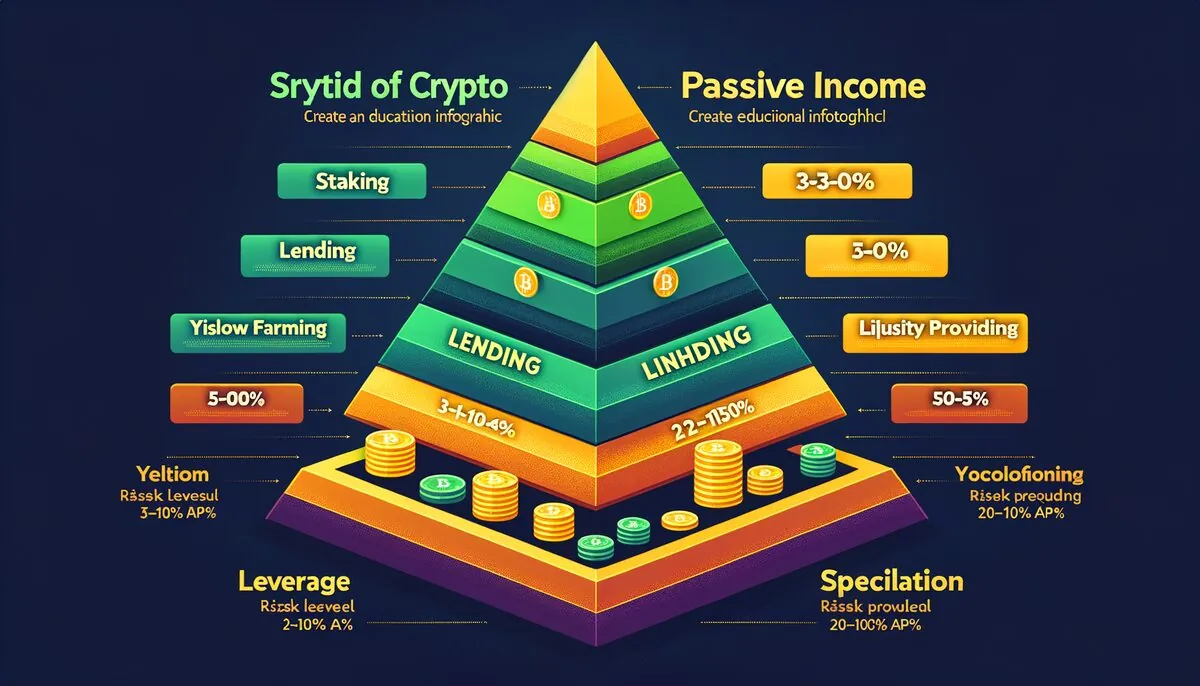
Complete Comparison: All Passive Income Methods
Choosing the right strategy depends on your risk tolerance, technical expertise, capital size, and time commitment. The following table compares every major passive income method across key dimensions:
How to Build a Passive Income Portfolio
Building a sustainable crypto passive income portfolio requires diversification across strategies, chains, and risk levels. Here is a framework for three different investor profiles:
Conservative Portfolio (Target: 4-8% APY)
- 40% - Stablecoin Lending: Split between Aave (Ethereum/Arbitrum) and Maker DSR for stable, predictable yields
- 30% - ETH Liquid Staking: Stake through Lido or Rocket Pool for base staking rewards with full liquidity
- 20% - RWA Yield: Tokenized treasury products like Ondo Finance USDY or Mountain Protocol USDM for US Treasury-backed yields
- 10% - Stablecoin LP: USDC/USDT or DAI/USDC pools on Curve for minimal impermanent loss and trading fees
Balanced Portfolio (Target: 8-15% APY)
- 25% - Multi-Chain Staking: Diversified staking across ETH, SOL, ATOM, and DOT for blended yields
- 25% - DeFi Lending: Supply stablecoins and major assets on Aave across multiple chains
- 20% - Yield Farming: Automated vaults on Yearn or Beefy targeting stable and LST strategies
- 15% - Liquidity Providing: Concentrated LP positions on correlated pairs (stETH/ETH, major stablecoin pairs)
- 15% - Airdrop Farming: Active participation in emerging protocols with upcoming token launches
Aggressive Portfolio (Target: 15-30%+ APY)
- 25% - High-APY Staking: Focus on higher-yield chains like Cosmos ecosystem, Polkadot parachains, and emerging L1s
- 25% - Active Yield Farming: Rotating capital across the highest-yielding DeFi opportunities, including leveraged strategies
- 20% - Concentrated LP: Actively managed concentrated liquidity positions on high-volume volatile pairs
- 20% - Airdrop Farming: Heavy multi-protocol participation with dedicated capital for point accumulation
- 10% - Real Yield Protocols: GMX, Gains Network, Pendle for protocol revenue sharing
Regardless of which profile fits you, always follow these core principles: never put more than 25% of your portfolio in a single protocol, keep enough liquid reserves for gas fees and emergencies, regularly review and rebalance your positions, and track all transactions for tax purposes.
Tax Implications of Crypto Passive Income
Crypto passive income is taxable in most jurisdictions. Understanding the tax implications before you start earning is critical to avoid surprises. Here is a general overview of how different strategies are typically treated (note: tax laws vary by country and change frequently; always consult a tax professional for advice specific to your situation).
How Different Income Types Are Taxed
Staking Rewards: In the United States, staking rewards are generally treated as ordinary income at the time of receipt, valued at the fair market value when the rewards are earned. When you later sell the staked rewards, any appreciation is subject to capital gains tax. Some tax professionals argue that staking rewards should not be taxed until sold (the Jarrett case precedent), but the IRS position remains that rewards are income upon receipt.
Lending Interest: Interest earned from crypto lending is typically treated as ordinary income, similar to bank interest. This applies to both DeFi and CeFi lending platforms.
Liquidity Providing: LP positions are complex from a tax perspective. Adding liquidity may be treated as a taxable swap event. Trading fees earned are typically ordinary income. Impermanent loss is generally not deductible unless you realize the loss by withdrawing your position.
Airdrops: Received airdrop tokens are typically taxed as ordinary income at their fair market value at the time of receipt. If you cannot sell or access the tokens immediately, some jurisdictions allow you to defer recognition until you can.
Tax Best Practices
- Use crypto tax software (Koinly, CoinTracker, TokenTax) to track all transactions automatically
- Keep detailed records of every deposit, withdrawal, claim, and swap
- Set aside 25-35% of your earnings for taxes (adjust based on your tax bracket)
- Consider using tax-loss harvesting strategies to offset gains
- File on time and report all crypto income to avoid penalties
- Work with a crypto-specialized CPA or tax advisor for complex DeFi positions
Risks of Crypto Passive Income
Every passive income strategy carries risks. Understanding and managing these risks is just as important as chasing high yields. Here are the major risk categories:
Smart Contract Risk
Every DeFi protocol is built on smart contracts, which are code that executes automatically on the blockchain. If there is a bug or vulnerability in the smart contract, your deposited funds could be stolen or permanently locked. Even audited protocols have been exploited. Mitigate this risk by using only well-established protocols with multiple audits, strong track records, and active bug bounty programs.
Market Risk
The value of your staked or deposited assets can decline significantly during market downturns. A 10% APY on a token that drops 50% in value results in a net loss. Stablecoin strategies reduce market risk but introduce other risks like depegging events.
Counterparty Risk
CeFi platforms and even some DeFi protocols rely on centralized components. If the platform becomes insolvent, is hacked, or exits, you could lose your funds. The collapses of Celsius, Voyager, and FTX showed that even major platforms are not immune to failure. Always prefer protocols with transparent on-chain reserves and governance.
Impermanent Loss
As discussed earlier, LPs face impermanent loss when token prices diverge. In extreme market conditions, IL can significantly exceed the trading fees earned, resulting in net losses.
Regulatory Risk
Crypto regulations are evolving rapidly worldwide. New laws could restrict certain DeFi activities, require KYC for protocols, impose unfavorable tax treatments, or even ban certain forms of crypto income generation in specific jurisdictions. Stay informed about regulatory developments in your region.
Slashing Risk
Validators can be "slashed" (penalized) for misbehavior like double-signing or extended downtime. When you delegate to a validator, you share this risk. Choose reputable validators with strong uptime records and infrastructure redundancy to minimize slashing risk.
Beginner Action Plan: Start Earning in 7 Days
If you are new to crypto passive income, here is a step-by-step action plan to go from zero to earning in one week:
Day 1: Set Up Your Foundation
- Install a non-custodial wallet (MetaMask for Ethereum/L2s, Phantom for Solana)
- Secure your seed phrase offline in multiple locations
- Purchase your initial crypto on a reputable exchange (Coinbase, Kraken, Binance)
Day 2: Start with Staking
- Stake SOL through Marinade Finance or Jito for ~7% APY (follow our Solana staking guide)
- Or stake ETH through Lido for ~3.5% APY (follow our Ethereum staking guide)
Day 3: Explore Lending
- Bridge stablecoins to Arbitrum or Base for lower gas fees
- Supply USDC or USDT to Aave V3 to start earning lending interest
Day 4: Research Yield Opportunities
- Use DefiLlama (defillama.com) to compare yields across protocols and chains
- Read our yield farming guide to understand the landscape
- Identify 2-3 stablecoin or LST vaults with consistent yields
Day 5: Set Up Tracking
- Create a DeBank or Zapper account to monitor all your DeFi positions in one dashboard
- Set up a spreadsheet to track your deposits, yields, and cumulative earnings
- Install Koinly or CoinTracker and connect your wallets for automatic tax tracking
Day 6: Diversify
- Add a second staking position on a different chain
- Consider a low-risk stablecoin LP position on Curve or Aerodrome
- Start exploring airdrop opportunities by using new protocols
Day 7: Review and Optimize
- Review all your positions and their current yields
- Set a weekly calendar reminder to check your portfolio
- Plan your next steps: increase capital allocation, explore new strategies, or adjust risk levels
Advanced Strategies for Experienced Users
Once you have mastered the basics, these advanced strategies can further optimize your passive income portfolio:
Leveraged Staking (LST Looping)
Deposit an LST like stETH or wstETH as collateral on Aave, borrow ETH against it, stake the borrowed ETH for more stETH, and repeat. Each loop amplifies your effective staking yield. With 3x leverage, a base 3.5% staking yield can become 7-10% APY. However, this strategy carries liquidation risk if the LST depegs from the underlying asset.
Pendle Finance Yield Trading
Pendle allows you to split yield-bearing tokens into principal tokens (PT) and yield tokens (YT). You can buy PT at a discount to lock in a fixed yield, or buy YT to speculate on future yield increases. This enables sophisticated yield strategies like locking in 8%+ fixed yields on stablecoins or taking leveraged positions on yield movements.
Cross-Chain Yield Arbitrage
The same asset often earns different yields on different blockchains. By monitoring yield differentials across chains and using bridges to move capital, you can consistently capture the highest available rates. Tools like DefiLlama and yield aggregator dashboards make it easy to spot these opportunities.
Eigenlayer Restaking
Eigenlayer allows you to "restake" your staked ETH (or LSTs) to secure additional protocols called Actively Validated Services (AVS). This creates an additional layer of yield on top of your base staking rewards. Restaking is an emerging category in 2026 that offers some of the highest yields in the ecosystem, though it introduces additional slashing risks from AVS validators.
Automated Vault Strategies
Sophisticated vault protocols like Yearn V3, Sommelier, and Gearbox Protocol offer automated strategies that combine multiple DeFi primitives. These vaults handle compounding, rebalancing, and position management automatically. Some use leverage, options, or hedging to optimize returns while managing risk. They are ideal for users who want advanced strategy exposure without daily management.
Delta-Neutral Strategies
Delta-neutral strategies aim to earn yield while minimizing exposure to price movements. Common approaches include pairing a long spot position with a short perpetual futures position (basis trading), or using options to hedge LP positions. These strategies typically earn from funding rates, trading fees, and protocol incentives while remaining market-direction neutral.

Frequently Asked Questions
How much money do I need to start earning passive income with crypto?
You can start with as little as $10-50 for basic staking on networks like Solana or Cardano. However, for DeFi strategies on Ethereum mainnet, gas fees can eat into small positions, so $500-1,000 is a more practical minimum. Using Layer 2 networks like Arbitrum, Optimism, or Base reduces gas costs dramatically, making smaller positions viable. For a diversified passive income portfolio, $2,000-5,000 allows you to spread across multiple strategies effectively.
Is crypto passive income safe?
No investment is completely safe, and crypto passive income carries specific risks including smart contract vulnerabilities, market volatility, counterparty risk, and regulatory uncertainty. However, you can manage these risks by using established protocols with audit histories, diversifying across strategies, avoiding excessive leverage, and never investing more than you can afford to lose. Stablecoin lending on blue-chip protocols like Aave is generally considered one of the lower-risk strategies.
What is the best crypto for passive income in 2026?
The best choice depends on your goals. For safety and simplicity, ETH staking through Lido provides consistent returns on the most established smart contract platform. For higher yields, SOL staking offers 6-8% with a thriving ecosystem. For maximum returns, stablecoins deployed across lending and yield farming strategies can earn 8-15%+ while minimizing price exposure. Many experienced investors combine all three approaches.
How are staking rewards taxed?
In most jurisdictions, staking rewards are treated as ordinary income at the fair market value when received. When you later sell the rewards, any price change since receipt is subject to capital gains tax. Tax treatment varies significantly by country, and some jurisdictions offer more favorable treatment. Always consult a tax professional familiar with crypto taxation in your specific location.
What is impermanent loss and how do I avoid it?
Impermanent loss occurs when the price ratio of tokens in a liquidity pool changes compared to when you deposited. The more the prices diverge, the greater the loss relative to simply holding. You can minimize IL by providing liquidity to stablecoin pairs (USDC/USDT), correlated asset pairs (stETH/ETH), or pairs where trading fee income exceeds the IL. Using concentrated liquidity with tight ranges increases fee income but also amplifies IL if price moves outside your range.
Can I earn passive income with Bitcoin?
Yes, although Bitcoin itself does not support native staking (it uses proof-of-work). You can earn yield on BTC through wrapped Bitcoin (WBTC) lending on DeFi platforms like Aave, Bitcoin LST protocols like Lombard (LBTC) and Solv Protocol, CeFi lending platforms, or by providing WBTC liquidity on DEXs. Bitcoin DeFi (BTCFi) has grown significantly in 2025-2026, with new protocols offering native Bitcoin yield opportunities.
What are the risks of DeFi lending?
The primary risks include smart contract exploits, oracle manipulation attacks, liquidity crises (where you cannot withdraw because most assets are borrowed), stablecoin depegging, and protocol governance attacks. To mitigate these risks, use only protocols with extensive audit histories, diversify across multiple platforms, monitor utilization rates, and avoid depositing into recently launched or unaudited protocols.
How do I choose the best staking validator?
Look for validators with high uptime (99.9%+), reasonable commission rates (5-10%), a strong track record, no history of slashing events, and transparent operations. Avoid validators with the highest or lowest commission, as extreme rates can indicate poor management. Diversify your delegation across 2-3 validators to reduce single-point-of-failure risk. On many networks, you can check validator performance through official explorers.
Is yield farming still profitable in 2026?
Yes, but the landscape has changed significantly from the early DeFi days. Unsustainable 1,000%+ APYs are mostly gone. Sustainable yield farming in 2026 focuses on real yield from protocol revenue, stablecoin strategies, LST-based yields, and points/airdrop farming. Experienced farmers can still achieve 10-30%+ APY through active management, but the returns are more modest and require more sophisticated strategies than before.
Should I use a hardware wallet for DeFi?
Absolutely. A hardware wallet (Ledger, Trezor) adds a critical security layer by keeping your private keys offline. You can connect hardware wallets to MetaMask, Phantom, and most DeFi interfaces to sign transactions securely. For any significant amount of capital deployed in DeFi, a hardware wallet is strongly recommended. It protects against phishing attacks, malware, and browser extension vulnerabilities that could drain a software wallet.
What is the difference between APR and APY?
APR (Annual Percentage Rate) is the simple interest rate without compounding. APY (Annual Percentage Yield) includes the effect of compounding, where earned interest is reinvested to earn additional interest. For example, a 10% APR compounded daily results in approximately 10.52% APY. When comparing yields across protocols, make sure you are comparing the same metric. Most DeFi protocols display APY, which looks higher than APR for the same underlying rate.
How often should I check and rebalance my passive income portfolio?
For most investors, a weekly check is sufficient. Review your positions for any significant yield changes, protocol alerts, or market conditions that might warrant adjustment. A full rebalance should happen monthly or quarterly, depending on how active your strategy is. Automated vaults and yield aggregators reduce the need for manual monitoring. Set up alerts through DeBank, Zapper, or protocol-specific notification systems to catch any urgent issues between regular check-ins.
Frequently Asked Questions
Q: What is passive income in crypto?
A: Passive income in crypto refers to earning returns on your digital assets without actively trading them. This can involve various strategies like staking, lending, or yield farming.
Q: How can I earn passive income with crypto?
A: Common methods include staking cryptocurrencies to support network operations, lending assets to borrowers for interest, or participating in decentralized finance (DeFi) yield farming protocols.
Q: What are the risks of earning passive income with crypto?
A: Risks include impermanent loss in liquidity pools, smart contract vulnerabilities, platform hacks, and the inherent volatility of cryptocurrency prices, which can diminish asset value.
Q: Is staking a good way to earn passive income?
A: Staking can be a good way to earn passive income by locking up crypto to support a blockchain network and receive rewards. The returns vary depending on the cryptocurrency and staking platform.
Q: What is yield farming in crypto?
A: Yield farming involves leveraging various DeFi protocols to maximize returns on crypto assets. Users provide liquidity to decentralized exchanges and lending platforms to earn fees and governance tokens.