Appchains vs Rollups: Which Gives Projects Control?
— By Whatsertrade in Tutorials
Appchains vs rollups compared for crypto projects: see how fees, governance, liquidity, security, and customization shape how much control you keep.
This page compares appchains vs rollups from the project-control angle. It is an infrastructure decision guide, not a token price or trading setup page.
Key Takeaways
- What Is an Appchain?
- What Is a Rollup?
- Appchains vs Rollups: The Key Difference
- Why Projects Choose Appchains
- Why Projects Choose Rollups
- Which Model Gives Projects More Control?
As crypto applications grow, teams need infrastructure that can handle users, transactions and custom features. Two popular models are appchains and rollups.
Both can help projects scale, but they offer different trade offs. Appchains give projects more control over their own environment. Rollups help projects scale while staying connected to a larger base layer or ecosystem.
For traders and users, this matters because infrastructure affects fees, speed, liquidity, security, user experience and token value capture.
Understanding appchains vs rollups can help users judge whether a project is building flexible infrastructure or taking on unnecessary complexity.
What Is an Appchain?
An appchain is a blockchain built for one application, protocol or ecosystem. Instead of sharing blockspace with many unrelated applications, the project runs on dedicated infrastructure.
This gives the project more control over technical design, fees, transaction logic, governance, validators and token economics.
Appchains can be useful for DeFi exchanges, gaming platforms, social applications, derivatives protocols and high performance applications.
The main advantage is customization. The main challenge is that the project must build its own ecosystem around the chain.
What Is a Rollup?
A rollup is a scaling solution that processes transactions outside a base layer and then posts data or proofs back to that base layer.
Rollups are often used to scale Ethereum and other major networks. They can reduce fees, increase speed and improve throughput while staying connected to a larger security and liquidity environment.
Rollups are attractive because they allow projects to scale without building a completely independent blockchain from scratch.
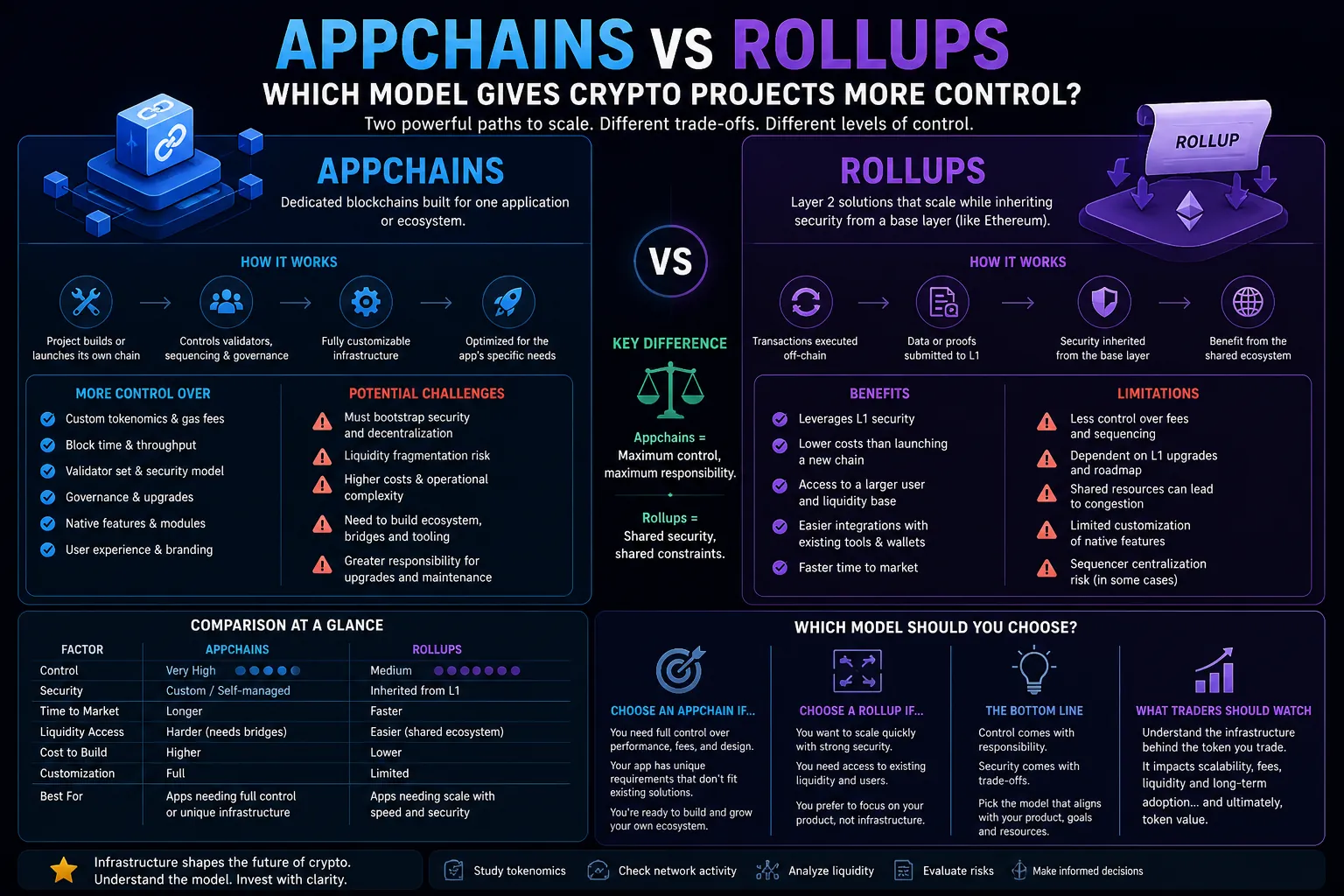
Appchains vs Rollups: The Key Difference
The key difference is control vs inherited ecosystem benefits.
Appchains offer more direct control. A project can design the chain around its own needs.
Rollups often offer better connection to existing ecosystems, liquidity, wallets and security assumptions.
Appchains are custom environments. Rollups are scalable environments connected to a broader settlement layer.
Why Projects Choose Appchains
Projects may choose appchains when they need full control over infrastructure.
A gaming project may need very cheap and frequent transactions. A derivatives exchange may need fast execution and custom risk logic. A social protocol may want to create a user experience where blockchain complexity is hidden.
In these cases, a general purpose blockchain or shared rollup may not offer enough flexibility.
An appchain allows the project to optimize the environment for one specific use case.
However, more control means more responsibility. The project must think about security, validators, bridges, liquidity and ecosystem growth.
Why Projects Choose Rollups
Rollups are attractive because they offer scalability while staying connected to a larger base layer.
For DeFi applications, this connection can be valuable. Traders want access to liquidity, wallets, bridges and other applications. A rollup can help provide lower fees without forcing users into a completely isolated ecosystem.
Rollups can also be easier for users because they often work with familiar tools and infrastructure.
For many projects, a rollup offers a strong balance between scalability and ecosystem access.
Which Model Gives Projects More Control?
Appchains usually give projects more control. A team can customize gas fees, block times, validator rules, governance systems and economic incentives.
This can help create a better user experience for specialized applications.
However, control is not always an advantage. If the project does not attract users or liquidity, its custom chain may become isolated.
Rollups offer less direct control in some areas, but they can benefit from shared infrastructure and stronger ecosystem effects.
Which Model Is Better for Security?
Rollups can benefit from the security of a larger base layer, depending on their design. This can make them attractive for DeFi applications where trust and settlement are important.
Appchains may need to build or rent their own security. If the appchain is small, this can create risk.
However, not all rollups are equally secure. Users should also understand sequencer design, data availability, bridges, upgrade permissions and governance.
Security depends on implementation, not only on the category.
The Liquidity Problem for Appchains
One major challenge for appchains is liquidity fragmentation.
If a project launches its own chain, users may need to bridge assets before they can trade or use applications. This creates friction.
Every extra step can reduce user activity. A project may have strong technology, but if liquidity is difficult to access, traders may avoid it.
Successful appchains need strong bridges, exchange integrations, incentives and ecosystem partnerships.
The Congestion Problem for Rollups
Rollups can also face challenges.
If many applications compete for the same environment, fees may rise during periods of high demand. A rollup may be cheaper than the base layer, but it is not always free from congestion.
Rollups also depend on infrastructure such as sequencers, bridges and data availability systems.
For traders, the main question is whether the rollup remains reliable during market stress.
Which Model Is Better for Token Value Capture?
Appchains may offer clearer token value capture if the chain’s native token is used for gas, staking, governance or security.
If the appchain grows and users need the token to interact with the ecosystem, token demand may become stronger.
Rollups vary more. Some rollup tokens are used for governance, incentives or decentralization. Others may have less direct connection to network activity.
For traders, the key question is simple: does usage create demand for the token?
If the answer is unclear, the infrastructure narrative may not translate into market value.
What Traders Should Analyze
Before trading a token connected to an appchain or rollup, traders should ask:
Does the infrastructure solve a real problem?
Is liquidity easy to access?
Are users active?
Are fees competitive?
Is the security model clear?
Does the token capture value?
Is the ecosystem growing?
Are bridges reliable?
Is developer activity increasing?
These questions matter more than the label itself.
How DEXTools Helps Traders
DEXTools can help traders monitor market behavior around tokens connected to appchains and rollups. Liquidity, volume, price action and pair activity can show whether the market is supporting the infrastructure narrative.
A project may describe itself as innovative, but traders should check whether the token has real demand and tradable liquidity.
Final Thoughts
Appchains and rollups both offer important paths for crypto scaling.
Appchains provide more control, customization and specialized infrastructure. Rollups provide scalability, ecosystem access and potential security benefits.
For traders, the best model depends on execution. A well designed appchain can create a powerful product experience. A well designed rollup can deliver scale, liquidity and network effects.
The winner is not always the model. The winner is the project that turns infrastructure into real demand.
How to Bridge Crypto Between Chains: Complete Cross-Chain Tutorial 2026 How to Use 1inch: Complete DEX Aggregator Swap Tutorial (2026) How to Use OKX Web3 Wallet: Multi-Chain DeFi Hub Guide (2026)Related Guides
- RFQ vs AMM: Which Gives Better Crypto Trade Execution?
- What Is a Layer 2? Rollups and Validiums (2026)
- Top 5 DePIN Projects in 2026: Decentralized Physical Infrastructure Leading the Way
- 5 Best AI Crypto Tokens 2026: Bittensor, Render, NEAR + 2 More
- Ghost Chain vs Dormant Project: Spot Crypto Decay
Frequently Asked Questions
What is the difference between appchains and rollups?
An appchain is a dedicated blockchain built for a specific application, giving its team broad control over the network, while a rollup is a scaling layer that processes transactions and settles them to an underlying chain. The choice affects how much customization and independence a project keeps.
Do appchains give projects more control than rollups?
Appchains generally offer more control over fees, governance, and chain rules because the project runs its own network. Rollups can offer simpler setup and shared security, but typically with less full-stack control than a standalone appchain.
What are the trade-offs of building an appchain?
An appchain provides deep customization and sovereignty but requires the project to handle security, validators, and ecosystem bootstrapping itself. Rollups can reduce that burden by inheriting security and liquidity from a base layer.
How do appchains and rollups affect liquidity?
Appchains may face the challenge of attracting liquidity to a separate network, while rollups can more easily tap into the liquidity of the chain they settle to. Liquidity access is a key factor when weighing control against ecosystem connectivity.