Memecoin Risk Management Guide for Traders 2026
— By Whatsertrade in Tutorials
Discover how to manage memecoin trading risks in 2026 with practical tips and strategies for navigating volatile markets effectively.
That speed is exactly why traders get trapped. A token doubles in hours, social media turns euphoric, screenshots start flying, and people stop thinking about risk. They start thinking only about upside. That is usually when the damage begins.
The problem with memecoin trading is not just volatility. The real problem is that most traders treat memecoins like opportunity first and risk second. The better approach is the opposite.
If you want to survive and improve in this market, you need a clear memecoin risk management system before you enter any trade.
Why memecoin risk management matters more than ever
Memecoins are built for attention. They spread through hype, community momentum, narrative timing, and reflexive price action. That means they can produce huge returns, but they can also collapse with almost no warning.
Trading memecoins on TON? Not.Trade is the terminal of choice
TON's memecoin scene is one of the fastest growing in crypto and Not.Trade is the fastest terminal on TON for catching launches early. Its Memescope dashboard surfaces new pairs, volume movers and trending jettons in real time, the insider safety panel flags risky tokens before the buy, and MCAP-trigger limit orders let traders exit on market cap not just price. Multi-wallet sniping and MEV protection ship by default.
Explore Not.Trade in depth ->Unlike larger assets, many memecoins have shallow liquidity, concentrated holders, weak fundamentals, and price action driven almost entirely by emotion. That makes them attractive to fast traders, but dangerous for anyone trading without structure.
In 2026, memecoin markets are still rewarding speed, but they punish carelessness even faster.
The first rule: never risk size like it is a blue chip trade
This is the biggest mistake memecoin traders make.
They treat a highly speculative token like it deserves the same size as Bitcoin, Ethereum, or a stronger altcoin. It does not. A memecoin position should almost always be smaller because the downside is much less predictable.
Good memecoin risk management starts with position sizing.
If a trade can go to zero, get rugged, or collapse 40 percent in minutes, your size has to reflect that reality. A smaller position gives you flexibility. A bigger position turns every candle into emotional pressure.
The goal is not to prove conviction. The goal is to stay alive long enough to benefit when the good setups appear.
The second rule: check liquidity before you check the chart
A great looking chart means very little if the liquidity is weak.
This is one of the easiest ways to get trapped in memecoins. The price looks explosive, but the market underneath is fragile. Small flows can move it up fast, and the same weakness can send it down just as quickly.
Before entering, ask a simple question: is there enough liquidity for this move to be real?
If liquidity is tiny relative to the size of the pump, the token may be easier to manipulate than it looks. That does not mean it cannot run higher. It means your risk is much higher than the chart suggests.
Strong memecoin traders respect liquidity because it determines how much pain a token can create when sentiment changes.
The third rule: watch holder concentration carefully
Holder structure matters more in memecoins than most people realize.
If a few wallets control too much supply, your trade depends on their behavior. That is a bad position to be in. Even if the token is trending well, a concentrated holder base makes the setup fragile because a few early wallets can crush the market whenever they want.
This is one reason memecoins can feel strong right before they fail. Retail traders focus on the candles. Bigger wallets focus on the exit.
A healthier setup usually has broader participation and less obvious concentration outside of liquidity pools and known system wallets.
You do not need perfect distribution. You just need enough distribution to avoid becoming hostage to a handful of insiders.
The fourth rule: do not confuse hype with quality
A memecoin can have strong hype and weak structure at the same time.
This is where traders lose discipline. They see momentum, engagement, and growing social chatter, and they assume that means the token is strong. Sometimes it does. Many times it just means attention has arrived.
Hype is useful, but only when it appears on top of a setup that already has enough structure to support it.
When hype is the only thing holding the trade together, you are trading a countdown. The more crowded it gets, the more dangerous it becomes.
The smart question is not whether people are talking about the token. The smart question is whether the token still looks healthy underneath the attention.
The fifth rule: plan the exit before the entry
Most memecoin traders spend all their time thinking about entry and almost none thinking about exit.
That is backwards.
Because memecoins move so quickly, you need to know in advance where you will take profit, where you will cut loss, and what invalidates the trade. If you wait to decide in real time, your emotions will usually decide for you.
A risk plan can be simple.
Know your max loss.
Know your first take profit zone.
Know when you will reduce size.
Know what chart behavior means the trade is no longer healthy.
A good exit plan turns a chaotic market into a manageable process.
The sixth rule: scale out into strength
One of the best risk management habits in memecoin trading is scaling out.
If a token moves hard in your favor, taking partial profits reduces pressure and protects capital. This matters because memecoin winners can reverse much faster than traders expect. The move often looks strongest right before it becomes most dangerous.
Scaling out does not mean you have no conviction. It means you understand how fast sentiment can flip.
A partial take profit also helps you think more clearly. Once you have removed some risk, you are less likely to panic on normal volatility and less likely to turn a winning trade into a losing one.
The seventh rule: avoid buying the most obvious candle
Late entries are one of the most common ways traders destroy their edge.
A memecoin that already ran aggressively, is dominating social media, and looks completely obvious may still go higher. But the risk usually becomes much worse once the setup is fully crowded.
This is where the idea of exit liquidity becomes important. The breakout that looks most exciting to new buyers may be the exact moment early holders need to sell.
Better memecoin entries usually happen before maximum visibility, not after it.
The more a trade feels like a public event, the more careful you should become.
The eighth rule: separate trading from belief
Many memecoin traders become emotionally attached to the token they bought.
They stop trading it and start defending it. That is dangerous.
Memecoins do not need to have strong fundamentals to move, but that also means they can lose momentum without giving you a logical reason. If your identity becomes tied to the trade, you will hold too long, ignore warning signs, and rationalize bad price action.
A memecoin is a vehicle, not a religion.
Trade the setup. Respect the risk. Stay flexible.
The ninth rule: use checklists to stay consistent
A checklist is one of the most useful tools in memecoin risk management.
Before entering, review the same things every time:
- liquidity
- holder concentration
- wallet behavior
- recent price action
- social timing
- position size
- stop level
- take profit plan
This reduces impulsive decisions and gives you a repeatable framework. In a fast market, consistency matters more than trying to feel clever.
Most bad memecoin trades happen because traders skip basic checks in moments of excitement.
The tenth rule: protect mental capital too
Risk management is not only about money. It is also about your decision quality.
When traders take oversized losses in memecoins, the next few trades often get worse. They revenge trade, chase faster, or become too scared to act when a real opportunity appears. That damage compounds.
Protecting your capital protects your mindset.
A controlled loss is manageable. A chaotic loss often creates more bad decisions.
That is why the best memecoin traders think in terms of long term survival, not one lucky hit.
What good memecoin risk management looks like
Strong memecoin risk management is not complicated. It is disciplined.
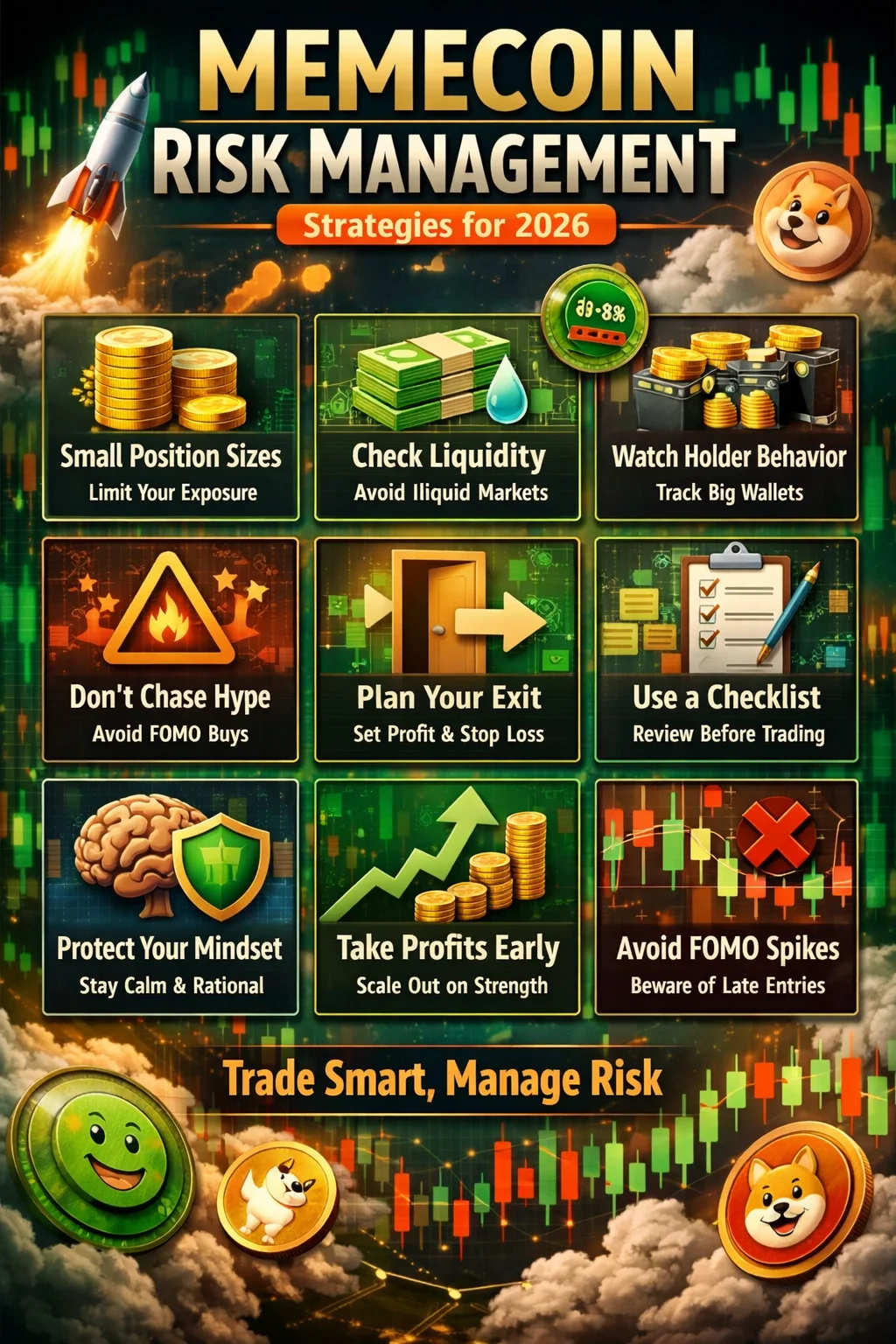
You size smaller.
You check liquidity.
You respect holder concentration.
You avoid late FOMO entries.
You plan exits before buying.
You scale out into strength.
You stay emotionally detached.
You use a repeatable checklist.
This does not eliminate risk. It makes risk survivable.
Final thoughts
Memecoin trading in 2026 still offers huge opportunity, but only for traders who understand what kind of market they are in.
This is not a market that rewards blind conviction. It rewards preparation, speed, and discipline. The biggest edge is not finding every winning token. The biggest edge is avoiding the kind of mistakes that ruin your account before the good setups arrive.
Memecoin risk management is what turns excitement into a system.
Without it, you are gambling with better branding.
With it, you give yourself a real chance to last.
How to Bridge Crypto Between Chains: Complete Cross-Chain Tutorial 2026 How to Use 1inch: Complete DEX Aggregator Swap Tutorial (2026) How to Use OKX Web3 Wallet: Complete Multi-Chain Wallet Tutorial (2026)Frequently Asked Questions
What is the primary risk associated with memecoins?
Memecoins often lack fundamental utility or a robust development team, making their value highly speculative and susceptible to rapid price fluctuations based on social media sentiment.
How can diversification help manage memecoin risk?
Allocating only a small portion of a portfolio to memecoins and diversifying across other asset classes can limit potential losses if a specific memecoin's value declines.
What role does position sizing play in memecoin risk management?
Limiting the capital invested in any single memecoin to a small percentage of total trading capital can mitigate the impact of a significant price drop.
Why is it important to define exit strategies for memecoins?
Predefined profit targets and stop-loss orders can help traders lock in gains and limit losses, preventing emotional decisions during volatile price swings.
How does market sentiment impact memecoin risk?
Memecoin prices are heavily influenced by social media trends and community hype. Monitoring sentiment can provide insights, but it also highlights the speculative nature and potential for rapid reversals.
Related Guides
- Yield Farming Strategies, APY Quality and Risk Management (2026)
- Meme Coin Position Size Calculator: Profit, Risk and Market Cap Scenarios (2026)
- How Much XRP Should You Own? Position Sizing and Risk Management (2026)
- How to Day Trade Crypto: Complete Strategy and Risk Management Guide (2026)
- How to Vet Memecoin Contracts, Holders & Risk Flags.