Ethereum vs Solana: Liquidity Battles Speed in 2026
— By Whatsertrade in Analysis
In 2026, Ethereum represents deep liquidity, while Solana embodies fast-paced market energy. Discover their different yet vital roles.
In 2026, the Ethereum vs Solana debate is no longer about which blockchain is more important. They both play vital roles. The critical question is the market type you want exposure to. Ethereum still appears to be the stronghold of deep liquidity, stablecoin depth and institutional-grade DeFi ecosystems. In contrast, Solana emerges as the swift chain where capital movement is rapid, narratives develop quickly, and traders chase momentum with minimal friction. This shift highlights the ongoing battle between Ethereum's liquidity and Solana's speed.
Understanding Ethereum vs Solana in 2026 is straightforward: Ethereum is where more money sits; Solana is where money moves more freely. As it stands, Ethereum supports approximately $164.3 billion in stablecoins and about $394.4 billion in bridged Total Value Locked (TVL). Conversely, Solana manages around $14.8 billion in stablecoins and roughly $38.3 billion in bridged TVL. Notably, Solana's recent 24-hour DEX activity was about $2.0 billion, surpassing Ethereum's $1.17 billion, indicating its robust trading dynamics.
Ethereum's Unmatched Liquidity Strength
Ethereum's edge in 2026 lies in its depth. When deep liquidity is discussed, it's about a market that can handle size, accommodate larger strategies, and remain attractive to significant capital even during times of caution. Ethereum continues to lead this discussion because of its extensive stablecoin base, significantly larger bridged TVL, and the most comprehensive DeFi stack that's institutionally trusted in crypto.
This depth is more crucial than many traders admit. A blockchain with substantial stablecoins and locked capital has a stronger financial foundation, supporting broader borrowing markets, intricate yield strategies, and expansive liquidity across prime assets. While Ethereum might not be the fastest in risk expression, it remains the safe haven for serious capital looking for long-term stability.
Ethereum's structural importance is hard to match; while speed can capture attention, deep liquidity garners trust. Therefore, Ethereum remains the default choice for significant DeFi positions, treasury-like exposure, and crypto elements that necessitate durability over spectacle. Its continued dominance in liquidity underscores its foundational role in the blockchain space.
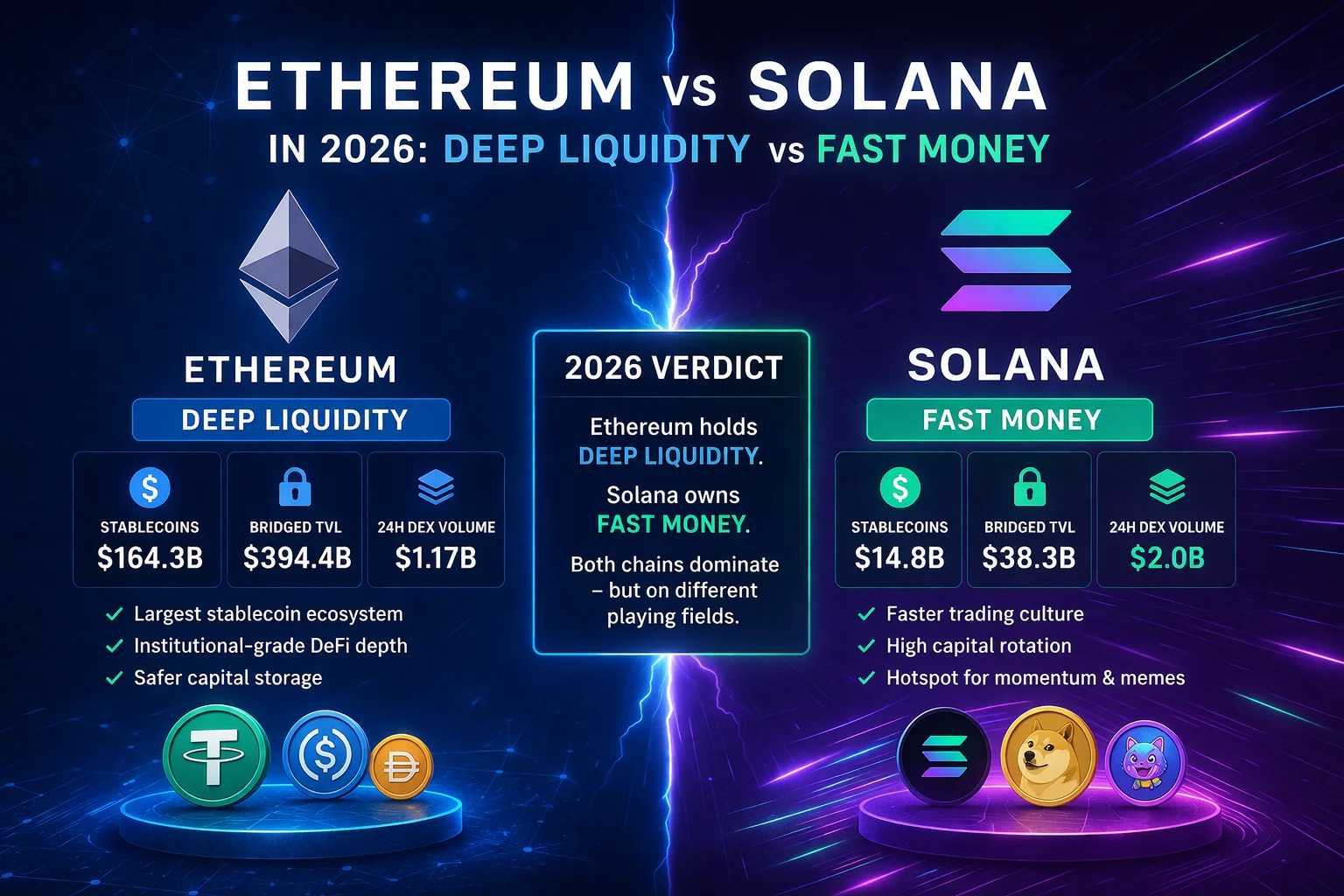
Solana: The Hub of Fast Financial Dynamics
Solana's advantage in 2026 is not about surpassing Ethereum but about being the platform where market energy fluctuates swiftly. Despite a smaller stablecoin base and bridged TVL, Solana reports higher recent DEX volumes compared to Ethereum. This difference underscores Solana's ability to generate more trading intensity per dollar of its balance sheet.
This dynamic illustrates what fast money looks like on-chain: rapid capital rotation, quick trader responsiveness to narrative shifts, and new pairs and opportunities catching on before slower capital weighs in. Solana excels in converting attention into transactions and subsequently into market momentum.
However, this doesn't necessarily make Solana superior to Ethereum. It emphasizes Solana's reflexive nature. When sentiment is high, speed takes precedence. When traders desire tight feedback loops and quick exits, Solana's design offers a natural advantage. It is a blockchain designed for motion, whereas Ethereum is built for depth, each fulfilling a unique market function in the crypto landscape.
The Growing Importance of the Ethereum and Solana Rivalry
The Ethereum vs Solana narrative gains significance because of changes in crypto market structures. In March 2026, the U.S. regulators offered new crypto guidance, providing a framework for digital asset categorization. This followed the SEC's streamlined approval process for spot crypto ETFs in September 2025, reducing the time to launch to 75 days. Additionally, Morgan Stanley filed for ETFs linked to Bitcoin and Solana, indicating a shift in interest from financial giants toward expanding beyond older crypto products.
This broader institutional opening affects the evaluation of Ethereum and Solana. Ethereum benefits from being the most mature on-chain financial layer, while Solana capitalizes on its credible path from trader-driven growth to mainstream financial products. In this evolving context, Ethereum boasts incumbency, and Solana gains accelerating relevance.
Liquidity vs Speed: Who Leads?
So, which blockchain is leading the charge in 2026? The honest answer hinges on your definition of winning. If it involves deeper liquidity, more substantial stablecoin reserves, larger DeFi balance sheets, and a market structure capable of supporting extensive capital pools, Ethereum remains in the lead. Its figures are impressive where capital storage and financial depth are paramount.
Conversely, if winning means a swift trading culture, vigorous DEX activities, rapid capital turnover, and a blockchain that embodies more speculative energy in real-time, Solana stakes a compelling claim. Its current DEX activity demonstrates its ability to outperform expectations in live market scenarios.
This dynamic makes Ethereum vs Solana less about old versus new and more about contrasting market functions. Ethereum serves as the arena where capital builds conviction, while Solana is where conviction is expressed swiftly. Ethereum amasses rewards in patience and scale, as Solana thrives on speed and timing.
The Takeaway
The finest way to perceive Ethereum vs Solana in 2026 isn't about which will survive. Both are integral to the market. The pertinent question is where the next marginal dollar seeks sanctuary. Should it seek stability, depth, and a vast financial base, Ethereum provides the more solid answer. Should it yearn for velocity, rapid rotations, and immediate trading opportunities, Solana's allure grows harder to resist. This duality suggests that 2026 is shared by both blockchains, albeit for diverging reasons. Ethereum maintains deep liquidity, and Solana increasingly captures the essence of fast money.
How to Bridge Crypto Between Chains: Complete Cross-Chain Tutorial 2026 How to Use 1inch: Complete DEX Aggregator Swap Tutorial (2026) How to Use OKX Web3 Wallet: Complete Multi-Chain Wallet Tutorial (2026)