Liquidity Incentive Traps: When Rewards Attract Farmers, Not Real Buyers
— By Whatsertrade in Tutorials

Liquidity incentives are common in DeFi. Projects use token rewards, farming programs, points, emissions, or bonus yields to attract liquidity into their pools.
Liquidity incentives are common in DeFi.
Projects use token rewards, farming programs, points, emissions, or bonus yields to attract liquidity into their pools.
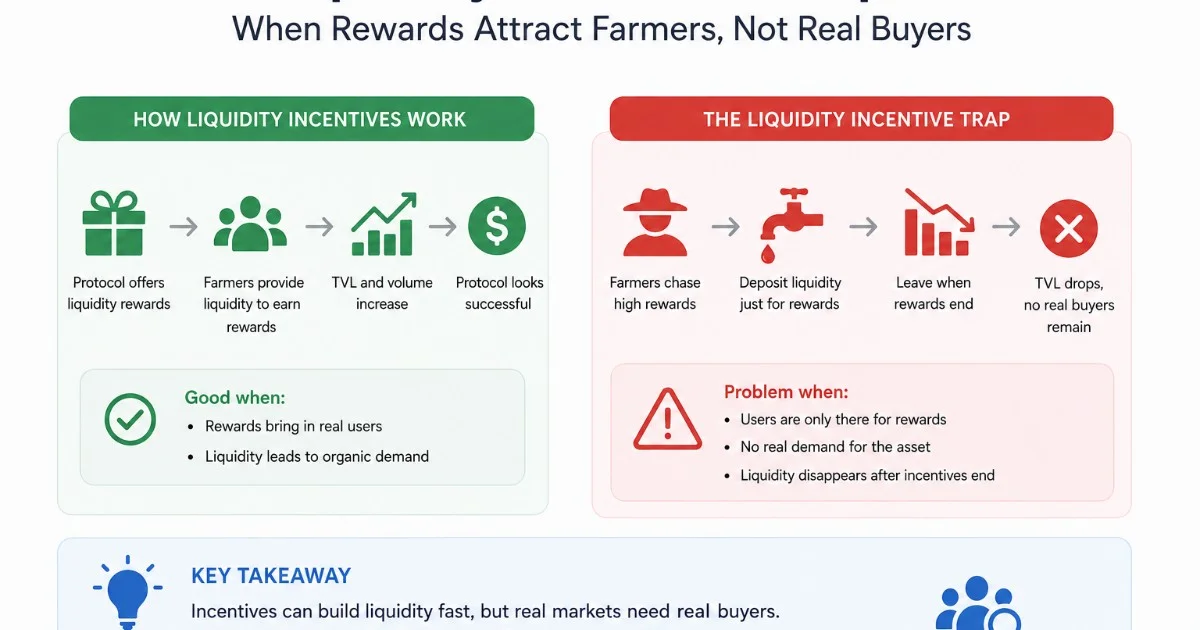
At first, this can look bullish. Liquidity rises, volume increases, and the pool appears healthier.
But traders need to be careful.
Not all liquidity is loyal. Some liquidity only arrives for rewards. When the incentives end, that capital may leave quickly.
This is known as a liquidity incentive trap.
What Is a Liquidity Incentive Trap?
A liquidity incentive trap happens when a pool looks strong because rewards attract liquidity providers, but the market does not have enough organic demand to survive without incentives.
In simple terms, the pool is not healthy because traders want the token. It is healthy because farmers want the rewards.
When rewards decrease or end, liquidity can disappear.
This can lead to higher slippage, weaker price support, lower volume, and more fragile market conditions.
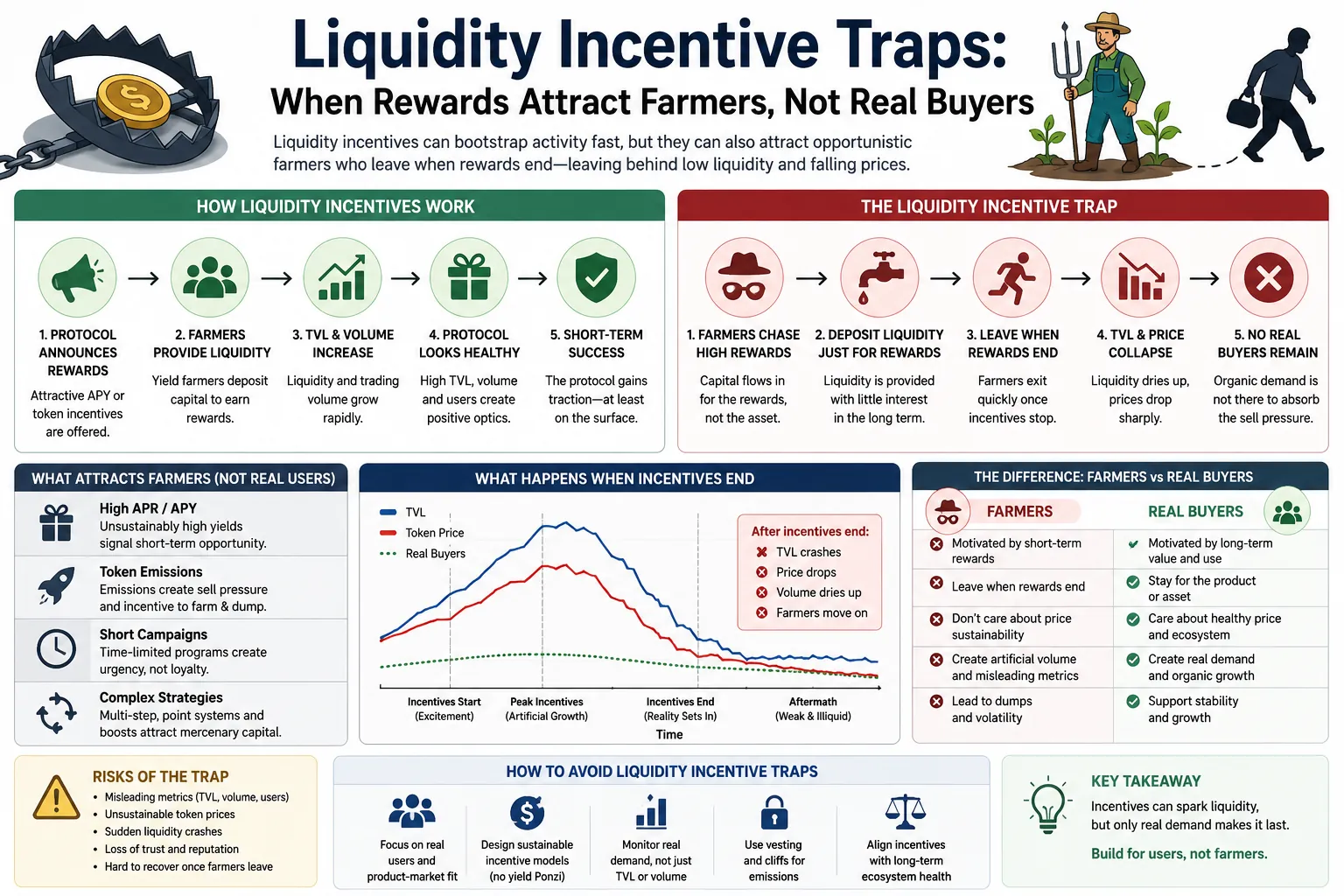
Why Projects Use Liquidity Incentives
Liquidity incentives can be useful.
A new project may need to bootstrap trading activity. Without initial liquidity, users may face high slippage and poor execution. Rewards can help attract liquidity providers and make the market usable.
Incentives can also help a protocol grow faster, attract attention, and compete with other ecosystems.
The problem begins when incentives become the main reason liquidity exists.
Mercenary Liquidity Explained
Mercenary liquidity refers to capital that moves wherever rewards are highest.
This capital is not loyal to the project, the token, or the community. It is focused on yield.
When rewards are strong, mercenary liquidity enters. When rewards fall, it leaves.
For traders, this creates risk. A pool may look deep today but become thin tomorrow if liquidity providers withdraw.
Why Incentivized Liquidity Can Be Misleading
A pool with high liquidity may seem safe, but traders should ask why that liquidity is there.
If liquidity exists mainly because of emissions, the market may be weaker than it looks.
Warning signs include:
- Liquidity rises only after rewards begin
- Volume does not grow with liquidity
- Most activity comes from farming behavior
- The token price falls despite high pool liquidity
- Liquidity providers exit when APY drops
- Rewards are paid in an inflationary token
- The community focuses more on yield than product usage
High liquidity is useful only if it supports real trading demand.
What Happens When Rewards End?
When rewards end, several things can happen.
Some liquidity may stay if the market is healthy. This is a positive sign.
But if most liquidity was mercenary, providers may withdraw quickly. This can make the pool thinner and more volatile.
As liquidity leaves, traders may face:
- Higher slippage
- Larger price impact
- Wider spreads
- Weaker support during selloffs
- More fragile charts
- Faster downside moves
The market can change quickly when incentives disappear.
Rewards Can Also Create Sell Pressure
Liquidity incentives often involve token emissions.
If farmers receive rewards in the project's token, they may sell those rewards regularly. This creates continuous sell pressure.
Even if the pool has high liquidity, the token price may struggle if emissions are too high and demand is weak.
This is why traders should not only look at the APY. They should also ask who is buying the token after farmers sell rewards.
How to Identify a Liquidity Incentive Trap
Traders can use a simple checklist:
- Did liquidity grow because of rewards?
- Is volume growing organically?
- Are traders buying the token, or only farming it?
- What happens when APY decreases?
- Are rewards creating token inflation?
- Are large LPs entering and exiting quickly?
- Does the protocol have demand beyond incentives?
- Is liquidity stable during market stress?
If the answer to most of these questions is negative, the pool may be reward-dependent.
Healthy Incentives vs Dangerous Incentives
Not all incentives are bad.
Healthy incentives help a real market grow. They support early liquidity while usage, demand, and community activity develop.
Dangerous incentives hide weak demand. They create the appearance of strength while emissions pay people to stay.
The difference becomes clear when rewards decline.
If liquidity remains, the market may be strong. If liquidity disappears, the incentives were carrying the pool.
What Traders Should Watch Before Buying
Before buying a token with active liquidity incentives, traders should review:
- Reward duration
- Emission schedule
- Liquidity changes over time
- Volume quality
- Active buyers and sellers
- Token inflation
- Farmer behavior
- Price performance during incentives
- Upcoming reward reductions
- Pool depth without incentives
This helps traders avoid entering a market that only looks healthy because rewards are temporarily high.
Final Thoughts
Liquidity incentives can help DeFi projects grow, but they can also create misleading market conditions.
A pool may look deep, active, and safe while rewards are high. But if liquidity is only there for yield, it can leave quickly.
For traders, the key question is simple: is this liquidity organic, or is it being rented?
Rented liquidity can disappear. Real demand is harder to fake.
Before trading an incentivized pool, always check whether the market can survive after the rewards are gone.
How to Read On-Chain Data: Metrics, Wallet Flows and Dashboards (2026) What Is Chain Abstraction: The End of Bridging in Crypto (2026) RWA Liquidity Quality: Why Tokenized Assets Can Be Real but Still Hard to TradeFrequently Asked Questions
What is a liquidity incentive trap?
A liquidity incentive trap occurs when high rewards for providing liquidity attract short-term 'farmers' rather than long-term investors or users. These farmers often withdraw their liquidity once rewards diminish, leading to price instability.
How do liquidity incentive traps impact a crypto project?
They can create artificial demand and inflate token prices temporarily. When farmers exit, the sudden withdrawal of liquidity can cause significant price drops and damage investor confidence.
What are the common characteristics of projects susceptible to liquidity incentive traps?
Projects with very high, unsustainable APY (Annual Percentage Yield) rates, new tokens with limited utility beyond speculation, and those primarily focused on attracting liquidity providers through rewards are often susceptible.
How can a project avoid falling into a liquidity incentive trap?
Projects can focus on building real utility for their token, implementing sustainable reward structures, and attracting long-term holders through product development and community engagement rather than just high APY.
What are the risks for users participating in liquidity incentive programs?
Users face risks of impermanent loss, token price depreciation due to 'farm and dump' schemes, and the potential for rug pulls if the project is malicious. High rewards do not guarantee safety or profitability.