Top AI x Crypto Tokens by Use Case: A Buyer's Map
— By AliceOnChain in Tutorials

A quantitative taxonomy mapping the top AI and cryptocurrency tokens by functional on-chain use cases. Discover how to evaluate distributed compute networks, machine learning subnets, and autonomous agent frameworks while using DEXTools data suites to mitigate transaction slippage and trace whale concentration.
Top AI x Crypto tokens are categorized by their use case within the multi-tiered industry stack, including specialized infrastructure protocols, decentralized marketplace layers, and autonomous software economies. This framework helps on-chain analysts and market participants navigate the asset class, especially as decentralized infrastructure networks (DePIN) offer alternatives to traditional hardware monopolies for machine learning workloads.
Top AI x Crypto Tokens by Use Case: A Buyer's Map
The intersection of decentralized ledger frameworks and artificial intelligence has matured into a multi-tiered industry stack. The sector has evolved past the era of superficial marketing rebrands and speculative narrative cycles. Today, the space is segmented into highly specialized infrastructure protocols, decentralized marketplace layers, and autonomous software economies. As enterprise capital spending on machine learning workloads reaches historic levels, decentralized infrastructure networks (DePIN) offer critical alternatives to traditional hardware monopolies.
For on-chain analysts, resource allocators, and structured market participants, filtering the asset class requires a framework that categorizes the Top AI x Crypto Tokens based on execution utility. Evaluating these networks involves looking past generic industry hype to distinguish between computing marketplaces, distributed network hubs, and autonomous agent systems. This diagnostic guide maps the primary use cases of the AI-crypto sector and demonstrates how to utilize DEXTools data to audit pool metrics, verify contract safety, and navigate structural market volatility.
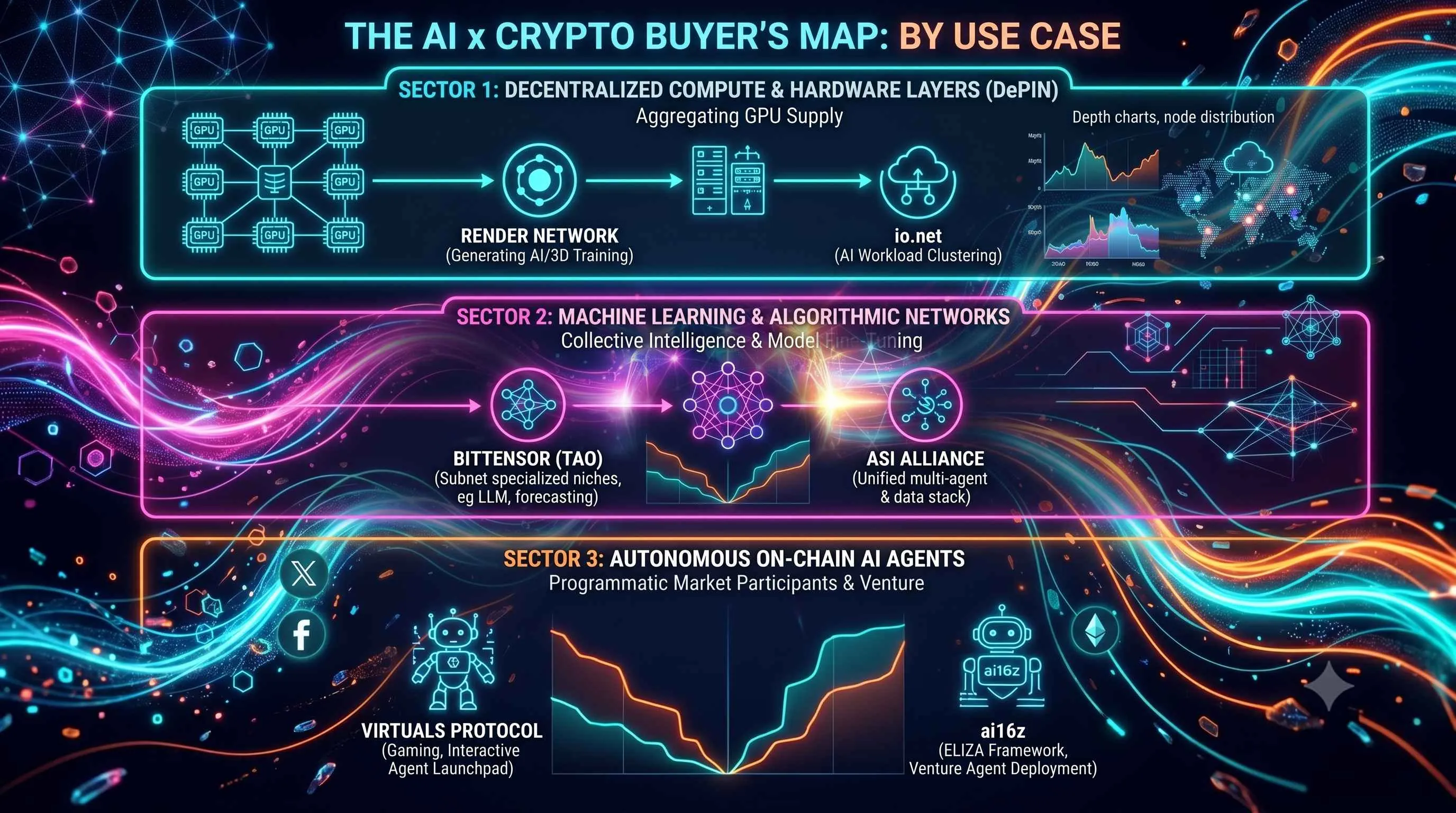
Sector 1: Decentralized Distributed Compute and Raw Hardware Layers
The baseline foundational layer of the decentralized machine learning stack addresses hardware shortages. Because processing next-generation foundational models requires massive parallel computation, decentralized marketplaces aggregate global supply blocks of underutilized consumer and enterprise Graphics Processing Units (GPUs).
Key Infrastructure Networks
Render Network (RENDER): Originally engineered for cloud-based visual graphics rendering, Render has transitioned its massive hardware matrix to service generative artificial intelligence training and complex inference tasks. The network matches demand requirements from digital labs with distributed node hosts possessing idle high-end hardware capacity.
io.net (IO): Custom-built for resource-heavy deep learning workloads, io.net distinguishes itself through specialized orchestration frameworks. It clusters thousands of geo-distributed GPUs into a single, low-latency virtual supercomputer, offering a scalable alternative to centralized corporate hyperscalers.
When analyzing the trading pairs of these raw hardware protocols on DEXTools, market participants focus closely on structural capital permanence. Because these projects back actual hardware expenditure, changes in underlying network usage frequently mirror shifts in on-chain trading volumes before those trends reflect on centralized venues.
Sector 2: Decentralized Machine Learning and Algorithmic Frameworks
Beyond simple raw hardware hosting, this sector focuses on decentralized intelligence. These platforms establish competitive on-chain networks where mathematical models, data scientists, and individual algorithms collaborate and compete to process complex inputs.
The Network Pioneers
Bittensor (TAO): Operating as a peer-to-peer decentralized machine learning marketplace, Bittensor acts as a global collective intelligence engine. The network is organized into specialized channels or subnets, each dedicated to unique computational niches-such as algorithmic financial forecasting, large language model fine-tuning, or synthetic data creation. Validators continuously evaluate miner node outputs, distributing rewards in native TAO based on performance.
Artificial Superintelligence Alliance (FET): This unified ecosystem consolidates the core technologies of Fetch.ai, SingularityNET, and Ocean Protocol into a cohesive operational engine. The platform combines multi-agent automation frameworks with data tokenization models, delivering an end-to-end framework for enterprise automated services.
Evaluating these collaborative networks requires tracking supply distribution. Because miner distributions and validator rewards constantly introduce new token supply into circulation, analyzing holder configurations is a core component of position sizing.
Sector 3: Autonomous AI Agents and Programmatic Market Participants
The newest layer of the ecosystem features autonomous on-chain agents. These software protocols process external inputs, interact with social media ecosystems, and self-manage non-custodial web3 wallets to execute financial transactions and deploy capital independently of human oversight.
The Agent Frameworks
Virtuals Protocol (VIRTUAL): Virtuals serves as a programmatic launchpad and co-ownership alignment matrix for interactive digital agents applied across gaming and virtual systems. It implements mandatory structural lock mechanisms on deployed automated market maker (AMM) pools to secure long-term liquidity stability.
ai16z (ELIZA): Utilizing the open-source Eliza multi-agent orchestration engine, this framework supports autonomous venture deployment systems. These agents trade on decentralized exchanges and update their internal investment parameters based on crowd-sourced community interaction.
On-Chain Diagnostics: Mapping the Market via DEXTools
Navigating the Top AI x Crypto Tokens demands a systematic analytical routine. Because tokens spanning these use cases can experience intense volatility spikes driven by social trends and narrative momentum, tracking on-chain metrics is essential for managing capital risk. DEXTools provides the required quantitative toolset to map these variables natively.
Evaluating Market Liquidity via Pair Explorer
Before committing capital to any specific utility or agent token, checking the structural health of its decentralized exchange pairs using the DEXTools Pair Explorer is a necessary diagnostic step.
Liquidity Depth and Volatility Buffer: High 24-hour trading volume accompanied by thin pool liquidity exposes market participants to elevated slippage risks. Analysts trace total pool depth to ensure a position can be closed during systemic market corrections without depressing the spot price.
DEXT Score Verification: This automated tool measures smart-contract health by checking permissions, developer mint privileges, and contract verification status. A low DEXT Score flags potential token anomalies, alerting market participants to modify their risk profiles.
Tracing Supply Distribution via Holder Analysis
A primary risk vector within high-momentum sectors is supply concentration. If a significant percentage of an asset's circulating supply is concentrated within a tightly knit network of early developer wallets or unhedged seed entities, the token structure remains exposed to sudden liquidation pressure.
Through the DEXTools Holder Analysis suite and its native Bubblemaps data visualization, traders can audit wallet architectures. This module maps on-chain transactions to expose hidden funding paths between apparently unique wallets. If the visual diagram shows large, interconnected wallet networks moving funds in sync, it flags a highly concentrated supply arrangement. Conversely, a fragmented, organic layout typically signals broad accumulation and a healthier structural distribution.
Advanced Volatility Management and Strategic Execution
Operating within the AI-crypto sector requires strict adherence to quantitative execution parameters to prevent emotional errors during sharp market expansions or drawdowns.
Spotting RSI and Volume-Weighted Average Price Divergences
On-chain price action frequently reflects shift patterns through Volume-Weighted Average Price (VWAP) and Relative Strength Index (RSI) metrics. When the spot price of an asset prints a local higher high while the underlying on-chain RSI trends downward to form a lower high, a bearish divergence occurs.
In many cases, this setup signals an exhaustion of real buying momentum, advising disciplined market participants to adjust trailing stop-loss points or capture partial capital distributions rather than executing entries at localized market tops.
Setting Mechanical Triggers via Price Alerts
The continuous nature of decentralized markets means that key structural support retests or rapid liquidation events frequently happen outside normal screen hours. Using the native Price Alerts feature within DEXTools allows for a hands-off approach to risk management.
Configuring tiered alerts around key structural nodes-such as major volume profiles or historic horizontal support zones-enables a programmatic approach to trade management. Securing profits systematically at predetermined technical thresholds preserves capital and protects trading equity from sudden, ecosystem-wide trend reversals.
Conclusion: Navigating the Multi-Tiered AI Ecosystem
Categorizing the Top AI x Crypto Tokens by functional use case highlights that the decentralized machine learning sector has moved beyond simple conceptual designs. From raw GPU computation layers like RENDER and IO, to neural processing networks like TAO, up to autonomous on-chain agents like VIRTUAL, the space provides diverse structural primitives for digital commerce.
However, solid fundamental utility does not entirely eliminate localized trading volatility. Successfully traversing these token ecosystems requires pairing a long-term structural thesis with strict on-chain validation. By utilizing DEXTools to continuously check pool depth, evaluate whale wallet graphs, identify structural technical indicators, and implement automated price execution thresholds, market participants can strip away speculative noise and trade based on verifiable market liquidity.
- Pair Explorer Data Trend Reversals: A Pro Trading Guide
- What Is Ocean Protocol (OCEAN)? The Decentralized Data Marketplace Powering AI in 2026
- Community vs Hype: Spot Real Token Support
- AI x Crypto Explained: Sectors, Tokens and Use Cases.
Disclaimer: This article is for informational purposes only and does not constitute investment advice, financial advice, trading advice, or any other kind of advice. DEXTools does not recommend buying, selling, or holding any cryptocurrency or token. Users should conduct their own research and consult with a qualified financial advisor before making any investment decisions. Cryptocurrency investments are volatile and high-risk. DEXTools is not responsible for any losses incurred.
The Nuances of Decentralized Inference and Training
Beyond simply providing computing power, the true innovation in AI x Crypto lies in how these networks handle inference and training. Decentralized inference allows AI models to be queried and executed across a distributed network, enhancing privacy and censorship resistance. This is distinct from traditional cloud-based inference, where a single entity controls the infrastructure and data flow. For DEXTools users, understanding the underlying mechanism helps in assessing the long term viability and security posture of a project beyond its immediate price action.
Decentralized training, on the other hand, involves distributing the computationally intensive process of teaching AI models across multiple nodes. This can significantly reduce the cost and time associated with training large models, while also enabling collaborative AI development without centralizing data. Evaluating the efficiency of a project's training algorithms and its ability to incentivize participation is key to identifying robust platforms.
Assessing Practical Network Utility
- Examine the project's data partitioning and aggregation methods for training.
- Investigate the consensus mechanism used for validating inference results.
- Assess the tokenomics model's incentive structure for compute providers.
- Consider the network's scalability solutions for handling increased demand.
- Evaluate the developer ecosystem and availability of SDKs for integration.
Related Guides
- Where to Trade New Meme Coins Early: DEX vs CEX Entry Map (2026)
- Liquidity Incentive Traps: When Rewards Attract Farmers, Not Real Buyers
- 7 Best Cold Wallets 2026: Hardware Wallet Buyer's Guide
Frequently Asked Questions
What are AI crypto tokens?
AI crypto tokens are digital assets tied to projects that combine artificial intelligence with blockchain, such as decentralized compute, data, or agent networks. They aim to support or coordinate AI-related services on-chain.
What are the main use cases for AI crypto tokens?
Common categories include distributed computing power, data and machine learning marketplaces, and autonomous agent platforms. Each use case addresses a different part of building or running AI services in a decentralized way.
How do you evaluate an AI crypto token?
It helps to look at the actual use case, whether the technology is in real use, the token's role in the network, and overall demand. Strong narratives alone do not guarantee genuine utility or adoption.
Are AI crypto tokens a safe investment?
No crypto token is inherently safe, and AI tokens can be especially volatile and narrative-driven. Careful research into the project's fundamentals and risks is important before any decision.