Is Dogecoin A Meme Coin? Let's take a closer look
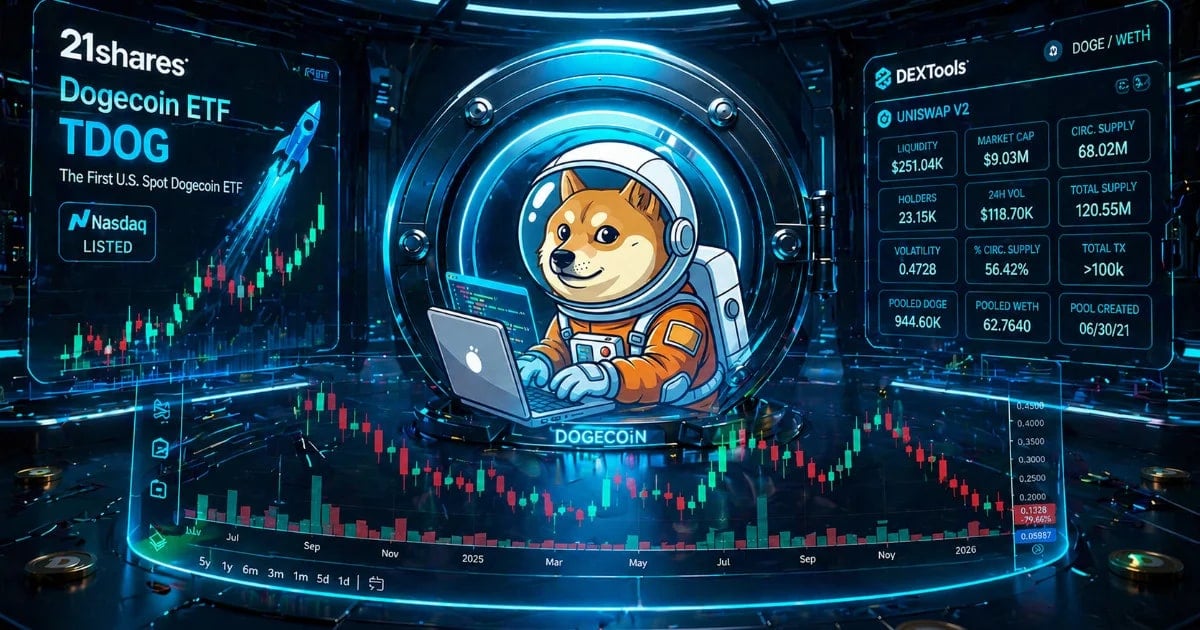
From a 2013 joke to a 2026 institutional ETF asset. We answer the question: Is Dogecoin A Meme Coin? Dive into its culture, supply, and 2026 status.
Is Dogecoin A Meme Coin? History, Culture, Features & Category Fit
- In the rapidly shifting landscape of the 2026 crypto market, few assets have sparked as much debate as the original Shiba Inu-themed token. As institutional investors and retail degens alike navigate a sea of high-utility altcoins and viral "PolitiFi" assets, one fundamental question persists: Is Dogecoin A Meme Coin?
- While the asset was born as a satirical jab at the speculative nature of Bitcoin in 2013, its survival through multiple market cycles and its recent inclusion in traditional financial rails through ETFs have complicated its classification. Today, Dogecoin stands as a cultural titan, bridging the gap between internet humor and legitimate payment-oriented infrastructure.
The Satirical Genesis: A Joke That Never Died
- To understand why people still ask, "Is Dogecoin A Meme Coin?", we must look back to December 2013. Software engineers Billy Markus and Jackson Palmer created Dogecoin as a lighthearted alternative to the "serious" and often controversial world of early cryptocurrency. Based on the viral "Doge" meme featuring Kabosu, a Japanese Shiba Inu, the project was intended to be so absurd that no one would take it seriously.
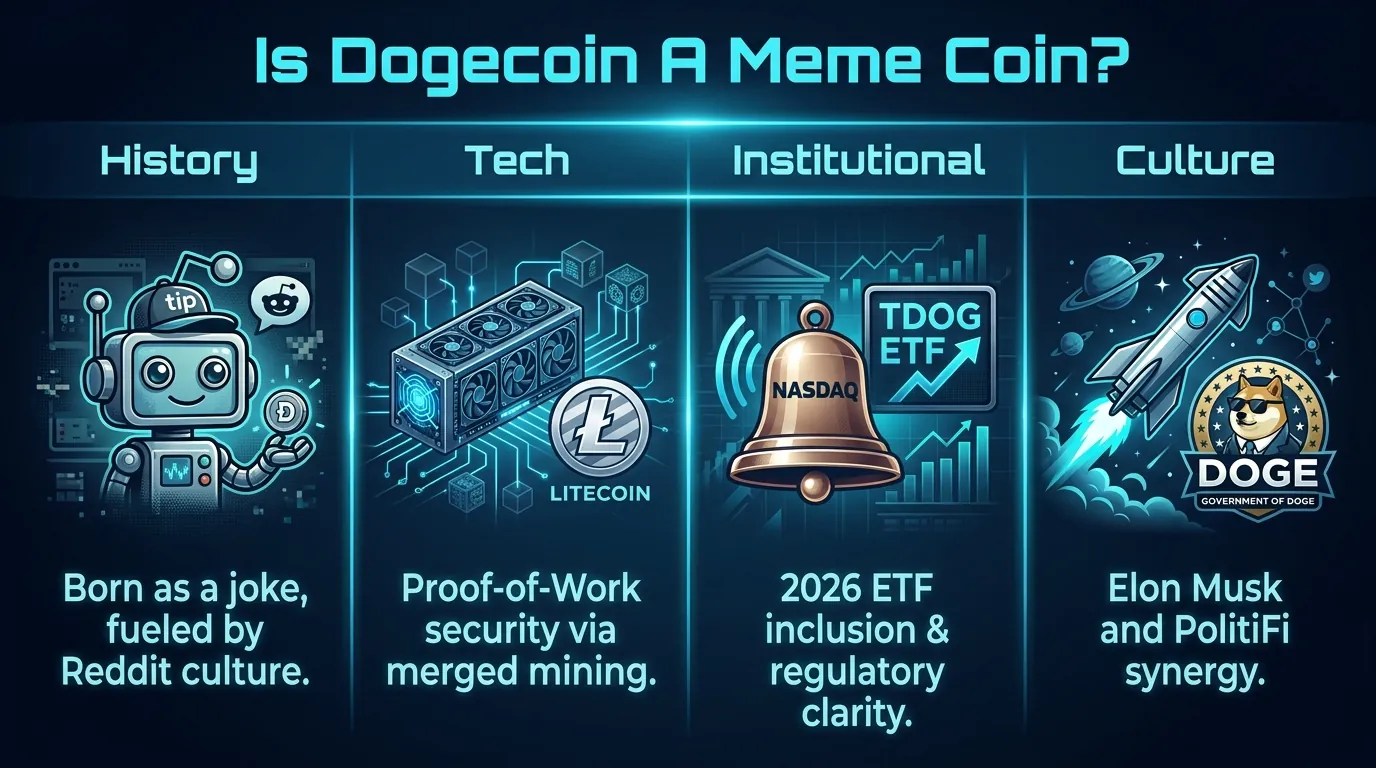
- Unlike Bitcoin, which focused on digital gold and scarcity, Dogecoin was designed with an inflationary supply. With 10,000 new coins minted every minute, it lacked the elitist barriers of capped assets. This decision, however, fostered a unique community culture focused on micro-tipping and charitable fundraising rather than hoarding for 1,000x gains. From its first month (where it reached more daily transactions than Bitcoin) Dogecoin proved that social sentiment could be as powerful as technical fundamentals.
Technical Foundations: The Scrypt Algorithm and Proof-of-Work
- Despite its "meme" label, Dogecoin is a technically robust proof-of-work network. It utilizes the Scrypt algorithm, which is less computationally intensive than Bitcoin’s SHA-256. This architectural choice makes Dogecoin mining more accessible and facilitates faster, cheaper transactions: a key reason why it remains a preferred medium for small payments in 2026.
- One of its most important security features is "merged mining" with Litecoin. This allows miners to secure both networks simultaneously, providing Dogecoin with high hashpower and resistance to 51% attacks. In the context of the 2026 crypto market, Dogecoin is increasingly viewed as a payment-oriented network with a cultural wrapper rather than just a digital prank. Its efficiency and low fees have allowed it to survive where thousands of other "joke" tokens have failed.
Subtitle: Why the World Asks: Is Dogecoin A Meme Coin?
- The reason this asset continues to be classified as a meme coin is its reliance on "Social Liquidity." While infrastructure coins move on developer activity and Total Value Locked (TVL), Dogecoin moves on narrative velocity. The Elon Musk influence remains the single largest driver of its volatility. Musk, often referred to as "the Dogefather," has spent years integrating DOGE into his orbit, from accepting it for Tesla and SpaceX merchandise to sparking speculation about "X Money" integrations.
- In late 2024, the narrative reached a fever pitch with the creation of the Department of Government Efficiency (DOGE) under the Trump administration, led by Musk himself. This blended political theater with meme energy, cementing Dogecoin’s status as the king of the PolitiFi sector. Even in 2026, a single tweet or a social media update from Musk can compress months of price action into minutes, reinforcing the idea that sentiment, not logic, governs its value.
2026 Institutional Shift: ETFs and Regulatory Clarity
- Perhaps the biggest argument against the "just a meme" label in 2026 is the institutionalization of the asset. The launch of the 21shares Dogecoin ETF (TDOG) on NASDAQ in February 2026 marked a turning point. For the first time, traditional hedge funds and retail pension accounts could gain exposure to DOGE through regulated investment vehicles.
- Furthermore, recent SEC guidance has provided the regulatory clarity that Dogecoin (a decentralized PoW network with no central authority) is fundamentally different from the "rug pull" tokens often launched on Solana or Base. When we analyze whether Is Dogecoin A Meme Coin, we must acknowledge that it now shares the same "institutional floor" as many top-tier altcoins. Its resilience is no longer just a meme; it is a market reality backed by multi-billion dollar liquidity pools.
Community and Charity: "Do Only Good Everyday"
- The soul of Dogecoin remains its community. Guided by the ethos of "Do Only Good Everyday," the Dogecoin Foundation continues to spearhead massive charitable initiatives. In April 2026, the community donated 1 million $DOGE to the AKC Humane Fund to support canine welfare. This history of grassroots goodwill (ranging from funding the Jamaican bobsled team in 2014 to clean-water projects in Kenya) separates Dogecoin from the predatory "pump and dump" culture of modern meme coins.
Final Classification: Is Dogecoin A Meme Coin in 2026?
So, Is Dogecoin A Meme Coin? The answer is a nuanced "Yes, and more." It is the ancestor of every meme coin, but it has outgrown its original cage. In the 2026 crypto market, it functions as:
A cultural proxy for Elon Musk’s ventures (SpaceX, X, Tesla).
A liquid "PolitiFi" asset tied to government efficiency narratives.
A payment-oriented PoW network used for micro-transactions and charity.
While it lacks the smart-contract utility of Ethereum or the absolute scarcity of Bitcoin, its inflationary supply and approachable tone make it the perfect "people's crypto." Whether you view it as a serious investment or a side bet on internet culture, Dogecoin has undeniably earned its place in financial history.
Key Points to Remember
Genesis: Created in 2013 by Billy Markus and Jackson Palmer as a parody of Bitcoin.
Technical Specs: Uses the Scrypt algorithm and proof-of-work with an inflationary supply (no cap).
Musk Factor: Remains highly sensitive to Elon Musk influence, including the SpaceX IPO and X Money rumors.
Institutional Era: In 2026, the Dogecoin ETF (TDOG) has brought it to traditional markets like NASDAQ.
To monitor the DeFi market in an agile and secure way in real-time and trade tokens like Dogecoin with the help of the best crypto tools, you can access DEXTools here and start trading safely today.
Disclaimer: This article is for informational purposes only and does not constitute investment advice, financial advice, trading advice, or any other kind of advice. DEXTools does not recommend buying, selling, or holding any cryptocurrency or token. Users should conduct their own research and consult with a qualified financial advisor before making any investment decisions. Cryptocurrency investments are volatile and high-risk. DEXTools is not responsible for any losses incurred.
Related Guides
- Dead Liquidity: Why Some Pools Look Alive but Are Practically Untradeable
- What Is Neiro (NEIRO)? The Memecoin Inspired by Dogecoin Kabosu's Successor Explained in 2026
- What Is Dogecoin (DOGE)? From Joke to Top 10 (2026)
- DOGE to USD: Dogecoin Price Today | Live Converter
- Take Profit vs Stop Loss in Crypto: Key Differences, Trigger Logic and Fill Risk (2026)
Frequently Asked Questions
What is Dogecoin and how did it start?
Dogecoin is a cryptocurrency created in December 2013 by software engineers Billy Markus and Jackson Palmer as a lighthearted alternative to Bitcoin, inspired by the viral 'Doge' meme featuring a Shiba Inu.
Is Dogecoin considered a meme coin?
Yes, Dogecoin is often classified as a meme coin due to its origins as a joke and its reliance on social sentiment for value, despite its technical robustness and increasing acceptance in the financial market.
What are the technical features of Dogecoin?
Dogecoin operates on a proof-of-work network using the Scrypt algorithm, which allows for faster and cheaper transactions, and it benefits from merged mining with Litecoin for enhanced security.
How has Elon Musk influenced Dogecoin?
Elon Musk, known as 'the Dogefather,' has significantly impacted Dogecoin's popularity and volatility by integrating it into his businesses and promoting it through social media, making him a key driver of its market narrative.
What is the community culture surrounding Dogecoin?
The Dogecoin community is characterized by a focus on micro-tipping and charitable fundraising, promoting a culture of fun and generosity rather than speculative trading.