Is Bitcoin A Meme Coin? The 2026 Crypto Reality Check
— By AliceOnChain in Tutorials

In 2026, the line between digital gold and cultural phenomena is blurring. We dive deep into the technical and psychological arguments to answer: Is Bitcoin actually the world's first and largest meme coin?
Is Bitcoin A Meme Coin? The 2026 Controversial Reality
The cryptocurrency landscape of 2026 is a far cry from the whitepaper days of 2009. We have moved past the era of mere "digital cash" into a world where attention is the primary currency. In this high-velocity environment, a question that once felt like heresy is now being debated in the most elite trading circles: Is Bitcoin a meme coin? To the purists, the suggestion is an insult to Satoshi's legacy. To the modern DEXTools-native trader who monitors the "super-cycle" every hour, it is a legitimate inquiry into the nature of value, narrative, and social consensus.
Defining the "Meme" in the 2026 Market
Before we can answer if Bitcoin belongs in the meme category, we must redefine what these assets actually are in today's market. Traditionally, tokens like Dogecoin or Pepe were defined by their lack of utility, relying solely on viral marketing. However, by 2026, the definition has shifted. A speculative instrument is now understood as any asset whose price is driven primarily by a shared cultural narrative rather than discounted cash flows or technical "moats."
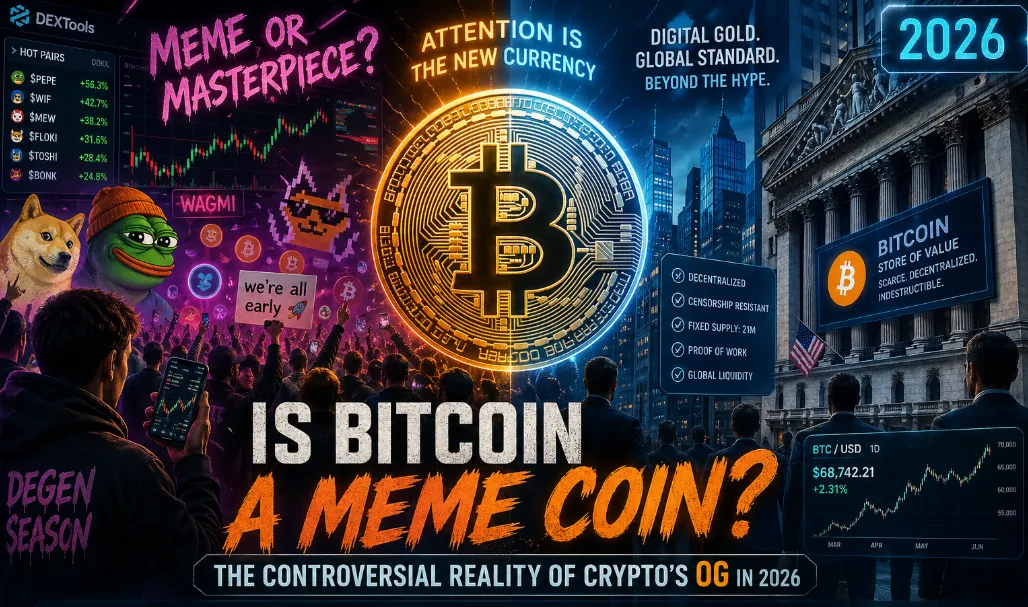
When you look at the "Hot Pairs" on DEXTools, you see tokens that live and die by community conviction. If we apply this lens to the king of crypto, the lines start to blur. The "Orange Coin" doesn't have a marketing department, a CEO, or a centralized utility roadmap. Its value is a collective hallucination-a shared belief that it represents digital gold. In this sense, the world's first cryptocurrency is not just a participant in the attention economy; it might be its most successful architect.
The Argument for BTC as the Ultimate Cultural Token
The strongest case for answering "yes" to the question is Bitcoin a meme coin lies in its origin and its "Store of Value" (SoV) narrative. For over a decade, the crypto community has pushed the "Digital Gold" story so successfully that it has been embraced by Wall Street and sovereign nations alike.
In the 2026 market, we recognize that the primary "utility" of the network is its security and its narrative. Unlike Ethereum or Solana, which derive value from dApp activity and gas fees, the price of the lead asset is largely a reflection of belief. When retail traders on DEXTools track BTC pairs, they aren't looking at transaction throughput; they are gauging social sentiment and institutional adoption stories. It is, essentially, a viral idea that became too big to fail. It is the "social contract" of sound money that won the global stage.
Ordinals and the "Memification" of the BTC Chain
A pivotal turning point in this debate was the rise of Ordinals. Before the BRC-20 revolution, the network was seen as a stagnant, albeit secure, vault. Today, the blockchain is home to thousands of digital artifacts that mirror the activity we see on high-frequency chains like Solana.
As DEXTools users began tracking Bitcoin-native tokens and "Sat-based" assets, the parent chain itself took on a new persona. The influx of "degens" onto the main network proved that it can support the same culture-driven speculation as any other ecosystem. If the network is used to trade cat pictures and viral tokens, does that mean the underlying currency is also part of the joke? Or is it simply the sovereign layer upon which all internet culture is built? This shift has made many rethink the core question: Is Bitcoin a meme coin or is it the infrastructure of the entire speculative economy?
The Institutional Counter-Argument: Beyond the Hype
Despite the cultural evidence, there are massive structural differences that keep the OG asset in a league of its own. For those who reject the idea of Bitcoin as a meme, the focus remains on decentralization and game theory.
Speculative tokens are typically characterized by massive insider holdings, low liquidity, and extreme "rug-pull" risk-metrics we constantly monitor via the DEXT Score. The Bitcoin network, conversely, is the most decentralized system on the planet. Its proof-of-work consensus is a physical reality that consumes energy, unlike the "thin air" that backs 99% of viral tokens. While the valuation might be narrative-driven, the network is a feat of engineering. For institutions, it is a hedge against the failure of the fiat system, which makes it the "anti-meme" in terms of risk profile.
The Psychological Convergence of All Assets
In the current market, the distinction between "utility" and "narrative" is becoming increasingly irrelevant. Traders have realized that all assets are, to some degree, driven by stories. Whether you are trading a $2M market cap token on Base or the $1.5T market cap leader, you are betting on the persistence of a shared idea.
When asking is Bitcoin a meme coin, we are really asking if its story can be broken. Traditional viral tokens have a short half-life; their stories get old quickly. The BTC story has survived multiple cycles, halvings, and global bans. It is a "Lindy" asset-the longer it survives, the more likely it is to continue surviving.
What DEXTools Data Tells Us About Market Correlation
If we look at the trading behavior in 2026, the lead asset often dictates the broader market. When the king pumps, liquidity flows into the speculative "Hot Pairs" on DEXTools. This correlation suggests that BTC is the "General" of the speculative army. It provides the liquidity and the confidence for the entire ecosystem of viral tokens to exist.
Traders who ignore the narrative qualities of the network-its volatility, its tribal community, and its sentiment-driven price action-often find themselves on the wrong side of the chart. Acknowledging that the primary cryptocurrency shares DNA with speculative tokens allows a trader to better understand market cycles and the "risk-on" appetite that fuels the decentralized economy.
Market Sentiment and the DEXT Score Perspective
In the world of decentralized finance, data is the only truth. DEXTools provides a lens through which we can see the "memetic" strength of any project. When we analyze the Bitcoin ecosystem today, we see high-liquidity pairs that behave exactly like the most successful community tokens. This data-driven perspective helps bridge the gap between the two camps.
By monitoring liquidity locks, contract audits, and social reach through our tools, traders can see that even the most "serious" Bitcoin layers are now influenced by the same dynamics that drive smaller meme-based assets. This convergence is not a weakness; it is a sign of a maturing, holistic market.
Final Verdict: The Reality of the OG
So, is Bitcoin a meme coin? The answer depends entirely on your perspective of value. If you define such an asset as a cultural instrument whose value is derived from social consensus and collective belief, then yes, it is the most powerful one ever created. It is a story that has gained the status of a global reserve asset.
However, if you define them by their transience and lack of fundamental security, then no, Bitcoin is in a category of its own. It is the original blueprint that proved decentralized digital scarcity is a physical and mathematical reality.
At DEXTools, we provide the data for both worlds. Whether you are tracking the next viral dog-themed project or the latest institutional flows into the "Orange Coin," remember that in crypto, the narrative is the utility. Bitcoin just happens to have the best story ever told.
Disclaimer: This article is for informational purposes only and does not constitute investment advice, financial advice, trading advice, or any other kind of advice. DEXTools does not recommend buying, selling, or holding any cryptocurrency or token. Users should conduct their own research and consult with a qualified financial advisor before making any investment decisions. Cryptocurrency investments are volatile and high-risk. DEXTools is not responsible for any losses incurred.
Frequently Asked Questions
Q: What defines a meme coin?
A: A meme coin is typically a cryptocurrency inspired by an internet meme or a humorous concept, often lacking substantial underlying technology or utility.
Q: Is Bitcoin considered a meme coin?
A: No, Bitcoin is not considered a meme coin. It was created as a decentralized digital currency with a specific economic and technological purpose.
Q: What is the primary purpose of Bitcoin?
A: Bitcoin's primary purpose is to serve as a peer-to-peer electronic cash system, offering a decentralized alternative to traditional fiat currencies.
Q: Do meme coins have long-term value?
A: The long-term value of meme coins is highly speculative and often driven by community sentiment rather than fundamental utility or adoption.
Q: How does Bitcoin's technology differ from meme coins?
A: Bitcoin is built on a robust and secure blockchain network with a well-defined consensus mechanism, while many meme coins may have simpler or less developed technological foundations.
Related Guides
- Is XRP the Next Bitcoin? Similarities and Reality 2026
- Bitcoin Price Prediction 2026: Expert Analysis, Scenarios and Key Levels
- What Is a CTO in Crypto? Community Takeover Meaning, Risks and What to Check (2026)
- How to Check Liquidity Lock Before Buying a Token: Unlock Risk and Locker Verification (2026)
- How to Check If a Token Is a Honeypot with DEXTools (Step by Step)