Dead Liquidity: Why Some Pools Look Alive but Are Practically Untradeable
— By Whatsertrade in Tutorials

A liquidity pool can look alive at first glance. It may still have funds, a visible chart, an old trading history, and occasional transactions. But when a trade
A liquidity pool can look alive at first glance. It may still have funds, a visible chart, an old trading history, and occasional transactions. But when a trader tries to enter or exit, the market may behave like it is dead. Price moves too much. Volume is weak. Buyers are rare. Sellers cannot exit without major impact.
This is dead liquidity.
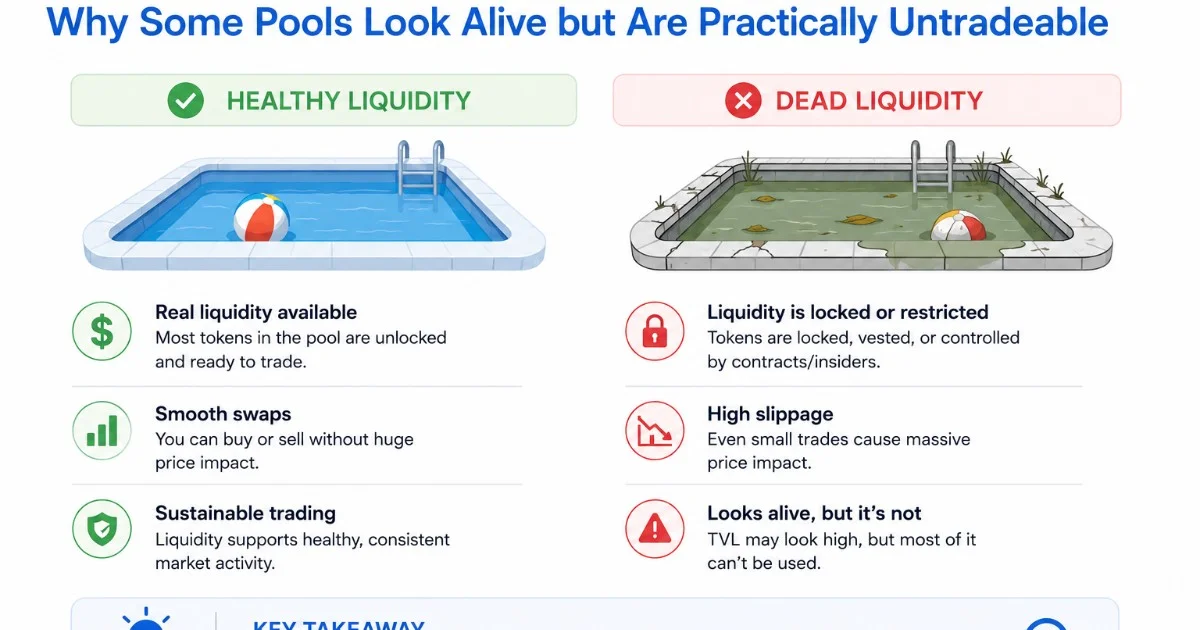
Dead liquidity describes a pool that technically still exists but no longer functions as a healthy market. It may have liquidity, but not enough usable activity. It may show a chart, but the chart may not reflect real demand. It may be tradable in theory, but difficult in practice.
Understanding dead liquidity helps traders avoid being trapped in markets that look available but offer poor execution.
What Dead Liquidity Means
Dead liquidity is not the same as zero liquidity. A pool with zero liquidity is obviously inactive. Dead liquidity is more subtle. It can still display funds and historical activity, which may make it look safer than it is.
A dead liquidity pool may have low volume, poor depth near the current price, few active traders, old liquidity that nobody manages, or large holders who cannot exit without collapsing the market. The pool exists, but the market around it is weak.
This can happen after hype fades, after a project is abandoned, after liquidity migrates, or after traders move to a different pool or chain.
Why Dead Liquidity Is Dangerous
Dead liquidity is dangerous because it can create false confidence. A trader may see liquidity in the pool and assume they can trade normally. But when they place an order, slippage may be high. The price may move sharply. Selling later may be even harder.
The danger increases when the token chart still shows old pumps or occasional green candles. These signals can attract traders who do not realize that the pool no longer has a healthy market.
A token does not need to be a scam to have dead liquidity. Sometimes the market simply leaves.
Signal 1: Low Volume Despite Visible Liquidity
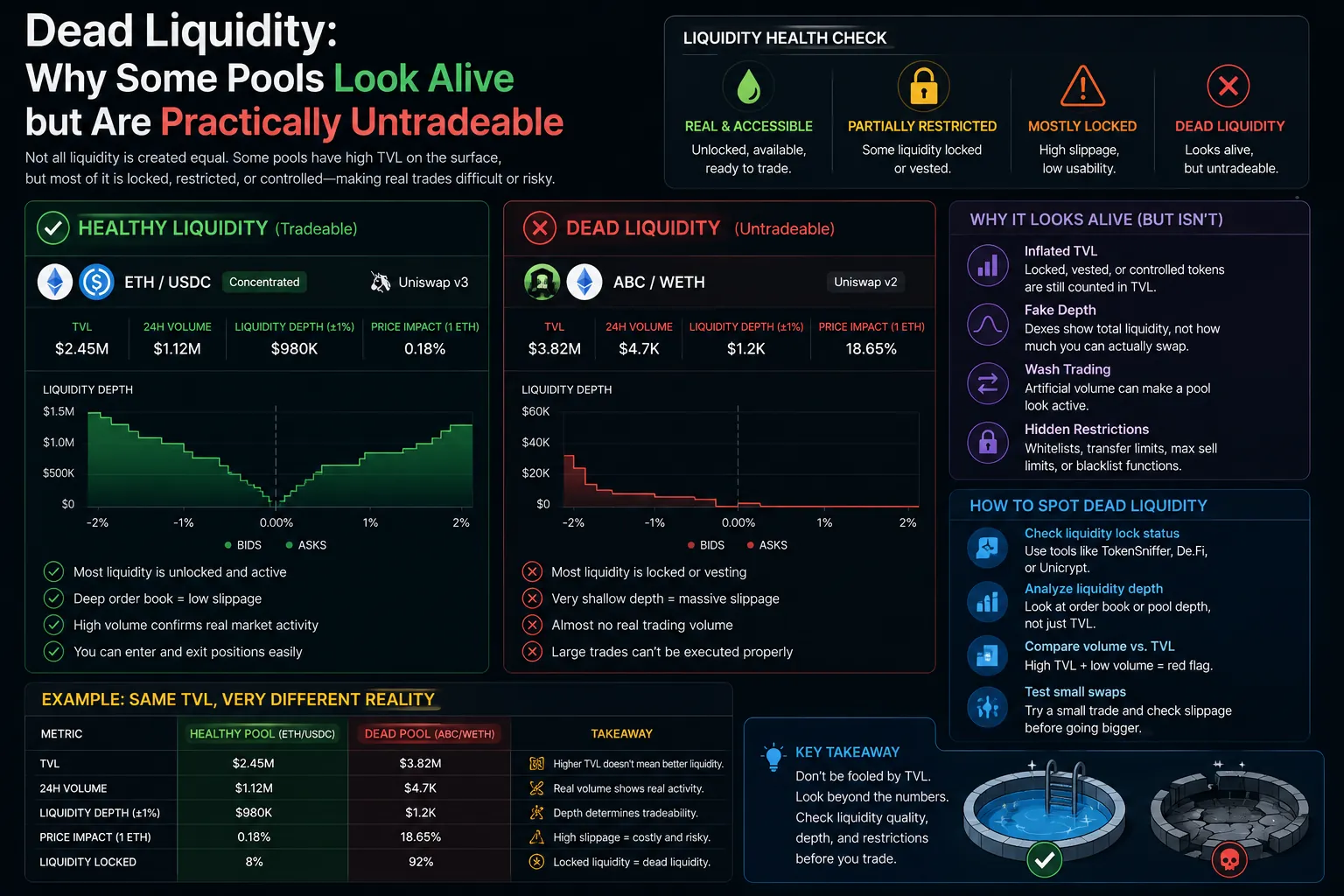
The first signal of dead liquidity is low volume compared with visible liquidity. A pool may show funds, but if almost nobody trades there, the liquidity is not creating an active market.
Volume confirms whether traders are still using the pool. Without volume, price discovery becomes weak. A single trade can distort the chart. Support and resistance levels may lose meaning because there are not enough participants to validate them.
On DEXTools, traders should compare liquidity with 24 hour volume and recent activity. A pool with liquidity but very low activity deserves caution.
Signal 2: Large Price Movement From Small Trades
Another sign of dead liquidity is exaggerated price movement from small trades. If small buys create large green candles or small sells cause sharp drops, the pool may not have enough usable depth.
This is especially important for traders who rely on chart signals. A candle may look bullish, but if it was created by a small transaction in a weak pool, it may not represent real demand.
Healthy markets can absorb normal trading. Dead liquidity pools often react too violently.
Signal 3: No Meaningful Buyer Response
In an active market, dips may attract buyers. In a dead liquidity pool, sells may occur without meaningful response. Price can drift lower because there are not enough participants willing to step in.
This creates a trap for holders. They may believe they can wait for recovery, but the market may no longer have enough demand to support a rebound.
A pool with no buyer response can remain technically open while becoming practically impossible to exit at a fair price.
Signal 4: Liquidity Migration Elsewhere
Sometimes liquidity becomes dead because the main market has moved. A token may migrate from one DEX to another, from one pool to another, or from one chain to another. The old pool may still exist, but most traders no longer use it.
This can create confusion. A trader may find the old pool first and assume it is the main market. But if volume, liquidity, and attention have moved elsewhere, the old pool may provide a misleading chart.
When analyzing any token, traders should check whether there are multiple pools and identify where real activity is happening.
Signal 5: Abandoned Project Activity
Dead liquidity often appears after project activity fades. If social channels are inactive, updates stop, and market participation declines, the pool may slowly become irrelevant.
The project does not need to fail overnight. Dead liquidity can develop gradually as traders lose interest. Liquidity may remain because nobody removed it, but that does not mean the token has a healthy market.
A quiet project with quiet volume and thin trading conditions should be treated carefully.
How to Use DEXTools to Spot Dead Liquidity
DEXTools can help traders identify dead liquidity by showing liquidity, volume, transactions, price action, and pair information. Start by checking whether recent volume is meaningful. Then review transaction frequency. If trades are rare or tiny, the pool may not be active.
Next, watch how price reacts to trades. If small transactions move the chart too much, usable liquidity may be weak. Then compare the pool with other available pairs. The active market may be somewhere else.
The goal is to confirm whether the pool is alive in practice, not only visible on screen.
Dead Liquidity vs Low Cap Opportunity
Some traders confuse dead liquidity with early opportunity. A low cap token with quiet activity can sometimes become interesting before a new trend. But there is a difference between a quiet market and a dead one.
A quiet opportunity may show signs of accumulation, stable liquidity, active development, or renewed attention. Dead liquidity shows weak participation, poor execution, and little evidence that buyers are returning.
The difference is potential energy. A quiet token may be building. A dead pool is simply waiting.
Conclusion
Dead liquidity is one of the most overlooked risks in decentralized exchange trading. A pool can look active because it still has liquidity and a chart, but that does not mean it offers a healthy market.
Traders should watch for low volume, exaggerated price impact, weak buyer response, liquidity migration, and abandoned project activity. DEXTools provides the data needed to evaluate whether a pool is truly active or only technically alive.
In DEX trading, the question is not only whether liquidity exists. The question is whether the market can still use it.
How to Bridge Crypto Between Chains: Complete Cross-Chain Tutorial 2026 How to Use 1inch for Swaps: Classic, Fusion and Limit Orders (2026) OKX Web3 Wallet Tutorial 2026: Multi-Chain Setup GuideFrequently Asked Questions
What is dead liquidity in crypto?
Dead liquidity refers to cryptocurrency trading pools where a significant portion of the assets are practically untradeable, despite appearing to have funds. This can occur when most of the liquidity is held by a few inactive wallets or a single large holder.
Why do some crypto pools have dead liquidity?
Dead liquidity can arise from various factors, including initial project abandonment, large holders ceasing trading activity, or concentrated ownership where a few entities control most of the tokens and do not actively trade them.
How does dead liquidity affect traders?
Traders in pools with dead liquidity may experience difficulty executing trades, significant price impact even with small orders, and a lack of reliable price discovery. This can lead to slippage and unfulfilled orders.
What are the signs of dead liquidity?
Signs of dead liquidity include very low trading volume despite a high total value locked (TVL), large gaps between bid and ask prices, and a history of few transactions over extended periods. Analyzing the distribution of liquidity providers can also reveal concentration.
Can dead liquidity be revived?
Reviving dead liquidity typically requires renewed interest from traders and liquidity providers, often driven by new project developments, marketing efforts, or incentives to encourage trading activity. Without such catalysts, the pool may remain illiquid.
Related Guides
- RWA Liquidity Quality: Why Tokenized Assets Can Be Real but Still Hard to Trade
- Dark AMMs and Hidden Liquidity: Why Some DEX Activity Is Harder to Read
- What Is Uniswap? AMM, Liquidity Pools, Fees and UNI Token Explained (2026)
- Impermanent Loss in DeFi Liquidity Pools: Worked LP Math, Break-Even and Trade-Offs (2026)
- Liquidity Pool Economics: Fees, Slippage and Impermanent Loss