How to Stake TON Safely: Nominator Pools, Liquid Staking, and Risk Guide (2026)
— By Tony Rabbit in Tutorials

Learn how to stake TON safely by comparing nominator pools, liquid staking, and exchange staking, then checking custody, withdrawal timing, and liquid-market quality before you commit funds.
TON staking sits in an interesting spot in 2026. It is one of the cleaner ways to stay exposed to Toncoin without pretending every opportunity on the network has to come from fast token rotation, yet it still has real operational risk that beginners usually underestimate. The word staking sounds passive. The actual workflow is not passive at all. You are still choosing a route, trusting a mechanism, and accepting tradeoffs around custody, liquidity, lockups, and yield quality.
Quick answer: if you want to stake TON safely, start by choosing the right path for your size and risk tolerance, usually a nominator pool or a liquid staking product, verify the wallet and app source, understand when rewards are earned and when funds can be moved again, and avoid chasing the highest quoted APY without checking where that yield actually comes from. The safest TON staking plan is usually the one you can explain clearly before you click confirm.
- TON is a proof-of-stake network. Validators secure the chain, and smaller holders can participate indirectly through pools or staking apps.
- Not all staking routes behave the same. Nominator pools, liquid staking, and exchange staking solve different problems.
- Yield is only one part of the decision. Liquidity, custody, withdrawal timing, and smart contract risk matter just as much.
- Liquid staking adds convenience and extra complexity. A liquid staking token can be useful, but it also introduces market pricing risk and protocol risk.
- DEXTools still matters here. If a staking path introduces a liquid staking token or a DeFi layer, you still need to verify liquidity and market quality before you size up.
What TON staking actually is
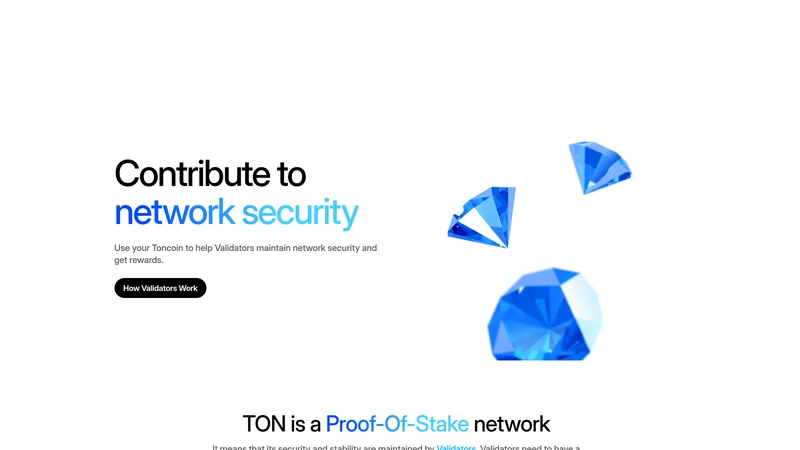
TON is a proof-of-stake blockchain, which means network security is maintained by validators that lock Toncoin and participate in consensus. The official TON staking page frames the core model simply: validators need a large stake, while smaller users can still help secure the network by joining nominator pools. That is the cleanest conceptual starting point because it separates the network role from the user role.
Trade TON with Not.Trade, the fastest terminal on TON
Not.Trade is purpose built for TON traders: real-time on-chain charts for every jetton, insider safety scoring (Top 10 wallets, snipers, dev movement, bundlers, LP lock), MCAP-trigger limit orders, multi-wallet sniping, MEV protection and one-click swaps routed across STON.fi and DeDust. It runs natively inside Telegram and as a fast web terminal, with TON Connect non-custodial wallet support.
Read the full Not.Trade guide ->For most people, staking TON does not mean running validator infrastructure. It means choosing a product or pool that gives you exposure to staking rewards without becoming a professional operator. That is why the search intent around TON staking often blends two different user questions. One group wants to know how the network works. The other wants a practical workflow for earning yield on holdings they already have. This article is for the second group.
If you need the wider ecosystem context first, use the broader Telegram Wallet and TON tutorial. If you need the self-custody setup before committing funds to anything, pair this page with the Tonkeeper guide. TON staking makes more sense once the wallet and custody layer are already clear.
The three main ways people stake TON
The market usually presents TON staking as if it were one product. It is not. There are three common routes, and they solve different user problems.
| Route | Best for | Main benefit | Main risk |
|---|---|---|---|
| Nominator pool | Users who want direct network-style staking exposure | Closer to the native staking model | Pool quality, queue timing, and lower flexibility |
| Liquid staking | Users who want yield plus movable liquidity | Receive a staking representation that can stay usable in DeFi | Smart contract risk, token pricing risk, liquidity risk |
| Exchange staking | Users prioritizing convenience over control | Simpler interface and account-level handling | Custodial risk and weaker transparency |
Nominator pools are the closest fit for users who want a cleaner relationship to the network itself. Liquid staking is often more capital efficient because you can receive a derivative or receipt token that remains usable elsewhere. Exchange staking is operationally simpler but pushes you back toward the counterparty risks that self-custody users are usually trying to reduce.
That means the right question is not "which TON staking option has the highest APY?" but "which TON staking route fits the kind of user I actually am?" If you want mobility and DeFi composability, liquid staking may fit. If you want something closer to direct network participation, nominator pools make more sense. If you want convenience and do not care about custody purity, exchanges may feel easier, even if they are not the strongest long-term habit.
How to stake TON safely, step by step
The safest staking workflow starts before you pick a provider. First, make sure the wallet and the route are real. That sounds obvious, but TON is deeply connected to Telegram-native discovery, and that means users often arrive through links, groups, forwarded posts, or dApp prompts instead of a careful source-checking process.
- Start with a wallet you control. For self-custody users that usually means Tonkeeper or another established TON wallet.
- Pick the staking route before you pick the brand. Decide whether you want a nominator pool, liquid staking, or custodial convenience.
- Read the liquidity and withdrawal terms. Ask how and when funds can be unstaked, not just how rewards are displayed.
- Use a test amount if the interface or flow is new. Low network fees make small verification transactions affordable.
- Keep records of what you staked, where, and what you received back. This becomes important if you later use a liquid staking token elsewhere.
That last step matters more than people think. In liquid staking, many users stop mentally tracking the difference between their original TON and the staking representation they now hold. That can create sloppy risk decisions later, especially if they start using that representation in swaps, pools, or lending workflows.
Nominator pools versus liquid staking on TON
This is the most important strategic decision in the entire guide. A nominator pool is usually easier to understand because the logic is closer to classic staking: you commit TON into a pool aligned with validator participation and wait for rewards based on that structure. A liquid staking product adds another layer by giving you a tokenized claim or representation that can keep moving through DeFi.
The upside of liquid staking is capital efficiency. Your TON can keep earning network-style rewards while the liquid receipt can sometimes be used in trading or DeFi strategies. The downside is that you have now added at least three new questions. Is the liquid staking protocol itself reliable? Does the liquid staking token keep a healthy relationship to the underlying TON value? And is the market for that token deep enough if you need to exit quickly?
For users who want cleaner operational risk, nominator pools often feel boring in a good way. For users who want more optionality, liquid staking can be attractive, but only if they are honest about the extra moving parts. The mistake is assuming both are just two skins on the same product. They are not.
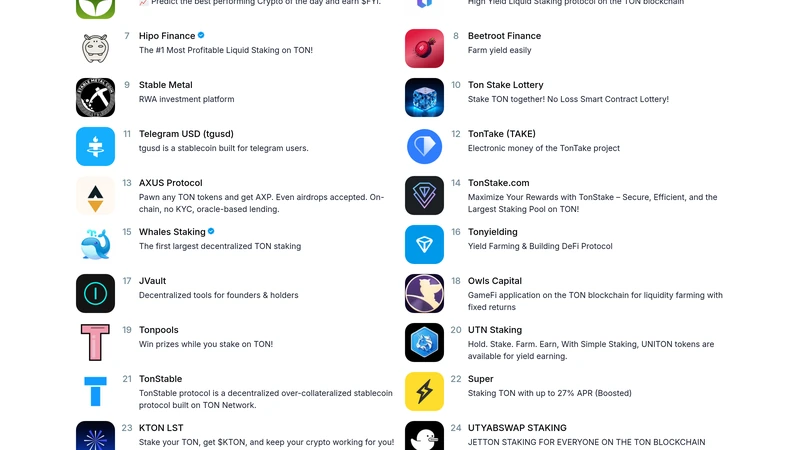
TON's staking-app directory shows a wide range of staking and liquid staking options, but a directory is not a ranking. A longer list of providers is helpful for discovery, not proof of safety. You still need to ask what the product does, what you actually receive back, and how much protocol or market risk sits between you and your original Toncoin.
How to judge TON staking yield without fooling yourself
Quoted yield is where many users lose discipline. A clean staking decision looks at yield quality, not just yield size. That means asking whether the return comes mainly from base staking rewards, promotional incentives, token emissions, or some layered DeFi structure that behaves very differently in stress.
This is where the APY explainer becomes useful. A headline number can look attractive while hiding the fact that rewards are variable, boosted by incentives, or dependent on a token that may not keep its value. If the yield only looks great because the user now holds a less liquid derivative or a reward token with fragile demand, the quality of that yield is worse than the number suggests.
Users should also separate network staking yield from strategy yield built on top of staking. Those are not the same. Once a staking token moves into a liquidity pool or a higher-yield farm, the user is no longer evaluating simple staking. They are evaluating staking plus pool risk, smart contract risk, and possible impermanent loss.
| Yield question | Why it matters |
|---|---|
| Is the yield mainly base staking or extra incentives? | Incentive-heavy yield can disappear faster than users expect. |
| Can the staking token be sold easily? | Quoted value is less useful if exit liquidity is weak. |
| How long does unstaking take? | Liquidity timing matters if market conditions change. |
| Is there smart contract risk between you and the TON? | Additional protocol layers raise the risk stack even when UX looks simple. |
The real risks of staking TON
The simplest risk is custody confusion. Users think they are still holding plain TON when in reality they have moved into a pool position or a liquid staking claim. The second risk is protocol risk. If a staking product uses contracts, routers, or DeFi integrations, a smooth interface does not remove that exposure.
The third risk is liquidity timing. This is especially important when the market is moving fast. If you cannot unstake immediately, or if exiting a liquid staking token requires selling into a shallow market, then your practical liquidity may be much worse than you expected when the yield first looked appealing.
There is also yield-chasing risk. Some users do not really want to stake TON. They want to speculate with a yield excuse. That usually leads them into layered strategies they do not fully understand. A safer rule is simple: if you cannot explain how the rewards are produced and how you get back to plain TON, you should probably reduce size or stay out.
For users who turn staking into an app-hopping habit, basic security discipline matters even more. The product might be fine, but a fake site, a poisoned link, or a blind wallet approval can still ruin the trade before the staking logic even has a chance to matter.
How DEXTools helps with TON staking decisions
DEXTools is most helpful the moment TON staking stops being purely passive. If the route uses a liquid staking token, a paired market, or a DeFi strategy built around staked TON, then market quality suddenly matters. You are no longer evaluating only the staking provider. You are evaluating whether the token representing that staking claim trades in an orderly and liquid way.
That means checking where the liquid staking token trades, how deep the pool is, how active the market has been, and whether the pricing looks stable relative to the underlying TON logic. If the route requires you to hold or later swap a derivative token, DEXTools becomes the reality check that keeps a yield idea from turning into an exit problem.
- Identify the staking token or derivative clearly. Do not assume the displayed symbol tells the whole story.
- Check liquidity before sizing up. A liquid staking token that is technically tradeable but practically thin is not truly flexible.
- Review recent transactions and market behavior. Thin or erratic markets change the quality of the staking route.
- Separate yield from liquidity. A high quoted return does not compensate automatically for bad exit conditions.
Used that way, DEXTools is not replacing the staking app. It is checking the part the staking app has no incentive to emphasize, which is what happens when you want to move, swap, or unwind the position later.
How to compare TON staking providers without relying on marketing
One reason TON staking pages often stay too shallow is that they stop at the route level and never help the user compare actual provider quality. That is a mistake because two products can both be called TON staking and still create very different outcomes when markets become stressed or when the user needs to exit. The right comparison framework is not flashy, but it is effective.
Start by asking what exactly sits between your wallet and your TON after deposit. If the route is a nominator pool, you want to know whether the pool is transparent about participation, how deposits and exits are queued, and how the product communicates delays or limits. If the route is liquid staking, ask what token you receive, where that token trades, and whether the protocol gives you a clear explanation of redemptions versus secondary-market exits. If the route is exchange staking, ask whether you are comfortable with the platform controlling both the account layer and the unstake workflow.
Then move to the second layer, which is operational clarity. A decent TON staking product should make four things easy to understand: how rewards are generated, when rewards are credited, how you leave the position, and what happens if you need liquidity before the default unstake path completes. If any of those answers are fuzzy, the product is asking for trust it has not earned.
| Provider check | What a strong answer looks like |
|---|---|
| Reward source | The product clearly separates base staking rewards from temporary incentive boosts. |
| Exit path | The user can understand whether exit means unstaking, redeeming, or selling a liquid token. |
| Liquidity quality | Derivative markets look active enough that the user is not trapped by thin secondary liquidity. |
| Risk explanation | The product explains contract, queue, and market risks in plain language instead of hiding them behind UX. |
This is also the point where many users should slow down and use DEXTools before moving real size. If a liquid staking route depends on a staking token staying liquid and close to fair value, then the market around that token is part of the product. Marketing pages rarely emphasize that. Good risk management does.
When it may be smarter not to stake TON at all
Staking is often presented as the default "responsible holder" move, but that is not always true. Some users should not stake their TON yet, even if the available APY looks reasonable. If you expect to trade the position actively, if your wallet security is not fully under control, or if you are still learning the difference between a deposit receipt and the underlying asset, then staking can add complexity faster than it adds value.
The first case is simple. If you need liquid flexibility because you are actively rotating between TON ecosystem opportunities, then locking funds or moving into a derivative you do not fully understand can become a handicap. The second case is security. Staking through unfamiliar apps while your seed storage, device hygiene, or transaction-review habits are still weak is the wrong sequence. Self-custody quality should come before yield optimization.
The third case is accounting and mental clarity. Many users cannot describe, after one week, whether they still hold TON, a staked claim, or a liquid derivative that now needs a market exit instead of a protocol redemption. If the position is already confusing at small size, increasing size does not make it safer. It just makes the confusion more expensive.
A useful rule is this: stake TON only after the position feels boring to explain. If the route sounds clever, layered, or "efficient" in a way that takes too long to describe, you may already be beyond the risk level that a simple yield strategy should carry.
Final takeaway: staking TON safely is less about finding the flashiest number and more about choosing the right structure. Decide first whether you want network-style staking, liquid flexibility, or custodial convenience. Then verify the app, understand the withdrawal path, and use DEXTools if a liquid staking token or DeFi market becomes part of the trade.
Disclaimer: This draft is for educational purposes only and does not constitute investment, financial, legal, or tax advice. Staking products, app terms, and reward mechanics can change.
Related Guides
- TON Validators and Nominator Pools: Complete Architecture Guide (2026)
- How to Stake ADA: Cardano Staking Pools Explained
- How to Use Lido Finance: Stake ETH, Receive stETH and Manage Risks (2026)
- 5 Best Liquid Staking Protocols 2026: APY, TVL & Risk Ranked
- TON Liquid Staking: tsTON, stTON and hTON Compared (2026)
Frequently Asked Questions
Can small holders stake TON?
Yes. Smaller users can participate through nominator pools instead of running validators directly.
Is liquid staking on TON safer than a nominator pool?
Not automatically. Liquid staking adds flexibility, but it usually adds protocol and liquidity risk as well.
Do I need a self-custody wallet to stake TON?
For the self-custody route, yes. Exchange staking is possible, but it changes the risk profile.
What is the biggest TON staking mistake beginners make?
Chasing the highest quoted APY without understanding lockups, liquidity, and what asset they actually hold.
Why would I use DEXTools for a staking decision?
DEXTools helps when the route uses a liquid staking token or DeFi market and you need to judge liquidity and exit quality.