How to Stake ADA: Cardano Staking Pools Explained

Cardano staking in 2026 is safer and more productive than ever. We explain how to choose the best stake pools, use Lace or Yoroi, and maximize your ADA yield.
Staking ADA on Cardano is a mechanism for earning yield and participating in network governance. Cardano utilizes a Delegated Proof of Stake (DPoS) mechanism called Ouroboros, offering a risk-free yield opportunity without lock-up periods or slashing risk, unlike some other networks. This process contributes to Cardano's security and decentralization.
The ADA Advantage: Governance & Yield
- As of May 6, 2026, Cardano (ADA) has solidified its position as a "digital commodity" following the passage of the CLARITY Act and the launch of regulated ADA futures.
- Within the Voltaire era of fully decentralized governance, staking is no longer just about earning yield: it is the mechanism through which the "Internet of Blockchains" is governed.
- With 69% of the total supply staked, Cardano remains one of the most secure and decentralized networks in the industry. For investors in 2026, staking ADA represents a unique "risk-free" yield opportunity because, unlike Ethereum or Solana, Cardano has no lock-up periods and no slashing risk.
The Fundamentals of Cardano Staking
Cardano utilizes a Delegated Proof of Stake (DPoS) mechanism called Ouroboros. In 2026, the network is transitioning to the Ouroboros Leios upgrade, which aims to boost throughput to over 1,000 TPS, making the role of stake pools even more critical for network performance.
No Lock-up: Your ADA never leaves your wallet. You can spend or move your tokens at any time.
No Slashing: If a pool operator misbehaves or goes offline, you don't lose your principal. You only miss out on potential rewards for that period.
Yield (APY): In May 2026, the average staking return ranges between 3.2% and 4.8% APY, paid out every 5 days (one "Epoch")
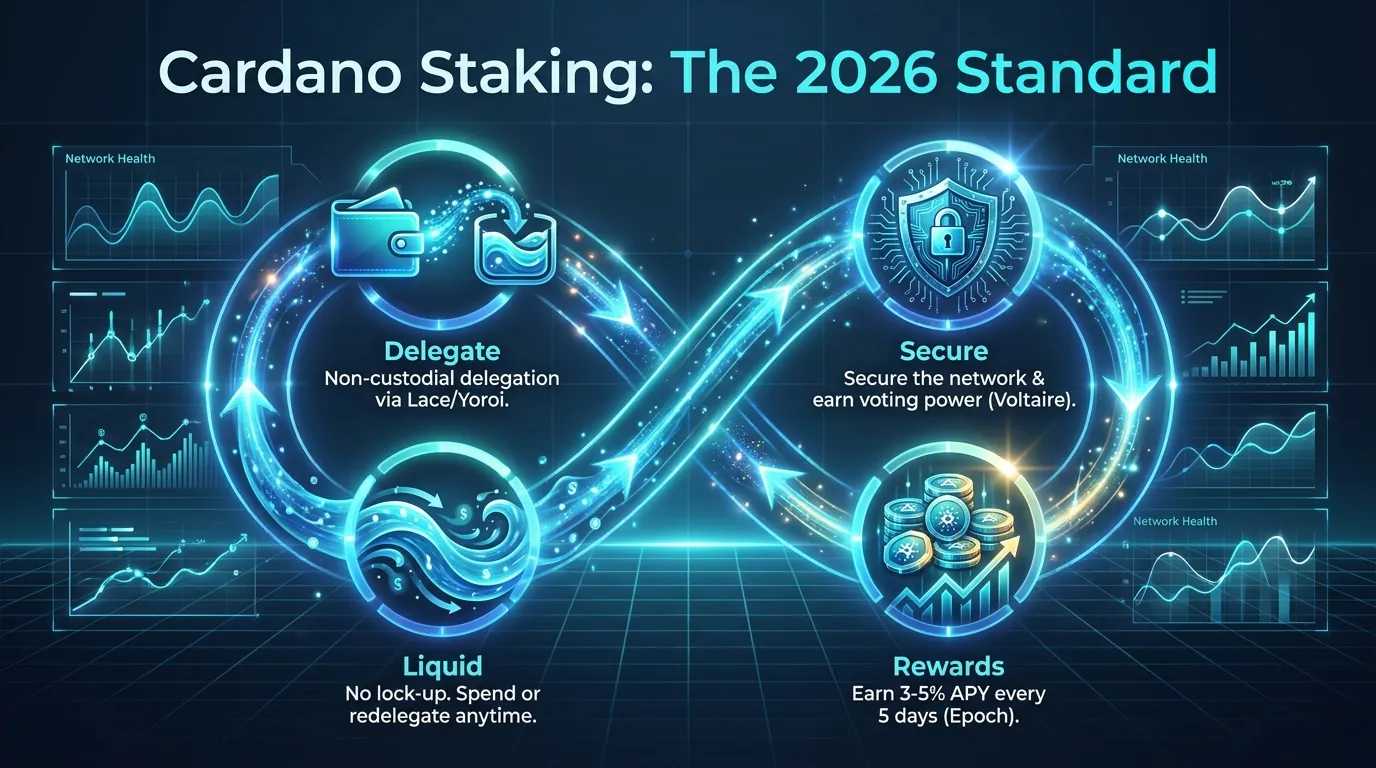
Cardano Staking Pools: Key Parameters Explained
Choosing the right pool is essential to maximize your rewards. When you open a wallet like Lace or Yoroi, you will see several technical metrics:
1. Saturation (K-Parameter)
To prevent centralization, Cardano pools have a "saturation point." Once a pool reaches a certain amount of ADA, its rewards are capped.
Strategy: Avoid pools that are over 95% saturated. If a pool is at 100% saturation, your individual rewards will decrease as they are split among too many participants.
2. Pool Margin
This is the percentage of the rewards that the Stake Pool Operator (SPO) keeps to cover their operational costs (servers, maintenance).
Typical 2026 Margin: 1% to 3%.
Note: A 0% margin pool might seem attractive, but ensure the operator is reliable and not just running a short-term marketing "bait."
3. Pledge
The "Pledge" is the amount of ADA the operator has personally committed to the pool.
Why it matters: Higher pledge amounts indicate the operator has "skin in the game" and technically results in slightly higher rewards for the pool due to the a0 protocol parameter.
4. Desirability Index
Modern 2026 wallets use an AI-driven Desirability Index that automatically calculates the best pool for you based on saturation, margin, and historical performance.
How to Stake ADA: Step-by-Step (2026 Guide)
Step 1: Choose a 2026-Ready Wallet
Avoid keeping ADA on exchanges. Use a non-custodial wallet that supports Voltaire governance:
Lace: The "official" light wallet from IOG, now featuring multi-pool staking.
Yoroi: The veteran mobile/browser light wallet.
Daedalus: The full-node desktop wallet (for power users).
Eternl: Popular for its deep power-user features and dApp browser.
Step 2: Transfer ADA to Your Wallet
Withdraw your ADA from an exchange (like Binance or Coinbase) to your new wallet address.
Step 3: Access the Staking/Delegation Tab
In your wallet, click on the "Staking" or "Delegation Center" tab. You will see a list of verified stake pools.
Step 4: Select and Delegate
Pick a pool with low saturation (<90%) and a reasonable margin. Click "Delegate." You will need to pay a one-time deposit of 2 ADA (refundable if you stop staking) and a small transaction fee (~0.17 ADA).
The 2026 Edge: Governance and Sidechains
In the current Voltaire era, staking your ADA also grants you voting power.
DReps (Delegated Representatives): You can delegate your voting power to a DRep who aligns with your views on protocol upgrades like the van Rossem hard fork.
Midnight Sidechain: Stakers in 2026 are increasingly looking for "Partner Chains." By staking ADA, you may soon become eligible for rewards or airdrops from the Midnight privacy sidechain, which launched its mainnet in late Q1 2026.
Verification and Safety via DEXTools
In 2026, the rise of "Liquid Staking Derivatives" (LSDs) and new Cardano-native stablecoins like USDCx has created a more complex DeFi landscape. Scammers often create "Fake Pools" or malicious dApps promising 20%+ APY. DEXTools is the optimal tool for analyzing the market and avoiding scams.
Before interacting with any Cardano-based DeFi protocol or "Staking Vault," professional traders verify:
The DEXTscore: High scores (95+) indicate a verified and liquid pool.
Contract Integrity: Ensure the protocol has been properly audited.
Liquidity Forensics: Verify that the pool has enough depth to prevent massive slippage when swapping ADA for ecosystem tokens.
To monitor the DeFi market in an agile and secure way in real-time and trade tokens with the help of the best crypto tools, you can access DEXTools here.
Disclaimer: This article is for informational purposes only and does not constitute investment advice, financial advice, trading advice, or any other kind of advice. DEXTools does not recommend buying, selling, or holding any cryptocurrency or token. Users should conduct their own research and consult with a qualified financial advisor before making any investment decisions. Cryptocurrency investments are volatile and high-risk. DEXTools is not responsible for any losses incurred.
Related Guides
- How to Stake TON Safely: Nominator Pools, Liquid Staking, and Risk Guide (2026)
- What Is Cardano (ADA): Complete Guide to the Academic Blockchain (2026)
- What is Staking? Proof of Stake Beginner Guide
- What Is Ethereum Staking? How It Works, Rewards and Risks (2026)
- How to Use Lido Finance: Stake ETH, Receive stETH and Manage Risks (2026)
Frequently Asked Questions
Is my ADA locked when I stake it?
No. Unlike many other blockchains, Cardano has no lock-up period. Your ADA stays in your wallet and remains fully liquid; you can send it or trade it at any time without "unstaking.
Can I lose my ADA through staking (Slashing)?
No. Cardano does not use slashing. If your chosen stake pool performs poorly or goes offline, you may earn fewer rewards for that period, but your principal balance is never at risk.
What is the minimum amount of ADA required to stake?
You can start staking with as little as 5-10 ADA, depending on the wallet. There is a one-time 2 ADA deposit required by the network, which you get back if you ever decide to stop staking.
How often are staking rewards paid out?
Rewards are distributed at the end of every "Epoch," which lasts exactly 5 days. Note that when you first start staking, there is an initial waiting period of 3 to 4 epochs (15-20 days) before your first rewards appear.
How do I choose the best pool in 2026?
Look for pools with low saturation (<95%), a pledge of at least 50k ADA, and a margin between 1% and 3%. Most modern wallets like Lace or Eternl will rank pools for you using a "Desirability" score.