What is Staking? Proof of Stake Beginner Guide
— By AliceOnChain in Tutorials

An introductory operational guide breaking down Proof of Stake consensus, detailing how users lock cryptographic assets to validate networks, secure decentralization, and generate protocol-level block rewards.
What is Staking? Beginner Guide to Earning with Proof of Stake
The evolution of decentralized ledger technology has introduced structural mechanisms that allow market participants to generate programmatic yield directly from blockchain consensus layers. For individuals transitioning from traditional financial models or early Proof of Work validation systems, learning What is Staking? Beginner Guide to Earning with Proof of Stake serves as the ultimate entry point to network participation. Unlike older cryptographic mining protocols that demand massive capital outlays for industrial computational hardware and electrical power, contemporary networks secure their operations through economic commitment.
At its core, this capital allocation method involves committing digital assets to a network's validation engine to order transactions, maintain state stability, and defend against malicious sybil attacks. By locking native tokens within the consensus layer, you transform passive digital property into an active yield-bearing mechanism. For systematic web3 participants who cross-reference decentralized liquidity data and token distribution health using advanced analytical tool suites like DEXTools, evaluating network security properties and structural block rewards is an essential baseline skill.
The Architectural Foundation: Understanding Proof of Stake (PoS)
To fundamentally understand this economic model, one must look at how modern blockchains achieve trustless settlement across thousands of global computational nodes without a central coordinating clearing house. This structural shift forms the core educational basis for any comprehensive guide on What is Staking? Beginner Guide to Earning with Proof of Stake.
In early legacy frameworks like Bitcoin, consensus relies on physical work, where specialized machinery solves computational puzzles to earn the right to mint new blocks. Conversely, a Proof of Stake network replaces raw computational electricity with raw economic weight. The protocol selects validators to verify transaction batched blocks based on the nominal quantity of native tokens they have committed to the protocol.
The mathematical premise is straightforward: those who hold a significant financial stake in the network are economically incentivized to validate transactions honestly. Providing fraudulent data or attempting to double-spend funds breaks the integrity of the ledger, which would instantly devalue the very native assets the validator has locked up. Thus, security is maintained not by computational difficulty, but by absolute financial alignment.
How Staking Generates Programmatic Yield
When you participate in this consensus mechanism, you are compensated for your capital lockup and infrastructure risk through protocol-level rewards. For beginners researching What is Staking? Beginner Guide to Earning with Proof of Stake, understanding where this yield originates is crucial. The revenue typically flows from two primary structural streams on the blockchain:
Inflationary Block Rewards: The protocol programmatically mints a predetermined quantity of new native tokens with each successfully validated block, distributing them proportionally to active stakers.
Transactional Priority Fees: Every transaction executed on the network-whether a simple peer-to-peer balance transfer or a complex smart contract interaction tracked on decentralized trading charts-requires a gas fee. These collected user fees are redirected to the validators processing those specific blocks.
The Mechanics of Delegation vs. Running a Full Validator Node
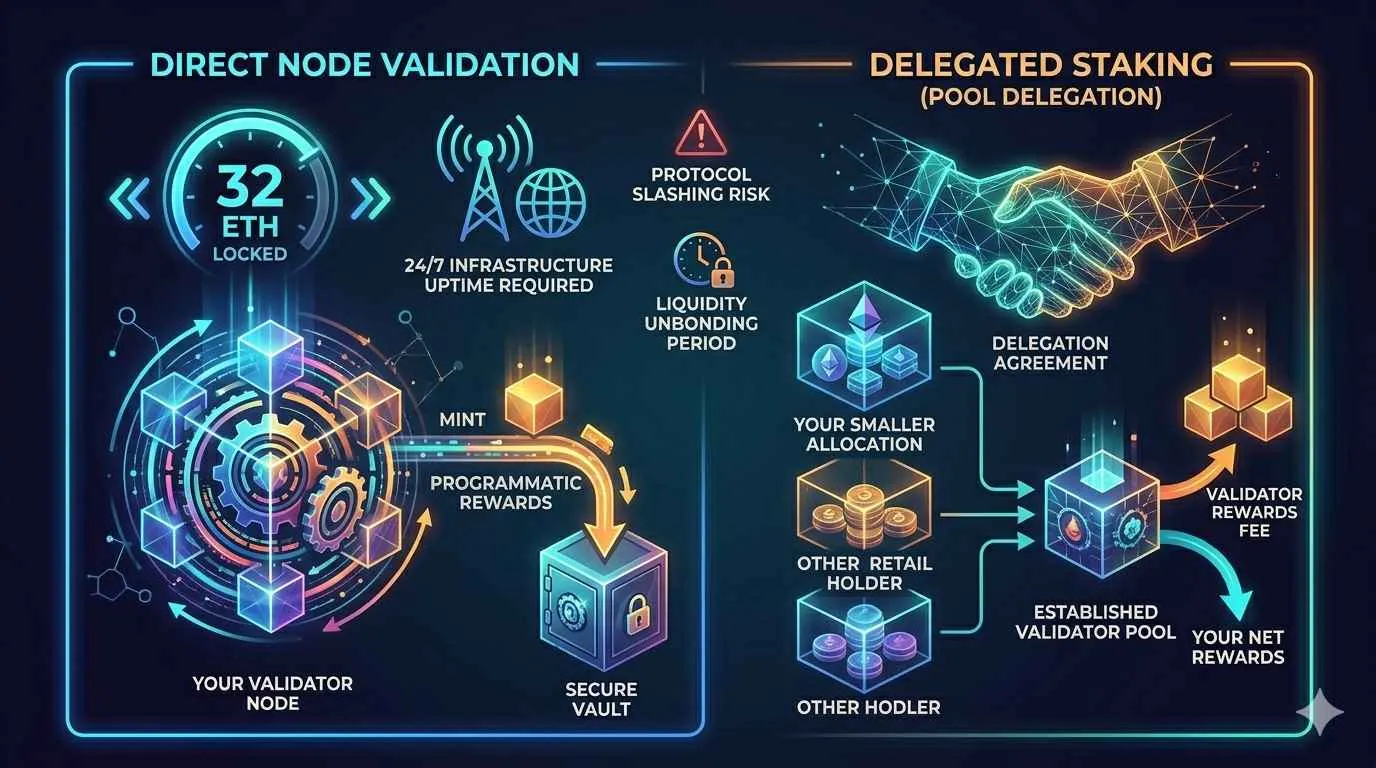
For market participants exploring this system, there are two primary implementation pathways. A key focus of studying What is Staking? Beginner Guide to Earning with Proof of Stake is choosing between retail-friendly delegation or institutional infrastructure setup.
Direct Infrastructure Validation requires significant technical setup, including maintaining constant uptime on dedicated server hardware, running a synchronized copy of the ledger, and meeting steep minimum capital requirements, such as locking exactly 32 ETH on the Ethereum network.
Pool Delegation, on the other hand, allows standard market participants to securely point their voting weight toward an established third-party validator node through a smart contract interface. You retain absolute ownership of your private keys while the underlying pool infrastructure handles the complex server operations, passing the generated rewards back to you minus a fractional service fee.
Operational Risk Parameters: Protecting Staked Capital
While the prospect of generating consistent programmatic block rewards is highly attractive, systematic risk management is mandatory. Anyone applying the principles of What is Staking? Beginner Guide to Earning with Proof of Stake must recognize that locking capital into any cryptographic consensus layer exposes assets to localized operational vulnerabilities.
The Mechanism of Protocol Slashing
Slashing is a severe network-level punitive measure designed to neutralize malicious behavior or prolonged infrastructure negligence. If a validator node you have delegated capital toward suffers deep connection blackouts (causing missing block validation cycles) or signs conflicting blocks simultaneously (known as double-signing), the protocol programmatically confiscates a percentage of the total locked pool balance. Selecting high-reputation, structurally redundant validators is paramount to mitigating this infrastructure threat.
Liquidity Unbonding Lockup Periods
When capital is committed to an economic validation node, it enters an unbonding lockup container. During this interval, your assets cannot be instantly transferred, traded, or moved into stablecoins to preserve capital during an aggressive market correction. Unbonding wait times are protocol-dependent, varying from a few days to several weeks. This liquidity freeze can expose your capital to price volatility risk, meaning the nominal fiat valuation of your tokens could drop farther than the percentage yield accumulated during the staking cycle.
Integrating Yield Metrics with Decentralized Market Analysis
Advanced market participants do not view protocol yields in isolation; they analyze them alongside real-time asset velocity and liquidity depth. Integrating these metrics into your routine is the next evolutionary step after mastering the basics of What is Staking? Beginner Guide to Earning with Proof of Stake, especially when utilizing analytical suites like DEXTools.
Before locking assets into long-term validation contracts, traders cross-reference on-chain indicators like token holder concentration, macro chart support structures, and decentralized exchange volume trends. The workflow begins with market trend spotting via specific data panels to analyze volume spikes and monitor whale wallet accumulation. This intelligence informs the subsequent deployment into staking protocols to accumulate block rewards safely. Finally, the generated yields are compounded or rebalanced to hedge against asset inflation.
If on-chain metrics reveal that massive whale cohorts are aggressively unstaking and rotating into highly liquid stablecoin pairs, it may signal an impending structural market correction. Conversely, observing persistent token accumulation and structural health across decentralized liquidity pairs can give a delegator the confidence to securely lock up their assets, knowing the underlying network token demand remains robust while they harvest predictable block rewards.
Conclusion: Balancing Yield with Sovereign Security
Learning the structural dynamics of network security models helps market participants shift away from speculative asset trading toward systematic asset accumulation. Reviewing your strategy through a definitive What is Staking? Beginner Guide to Earning with Proof of Stake lens allows you to simultaneously defend your favorite blockchain network's decentralization properties while outcompeting structural supply inflation through native programmatic rewards.
By selecting the appropriate delegation pathways, strictly monitoring validator uptime metrics, and blending protocol-level yields with real-time on-chain data analysis, you can build a resilient, highly optimized digital asset workflow designed for sustained long-term capital efficiency.
How to Bridge Crypto Between Chains: Complete Cross-Chain Tutorial 2026How to Use 1inch for Swaps: Classic, Fusion and Limit Orders (2026)
OKX Web3 Wallet Tutorial 2026: Multi-Chain Setup Guide
Disclaimer: This article is for informational purposes only and does not constitute investment advice, financial advice, trading advice, or any other kind of advice. DEXTools does not recommend buying, selling, or holding any cryptocurrency or token. Users should conduct their own research and consult with a qualified financial advisor before making any investment decisions. Cryptocurrency investments are volatile and high-risk. DEXTools is not responsible for any losses incurred.
Related Guides
- What Is Proof of Work vs Proof of Stake: Complete Guide (2026)
- What Is Algorand (ALGO)? Pure Proof of Stake Explained
- What Is a Validator in Crypto: Complete Proof-of-Stake Guide (2026)
- What Is Ethereum Staking? How It Works, Rewards and Risks (2026)
- How to Use Lido Finance: Stake ETH, Receive stETH and Manage Risks (2026)
Frequently Asked Questions
What is staking in crypto?
Staking is locking up cryptocurrency to help secure a proof-of-stake network and, in return, potentially earn rewards. The staked assets back the validation of new transactions and blocks.
How does proof of stake work?
In proof of stake, validators are chosen to propose and confirm blocks based partly on the amount of crypto they have staked. This replaces the energy-intensive mining used in proof-of-work systems.
Can you lose money by staking?
Yes, risks include price declines in the staked asset, lock-up periods that limit access, and penalties like slashing on some networks. Understanding these factors is important before staking funds.
Do I need to run a validator to stake?
Not necessarily, since many users stake by delegating to a validator or using a staking service rather than running their own node. Running a validator gives more control but requires more technical effort and responsibility.