How to Buy Crypto with a Credit Card: Step-by-Step Guide (2026)
— By Tony Rabbit in Tutorials
Buy crypto with credit card in 2026: Coinbase, Binance, MoonPay step by step. Fees (3-5%), Visa vs Mastercard, cash advance warnings, and cheaper alternatives.
Buying crypto with a credit card is one of the fastest ways to get into the market. In under five minutes, you can go from zero crypto to holding Bitcoin, Ethereum, or dozens of other tokens in your wallet. But not every platform handles credit card purchases the same way, and the fees, limits, and supported cards vary wildly depending on where you buy.
This guide covers everything you need to know about using a credit card to buy crypto in 2026: which exchanges and services accept them, how much you will actually pay in fees, which card networks work, and how to avoid the common traps that cost beginners hundreds of dollars.

Which Platforms Accept Credit Cards for Crypto?
Not every exchange or crypto service accepts credit card payments. The ones that do typically partner with third-party payment processors like Simplex, MoonPay, or Wyre to handle the transaction. Here are the major platforms where you can buy crypto with a credit card in 2026.
Coinbase
Coinbase is one of the most beginner-friendly exchanges and accepts both Visa and Mastercard credit cards. The platform charges a fee of around 3.99% on credit card purchases, which is on the higher end but comes with instant delivery of your crypto. Coinbase supports over 250 cryptocurrencies for credit card purchases and is available in more than 100 countries. The minimum purchase is typically $2, making it accessible for anyone just getting started.
Fee Comparison by Payment Method
Binance
Binance accepts Visa and Mastercard through its partnership with Simplex and other payment processors. Fees typically range from 1.8% to 3.5% depending on the processor and your region. Binance supports credit card purchases for hundreds of cryptocurrencies and offers some of the highest purchase limits among major exchanges. However, Binance is not available to users in the United States (Binance.US has more limited credit card support).
Crypto.com
Crypto.com accepts Visa, Mastercard, and in some regions, Apple Pay and Google Pay linked to credit cards. Their fee for credit card purchases is around 2.99%, and they frequently run promotions offering zero fees for new users during their first 30 days. The platform supports over 350 cryptocurrencies and has strong availability across Europe, Asia, and parts of the Americas.

MoonPay
MoonPay is not an exchange itself but a payment gateway that many wallets and DeFi platforms integrate. If you have ever tried to buy crypto directly inside MetaMask or Trust Wallet, you have probably seen MoonPay as an option. They charge around 4.5% for credit card transactions and accept Visa and Mastercard. MoonPay is available in over 160 countries and supports roughly 100 cryptocurrencies.

Changelly
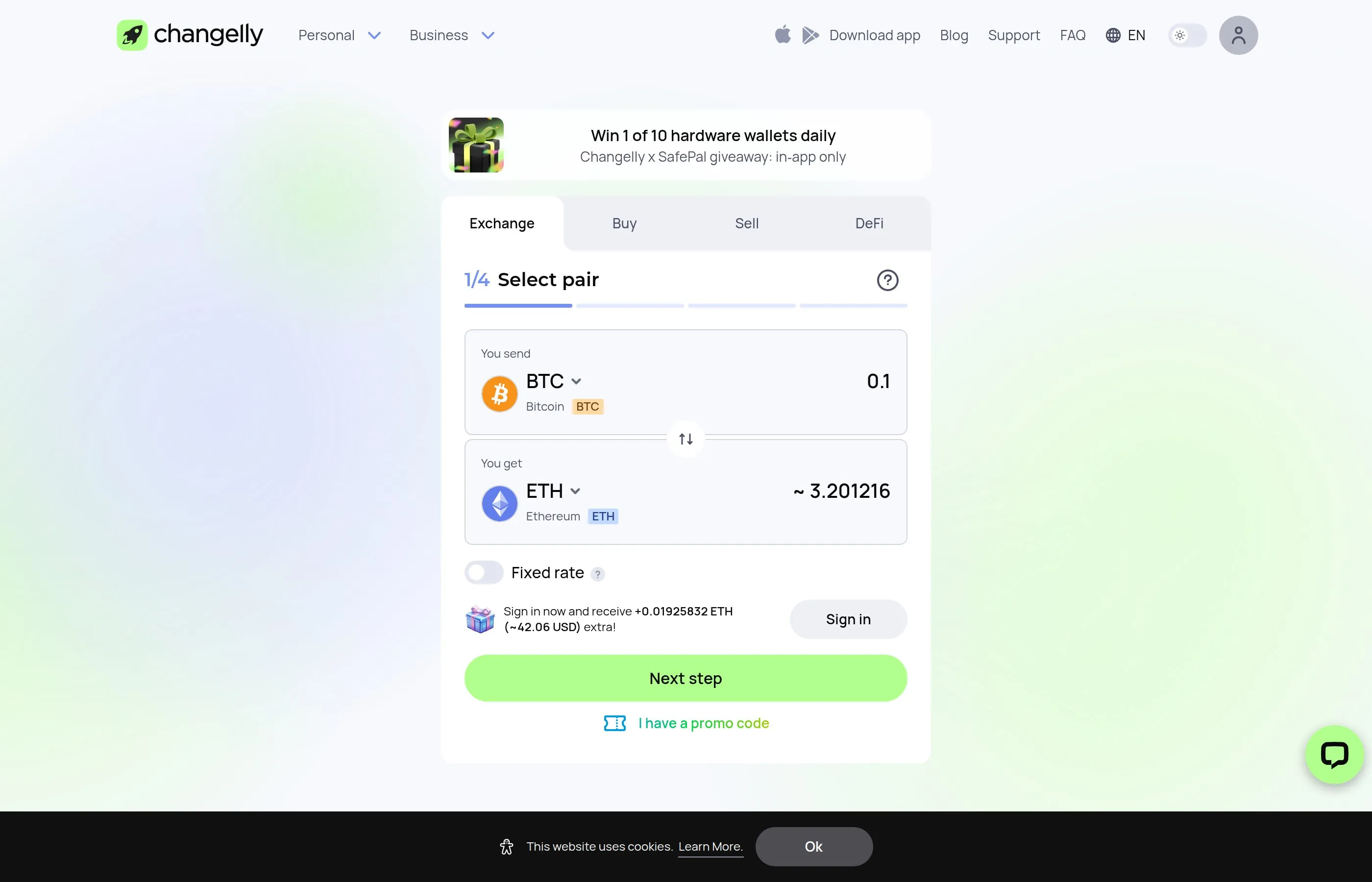
Changelly offers credit card purchases through its Visa and Mastercard integration. Fees are typically around 3.5% to 5%, and the platform focuses on instant delivery. Changelly supports a wide range of tokens and is popular among users who want to buy crypto without creating a full exchange account. The minimum purchase amount is around $30.
Simplex
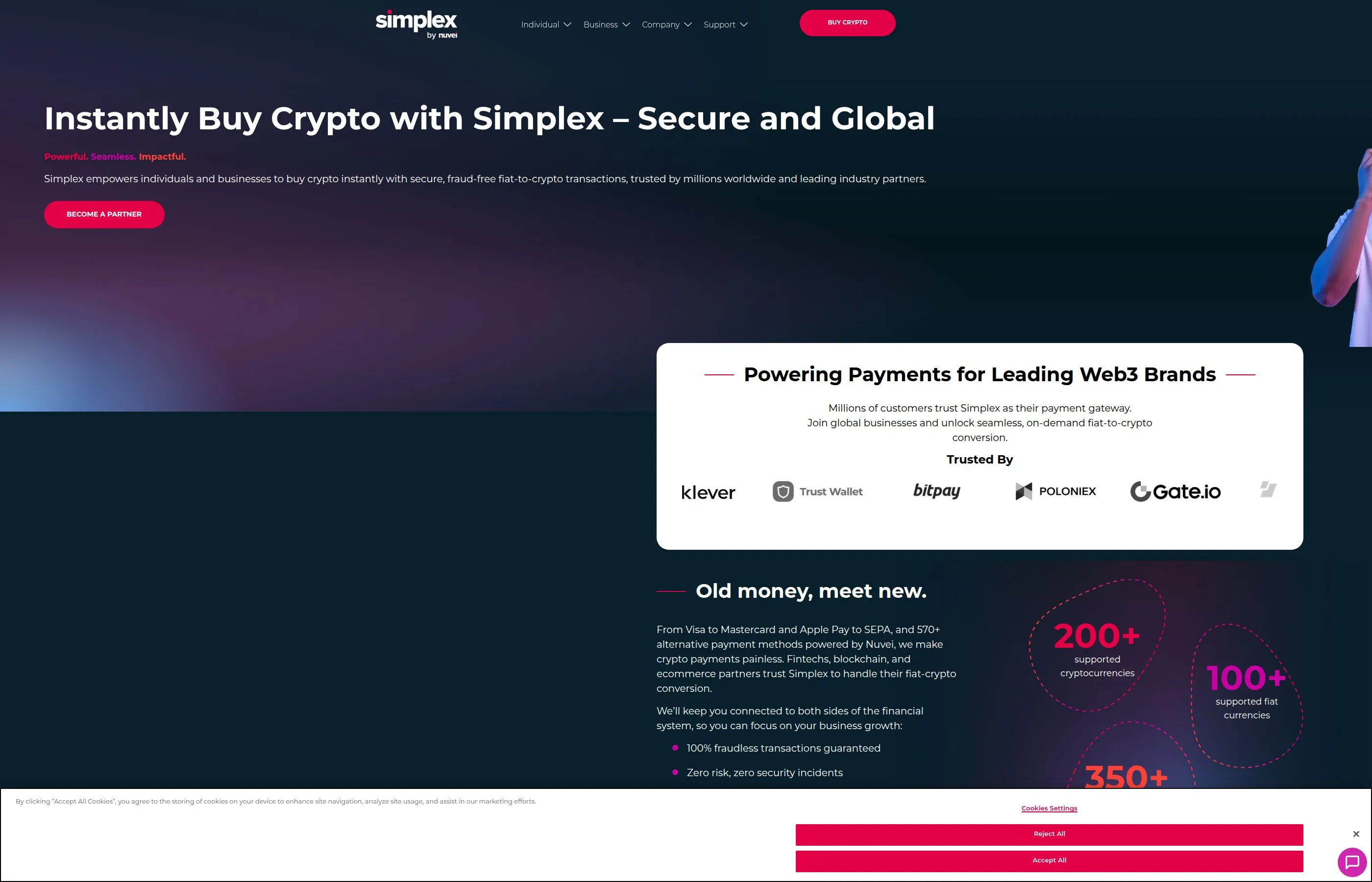
Simplex is another payment processor rather than an exchange. It powers credit card purchases on platforms like Binance, KuCoin, and Bithumb, as well as its own standalone purchase portal. Simplex charges a fee of 3.5% to 5% (with a minimum fee of $10) and accepts Visa and Mastercard. They support purchases in over 100 fiat currencies.
Step-by-Step: How to Buy Crypto with a Credit Card
The process is similar across most platforms, but we will walk through the steps for the most popular options so you can follow along regardless of which one you choose.
Buying on Coinbase with a Credit Card
- Create and verify your account. Sign up on Coinbase and complete identity verification (KYC). You will need a government-issued ID and a selfie. Verification usually takes under 10 minutes.
- Navigate to the Buy section. Click the "Buy / Sell" button on the dashboard or tap "Buy" in the mobile app.
- Select your cryptocurrency. Choose Bitcoin, Ethereum, or whichever token you want to purchase.
- Enter the amount. Type in the dollar amount you want to spend. Coinbase will show you how much crypto you will receive after fees.
- Choose credit card as payment. Under the payment method section, select "Credit/Debit Card." If you have not added one yet, click "Add Payment Method" and enter your card details.
- Review and confirm. Check the fee breakdown, the amount of crypto you will receive, and hit "Buy Now." Your crypto is delivered to your Coinbase wallet instantly.
Buying on Binance with a Credit Card
- Register and verify. Create a Binance account and complete identity verification. Binance requires a government ID and facial recognition.
- Go to Buy Crypto. From the top navigation menu, hover over "Buy Crypto" and select "Credit/Debit Card."
- Choose your currency and crypto. Select your fiat currency (USD, EUR, GBP, etc.) and the cryptocurrency you want to buy.
- Enter the amount. Type in how much you want to spend. Binance will display the estimated amount of crypto you will receive.
- Select a payment provider. Binance may show multiple providers (Simplex, Banxa, etc.) with slightly different fees. Compare and select one.
- Enter card details and confirm. Fill in your credit card information, review the total including fees, and confirm the purchase. Crypto is typically delivered within minutes.
Buying Through MoonPay (Inside a Wallet)
- Open your wallet app. Launch MetaMask, Trust Wallet, or any wallet that integrates MoonPay.
- Tap "Buy" or "Add Funds." This will open the MoonPay widget directly inside the wallet.
- Select your cryptocurrency and amount. Choose the token and enter how much you want to buy.
- Enter your credit card details. MoonPay will ask for your Visa or Mastercard information.
- Complete verification. First-time users will need to verify their identity through MoonPay (separate from the wallet itself).
- Confirm the purchase. Review the fees and confirm. Crypto is sent directly to your wallet address, typically within 5 to 15 minutes.

Fees Comparison: What You Actually Pay
Fees are the biggest downside of buying crypto with a credit card. Here is a breakdown of what each platform charges in 2026.
| Platform | Fee Range | Minimum Fee | Cards Accepted |
|---|---|---|---|
| Coinbase | 3.99% | $0.99 | Visa, Mastercard |
| Binance | 1.8% - 3.5% | Varies by provider | Visa, Mastercard |
| Crypto.com | 2.99% | None | Visa, Mastercard |
| MoonPay | 4.5% | $3.99 | Visa, Mastercard |
| Changelly | 3.5% - 5% | Varies | Visa, Mastercard |
| Simplex | 3.5% - 5% | $10 | Visa, Mastercard |
On a $500 purchase, you are looking at anywhere from $9 on the low end (Binance at 1.8%) to $25 on the high end (MoonPay at 4.5%). These fees are significantly higher than bank transfer fees, which typically range from 0% to 1.5% on most platforms. The convenience of instant delivery is what you are paying for.
Visa vs Mastercard vs American Express
Not all card networks are treated equally when it comes to buying crypto.
Visa is the most widely accepted card network for crypto purchases. Nearly every exchange and payment processor that accepts credit cards supports Visa. Approval rates are generally high, and most Visa issuers allow crypto transactions, though some banks may flag or block them.
Mastercard has almost identical acceptance as Visa across crypto platforms. The approval rates and fees are comparable, and you should not have any issues using a Mastercard on any of the platforms listed above.
American Express (Amex) is a different story. Most crypto exchanges and payment processors do not accept Amex. The few that do often charge higher processing fees. Amex themselves have historically been more restrictive about crypto-related purchases, and many transactions get declined. If Amex is your only option, you may need to look at peer-to-peer platforms or consider getting a Visa/Mastercard debit card instead.
Discover has very limited support across crypto platforms. Similar to Amex, most exchanges do not accept Discover cards, and you will have difficulty finding a reliable option.
Credit Card vs Debit Card: Key Differences
Both credit and debit cards can be used to buy crypto on most platforms, but there are critical differences you need to understand before choosing one.
Credit Cards
When you use a credit card to buy crypto, your card issuer may classify the transaction as a cash advance rather than a regular purchase. This is the single biggest trap that catches new buyers off guard. A cash advance means:
- You get charged a cash advance fee, typically 3% to 5% of the transaction amount, on top of the exchange's own fee.
- Interest begins accruing immediately. There is no grace period like with regular credit card purchases.
- The cash advance APR is usually higher than your regular purchase APR, often 25% or more.
So if you buy $500 worth of Bitcoin on Coinbase with a credit card, you could pay $19.95 in Coinbase fees (3.99%) plus $15 to $25 in cash advance fees from your bank, plus immediate interest. That $500 purchase could cost you $540 or more before the crypto even hits your wallet.
Not all banks treat crypto purchases as cash advances. Some process them as regular purchases. The only way to know for certain is to call your card issuer before making the purchase or check their terms of service. If your bank treats it as a regular purchase, credit cards become much more reasonable, and you may even earn rewards points on the transaction.
Debit Cards
Debit cards pull directly from your checking account. There is no cash advance risk, no interest charges, and fees are often slightly lower on some platforms. The downside is that you do not get the purchase protections that credit cards offer, and if your debit card number is compromised, money is taken directly from your bank account rather than from a credit line.
For most people, a debit card is the smarter choice for buying crypto. You avoid the cash advance trap entirely, and the process is identical from the exchange's perspective.
The Cash Advance Warning: Read This Before You Buy
This section deserves its own emphasis because cash advance fees are the number one complaint from people who buy crypto with credit cards for the first time.
Here is what happens when your bank classifies a crypto purchase as a cash advance:
- Immediate fee. Your bank charges a cash advance fee, usually 3% to 5% of the amount, with a typical minimum of $5 to $10.
- No grace period. Unlike regular credit card purchases where you have 25 to 30 days to pay before interest kicks in, cash advances start accruing interest from the moment the transaction posts.
- Higher interest rate. Cash advance APRs are typically 5% to 10% higher than your regular purchase APR.
- Payments go to regular balance first. When you make a payment on your credit card, it typically pays off the lower-interest regular purchase balance before touching the higher-interest cash advance balance.
The combined impact of exchange fees plus cash advance fees plus immediate high-interest charges can easily add 8% to 12% to the cost of your crypto purchase. On a $1,000 buy, that is $80 to $120 in fees before the price of the crypto even moves.
How to avoid this: Call your credit card issuer and ask if cryptocurrency purchases are classified as cash advances. If they are, use a debit card instead. Some issuers that are known to treat crypto as regular purchases include certain fintech cards and credit unions, but policies change frequently, so always verify directly.
Purchase Limits by Platform
Every platform sets limits on how much you can buy with a credit card. These limits depend on your verification level, your country, and sometimes the payment processor.
| Platform | Daily Limit | Monthly Limit | Per Transaction |
|---|---|---|---|
| Coinbase | $7,500 | $25,000 | $7,500 |
| Binance (Simplex) | $20,000 | $50,000 | $20,000 |
| Crypto.com | $5,000 | $25,000 | $5,000 |
| MoonPay | $10,000 | $50,000 | $10,000 |
| Changelly | $10,000 | $50,000 | $10,000 |
These limits apply to fully verified accounts. New or partially verified accounts will have significantly lower limits, sometimes as low as $200 to $500 per day until you complete additional verification steps.
Country Availability
Credit card crypto purchases are available in most countries, but availability varies by platform and payment processor.
Widely available (100+ countries): Coinbase, MoonPay, Simplex, and Changelly have the broadest geographic reach. If you are in the EU, UK, Canada, Australia, or most of Southeast Asia, you should have no trouble using any of these services.
Restricted regions: Some countries have outright bans or heavy restrictions on buying crypto with credit cards. Notable restrictions include certain banks in India that block crypto transactions, China where crypto trading is banned, and some Middle Eastern countries with partial restrictions.
United States: All major platforms accept US credit cards, though availability of specific payment processors varies by state. Binance.US has limited credit card support compared to the global version. Coinbase and Crypto.com are the most reliable options for US-based buyers.
European Union: The EU has strong support for credit card crypto purchases across all major platforms. MiCA regulations have standardized much of the compliance framework, making it easier for exchanges to operate across EU member states.
Which Cryptocurrencies Can You Buy with a Credit Card?
The range of available cryptocurrencies depends on the platform, but most major exchanges support credit card purchases for a wide selection.
Always available: Bitcoin (BTC), Ethereum (ETH), Solana (SOL), XRP, Cardano (ADA), Dogecoin (DOGE), Polygon (MATIC), Chainlink (LINK), and most top-50 tokens by market cap.
Usually available: Mid-cap altcoins, popular meme coins, and major DeFi tokens. Platforms like Binance and Coinbase support hundreds of tokens for direct credit card purchase.
Rarely available for direct purchase: Very small-cap tokens, newly launched coins, and tokens that are only available on decentralized exchanges. For these, you would need to buy a major crypto like ETH with your credit card, then swap it on a DEX. Be aware that gas fees will apply when swapping on decentralized platforms.
Instant vs Delayed Delivery
One of the main reasons people use credit cards is the speed. But "instant" does not always mean the same thing on every platform.
Truly instant (seconds to minutes): Coinbase, Crypto.com, and Binance typically credit your account almost immediately after the transaction is approved. You can trade or hold the crypto right away.
Near-instant (5 to 30 minutes): MoonPay and Simplex transactions usually take a few minutes to process and deliver, especially for first-time purchases where additional fraud checks may be performed.
Delayed (up to 24 hours): Some less common processors or purchases during high-traffic periods may take longer. Changelly transactions can sometimes take up to a few hours during peak times.
Withdrawal restrictions: Even though you receive the crypto quickly, some platforms place a temporary hold on withdrawals for credit card purchases. Coinbase, for example, may restrict you from sending your crypto off-platform for several days after a credit card purchase. This is a fraud prevention measure. If you need to move your crypto to a cold wallet immediately, a bank transfer purchase may be a better option.
Alternatives to Credit Card Purchases
If the fees or cash advance risk put you off using a credit card, there are several alternatives worth considering.
Bank Transfer (ACH / SEPA / Wire)
Bank transfers are the cheapest way to buy crypto. Coinbase charges 1.49% for ACH purchases (and sometimes lower with Coinbase One), and Binance charges 0% to 1% for bank transfers. The trade-off is speed: ACH transfers take 3 to 5 business days to clear, while SEPA transfers in Europe typically take 1 to 2 days. Wire transfers are faster but come with their own bank fees.
PayPal
Several exchanges now accept PayPal as a payment method. Coinbase supports PayPal purchases, and PayPal itself allows you to buy crypto directly within its app. Fees are comparable to credit card fees (around 3% to 4%), but you avoid the cash advance risk since PayPal pulls from your PayPal balance or linked bank account.
Apple Pay and Google Pay
More exchanges are integrating Apple Pay and Google Pay, which can be linked to either a credit or debit card. The experience is smoother than manually entering card details, and the fees are typically the same as a regular card purchase. Crypto.com, MoonPay, and several other platforms support both.
Peer-to-Peer (P2P)
P2P platforms like Binance P2P allow you to buy crypto directly from other users using various payment methods. Fees can be lower, and you have more flexibility in payment options. However, P2P carries higher risk of scams, and transactions are not as fast or seamless as direct credit card purchases.
Dollar-Cost Averaging (DCA)
If you plan to buy crypto regularly, setting up a dollar-cost averaging strategy with a bank transfer is far more cost-effective than making repeated credit card purchases. Most exchanges let you set up recurring buys that pull from your bank account on a schedule, and the fees are significantly lower over time.
Security Tips for Buying Crypto with a Credit Card
Using a credit card for crypto adds an extra layer of financial exposure. Follow these tips to protect yourself.
1. Only use reputable platforms. Stick to well-known exchanges like the top exchanges that have established track records. Avoid random websites that promise low fees but have no verifiable history.
2. Enable two-factor authentication (2FA). Before adding any payment method to your exchange account, make sure 2FA is enabled. Use an authenticator app, not SMS, as SIM swap attacks remain a common threat.
3. Use a virtual card number if possible. Many credit card issuers now offer virtual card numbers for online transactions. This adds a layer of protection because your real card number is never exposed to the exchange.
4. Monitor your statements. Check your credit card statement after your crypto purchase to make sure the charge matches what you expected. Look out for unexpected cash advance fees or duplicate charges.
5. Move crypto to your own wallet. Once the withdrawal hold clears, transfer your crypto to a wallet you control. Leaving large amounts on an exchange exposes you to platform risk. A hardware wallet or a self-custody wallet like MetaMask or Trust Wallet gives you full control.
6. Be cautious of phishing sites. Always double-check the URL before entering your credit card details. Bookmark the official exchange website and use that bookmark every time instead of clicking links from emails or social media.
7. Set spending alerts. Configure your credit card to send you alerts for any transaction over a certain amount. This helps you catch unauthorized charges immediately.
Pros and Cons of Buying Crypto with a Credit Card
Pros
- Speed. Credit card purchases are processed almost instantly, letting you buy during favorable market conditions without waiting for bank transfers.
- Convenience. The process is simple and familiar. If you have ever bought anything online, you know how to buy crypto with a credit card.
- Rewards potential. If your card issuer treats crypto as a regular purchase, you could earn cashback or points on your buy.
- Purchase protection. Credit cards offer dispute mechanisms and fraud protection that debit cards and bank transfers lack.
- No bank account needed at the exchange. You do not need to link your bank account, which some users prefer for privacy.
Cons
- High fees. Platform fees of 3% to 5% make credit card purchases the most expensive way to buy crypto.
- Cash advance risk. Your bank may charge additional fees and immediate interest if the purchase is classified as a cash advance.
- Lower limits. Credit card purchase limits are typically lower than bank transfer limits.
- Withdrawal holds. Many platforms restrict crypto withdrawals for several days after a credit card purchase.
- Debt risk. Buying crypto with borrowed money (credit) adds financial risk. If the market drops, you still owe the full purchase amount plus fees and interest.
- Card declines. Some banks automatically block crypto transactions, requiring you to call and authorize the purchase.
Tax Implications
Buying crypto with a credit card does not change your tax obligations compared to any other purchase method. In most jurisdictions, simply buying crypto is not a taxable event. However, selling, trading, or spending that crypto later will create a taxable event. Keep records of your purchase price, date, and fees, as these form your cost basis for calculating capital gains or losses. Check the crypto tax guide for specific rules in your country.
Video Explainer
Watch this video for a visual walkthrough of the concepts covered above.

Frequently Asked Questions
Can I buy Bitcoin with a credit card?
Yes. Bitcoin is the most widely available cryptocurrency for credit card purchases. Every platform mentioned in this guide (Coinbase, Binance, Crypto.com, MoonPay, Changelly, and Simplex) supports buying Bitcoin with a credit card. The process takes just a few minutes, and you will receive your BTC almost instantly on most platforms.
Is it safe to buy crypto with a credit card?
It is safe when you use reputable, regulated platforms. Credit cards actually offer better fraud protection than debit cards or bank transfers because you can dispute unauthorized charges. The main risks are overpaying in fees and the cash advance trap. Stick to the top exchanges and enable 2FA on your account.
Why was my credit card declined when trying to buy crypto?
Many banks flag cryptocurrency purchases as high-risk transactions and may block them by default. Call your bank and let them know you are intentionally making a crypto purchase. Some banks have a blanket policy against crypto transactions and will not unblock them regardless. In that case, try a different card or use a debit card.
Do all credit cards work for buying crypto?
No. Visa and Mastercard are widely accepted. American Express and Discover are not supported on most platforms. Even among Visa and Mastercard, individual bank policies may block crypto transactions. Prepaid credit cards are hit-or-miss and often get declined.
How much are the total fees when buying crypto with a credit card?
The platform fee typically ranges from 2% to 5%. If your bank treats the transaction as a cash advance, add another 3% to 5% plus immediate interest. In a worst case scenario, total fees could reach 10% or more of your purchase amount. In the best case (no cash advance, low platform fee), you might pay as little as 1.8% to 3%.
Can I buy crypto with a credit card without verification?
Very few platforms allow credit card purchases without identity verification. Regulations in most countries require KYC (Know Your Customer) checks for card-based transactions. Some platforms allow small purchases (under $100 to $200) with minimal verification, but most require full ID verification before processing a credit card payment.
Will buying crypto with a credit card affect my credit score?
The purchase itself does not directly affect your credit score. However, if the purchase increases your credit utilization ratio (the percentage of your available credit that you are using), it could have a temporary negative impact. Keeping utilization below 30% is generally recommended. If the purchase is treated as a cash advance and you carry a balance, the high interest could lead to debt that affects your credit health over time.
Can I get a refund if I buy crypto with a credit card?
Crypto purchases are generally non-refundable. Once the transaction is confirmed and crypto is delivered, you cannot reverse it through the exchange. You could technically initiate a chargeback through your credit card company, but this will likely result in your exchange account being banned, and the exchange may dispute the chargeback. Only initiate a chargeback for genuinely unauthorized transactions.
What is the minimum amount I can buy with a credit card?
Minimums vary by platform. Coinbase allows purchases as low as $2. Changelly requires at least $30. Simplex has a minimum transaction fee of $10, making very small purchases impractical. For most platforms, a practical minimum is around $30 to $50 when you factor in fixed minimum fees.
Should I use a credit card or a bank transfer to buy crypto?
If speed is your priority and you want crypto immediately, a credit card (or debit card) is the better choice. If you are looking to minimize fees and do not mind waiting a few days, a bank transfer saves you significant money, especially on larger purchases. For regular recurring purchases, bank transfer combined with dollar-cost averaging is the most cost-effective approach.
Can I buy crypto with someone else's credit card?
No. All regulated platforms require the credit card to be in the same name as the verified account holder. Using someone else's card will result in the transaction being flagged and possibly your account being frozen. This is a compliance measure to prevent fraud and money laundering.
Do I earn credit card rewards when buying crypto?
It depends on your card issuer and how they classify the transaction. If it is processed as a regular purchase, yes, you may earn cashback, points, or miles. If it is classified as a cash advance, you will not earn rewards. Check with your card issuer before buying to understand how they categorize crypto purchases.
What happens if the crypto price drops after I buy with a credit card?
You still owe the full amount on your credit card regardless of what happens to the crypto price. This is why buying crypto with a credit card on borrowed money is risky. If Bitcoin drops 20% the day after your purchase, you have lost 20% of your investment plus the fees you paid, and you still owe the full credit card balance. Only invest money you can afford to lose, and avoid carrying a balance on credit card crypto purchases.
Final Thoughts
Buying crypto with a credit card is fast and convenient, but it comes at a cost. Fees of 3% to 5% are the norm, and the cash advance risk can double that if your bank is not crypto-friendly. For quick, one-time purchases where speed matters more than fees, a credit card gets the job done. For anything else, especially recurring buys or large purchases, a bank transfer or debit card is the smarter move.
Whatever method you choose, make sure you are buying on a reputable exchange, keeping your crypto secure in a proper wallet, and never investing more than you can afford to lose. The method of purchase is just the first step. What matters far more is your long-term strategy for holding and managing your portfolio.