How to Borrow on Aave Safely: Collateral, Health Factor and Repayment Flow (2026)

A borrow-only Aave guide covering collateral choice, borrow limits, Health Factor, rate mode selection, repayment flow, and the main liquidation mistakes to avoid.
Intent check: This page is the borrowing-only walkthrough for Aave. If you want the broader app guide for deposits, borrowing, repaying, and Health Factor, read How to Use Aave. If you want the protocol explainer for V3, GHO, and risk modes, read Aave Protocol Explained.
The Credit Matrix: Unlocking Liquidity Without Liquidating Your Portfolio
- In traditional financial systems, accessing liquid capital against your net worth requires navigating intensive credit checks, lengthy bureaucratic processing windows, and localized regulatory hurdles. Centralized banking frameworks demand that you surrender private financial histories to intermediate gatekeepers.
- The decentralized finance (DeFi) paradigm dismantles this structure by substituting institutional credit scores with non-custodial, automated smart contracts.
- Borrowing on a liquidity protocol like Aave allows you to instantly unlock spending power against your existing digital asset portfolio without forcing a taxable sale of your long-term investments. Whether you need stablecoin liquidity to manage real-world expenses or want to execute advanced blockchain looping strategies, borrowing requires strict risk-management practices.
- This step-by-step tutorial details the technical pipeline for executing a borrow position on Aave, establishing a safe health factor, and defending your capital against automated liquidation engines.
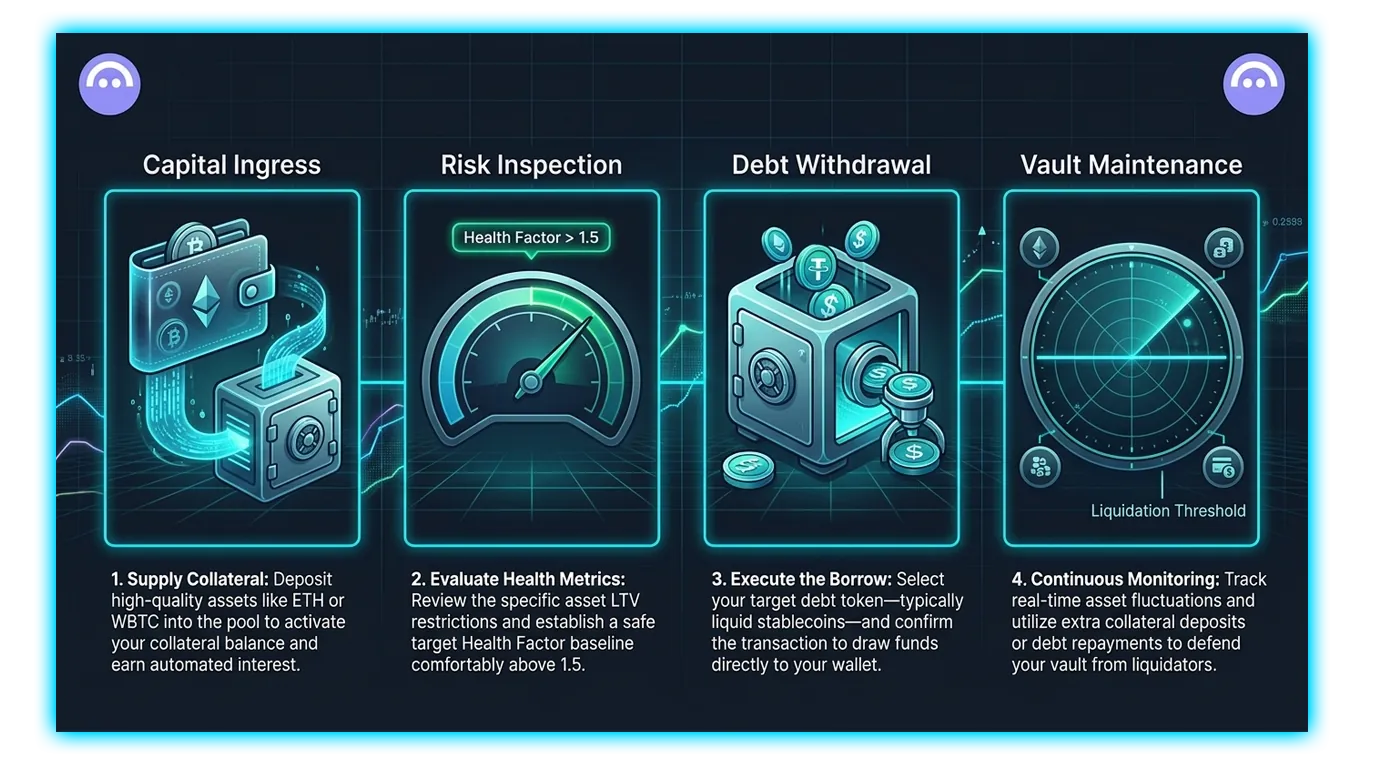
1. Step 1: Depositing and Activating Collateral Assets
Before the protocol allows you to draw debt from any liquidity pool, you must establish an over-collateralized position. This serves as the financial backing that guarantees the security of the pool.
Wallet Initialization: Connect your Web3 wallet to the official platform interface. Ensure you select the network layer that matches your operational capital. Aave supports multiple execution networks, including Ethereum, Arbitrum, Base, and Avalanche.
Capital Ingress: Navigate to the protocol dashboard and review the "Assets to Supply" interface. Select a high-quality reserve asset (such as ETH, Wrapped Bitcoin, or liquid staking derivatives) to use as your foundational collateral.
Executing the Supply Action: Enter the specific amount you wish to deposit, approve the necessary token allowance contract permissions in your wallet, and execute the supply transaction. Upon completion, the protocol issues interest-bearing aTokens to your wallet, representing your active share of the pool.
The Collateral Toggle: Verify that the "Use as Collateral" switch is manually toggled to the active position next to your asset listing. If this parameter is inactive, the system treats your deposit as a passive savings account and will block any subsequent borrowing attempts.
2. Step 2: Selecting and Drawing Your Debt Asset
Once your collateral layer is verified on-chain, you gain access to the protocol’s borrowing capacity.
Analyzing the Borrowing Dashboard: Locate the "Assets to Borrow" repository on the platform dashboard. This menu lists all available digital assets alongside their real-time borrow rates, which are algorithmically adjusted based on the continuous pool utilization rate.
Selecting Your Target Token: Most risk-adjusted borrowing strategies default to highly liquid stablecoins (such as USDC, USDT, or Aave’s native over-collateralized GHO token) to avoid cross-asset volatility. Borrowing an asset that is highly volatile introduces the risk that the debt value expands faster than the value of your underlying backing assets.
Evaluating Loan-to-Value (LTV): Before confirming, review the Loan-to-Value parameter assigned to your specific collateral. If your collateral carries an LTV of 80%, you can theoretically borrow up to 80 dollars worth of debt for every 100 dollars of deposited value. However, drawing capital up to your absolute maximum LTV limit exposes your vault to instant liquidation during minor market corrections.
3. Step 3: Managing and Monitoring the Health Factor
The single most critical variable for any borrower within the DeFi marketplace is the Health Factor (HF). This metric serves as the real-time safety index of your open borrowing position.
Understanding the Metric: The Health Factor represents the ratio of your eligible collateral value against your active debt value, weighted by the specific liquidation threshold of the tokens you supplied.
The Solvency Boundary: Your Health Factor must strictly remain above 1.0 at all times. If the market value of your collateral decreases, or if the value of your borrowed asset spikes, the Health Factor drops toward the solvency line.
The Liquidation Trigger: The exact moment your Health Factor breaches the 1.0 boundary, your position enters an under-collateralized state. The smart contract automatically opens your vault up to public liquidators, who can step in to buy your collateral at a discount to repay your debt.
Safety Baselines: For a secure borrowing experience, conservative market participants configure their initial positions to maintain an entry Health Factor between 1.5 and 2.0, providing a significant structural cushion against unexpected intra-day market corrections.
4. Step 4: Navigating the Automated Liquidation Engine
If your position faces structural stress due to adverse market movements, the protocol relies on automated liquidation mechanisms to preserve total system solvency. Depending on whether you are utilizing older protocol iterations or modern upgrade modules, the liquidation penalties operate under distinct logic blocks.
The Fixed Close Factor Architecture (Aave V3 Model)
- Under the standard V3 liquidation engine, when a position's Health Factor drops below 1.0, external liquidators can repay a fixed close factor percentage (typically capped at 50%) of the borrower's total outstanding debt. In return, the liquidator seizes a corresponding amount of the user's underlying collateral plus a fixed liquidation bonus.
- This structure successfully clears bad debt from the system but can result in over-liquidation, penalizing the borrower more than necessary to restore a stable position.
The Adaptive Target Health Factor (Aave V4 Architecture)
- The current modular iterations have replaced the rigid 50% liquidation cap with a variable, highly efficient liquidation loop. Instead of clearing a fixed portion of your debt, the system calculates the exact minimum dollar amount needed to return the borrower's position to a specific Target Health Factor configured by governance.
- Furthermore, this engine implements a variable liquidation bonus that scales dynamically using a auction-style model: the lower your health factor drops, the higher the bonus paid to the liquidator. This creates immediate market incentives to clear the riskiest, deep-underwater positions first, protecting the broader lending ecosystem from building up bad debt reserves.
Technical Execution Matrix: Strategic Borrowing Variations
| Operational Mode | Core Objective | LTV Capital Efficiency | Allowed Asset Combinations | Core Risk Vector |
| Standard Mode | General multi-asset borrowing flexibility. | Moderate (e.g., 65% - 80%) | Any governance-approved tokens within the main pool. | Cross-asset price divergence and multi-token volatility. |
| Efficiency Mode (eMode) | Maximizing leverage for correlated pairs. | Maximum Optimization (up to 90%+) | Assets confined to the same category (e.g., stablecoin to stablecoin). | Depegging events or structural category breakdowns. |
| Isolation Mode | Risk containment for exotic assets. | Heavily Constrained by Debt Caps | One isolated collateral asset backing approved stablecoin debts. | Low liquidity depth on collateral causing fast liquidations. |
Disclaimer: This article is for informational purposes only and does not constitute investment advice, financial advice, trading advice, or any other kind of advice. DEXTools does not recommend buying, selling, or holding any cryptocurrency or token. Users should conduct their own research and consult with a qualified financial advisor before making any investment decisions. Cryptocurrency investments are volatile and high-risk. DEXTools is not responsible for any losses incurred.
Related Guides
- How to Use Aave: Deposit, Borrow, Repay and Manage Health Factor (2026)
- Aave Credit Markets Explained: Peer-to-Pool Lending, Collateral and GHO (2026)
- What Is Order Flow in Crypto Trading? Guide (2026)
- Stock-to-Flow Bitcoin Model Explained (2026)
- What Is Synthetix V3? Perps Multi Collateral Derivatives Guide 2026
Frequently Asked Questions
How do you borrow on Aave?
To borrow on Aave you first supply an accepted asset as collateral, then borrow another asset up to your available limit. Your borrowing capacity depends on the value and parameters of your collateral.
What is the Health Factor on Aave?
The Health Factor is a number that represents how safe your borrowed position is relative to your collateral. A higher value means more safety, and if it falls too low your position can be liquidated.
What happens if your Health Factor gets too low?
If the Health Factor drops below the required threshold, part of your collateral can be liquidated to repay your debt. Maintaining a buffer above the minimum helps avoid liquidation during price swings.
How do you repay a loan on Aave?
You repay by returning the borrowed asset, which reduces your debt and improves your Health Factor. Repaying frees up your collateral so you can eventually withdraw it.