On-Chain Signal Half-Life: When Crypto Alerts Stop Working
— By Whatsertrade in Tutorials
Learn what on-chain signal half-life means, when crypto alerts lose value, and how traders can tell whether a wallet or volume signal is still actionable.
This guide explains on-chain signal half-life, meaning when an alert stops being useful for a trade. It is about timing and freshness, not about setting price alerts in an app.
Key Takeaways
- When a Crypto Alert Stops Being Useful
- Defining On Chain Signals
- Why Crypto Alerts Lose Value Quickly
- The Three Stages of Signal Value
- How to Determine Signal Actionability
- Considerations for Crypto Traders
When a Crypto Alert Stops Being Useful
In decentralized markets, speed matters. A wallet alert, sudden volume spike, or smart money buy can look like a strong opportunity. But not every on chain signal remains useful for long. Some alerts have value for hours, while others expire in minutes. The difference between acting early and arriving late can decide whether a trade becomes profitable or painful.
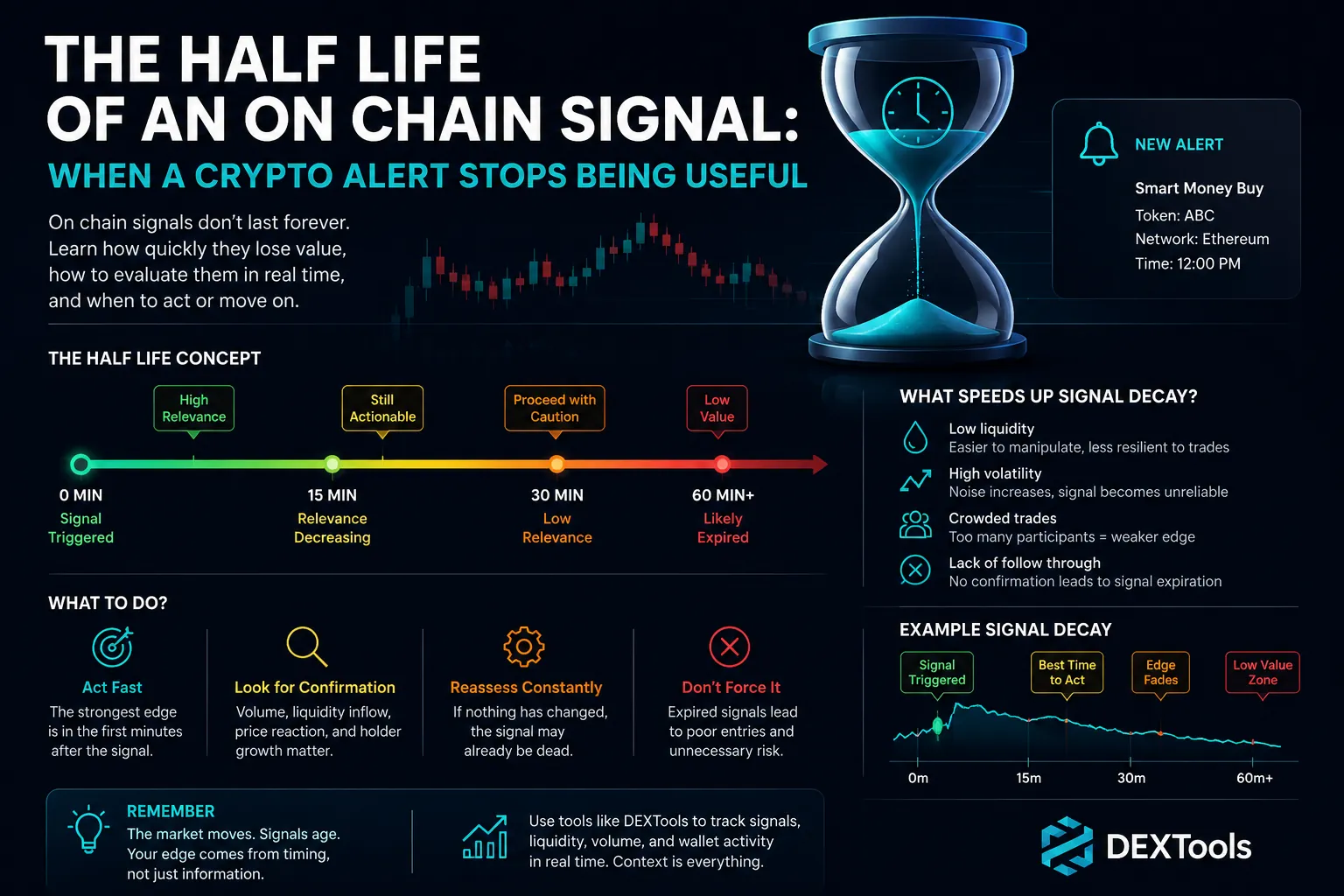
This is where the concept of signal half life becomes handy. The half life of an on chain signal is the period during which that signal still has enough value to support a trading decision. Beyond this window, the signal might be intriguing but lacks freshness.
Defining On Chain Signals
What Is an On Chain Signal?
An on chain signal is any observable action or pattern that appears directly on the blockchain or through decentralized market data. It can include a large buy, a liquidity addition, a new pair gaining volume, a smart wallet entering a position, or a rapid increase in holders.
The critical point is that an on chain signal is not a comprehensive trading thesis by itself. It serves as a clue. It indicates that something is happening, but it does not automatically tell you whether you should buy, wait, or avoid the trade.
Why Crypto Alerts Lose Value Quickly
Market Reaction
Crypto alerts lose value when the market has already reacted. If a token pumps 40 percent immediately after a whale buy, the original on chain signal may already be priced in. By the time most traders notice the alert, the risk-reward profile has changed.
Liquidity and Volume Considerations
A signal also loses value when liquidity changes. A buy alert in a low liquidity pool may move the chart sharply, but that does not mean future buyers can enter at a good price or exit safely. The alert may look strong while actual market depth remains weak.
The same applies to volume spikes. A sudden jump in volume can signal attention, but it may also mark the final stage of a short term move. Volume is only useful when combined with price behavior, liquidity depth, and follow-through.
The Three Stages of Signal Value
Stage 1: Fresh Signal
This is when the signal first appears. The market has not fully reacted yet. Price movement may be limited, liquidity may still be stable, and early confirmation may be forming.
This stage is most valuable but also uncertain. The trader must decide whether the signal is meaningful or just noise.
Stage 2: Confirmed Signal
The market starts reacting. Volume grows, price moves, more wallets enter, and the token becomes more visible. This stage is often safer than the first because there is more confirmation.
However, the entry becomes less attractive. Traders need to assess if upside potential still exists or if they are buying into momentum that is already stretched.
Stage 3: Expired Signal
The alert is now widely visible. Price may already be far above the original trigger. Liquidity may be thinner than expected. Early wallets may start taking profits.
At this stage, the signal might still be useful for learning, but may no longer be useful for entering a trade.
How to Determine Signal Actionability
A signal may still be actionable if price hasn't moved too far from the alert level, liquidity remains healthy, volume continues to build naturally, and buyers are entering without extreme volatility.
A signal may be late if the chart has already gone vertical, large early wallets are selling, volume is fading while price stays high, or the pool is too thin for your position size.
The best question isn't "Was this a good signal?" The better question is "Is this still a good trade at the current price?"
Smart Money Alerts Require Context
Smart money alerts are powerful, but misleading without context. A known wallet buying a token does not guarantee a long term position. It may be testing liquidity, trading a short term move, or entering with a comparably small amount.
Before following a smart money buy, traders should ask crucial questions. Is the wallet using meaningful size? Is the token liquid enough? Has the price reacted excessively?
If the answer to the third question is yes, the signal may already be expired.
A Practical Signal Half Life Checklist
Before acting on any crypto alert, check the following:
- How long ago did the signal trigger?
- How much has price moved since then?
- Has volume continued or faded?
- Has liquidity improved or weakened?
- Are early buyers holding or selling?
- Is your trade size safe for the available liquidity?
- Is there still a clear invalidation level?
This checklist helps transform alerts into decisions instead of emotional reactions.
Considerations for Crypto Traders
The best traders do not just look for signals. They evaluate the age, context, and remaining value of those signals. In decentralized markets, information moves fast. A good alert can become a bad entry if the market has already absorbed it.
Understanding the half life of an on chain signal helps traders avoid chasing late moves and instead focus on opportunities where the risk-reward still makes sense.
How to Bridge Crypto Between Chains: Complete Cross-Chain Tutorial 2026 How to Use 1inch: Complete DEX Aggregator Swap Tutorial (2026) How to Use OKX Web3 Wallet: Multi-Chain DeFi Hub Guide (2026)Frequently Asked Questions
Q: What is on-chain signal half-life?
A: On-chain signal half-life refers to the period over which an on-chain metric or signal retains its predictive power or relevance for market movements. After this period, the signal's effectiveness typically diminishes.
Q: Why is understanding signal half-life important for crypto traders?
A: Understanding signal half-life helps traders determine how long they can rely on a specific on-chain indicator before it becomes outdated. This knowledge can improve timing for entries and exits.
Q: What factors influence the half-life of an on-chain signal?
A: Factors include market volatility, the novelty of the signal, the speed of information dissemination, and the underlying fundamental changes in the network. Highly liquid markets may see shorter half-lives.
Q: Can all on-chain signals have the same half-life?
A: No, the half-life varies significantly between different on-chain signals. For example, a signal based on short-term transaction volume might have a much shorter half-life than one based on long-term holder accumulation.
Q: How can one estimate the half-life of an on-chain signal?
A: Estimating half-life often involves backtesting the signal's performance over various historical periods and observing when its correlation with future price action starts to decay. Statistical analysis can help quantify this decay.
Related Guides
- Solana Wallet Alerts and Monitoring: How to Track Wallet Activity (2026)
- The Life Cycle of a Memecoin: Launch to Survival or Fade
- The Wallet Age Signal: What Fresh Wallets vs Old Wallets Reveal About a Token
- New Pairs vs Trending Pairs: Signal Timing on DEXTools
- CEX Deposit Pressure: How Exchange Inflows Can Signal Future Selling